

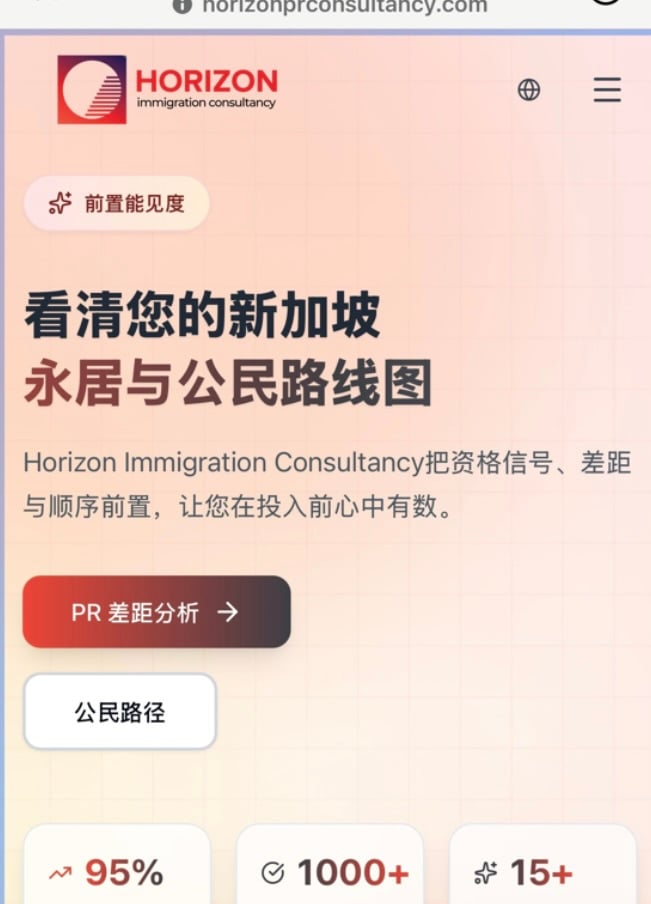
A Facebook ad for a Singapore PR consultancy offers to make a difficult application feel simple. It promises guidance, a smoother path, and perhaps a quicker answer.
For someone planning a life in Singapore, that offer can be hard to ignore. Before sharing a passport or paying a consultant, there is one important distinction to understand.
Overview
A convincing service wrapped around a real application
Singapore permanent residence is a genuine immigration status with a genuine application process. That reality gives a fake consultancy something credible to build around.
The Singapore Police Force and Immigration & Checkpoints Authority, or ICA, warned about a specific campaign in September 2026.
Its entry point was an advertisement on social media, including Facebook. The ad offered help with permanent resident applications and led to a purported consultancy website.
Visitors were asked for personal details and a mobile number. That form was not simply an information request; it gave the operators a direct line to the applicant.
The money request changes shape as the conversation continues
According to the advisory, the next conversation moved to WhatsApp. The person presenting as an adviser sought payments from S$200 to about S$90,000.
Different explanations were used: investments in companies, academic certificates, or donations supposedly needed to improve the applicant’s chance of approval.
Those demands should not be confused with ICA’s published government charges. ICA currently lists an S$100 application fee at submission, paid through its official process.
The amount or sales pitch may vary. The warning sign is the private party claiming that an extra transfer can influence an immigration decision.
A forged approval makes the payment feel worthwhile
Some applicants later received an automated-looking email with a forged In-Principle Approval letter bearing ICA branding, the authorities said.
The document was designed to answer a natural question: did the money actually produce a result? An official-looking letter can quiet doubts at exactly that moment.
Here is the central difference to keep in mind:
- A real consultant may help organize documents, but cannot guarantee or purchase approval.
- A real ICA decision must be checked through ICA’s own channels, not a forwarded PDF.
- A request to pay an unknown person by bank transfer or cash is not a government fee.
- A polished website and convincing letter are not proof of an authorized service.
Since January 2026, ICA had received at least 31 reports involving fake emails connected to permanent residence applications, with at least S$400,000 in reported losses.
Those figures describe reports known to ICA by the advisory date. They do not establish that every private immigration consultant is fraudulent.
The Fake Approval Letter Is the Critical Turning Point
The official warning includes an image of a purported ICA letter. Its crest, reference numbers, barcode, and appointment language mimic a government communication.
That visual authority matters. A reader may focus on the letterhead and miss the question that decides everything: does ICA itself recognize this application outcome?
ICA’s own permanent residence guidance says applicants can check their status through MyICA or the e-Service.
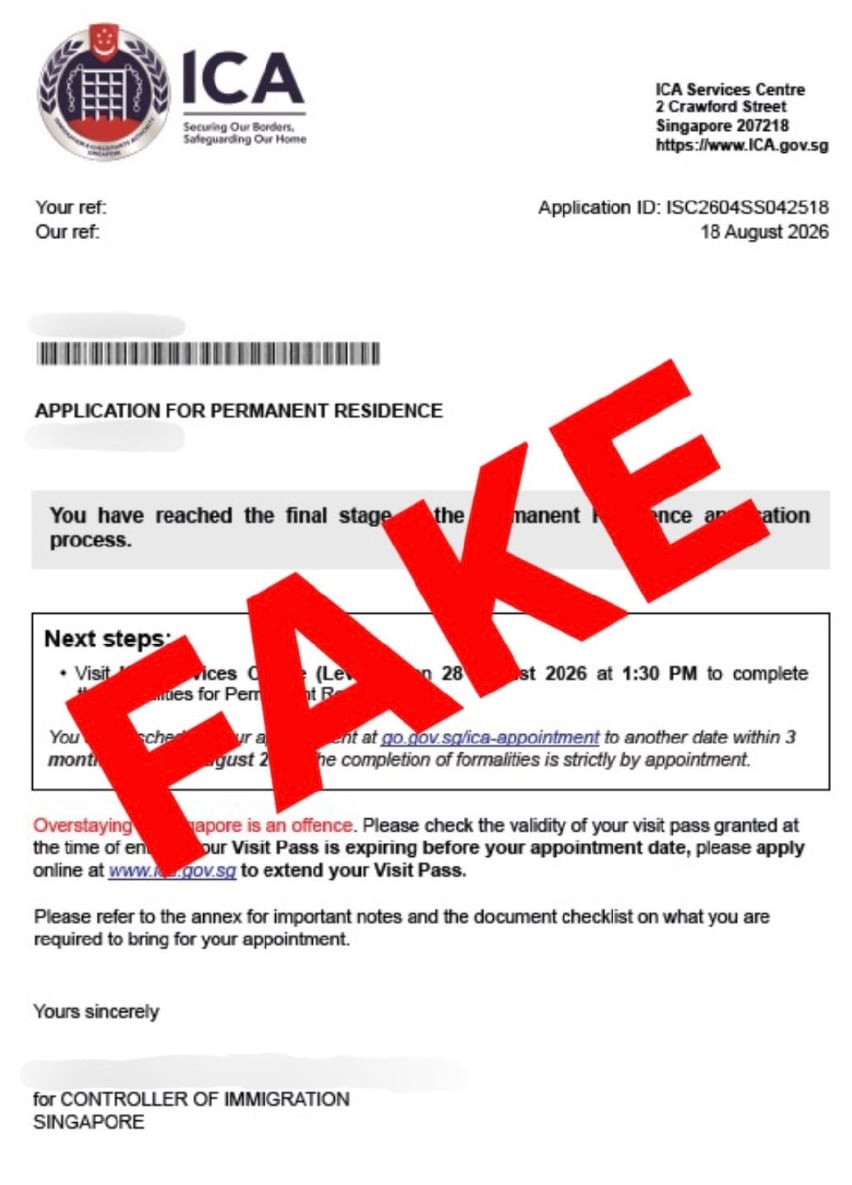
ICA states that successful applicants receive In-Principle Approval, but only after a genuine application assessment. A document delivered through a consultant does not bypass verification.
The person who created the PDF may have copied real address details and typography. Such borrowed details can make a counterfeit look persuasive without making it genuine.
Some recipients may not discover the problem until they contact ICA themselves. At that point, the promised immigration progress and the money may both be gone.
How the Fake Singapore PR Consultancy Scam Works
Step 1: A social ad meets an anxious applicant
The first touchpoint is often a sponsored post promising application help. It reaches people already researching eligibility, documents, timing, or their family’s future.
The pitch rarely needs to say “guaranteed approval” outright. Suggesting insider expertise or a better chance can be enough to start a conversation.
An applicant who has already waited months may read the offer as practical help. That is why the initial ad can feel useful rather than suspicious.
Step 2: A consultancy site collects enough detail to sound personal
After the click, a website asks for a name, contact number, and other particulars. The page may discuss eligibility and look like an ordinary immigration service.
Each answer helps the caller tailor the next message. A scammer who knows an applicant’s occupation or family circumstances can appear unusually informed.
Do not treat a form submission as harmless merely because no card details were entered. Identity documents and contact details can support further targeting.
Step 3: The conversation shifts to WhatsApp
Police say the operators then contacted applicants on WhatsApp. This shift moves the discussion away from a public website into private, fast-moving messages.
It also allows voice notes, documents, and a steady stream of reassuring replies. The adviser can answer objections before the applicant independently checks ICA.
A WhatsApp display name, profile picture, or business label proves little. Confirm the organization through official records and direct contact channels.
Step 4: An invented requirement turns advice into payment
The requested fee may be framed as an investment, donation, or certificate purchase that supposedly strengthens the case. None of those claims should be accepted at face value.
A genuine adviser can explain publicly documented criteria. It cannot sell a favorable decision or direct unknown intermediaries to collect cash for ICA.
The amounts reported by police ranged widely. That flexibility suggests the demand could be adapted to the applicant’s perceived resources and objections.
Some victims were told to transfer money to bank accounts. Others were directed to hand cash to people they did not know, according to the advisory.
Step 5: An automated email supplies false reassurance
Once money changes hands, a purported ICA acknowledgment email can make the process look complete. The attachment may carry a forged In-Principle Approval letter.
Look beyond the displayed sender name. A message can imitate an agency while originating from an unrelated address or forwarding chain.
Even an apparently plausible address is not enough. Contact ICA independently, using contact details you typed or found on its official website.
Step 6: The applicant is pushed toward another payment or discovers the forgery
A counterfeit letter can become a platform for a new demand, such as a final processing charge. The police advisory does not say every case had this extra stage.
The verified pattern ends with victims learning the document is not authentic, often after contacting ICA. Some first suspected trouble when the supposed adviser disappeared.
If a new “release fee” appears after an approval letter, pause immediately. A document that has not been validated should not justify another transfer.
Who Is Behind the PR Consultancy?
The consultancy name is not government authorization
A slick business name or corporate-style website can create an impression of legitimacy. It does not show that ICA endorses the service.
ICA explicitly says it does not support or endorse commercial entities claiming they can improve an applicant’s chances of permanent residence.
Check the legal entity behind any adviser and whether the same name appears on its terms, invoice, payment recipient, and official business record.
An address should lead to a real, accountable business
Do not assume an office photograph or city address belongs to the people messaging you. Search the address independently and identify its actual occupant.
A shared office or mailbox is not, by itself, evidence of crime. It also is not proof that the people handling sensitive documents are accountable.
Ask where original records are stored and who can access them. If the company avoids a clear answer, do not upload passports or family records.
Support that only exists on WhatsApp is fragile
Try the firm’s published phone number and email before sharing documents. Ask precise questions about refunds, adviser identity, and what happens if ICA rejects an application.
Do not rely on the phone number provided in the same message that requests money. Find independent contact details and compare them.
A seller who answers quickly before payment but vanishes afterward has given you useful evidence. Preserve the messages rather than arguing through the same chat.
The service must have a traceable path into ICA
The most important traceability question is simple: was an application actually lodged through the official ICA channel, under the applicant’s legitimate credentials?
Ask for a submission record that can be independently verified. A PDF, screenshot, or email sent by the consultant alone is not enough.
Never hand over Singpass credentials or one-time codes to someone claiming to expedite the process. Protect access to the official account yourself.
How to Check a PR Offer Before You Pay
Start from ICA’s own permanent residence page. It explains eligibility, required documents, payment methods, processing times, and status checks.
ICA says applications generally take up to six months when documents are complete, although some take longer. An outsider promising a much faster decision deserves scrutiny.
Read the fee schedule rather than accepting a consultant’s description of “government charges.” At submission, ICA lists an S$100 fee per application.
Completion formalities have separate published charges. Those do not become an open-ended reason to send large sums to a private bank account.
If you have a letter, use the ICA Feedback Form or its published call center number, 6391 6100, to verify it directly.
ICA issued an earlier warning about forged PR letters in March 2026. This was not merely a hypothetical risk raised in September.
For an uncertain ad or message, Singapore’s ScamShield helpline at 1799 is available around the clock.
Most importantly, keep the decision separate from the service. You may hire document help, but only ICA can decide an ICA application.
A trustworthy adviser should welcome independent verification. If they claim a government check would delay or jeopardize your case, treat that pressure as a serious warning.
Compare every requested document with ICA’s published checklist. The existence of a real requirement does not mean a stranger needs your original records or account access.
Keep copies of everything submitted through the official portal. That record makes it easier to distinguish a real status change from an invented update sent in chat.
When discussing your case with family, share the official application status rather than a forwarded image. Another person may notice a discrepancy you overlooked under stress.
Finally, remember that application assistance and approval influence are different products. The first can be legitimate; the second is a promise no consultant can substantiate.
What to Do if You Have Fallen Victim to This Scam
- Stop contact and stop payments. Do not send a “final” fee to validate a letter. Tell the adviser in writing that you dispute the representations and will verify directly.
- Call your bank immediately. Give the transfer reference, recipient account, time, amount, and WhatsApp number. Ask its fraud team whether a recall or freeze is possible.
- Verify the application with ICA. Use MyICA, the e-Service, or the official Feedback Form. Ask whether the quoted application reference and approval letter are genuine.
- Preserve a complete record. Save the ad, site address, form confirmation, chats, voice notes, email headers, PDF, receipts, bank details, and any cash handover instructions.
- File a police report. Include the documents and exact timeline. ScamShield can direct you to help, but its 1799 helpline does not itself file a police report.
- Protect your accounts and identity. Change passwords if you shared them, enable multifactor authentication, and tell ICA if passports or identity documents were exposed.
- Check your device if a file or app was involved. Malwarebytes can scan for unwanted software. AdGuard can reduce exposure to malicious ads and known scam pages.
- Reject recovery promises. Someone claiming to retrieve the payment for an upfront fee may be another scammer. Work through your bank and police instead.
There is no shame in being persuaded by a forged government letter. The useful next move is to act quickly and document everything.
Frequently Asked Questions
Can a consultant guarantee Singapore permanent residence?
No private consultant can guarantee an ICA decision. ICA does not endorse services claiming to improve an applicant’s chance of approval.
Is every paid immigration adviser a scammer?
No. Some firms provide administrative help. The problem here is false authority, unsupported approval claims, unusual payments, and forged correspondence.
How can I tell whether an In-Principle Approval letter is real?
Check your official application status and contact ICA through its own site. Do not ask the adviser who supplied the letter to verify it.
Should I pay for an investment or donation to improve my PR chances?
Do not pay based on that pitch. Police identified investment, certificate, and donation pretexts in this campaign; compare any requirement directly with ICA guidance.
What if I only submitted my phone number and passport details?
Stop further sharing, preserve the page and messages, watch for impersonation attempts, and ask ICA or police what protective steps fit the information exposed.
Where can I get a quick check on a suspicious PR message?
Contact ICA using its published channels. In Singapore, ScamShield’s 1799 helpline can help assess suspicious messages and direct victims toward support.
The Bottom Line
A fake Singapore PR consultancy places an adviser between the applicant and ICA. The forged approval letter is meant to make that detour feel official.
Check fees, submission status, and documents with ICA itself. No persuasive ad, helpful WhatsApp conversation, or official-looking PDF can replace that verification.








