

A private banker says a stranger with your surname died leaving millions unclaimed. The letter is addressed to you, includes a bank office, and asks for a confidential reply before anyone else learns about the estate.
The Bank of Singapore Derrick Tan letter scam reads like a once-in-a-lifetime mistake in your favor. The detail that matters most is why a banker would need a stranger to become a secret beneficiary.
Overview
The letter borrows a real private bank’s identity
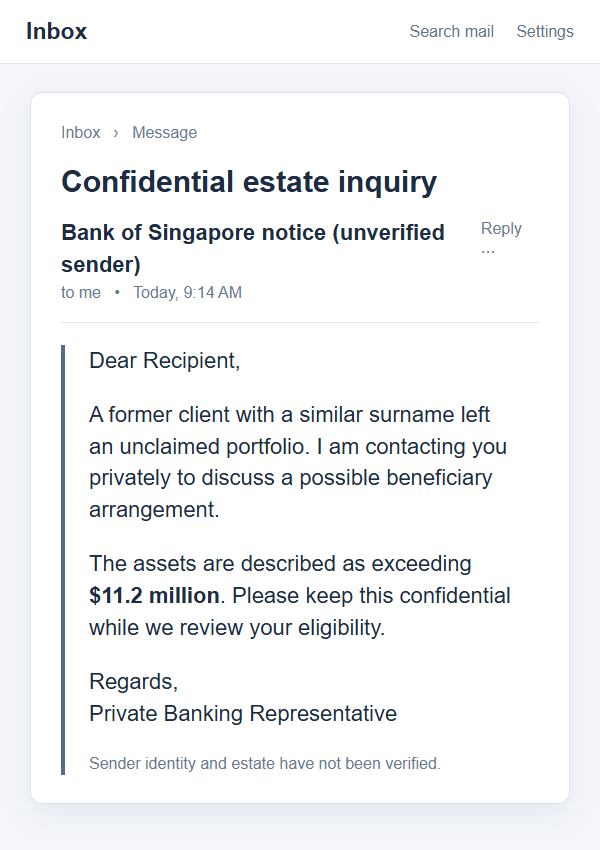
A documented scam letter used the Bank of Singapore name and claimed to come from “Derrick Tan” at its Hong Kong branch. It described a deceased client with the recipient’s surname and an unclaimed portfolio initially valued at about $11.2 million. The sender proposed putting the recipient in a beneficiary position.
The letter’s existence does not mean Bank of Singapore sent it. The bank has warned publicly about impersonation using its name and logo. The specific inheritance message is an older documented specimen, not proof of a newly active campaign today.
The promised fortune depends on a dishonest arrangement
The story says there is no known heir, but the recipient can be inserted as a beneficiary because of a shared surname. It proposes that the sender and recipient divide the money. That is not a normal inheritance notification or legitimate estate administration.
The request for secrecy is central. The writer claims no colleague knows about the contact and wants to continue by a private email address and phone number. Those are exactly the channels that prevent the recipient from checking the claim with the bank’s published office.
The likely danger comes after a reply
The documented letter asks for contact, but it does not prove that a particular victim paid a fee or sent documents. Inheritance fraud can progress to requests for identity records, bank details, or “release” payments. Those are plausible follow-on risks, not confirmed events in every version of this letter.
These details should stop you before you answer:
- A stranger promises a share of an estate because your surname matches.
- The supposed banker says the arrangement must be secret.
- The sender offers to manipulate beneficiary records.
- Private contact details replace the bank’s published channels.
- The proposal benefits the sender personally as well as you.
Why a Real Name and Address Do Not Make the Letter Real
Fraudulent letters often contain accurate fragments. A bank may really have a Hong Kong office. A person’s name may appear in public corporate documents. A building address may be copied from a directory. Those facts are easy for anyone to reproduce.
The leap is from “these public details exist” to “this sender is authorized to discuss an estate.” The second claim requires independent verification. A private Gmail account or unverified phone line cannot establish employment, authority, or a right to move a deceased person’s assets.
The letter’s proposed legal shortcut is also a warning. Real inheritance rights do not arise because someone at a bank says they can make a convenient change in a file. Probate and estate processes depend on law, identity, and documented entitlement. They are not secret profit-sharing deals with an unknown recipient.
The Federal Trade Commission has warned about letters promising unclaimed life insurance or inheritance money to people who share a deceased person’s surname. Its description is strikingly similar: a supposed professional says there is no heir, offers to split the proceeds, and then seeks money or sensitive information.
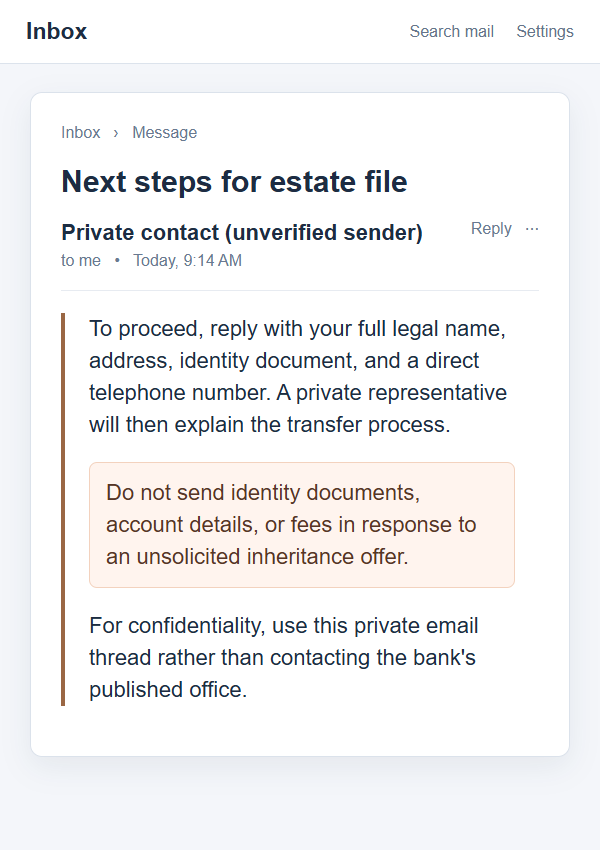
The two images in this article are nonfunctional illustrations, not copies of the original letter or an actual reply. They show the initial inheritance hook and a possible information-request stage. No real individual’s personal details or working reply address appear in them.
How the Bank of Singapore Derrick Tan Letter Scam Works
Step 1: A letter arrives with private-bank details
The sender uses a bank name, city, office address, and professional title to create a formal frame. The message may be delivered by email or as a letter image. Those details make it look different from a simple “you won a prize” spam message.
Do not treat formal layout as authentication. The question is whether the communication originated from a verified bank channel and describes a lawful reason to contact you. An unexpected private inheritance proposal fails that common-sense test before any money changes hands.
Step 2: A shared surname turns randomness into destiny
The sender says a former client died and had a last name similar to yours. That small point invites you to imagine a family connection, even though the letter admits no relationship has been established. The recipient may think there is no harm in asking a few questions.
A surname match is not evidence of inheritance. Many unrelated people share names. The FTC’s current warning identifies this as a common lure in bogus unclaimed-money letters, not a legitimate basis for an estate claim.
Step 3: The amount and secrecy create a private opportunity
The documented specimen described a large portfolio and later gains, then suggested that the supposed banker could place the recipient in a beneficiary position. The sender proposed an even split rather than an ordinary distribution to lawful heirs.
This is where the story reveals its purpose. The recipient is invited to become complicit in a hidden arrangement, making it harder to ask a lawyer, family member, or the bank whether the claim is real. Secrecy is not a perk; it isolates the target from an independent check.
Step 4: The conversation moves off official channels
The sender offers private contact details. Once the target replies, the scammer can tailor the story, answer objections, and create deadlines. They may send documents bearing copied letterheads or claim that a bank, law firm, or transfer agent needs information.
The documented letter does not prove every one of those later steps occurred. They are common risks when an inheritance approach leaves official channels. The safe response is to avoid that conversation entirely and contact the named institution only through its independently published website.
Step 5: Data or fees may be demanded to “release” funds
If the recipient engages, an attacker may request a passport scan, address, bank account, tax form, or payment for a certificate, transfer, clearance, or attorney. A large promised payout makes a smaller fee look tolerable, especially after weeks of conversation.
No upfront payment can turn a false beneficiary claim into a real entitlement. Sending identity documents can create additional risk even if you refuse to pay. Stop at the first request, preserve the correspondence, and verify with the real bank or a trusted legal professional outside the sender’s network.
Four Checks Before You Believe a Bank Inheritance Letter
Check the claim, not just the letterhead
A copied logo and accurate building address are public information. Ask why the bank would contact a stranger with the same surname and then offer to split an estate privately. The proposed action is more revealing than the visual design.
Do not provide personal information merely to “verify eligibility.” A legitimate institution can explain an official process without asking you to enter a secret arrangement with an individual employee.
Check the reply address and phone route
A personal mailbox, especially one unrelated to the bank’s domain, is a warning sign for confidential estate business. The documented letter shifted the recipient toward private contact details rather than a published bank office.
Even a sender address that visually resembles the bank can be spoofed. Navigate to Bank of Singapore’s site yourself and use its current contact page. Do not rely on a number printed in the suspicious message to verify the message that supplied it.
Check the legal logic of the story
Estate distribution is not a matter of choosing someone with a similar name and changing records. A claimed “no heir” situation does not give a banker personal discretion to split funds with a stranger. The letter’s suggestion to manufacture a beneficiary is a reason to reject it, not a lucky loophole.
If you genuinely expect an inheritance, speak with the executor or a licensed professional whose identity you verified independently. Do not let the unsolicited sender choose your lawyer, notary, or document portal.
Check the bank’s current warnings
Bank of Singapore says unauthorized parties have impersonated it and advises people to verify unexpected contact directly. Its cybersecurity guidance covers phishing and asks customers to use official channels for suspicious activity.
The documented inheritance letter dates from 2020, while newer impersonation warnings show that copying the bank’s identity remains a relevant risk. Do not conclude the exact letter is circulating now without fresh evidence. The verification method remains useful whenever a similar message appears.
Why Replying “Just to See” Is Not Harmless
A reply tells the sender that the address is active and that the story caught your attention. It gives the scammer a chance to personalize the next message. They can explain away odd details, invent a legal deadline, or introduce another supposed official to make the claim feel corroborated.
Even if you never send money, the conversation can expose your full name, location, employer, relatives, and financial circumstances. Those details can be reused in other fraud. A scan of an ID or bank statement carries obvious additional risk.
The strongest response is brief: no response to the sender. If you want to make a report, preserve the letter and provide it to the bank through its published fraud or contact route. You can also report the attempt to consumer-protection authorities in your country.
Someone who has already replied should not feel trapped by embarrassment or by a claim that they “agreed” to a confidential deal. Stop communicating. No private agreement with an unverified stranger obligates you to keep sending information or fees.
What to Do if You Have Fallen Victim to This Scam
- Stop the conversation and save the messages. Keep the original email or letter, headers if available, attachments, reply addresses, phone numbers, and a timeline of what you sent. Do not delete the evidence out of embarrassment. It can help a bank or investigator understand the exposure.
- Contact your bank if you sent money or account details. Use the number on your card or the bank’s official website. Explain that you responded to a suspected inheritance fraud, identify every transfer, and ask what can be recalled or disputed. Move quickly, but do not assume recovery is guaranteed.
- Protect identity documents you shared. If you sent a passport, driver’s license, tax number, or bank statement, ask the issuing authority and your financial institution about appropriate safeguards. Watch for account openings, loan applications, or messages that quote details from those documents.
- Change compromised account passwords. If you used a link or portal supplied by the sender, reset any password entered there from the genuine service. Start with email because it can be used to reset other accounts. Enable multifactor authentication and review recovery settings and sign-in history.
- Check the device only if a file or app was involved. Opening an email does not automatically mean malware is present. If you downloaded a document with active content, ran software, or granted remote control, use a reputable scan such as Malwarebytes and consider technical help. AdGuard may reduce exposure to some malicious sites and ads, but neither tool can undo an identity disclosure or bank transfer.
- Report impersonation through verified channels. Send the suspicious communication to Bank of Singapore using contact information from its current official website. Report losses to your local police or fraud-reporting authority. Do not forward the letter to a “case officer” introduced by the same sender.
- Expect a recovery pitch. A second fraudster may claim they found your money or can process the inheritance for one final fee. They may know details you already shared. Verify any approach independently and never pay an upfront fee to unlock a supposed refund or estate.
Frequently Asked Questions
Is the Bank of Singapore inheritance letter genuine?
The documented letter’s secret beneficiary proposal and private contact route are hallmarks of a scam. Bank of Singapore has separately warned that criminals impersonate it. Contact the bank through its published website if you need to verify a communication.
Does using the name Derrick Tan prove it came from the bank?
No. A person’s name and historical role can be copied from public material. The name in a message does not authenticate its sender, current authority, or claimed estate. Verify through the institution itself, not through contact details in the letter.
Could a matching surname make me a legal heir?
A matching surname alone is not evidence of family relationship or entitlement. The letter’s offer to place a stranger into beneficiary records is a warning sign. A genuine estate claim follows legal procedures and independently verifiable documentation.
Was the $11.2 million portfolio real?
There is no independent evidence in the documented letter that the supposed portfolio existed. The large amount functions as bait. Do not send documents or money to discover whether the sender might be telling the truth.
What if I only replied once?
Stop communicating and watch for more tailored contact. A simple reply may confirm your address is active, but it is not the same as sharing a password or bank details. Save the correspondence and report it through official channels if appropriate.
Should I pay a clearance or transfer fee?
No fee requested by this unsolicited sender should be paid. Such requests are a common continuation of inheritance fraud. If you already paid, contact the payment provider promptly and preserve every receipt and message.
The Bottom Line
The Bank of Singapore Derrick Tan letter uses a respected bank’s identity, a matching surname, and an enormous estate to make a secret deal seem possible. Its proposed beneficiary switch is the clearest sign that the story is not a normal inheritance process.
Do not reply through the private contact details. Verify any real concern with the bank through its own website and keep your documents and money out of the sender’s hands. A legitimate inheritance does not depend on hiding a stranger’s share from the people responsible for administering it.








