

Collanol is sold as a once-daily joint supplement with bold language about renewed movement, intact collagen, and a “medical breakthrough.”
The package is real and its ingredients are identifiable. The harder question is how far the finished product’s advertising travels beyond the evidence behind those ingredients.
Overview
Collanol is an identifiable commercial supplement
Collanol is marketed by Vitaslim Innove for joint support. The company’s leaflet names a United States manufacturer and lists a Houston business address.
The formula combines undenatured type II collagen, branded UC-II material, curcumin, vitamins, and minerals. The published amounts make comparison possible.
This is not evidence of an imaginary bottle or anonymous checkout alone. Consumers can identify the brand, formula, corporate operator, and manufacturing information.
That legitimacy does not prove every promotional promise. A genuine supplement can still be advertised with wording that regulators consider misleading.
An advertising ruling changes the risk assessment
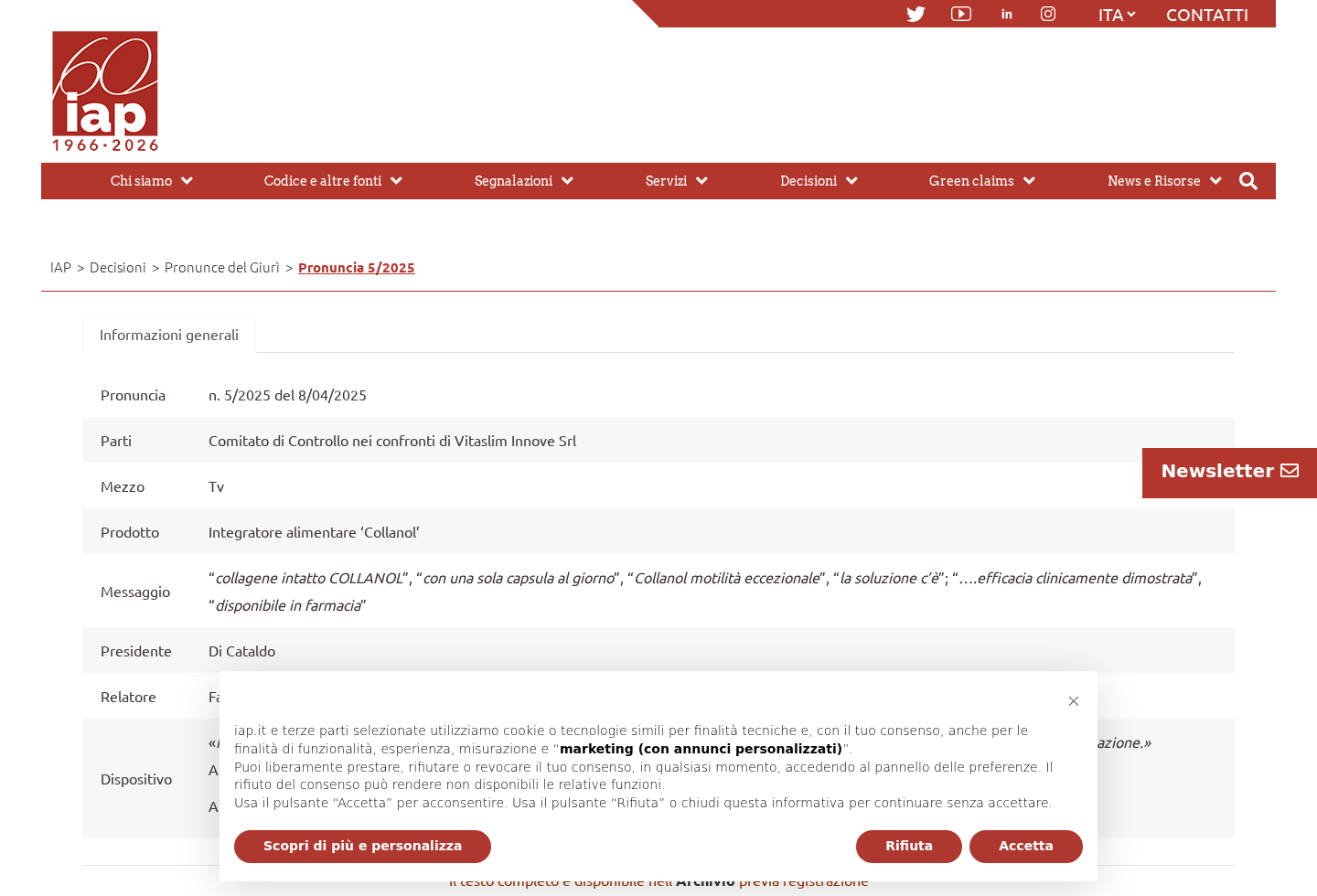
Italy’s advertising self-regulatory body, IAP, issued decision 5/2025 concerning Collanol advertising by Vitaslim Innove.
The decision identified messages including exceptional mobility, a solution for joint problems, clinically proven efficacy, and availability in pharmacies.
The panel found the communication contrary to rules on misleading advertising and supplement promotion, then ordered the challenged advertising to stop.
That is stronger evidence than a vague negative review. It is a documented ruling about specific promotional claims, not speculation about the product’s existence.
The evidence supports caution, not medical conclusions
Research exists on UC-II at a 40 mg daily dose, including studies measuring knee symptoms. Collanol’s leaflet lists 40 mg of UC-II.
However, evidence about one branded ingredient does not validate every statement made for a finished multi-ingredient supplement.
Study design, participants, endpoints, comparators, funding, and duration matter. “Clinically studied ingredient” is not the same as “clinically proven cure.”
- Collanol is a real branded dietary supplement.
- The formula and manufacturer are disclosed in its leaflet.
- The official site uses aggressive joint-restoration language.
- An Italian IAP ruling found challenged advertising misleading.
- Ingredient research cannot justify unlimited finished-product claims.
- The product should not replace diagnosis or medical treatment.
How the Collanol Offer Works
Step 1: Turn common joint discomfort into an urgent personal problem
The website speaks directly to aging, physical strain, diet, and cartilage. These are familiar concerns for people experiencing stiffness or pain.
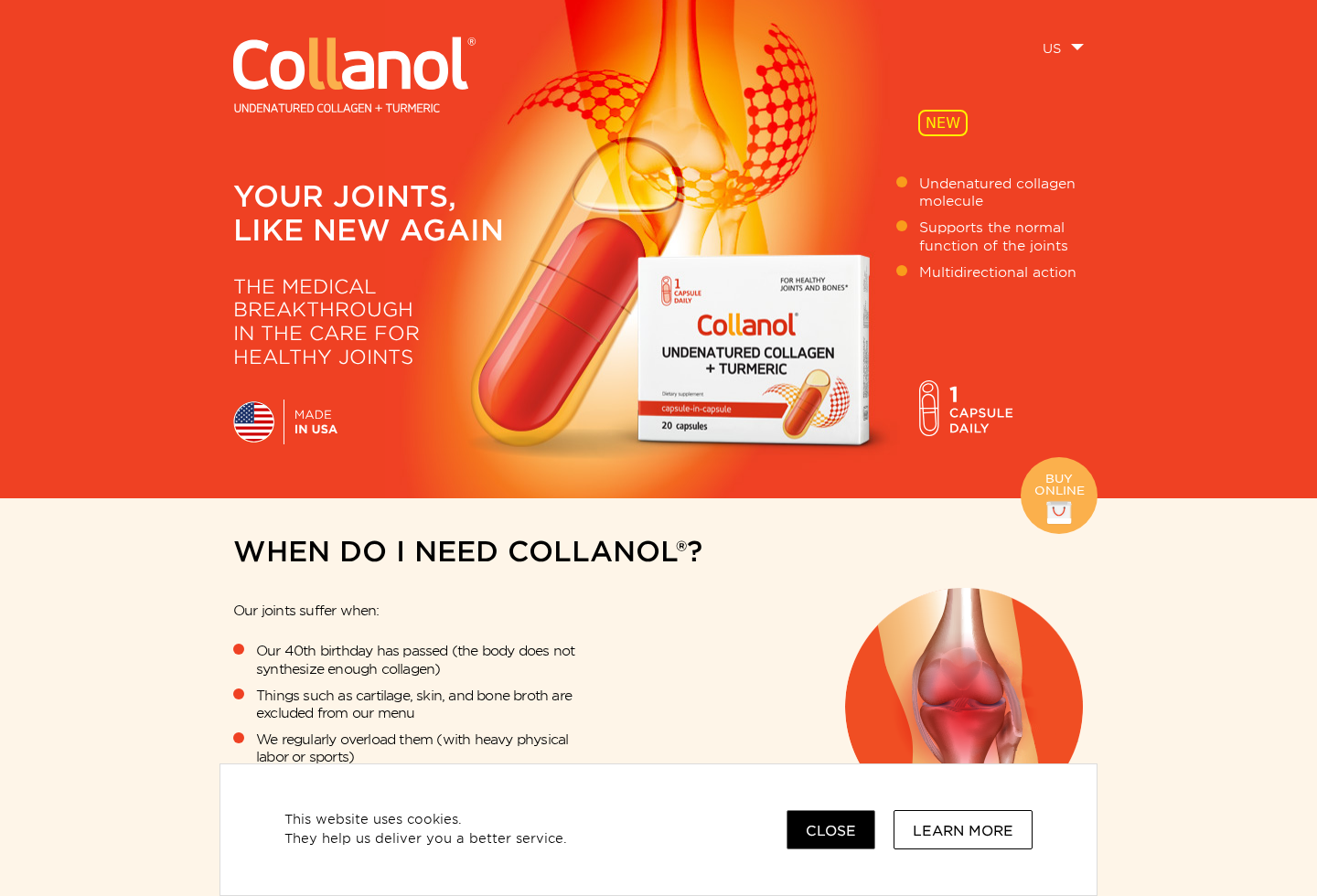
Its visual design shows a large capsule beside a glowing joint. The imagery suggests targeted repair before the visitor reads the ingredient evidence.
Pain can make decisive language especially persuasive. Someone waiting for an appointment may hope that a supplement offers a faster path.
Joint symptoms can have many causes. Persistent pain, swelling, weakness, redness, injury, or reduced movement deserves professional assessment.
Step 2: Frame the product as a breakthrough
The official page calls Collanol a medical breakthrough in healthy joint care. That phrase sounds more authoritative than ordinary supplement positioning.
The page also promises joints “like new again,” while nearby text uses softer language about supporting normal joint function.
These statements create different expectations. “Support” describes a limited wellness role, while restoration language can imply repair or treatment.
Consumers should give greater weight to the Supplement Facts, approved health claims, warnings, and actual clinical evidence than to a slogan.
Step 3: Borrow strength from researched ingredients
UC-II is a recognized branded undenatured type II collagen ingredient. Collanol lists the same 40 mg amount used in some published studies.
The formula also lists NovaSOL curcumin and claims substantially increased bioavailability. Absorption claims still require context about the comparison and meaningful clinical outcome.
A study can support a carefully worded ingredient claim without proving that every purchaser will regain mobility or avoid medical care.
Look for finished-product trials that match the exact formula, dose, population, duration, and advertised result. Do not accept ingredient citations as universal proof.
Step 4: Reinforce trust with manufacturing and pharmacy language
The site highlights United States manufacturing, and the leaflet names Lonza Greenwood LLC in South Carolina. These details provide useful traceability.
Manufacturing location does not independently establish effectiveness. A product can be properly manufactured while its advertising overstates likely benefits.
The 2025 IAP matter also addressed language suggesting pharmacy availability. Placement or availability through a pharmacy does not convert a supplement into an approved medicine.
Always identify the legal product category. Instructions and disclaimers on the packaging usually provide a clearer answer than the most dramatic advertisement.
Step 5: Close the sale with simplicity
One capsule daily feels manageable, especially compared with exercise programs, appointments, or complicated treatment. Convenience becomes part of the product’s appeal.
The easier the routine sounds, the more important it is to ask what outcome is realistically supported and how long a fair trial should last.
Check the number of capsules per package, daily serving, total order quantity, shipping, taxes, renewal terms, and return eligibility.
Do not order several months solely because the per-box price falls. Test tolerance and confirm return rights before accepting a large commitment.
What the 2025 IAP Decision Found
The ruling concerned specific advertising
IAP decision 5/2025 names Vitaslim Innove and the Collanol dietary supplement. It records the slogans and representations reviewed by the panel.
The challenged material included claims about intact collagen, one daily capsule, exceptional mobility, clinically proven efficacy, and pharmacy availability.
The panel found violations of Article 2 and Article 23bis of the Italian advertising code and ordered cessation of the messages.
The decision does not say every capsule is counterfeit
The ruling addresses commercial communication. It should not be exaggerated into a finding that no product exists or that every ingredient is useless.
Precision protects readers. The strongest supportable statement is that an advertising authority found specified Collanol promotions misleading under its code.
That finding gives consumers a concrete reason to distrust sweeping claims, even while recognizing the product and manufacturer as identifiable.
The old language still matters to buyers
Advertising claims can persist in videos, reposts, affiliate pages, translated storefronts, and cached search results after an official campaign changes.
A buyer may encounter a version different from the current official page. Save the exact advertisement, date, seller, price, and promises you saw.
If an affiliate promises a cure, restored cartilage, or guaranteed pain elimination, ask whether the manufacturer endorses that statement in writing.
Company, Address, Manufacturing, and Contact Checks
The operator is Vitaslim Innove
Brand materials identify Vitaslim Innove as the company behind Collanol. Trademark records also connect the Collanol name with that business.
This separates the product from unrelated companies with similar spellings. One FDA letter concerning “Vidaslim Co.” is not evidence against Vitaslim Innove.
Do not merge entities because their names sound alike. Match exact spelling, address, jurisdiction, product, and official correspondence.
The leaflet provides manufacturing details
The published leaflet says the product is manufactured by Lonza Greenwood LLC at 535 North Emerald Road in Greenwood, South Carolina.
It says manufacturing is for Vitaslim Innove Inc at 5629 Cypress Creek Parkway, Suite 221, Houston, Texas.
Those addresses improve traceability, but shoppers should still compare the current package. Labels can change by market or production run.
The contact route should be tested
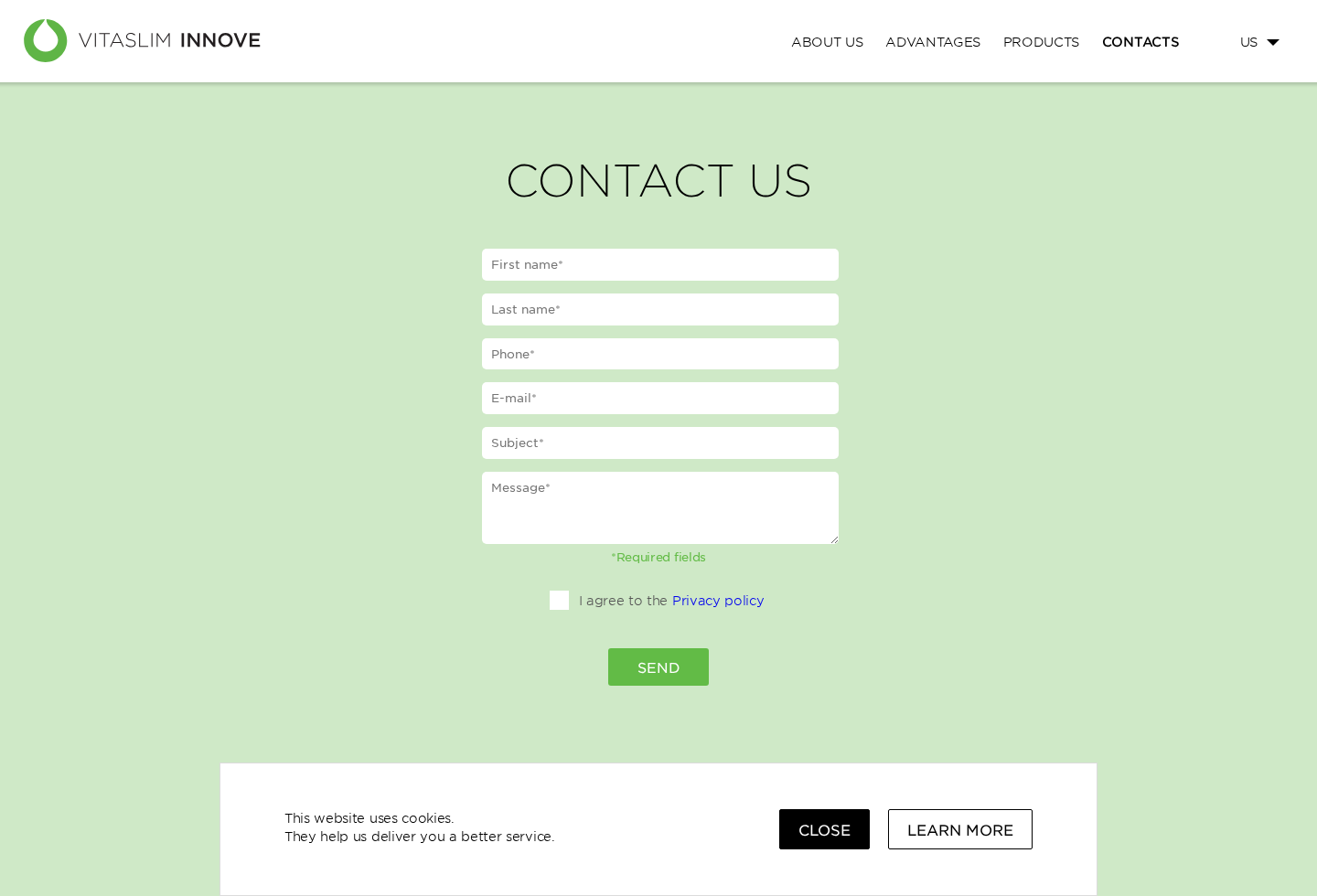
Vitaslim Innove provides an online contact form. Ask about the exact seller, country-specific distributor, returns, lot verification, and authorized retail channels.
A useful reply should identify who invoices the purchase and where returns are accepted. General wellness language does not answer a transaction question.
Keep a copy of your submission. Forms do not always email the customer, leaving no evidence unless the page is captured.
Fulfillment details can differ from brand ownership
A warehouse, pharmacy retailer, distributor, or marketplace can ship Collanol without owning the brand. Identify which party controls refunds and recurring charges.
Search any return address before mailing. It may be a logistics center rather than the corporate office or manufacturer.
Obtain written authorization, a tracking method, and a refund timeline. Delivery confirmation alone does not prove the merchant accepted the return.
How to Evaluate the Ingredient Claims
Begin with the exact daily amounts. Collanol’s leaflet lists UC-II, curcumin, vitamins, and minerals rather than an undisclosed proprietary blend.
Next, find human research matching the ingredient form and dose. Laboratory findings or animal studies cannot establish the same outcome in people.
Read what the study measured. A change in a questionnaire score is not the same as cartilage regrowth, disease reversal, or a joint becoming “new.”
Check the comparator. Results against placebo may differ from results against exercise, medication, physical therapy, weight management, or another supplement.
Review safety and exclusions. Even familiar ingredients can interact with medicines or be unsuitable in certain medical situations.
Finally, ask whether the research tested Collanol itself. If not, describe the evidence as ingredient-level support, not proof of the complete product.
Safety Questions Marketing Often Leaves Out
A supplement can create side effects even when its ingredients occur naturally. “Natural” describes origin, not automatic safety for every person.
Curcumin products may be unsuitable with certain medicines or medical conditions. Discuss the exact formula with a pharmacist or clinician.
Review every source of vitamins and minerals you already use. Combining products can raise total intake beyond what one label suggests.
People with food allergies should identify the collagen source and manufacturing warnings. Do not infer allergen safety from the front label.
Pregnant or breastfeeding consumers should seek professional advice before use. A general adult dosage does not answer pregnancy-specific questions.
Stop and obtain urgent help for severe swelling, breathing difficulty, fainting, or another possible serious reaction.
Report persistent gastrointestinal symptoms, rash, dizziness, or worsening pain to a healthcare professional rather than increasing the dose.
Do not combine several joint supplements simply because each uses different branding. Overlapping ingredients may appear under unfamiliar names.
Check the expiration date and storage instructions. Heat, moisture, broken seals, or damaged capsules can make a package unsuitable.
Keep the bottle and receipt if a reaction occurs. Lot information helps the seller, manufacturer, clinician, and regulator investigate.
Most importantly, do not delay assessment of a new injury, hot swollen joint, sudden weakness, fever, or rapidly worsening symptoms.
A supplement purchase should complement informed care. It should never become evidence that a diagnosis is unnecessary.
Consumers should also separate pain relief from structural change. Feeling better does not demonstrate that cartilage, ligaments, or bone have regenerated.
Likewise, a short period without improvement does not establish that every ingredient lacks value. It may indicate the advertised expectation was unrealistic.
Agree on a sensible trial period before ordering. Repeated purchases without a defined goal can turn uncertainty into an expensive routine.
Use the same movement or symptom measure at each review. Changing the standard makes ordinary fluctuations look like convincing progress.
Be skeptical of testimonials claiming rapid recovery from severe disease. Personal stories cannot control for diagnosis, other treatment, placebo effects, or natural variation.
If the seller promises results within a precise number of days, ask for the finished-product study supporting that deadline.
Report suspected misleading advertising to the appropriate consumer or advertising authority. Include the exact page, date, seller, and saved screenshots.
What to Do If You Bought Collanol
- Check the seller. Identify the merchant on the receipt, card statement, package, and return policy. The brand may not control every storefront.
- Photograph the package. Record seals, lot number, expiration, Supplement Facts, manufacturer, importer, warnings, and any damage before use.
- Compare the advertisement. Save claims about pain, mobility, cartilage, pharmacy status, guarantees, and expected timelines.
- Consult a healthcare professional. Discuss persistent joint symptoms, medications, allergies, pregnancy, and whether the ingredients are appropriate.
- Request returns in writing. State the order number, reason, unopened quantity, requested outcome, and ask for the authorized return address.
- Challenge a material mismatch. Contact the payment provider if the seller ignores documented non-delivery, unauthorized renewal, or materially misrepresented goods.
- Protect online accounts. If you used a suspicious imitation shop, change reused passwords and scan the device with Malwarebytes.
- Reduce risky ad exposure. AdGuard can block many deceptive redirects, but it cannot decide whether a supplement is medically suitable.
Frequently Asked Questions
Is Collanol a scam?
Collanol is a real branded supplement with disclosed ingredients and manufacturing information. The strongest concern is misleading advertising, documented by an IAP ruling.
Was Collanol advertising officially challenged?
Yes. IAP decision 5/2025 found specified Collanol communications contrary to Italian advertising rules and ordered the challenged messages stopped.
Does UC-II have clinical research?
Human studies exist for UC-II, including research using 40 mg daily. That evidence does not validate every claim made for Collanol’s complete formula.
Can Collanol rebuild cartilage?
Consumers should not infer cartilage reconstruction from general joint-support language. Ask for finished-product evidence measuring that exact outcome.
Is Collanol an FDA-approved medicine?
No. It is marketed as a dietary supplement. Manufacturing in the United States or sale through pharmacies does not make it an approved drug.
Where is Collanol manufactured?
The company leaflet names Lonza Greenwood LLC in Greenwood, South Carolina, manufacturing for Vitaslim Innove Inc in Houston, Texas.
The Bottom Line
Collanol is not an invented product, but its advertising deserves firm scrutiny. A documented 2025 ruling found specific promotional messages misleading.
Some ingredients have research, yet that does not prove sweeping promises about renewed joints, exceptional mobility, or cartilage repair.
Judge the product by its exact formula, credible finished-product evidence, realistic outcomes, seller terms, and advice from a qualified healthcare professional.








