

An investment offer pairs a household retail name with a green project and a reassuring return. It seems to connect familiar shopping with long-term savings.
The details look orderly enough to skim, but the name at the top is only useful if the real company actually stands behind the offer.
Overview
The brand being borrowed
Australia’s Scamwatch documented criminals impersonating Bunnings to offer environmental bonds. The offers invoked carbon reduction, sustainability, and waste reduction.
Bunnings was the impersonated business, not an accused seller of fraudulent bonds. The fake sites used its reputation to make an investment pitch appear established.
Scamwatch reported three investment options from $50,000 to $250,000, with claims of returns up to 9% and supposed government protection.
ASIC took down the fake Bunnings websites identified in the alert. That does not mean a new lookalike site cannot appear under another address.
The removed domains should not be treated as a complete list of future impersonations. A buyer needs a repeatable verification method, not one blocked-address list.
The case is also a useful reminder that a respectable brand can be a victim of the same deception as the investor.
Why this pitch is persuasive
“Green” investing sounds purposeful, while a known retailer makes the offer feel less remote than an unfamiliar finance company.
The fraud also used fake broker emails and websites containing links to the real business. A link to a legitimate site can coexist with a false sales page.
Higher-than-market returns can be framed as a rare opportunity. The claimed government protection then appears to answer the buyer’s risk questions.
Those two claims work together. The return invites attention, and the protection language lowers the resistance that a large transfer would normally create.
A buyer who recognizes the retailer may spend more time evaluating the rate than establishing whether the retailer ever authorized the offer.
The verification that matters
Start with Bunnings’s actual website or a separately found corporate contact. Ask whether it offers the named investment and recognizes the broker.
- Check the exact web domain, not just the logo or page colors.
- Verify the broker and licensing through ASIC’s official registers.
- Confirm any claimed government guarantee with the actual authority.
- Do not transfer funds to an account supplied only by the investment page.
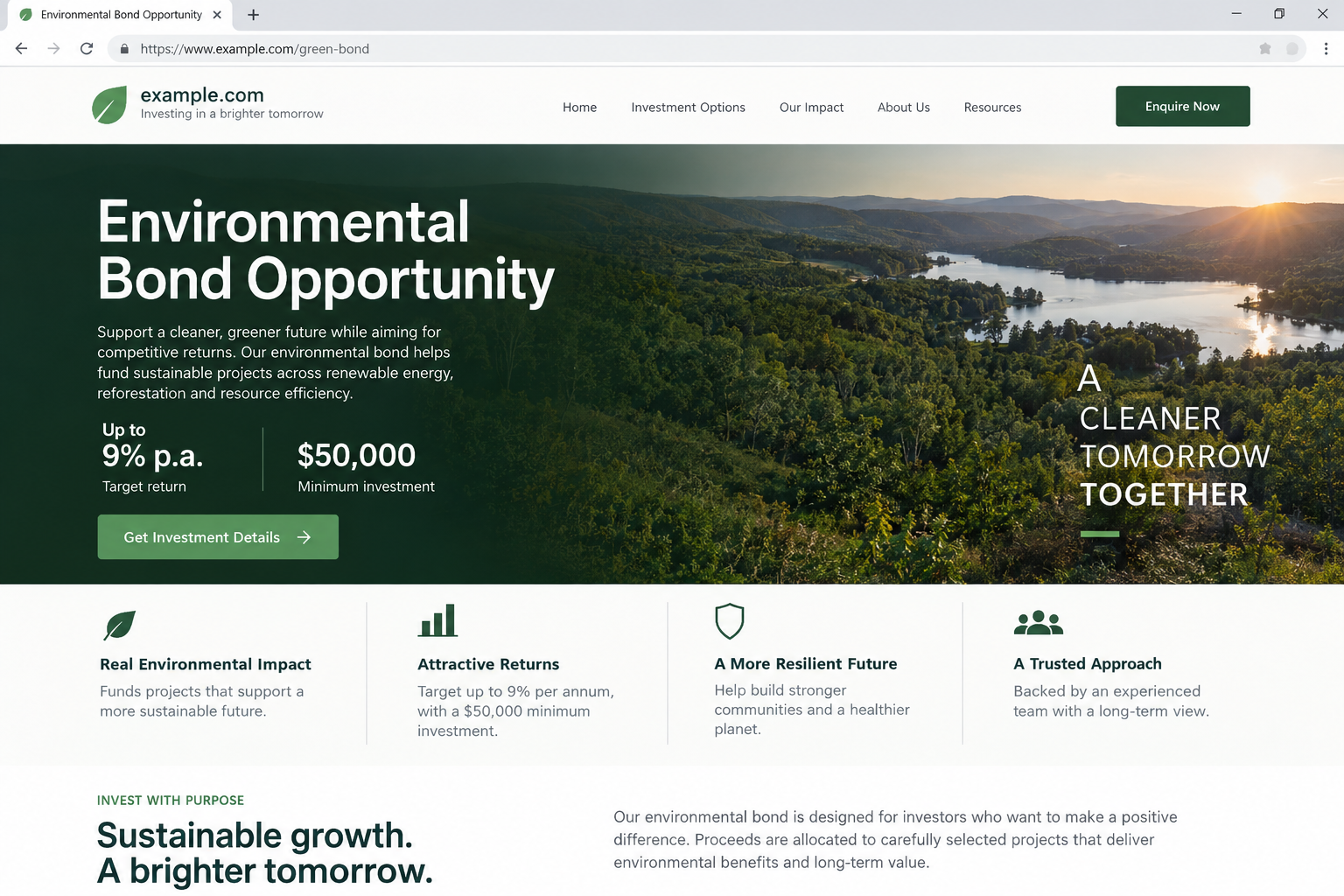
The image above is a fictional reconstruction without Bunnings branding. It shows the sales pattern, not one of the sites ASIC removed.
How the Fake Environmental Bond Scam Works
Step 1: Meet the investor at a believable search result
Scamwatch says the fake site appeared in searches for investment opportunities. That placement matters because the visitor may arrive while actively comparing products.
A search result is not an endorsement. Fraudulent pages can rank or be advertised alongside genuine financial information.
The page can use environmental language that resembles real corporate sustainability reports. That resemblance is a theme, not proof of authorization.
Someone seeking stable income may be especially receptive to a bond label. It sounds more conservative than speculative trading, even when the product is invented.
Search snippets may quote only a headline and domain. Open the page carefully, then inspect the actual address before entering contact details.
Do not assume a high search position reflects financial oversight. Search engines organize pages; regulators authorize financial services.
Step 2: Wrap the offer in copied credibility
According to Scamwatch, the fake website looked like the business’s real site and included its branding. Some links even led to the genuine company website.
Those genuine outbound links can be a trap for a careful reader. Clicking “About us” may show a real page while the investment form remains controlled elsewhere.
Return to the address bar after every click. If the domain changes back to an unfamiliar investment site, the genuine link did not certify that site.
Look at the domain in the address bar of the page requesting your name or money. A brand image inside the page cannot authenticate its owner.
The illustration here uses a fictional domain and avoids the company’s logo. It is meant to show how a sustainability pitch can occupy a polished layout.
Step 3: Capture contact information for a broker follow-up
Scamwatch reports that visitors were encouraged to register their name, mobile number, and email address. This supplies the operator with a reachable lead.
The next contact may appear to come from a legitimate broker. A professional email signature can make the website and salesperson seem to verify each other.
But both can be controlled by the same people. Verify a broker through independent licensing records and a number not provided in the sales email.
Personal details supplied at this stage can also be reused in later scams, even if the visitor never sends an investment transfer.
That follow-up may feel personal because the caller knows the amount you selected. They know it because the form provided the detail, not because they are licensed.
Ask for the broker’s full name and firm, then verify both in official records. A quick search for the name alone may return copied or outdated profiles.
Step 4: Offer tiers and a reassuring return claim
The documented pitch contained three options spanning $50,000 to $250,000. Up to 9% was the claimed return, not a verified investment performance figure.
Three tiers make the offer feel structured. They also create a middle option that can appear moderate beside the largest amount.
The supposed government protection is more powerful than the headline rate. It implies safety without identifying a real legal guarantee the buyer can independently confirm.
Before investing, ask for the issuer, security, governing documents, risks, and who actually owes repayment. A vague project theme cannot substitute for those facts.
Also ask how the money would be used and whether projects are already selected. Broad promises about sustainability can hide the absence of any identified asset.
A real adviser should explain downside risk, not only projected income. If every answer returns to “government protected,” request the official guarantee wording.
Step 5: Turn the “application” into a money transfer
Scamwatch says the criminals stole money by getting people to buy fake bonds. The payment is not funding a recognized Bunnings product.
A request to wire funds to a broker, unrelated company, or personal account should trigger a full stop until the recipient is independently verified.
The exact bank instructions used by the removed sites were not published in the alert. Do not rely on any single account pattern as a detection rule.
Do not send a small “test” transfer either. It confirms willingness to pay and can open the door to a larger request.
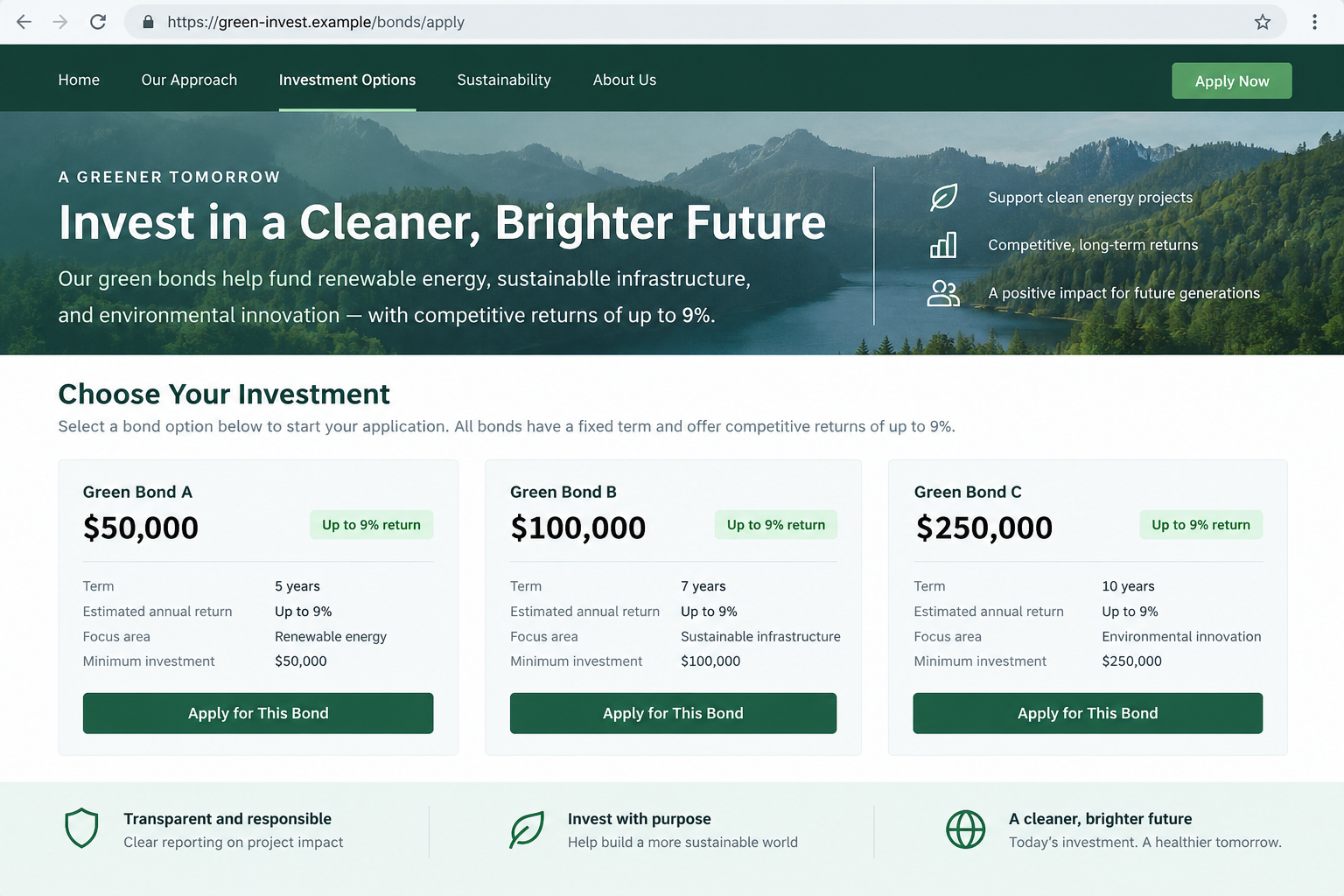
The second image illustrates tiered amounts and up to 9% language. The fictional site and terms are not an actual bond contract.
Step 6: Leave the buyer with a claim, not a security
After a transfer, a confirmation email may feel satisfying. It does not establish ownership of a real bond or a legal claim against the impersonated retailer.
The alert confirms fake bonds and losses, but not a universal post-payment script. The critical evidence is the seller’s authority before the transfer.
Do not wait for a promised interest payment to verify the issuer. Contact your bank promptly if you believe the offer was fraudulent.
A forged account dashboard could display a balance or scheduled coupon. Figures controlled by the seller are not proof a security was issued.
Company, Address, and Broker Checks
Go to the real business first
Find Bunnings independently and ask whether it issued the named environmental bond. Do not use the sales page’s “official site” button as your only route.
A real retailer can have environmental programs without offering a public bond under that name. Sustainability activity is not proof of a particular investment product.
Ask for a specific corporate confirmation, not a general statement about its sustainability work. The two subjects can be deliberately blurred in the pitch.
Identify the legal issuer
A legitimate investment should identify who issues the security and what rights an investor receives. A brochure that says only “supported by Bunnings” leaves a critical gap.
Compare the legal issuer across the prospectus, application, email signature, and receiving bank account. Inconsistency deserves an explanation from an independent source.
Look for a registered company number and a verifiable office, but do not stop there. Fraudsters can copy both from a genuine firm’s public records.
Check the broker and contact details
Search ASIC’s registers for the individual or firm offering financial services. Confirm the representative through the registered company’s own published phone number.
A listed street address may belong to another company, a mail service, or a shared office. It does not prove the sender works there.
Call before sharing documents. If the number never answers, or the person cannot name the issuer and product, do not treat a polished email as verification.
A return address can be a shared office or fulfillment location. The useful question is whether the verified issuer actually operates from it.
Trace the promised protection and payment route
Ask which government program supposedly protects the investment and where its official rules are published. Do not accept a statement in the sales PDF as evidence.
Check the bank recipient against the legal issuer. A demand for payment to an unrelated entity can reveal that the brand name is only cover.
If the salesperson says a third-party payment agent is routine, ask the genuine issuer to confirm that relationship in writing through its own channel.
Why “Up to 9%” Is Not a Safety Statement
A return figure describes a claim about possible income. It does not tell you whether the issuer exists, whether capital is at risk, or whether the security is enforceable.
“Up to” can also conceal conditions. Even a real bond needs clear terms for coupon payments, maturity, defaults, and the treatment of invested capital.
Government regulation of financial markets is not the same as a government guarantee for an individual bond. The fake pitch blurred that distinction.
A green theme is not independent due diligence. Carbon reduction and waste management are broad goals; the investor still needs a specific, verifiable project and issuer.
Do not let the size of the minimum investment work as a credibility cue. Criminals can request large amounts precisely because the promise appears substantial.
Scamwatch’s warning concerns the documented impersonation. It does not imply every sustainability bond or environmental investment is fraudulent.
Healthy skepticism is selective. An offer becomes credible through verifiable ownership, clear risks, and regulated intermediaries, not simply through green terminology.
When an investment sounds both unusually profitable and unusually safe, investigate both claims separately. One does not logically prove the other.
What to Do If You Fell for the Fake Bond Scam
- Call your bank immediately. Report the transfer as investment fraud, provide the receiving account details, and ask whether a recall or receiving-bank alert is possible.
- Stop sending further money. Do not pay a verification charge, tax, or release fee requested by the same seller. Preserve the demand instead.
- Save the complete offer trail. Keep the original domain, broker emails, brochures, application pages, contracts, receipts, and any claimed licence or guarantee numbers.
- Protect personal information. If you submitted identity documents, seek advice from IDCARE in Australia and monitor financial accounts for misuse.
- Report the impersonation. Notify Scamwatch, ASIC, and the real business whose name was used. Provide the exact domain rather than only a screenshot of the logo.
- Review other accounts. Change passwords if you reused them on the fake site. Check whether a broker asked for bank login details or installed anything.
- Ignore paid recovery agents. An unsolicited claim that funds can be released for another fee may compound the loss. Check any recovery process with your bank.
If the site caused a download or unexpected extension installation, scan the device with Malwarebytes. AdGuard can reduce exposure to deceptive ads, not validate an investment.
The important financial action is still to contact the bank and authorities quickly. Security software cannot turn a nonexistent bond into a legitimate holding.
If you shared the offer with friends, tell them the site is under suspicion. They may have registered without telling you or may receive follow-up calls.
Do not forward the scammer’s live link while warning others. Share the official alert or describe the domain in non-clickable form.
Frequently Asked Questions
Did Bunnings actually offer the bonds in Scamwatch’s alert?
No. Scamwatch describes criminals impersonating Bunnings. The legitimate retailer’s name was used to give a fake investment credibility.
Were the fake sites removed?
Scamwatch says ASIC took down the fake Bunnings sites it identified. New domains or copied pitches may still appear later.
Was a 9% return guaranteed?
No. Up to 9% was part of the criminals’ claimed offer. It was not verified performance or a government-backed guarantee.
Why do links to the real business not prove authenticity?
Anyone can link to a genuine website. The page collecting your details and money can remain under the scammer’s control.
Can I trust a broker who quotes a licence number?
Not without matching the person, firm, domain, and product through independent records. A valid number can be copied into a false email.
Where should an Australian investor report a loss?
Contact the bank first, then report to Scamwatch and ASIC. Keep the offer and transaction evidence for both.
The Bottom Line
The fake Bunnings environmental bond pitch used a familiar brand, green language, and up to 9% return claims to sell an investment that was not real.
Verify the issuer and broker outside the sales page before sending funds. If you already invested, alert your bank and report the impersonation promptly.








