

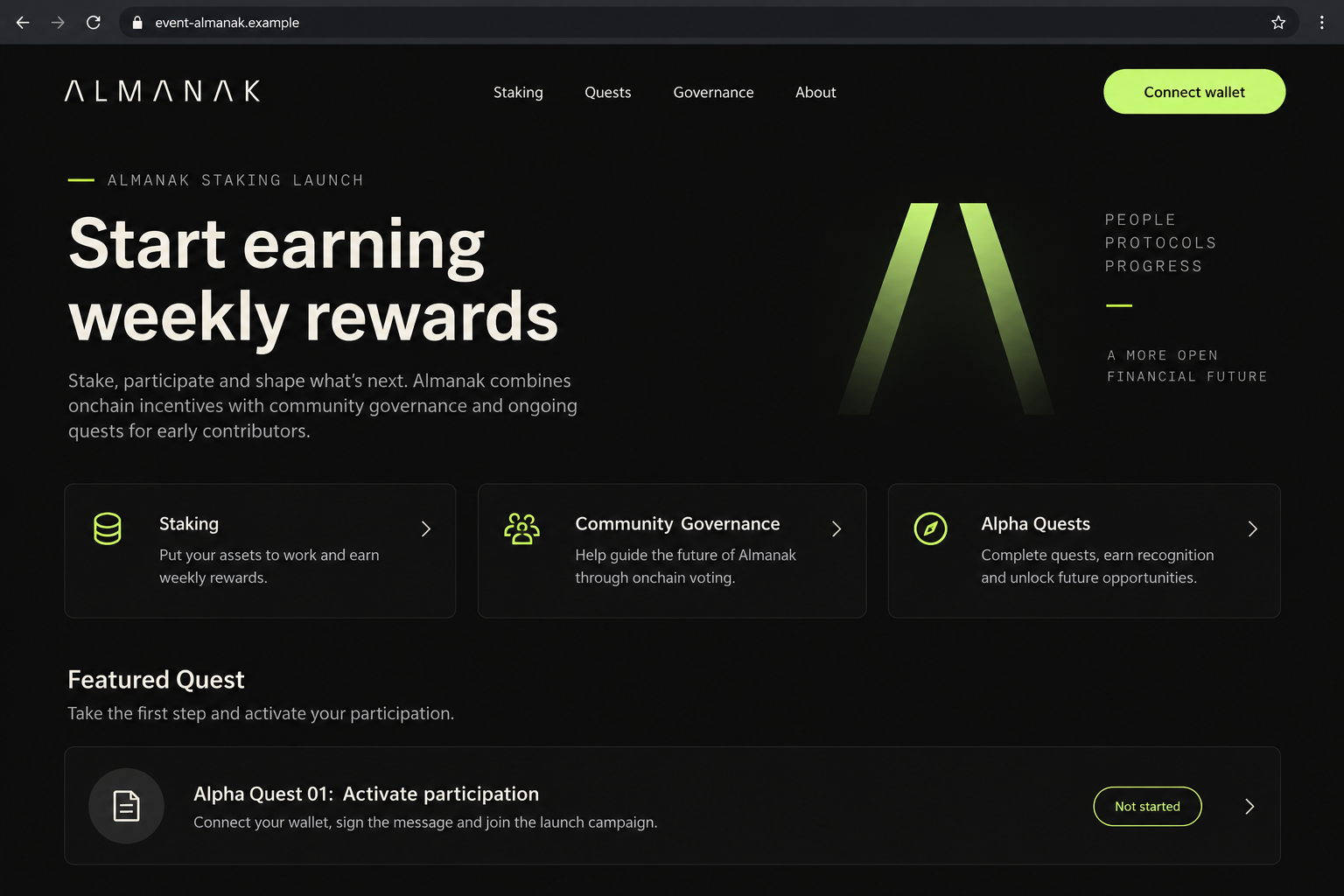
An Almanak staking launch page offers weekly rewards, community participation, and Alpha Quests. It sounds like a chance to join early rather than another ordinary financial advertisement.
The invitation gives you several reasons to explore. Before starting a quest or connecting an account, check which platform is actually organizing the event.
Overview
The launch page is an imitation of a real platform
The Almanak staking launch scam uses an unauthorized event page to seek wallet interaction. It is separate from the genuine Almanak platform and its documented tools.
A version recorded in December 2025 appeared at event-almanak[.]xyz. It advertised high weekly returns, governance participation, and exclusive Alpha Quests as reasons to get involved.
The recorded investigation identified that imitation as a cryptocurrency-draining scheme. We have not performed a contract audit or established the exact transaction requested from every visitor.
The central warning concerns the counterfeit event, not whether every autonomous trading tool or legitimate staking program is fraudulent.
The real platform provides an independent route for verification
Almanak’s current website describes tools for developing and testing financial strategies, with links to its application and official documentation.
That existing platform makes the copied event name plausible. It does not prove that a separate hostname has permission to collect funds or request wallet authority.
- Look for the specific event through the genuine platform, not only a forwarded announcement.
- Compare the full destination address with independently verified navigation.
- Separate community tasks from requests that send tokens or change spending permissions.
- Refuse secrets, unexplained transfers, and instructions to ignore wallet warnings.
A navigation label such as “Docs” is easy to copy. Read material reached through the real project rather than accepting every link within the imitation.
The pictures explain the handoff without claiming forensic proof
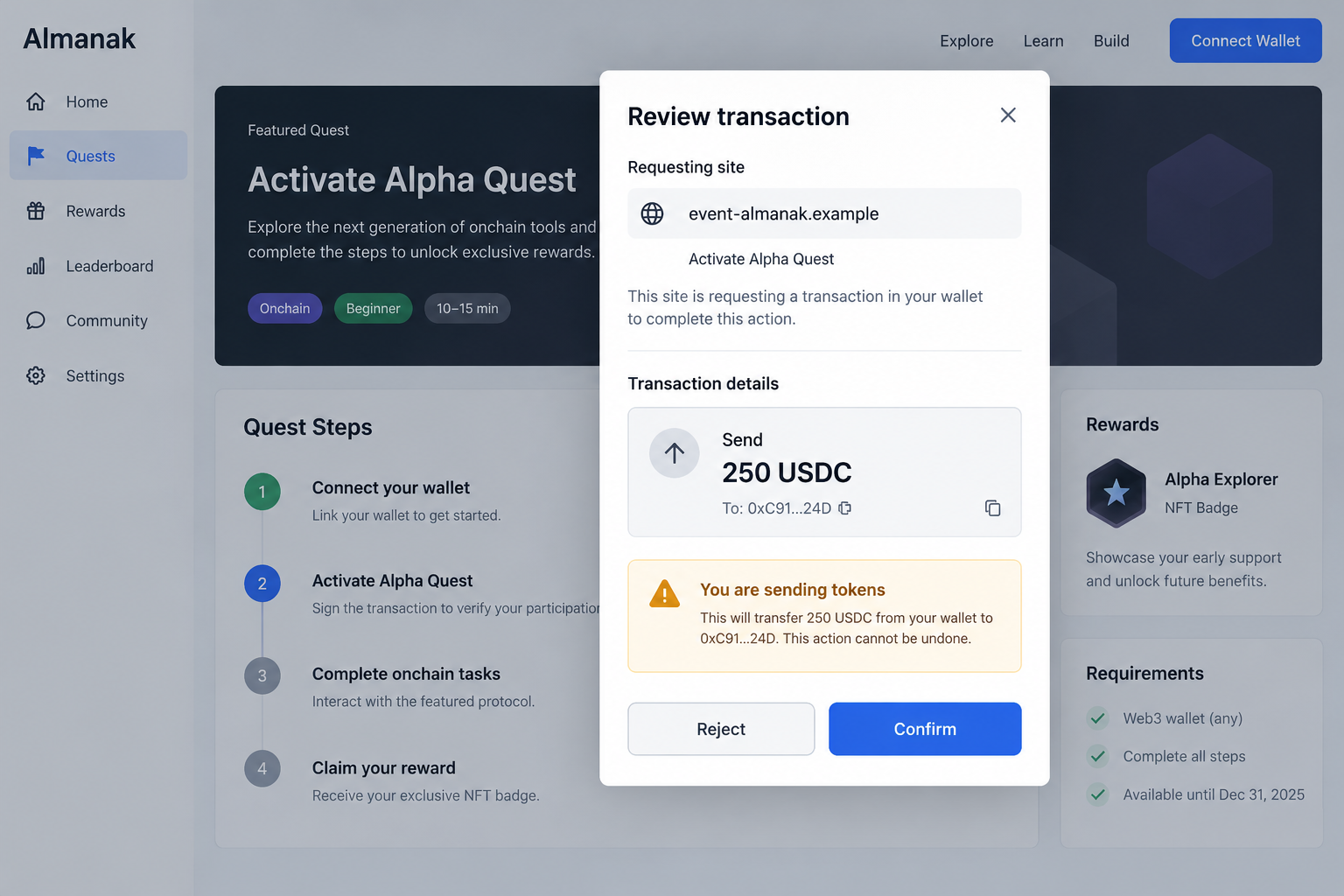
The illustrations use a fictional event domain. The second picture shows a hypothetical payment request labeled as quest participation, not a transaction captured from this campaign.
It highlights the question the reader must answer: does the wallet’s action match the task you intended to complete?
Connecting ordinarily identifies an account to an application. Additional approvals, signatures, or transfers may create financial exposure, but connection alone is not universal permission to empty a wallet.
This article revisits an earlier documented copy. It does not assert that the original event hostname is active today or that a new launch was announced.
Why the Launch Story Works Better Than a Bare Money Promise
Weekly rewards provide an immediate reason to participate
A weekly schedule makes the offer feel close enough to evaluate soon. The reader can imagine seeing a result before thinking through the underlying financial arrangement.
The recorded copy’s promise is not an independently verified yield. Without an authentic program and defined terms, the time interval is promotional language rather than an obligation.
A page may discuss earnings confidently while leaving the source of those earnings unexplained. Frequency alone says nothing about sustainability, loss exposure, or who controls the assets.
Ask what actually produces the return. An answer made entirely of launch excitement and participation language does not establish a funded reward mechanism.
Quests turn a decision into a series of small tasks
A quest suggests progress: begin here, finish a task, receive recognition. That framing can encourage a visitor to continue after each step without reevaluating the overall destination.
Community campaigns can be genuine. The problem is not the word “quest,” but an unverified organizer attaching financial requests to a seemingly simple participation task.
Once someone has spent time exploring, stopping can feel like wasting that effort. A deceptive page benefits when that feeling replaces scrutiny of the next permission.
Previous clicks do not obligate you to approve anything. The most consequential task may arrive after several harmless-looking screens.
Governance language suggests membership rather than custody risk
Voting and community participation sound different from sending savings to a stranger. An impersonator can use those terms to make a wallet request feel administrative.
Nevertheless, the transaction must stand on its own. A request to transfer tokens is not made harmless by calling the surrounding process a community vote.
The reported page combines several reasons to join. That variety can keep the visitor engaged even when one promise, such as high returns, would normally raise questions.
Evaluate the organizer first. You cannot safely assess a governance opportunity when the website’s connection to the project remains unestablished.
How the Almanak Staking Launch Scam Works
Step 1: A project-themed event gives the visitor a reason to explore
The counterfeit presents a launch rather than a random wallet form. Its story is that participants can earn, contribute, and gain early access through one organized campaign.
A person interested in financial automation may recognize the project name and look for details. That existing interest makes the invitation relevant without making it authentic.
Launch invitations may circulate through posts, direct messages, or ads. We cannot establish a single entry route for all visitors to this particular historical page.
Whatever the route, the invitation’s sender does not get to decide which site is official. Confirm that relationship before treating the event as part of your account.
Step 2: A separate event address borrows the project’s credibility
The recorded hostname pairs an event word with Almanak’s name. It sounds like a campaign address someone might create alongside a principal website.
That plausible naming pattern is not evidence of authorization. A separate domain can be registered independently even when it contains the complete brand name.
A copied page can also reproduce navigation, headings, and familiar design. Those details establish resemblance, not ownership of the program it advertises.
Check the exact event in official announcements reached independently. Do not rely solely on a link the event page provides to prove its own identity.
Step 3: Rewards and participation tasks make the connection feel routine
The visitor sees staking, governance, and Alpha Quests as related features. A wallet button then appears to be the natural first step for any of them.
Someone may connect to see available tasks without intending to invest. The site can exploit that exploratory intent by immediately presenting a more consequential request.
Opening a wallet dialog does not prove a transaction is safe. A genuine wallet can display a dangerous request accurately while the website supplies a misleading explanation.
You still control the decision at that point. Reject anything that does not match the task, and do not allow a progress indicator to hurry the review.
Step 4: The task label and the authorization can describe different actions
A website may describe a request as activation, eligibility, or participation. The wallet can reveal an outgoing payment or authority that the website’s language obscures.
The pictured 250 USDC transfer is a hypothetical teaching example. It is not a verified amount or transaction from the recorded Almanak imitation.
Its mismatch is the point: joining a quest should not silently become a payment you never chose. Read the actual asset movement and recipient before deciding.
Other harmful routes may involve spending allowances or signatures rather than the pictured transfer. Their consequences depend on the specific request and the network involved.
Step 5: Misplaced trust can produce an unwanted financial action
If a visitor authorizes a harmful action, funds or token authority may leave their control. The application’s friendly quest language does not limit what was actually approved.
A wallet balance is better evidence than a launch page’s success message. Review real records instead of assuming that a completion badge proves safe participation.
An approval may remain usable after the visitor leaves. A finished transfer has different implications, and a leaked recovery phrase requires a broader response still.
Do not assume every asset on every chain was affected. Determine the scope from your actual actions, account records, and trusted technical assistance if needed.
Step 6: A promised reward can keep the reader returning
Having completed a task, the visitor may wait for a reward and revisit the same site. That expectation can encourage further interaction with an unverified operator.
New demands to activate a payout or verify a wallet are possible follow-up risks. They are not established stages experienced by every visitor to this recorded copy.
A delayed reward does not justify another signature automatically. Treat each new request as a fresh financial decision, especially if it adds an unrelated recipient or token.
Stop at the first unexplained mismatch. You do not need to finish the launch journey to establish that its requested action is unacceptable.
AI and Noncustodial Claims Do Not Replace a Permission Review
Automation only does what its authority allows
The real Almanak project discusses autonomous financial strategies. A scam page can borrow that vocabulary to suggest that complex interactions are simply how its system works.
Complexity is not an exemption from verification. If an application needs permissions, those permissions still require a clear purpose and a scope consistent with your intention.
Do not approve an unexplained request because someone says an AI agent needs it. Identify the account, asset, authority, and intended action first.
A claimed smart strategy can lose money or behave unexpectedly even when genuine. The counterfeit event adds a separate problem: the identity and purpose are deceptive.
Your keys can stay private while an approval creates risk
“Noncustodial” does not mean nothing can go wrong. You can retain your keys and still sign a transaction you did not understand.
A token allowance can also authorize another party to spend within its scope. That is why keeping a recovery phrase secret is essential but not sufficient.
Use wallet previews as information, not decoration. If a preview is unavailable or unreadable, that is a reason to pause rather than assume the request is harmless.
No page should pressure you to disable protective warnings for an alleged reward. A legitimate technical explanation can be examined without surrendering control first.
Official documentation gives you a comparison point
Open Almanak’s documentation through the genuine project route. Compare its described products with what the purported event asks you to do.
A copied event need not resemble today’s real application perfectly. Historical designs and old announcement language can remain useful to impersonators after the genuine platform changes.
Check current information rather than relying on resemblance to a screenshot. An old design is not a license to introduce a new wallet destination.
When no official confirmation can be found, do not invent one from community enthusiasm. Leave the event alone until the organizer and transaction purpose are established.
What to Do if You Have Fallen Victim to This Scam
- End the quest flow and list the completed actions.
Record the page address and the tasks you attempted. Separate connecting, signing, approving, transferring, and entering secrets rather than grouping everything under “joined the launch.”
A clear sequence will help you identify the consequential request. Preserve the invitation and existing screenshots, but do not return for a better capture.
- Find the real result in your wallet.
Review recent activity from the wallet you normally use. Save transaction identifiers, networks, involved tokens, and unexpected recipients.
Look for asset movement that contradicts the task description. A claimed quest completion cannot establish that you received a valid reward.
- Remove unwanted application access and allowances.
Disconnect the event page, then investigate spending approvals for each affected network. Use a verified wallet process rather than a cleanup control inside the counterfeit.
The MetaMask disconnection guide describes the connection step. Spending authority requires its own review and, where applicable, revocation.
- Escalate if the wallet’s controlling secret was exposed.
If you entered a recovery phrase, stop treating the old wallet as secure. Establish a new wallet with a fresh secret using a trusted device.
A second account derived from the same exposed phrase does not fix the problem. Seek reliable technical help if remaining assets are difficult to secure.
- Inspect downloads and browser changes connected with the event.
A launch utility, unfamiliar extension, or unexpected notification permission deserves attention. Run updated Malwarebytes when unwanted software may have entered the device.
AdGuard can help reduce deceptive ads and some harmful-page exposure. It is not an authorization audit or a method for retrieving transferred tokens.
- Report the event rather than spreading its invitation.
Send the evidence to the genuine project through verified channels and report the link on the platform that carried it. Notify contacts you forwarded it to.
If assets were lost, contact the appropriate authority with the transaction records. US readers may report through the FTC’s fraud reporting service.
- Keep recovery separate from another rewards pitch.
Do not pay a stranger to activate a refund or unlock a community allocation. Such requests can add a second loss after the initial incident.
Public blockchain records may support an investigation, but no helper should promise guaranteed reversal. Protect your remaining assets while preserving evidence for legitimate review.
Frequently Asked Questions
Is the real Almanak platform fraudulent?
This article does not make that claim. It concerns the separate staking-launch imitation documented at an unauthorized event domain.
Are Alpha Quests always a scam?
No. Community tasks can be legitimate. Verify the organizer and read each wallet request, particularly when a simple task becomes a payment or spending approval.
Did the recorded copy actually request 250 USDC?
That amount appears only in our hypothetical transaction illustration. It explains an action mismatch and is not a verified request from the campaign.
Does a noncustodial wallet prevent losses from a false launch?
No. Keeping your keys does not stop you from authorizing an unwanted transfer or permission. The requested action still needs careful review.
Can I ignore a warning if the site says it is an AI feature?
Do not. AI branding does not explain away spending authority, unfamiliar recipients, or secret requests. Pause until the actual action is understandable and independently verified.
What if the quest badge appeared but my balance changed?
Investigate the wallet record, not the badge. Preserve the transaction details and stop interacting while you assess unwanted transfers or remaining permissions.
The Bottom Line
The Almanak staking launch scam combines earning, governance, and quests to make an unauthorized wallet journey feel like joining a community. Participation labels cannot authenticate financial requests.
Verify the real platform before exploring an event. If you already acted, follow the actual transaction trail and secure permissions rather than chasing the counterfeit reward.








