

The caller says there is a problem with your Canadian immigration file. They sound certain, and they want an answer before you have time to find your paperwork.
When your plans depend on a permit or application, that is a hard call to shrug off. Start by separating the caller’s story from your actual record.
Overview
The caller borrows immigration authority to demand action
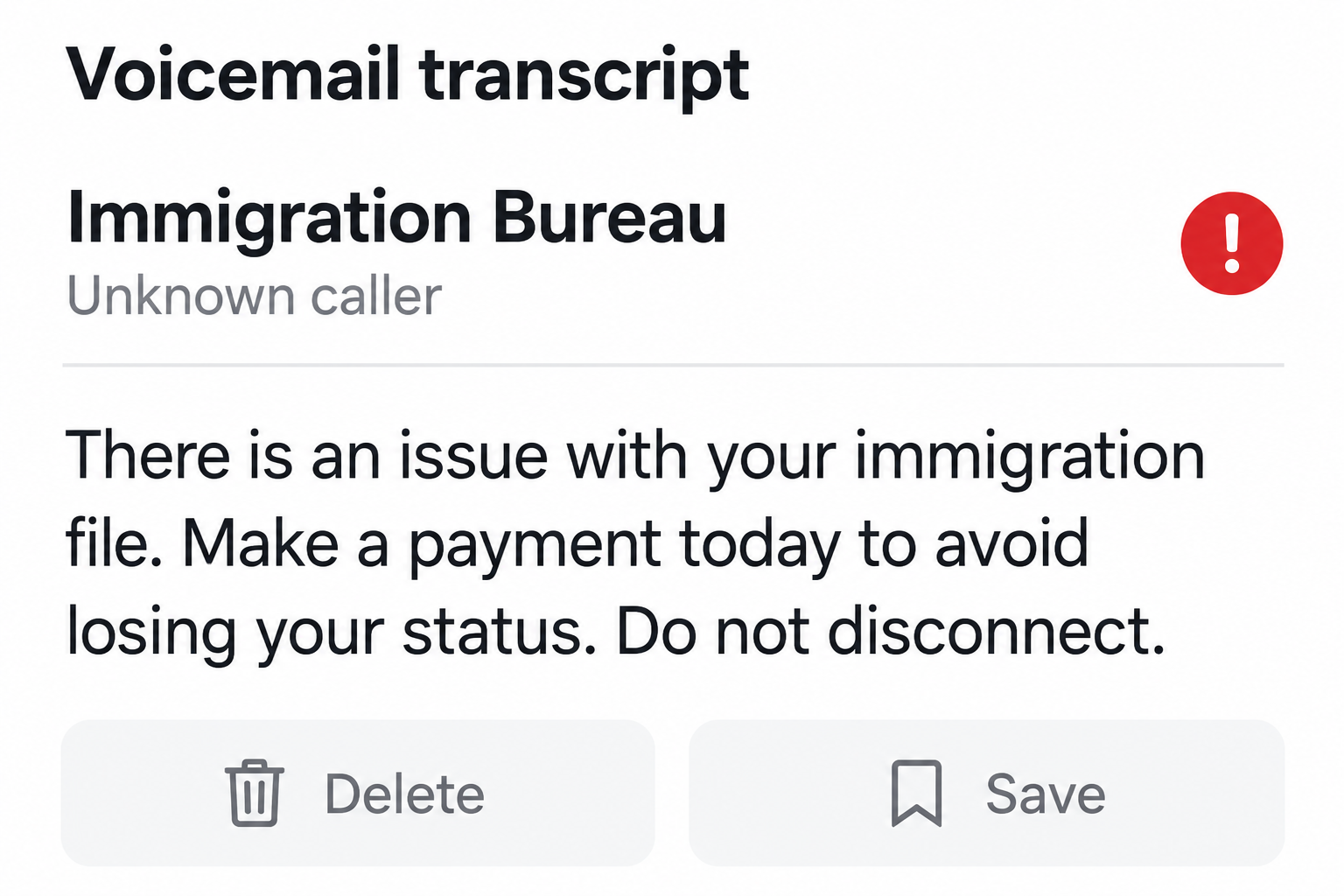
The Canada Immigration Bureau scam call is an impersonation attempt. Someone claims government authority and threatens your status unless you provide money or information.
Immigration, Refugees and Citizenship Canada, usually called IRCC, is the real federal department. An official-sounding bureau name on a call is not a connection to it.
The image above is an illustrative voicemail interface, not a recording or transcript from an identified victim. Individual scripts and caller names can vary.
IRCC directly rejects the threatened-payment story
IRCC’s warning about threatening callers says it does not collect payments to prevent deportation or similar consequences through personal, online, or telephone approaches.
That is the central distinction: a stranger offers to stop a frightening consequence by collecting something from you during an unexpected interaction.
A real application can have fees and deadlines. Those obligations do not authenticate a caller who demands an immediate private settlement.
Your case and the suspicious call need separate checks
Do not let the person making the threat also control the only way you can verify it. Keep these questions separate:
- Who is the caller claiming to represent?
- What problem do they say exists?
- Where would the money or documents go?
- What do your genuine notices and account actually show?
- Which official contact route can answer your question independently?
Why This Call Can Be So Unsettling
The threat reaches beyond an ordinary bill
A permit may connect you with your studies, job, partner, or children. Losing it can sound like losing an entire plan, not simply missing a payment.
That emotional weight helps explain why a careful person might stay on the line. The fear is real even when the caller’s authority is not.
You do not need to prove you are a perfect applicant before ending a threatening conversation. A worried recipient is entitled to seek an independent answer.
If English or French is not your strongest language, ask someone you trust to help read genuine documents. Keep the impersonator out of that conversation.
A familiar detail can make the rest sound plausible
The caller may use your name or refer to a broad category such as a student permit. You might supply the more specific details yourself while trying to explain.
Notice that moment. Correcting a stranger’s story can reveal the school, application type, family situation, or identifier they did not previously know.
You do not have to work out how they obtained a name before deciding to stop. Familiar information is not the same as verified authority.
Nor should an accurate guess make the threatened payment legitimate. Judge the action requested, not only the details the caller gets right.
How the Canada Immigration Bureau Scam Call Works
Step 1: A call announces an urgent immigration problem
A person or recorded voice introduces an alleged file issue. Some versions use a keypad prompt to move the listener into a conversation with a supposed officer.
The message may be vague enough to fit many recipients. Someone waiting for an update can easily connect that vague warning with their own application.
Do not press a key just to establish whether you were meant to receive it. You can check your real file without entering the caller’s process.
If the call goes to voicemail, keep it for reference. You are not required to use the callback route it supplies.
Step 2: The supposed officer supplies credentials
The caller can introduce a job title, badge-like number, or departmental label. These details make the conversation feel more formal than an ordinary unsolicited call.
Write down a claimed identity only if doing so is safe and useful. Do not prolong an abusive conversation to complete a checklist.
IRCC advises checking a suspicious agent’s identity through its own contact service. That check needs a fresh, independently obtained route, not a transfer arranged by the caller.
Caller ID is not a reliable shortcut. A displayed government-looking number cannot establish who is speaking or where the call actually originated.
Step 3: An administrative issue becomes a personal threat
The caller links the supposed mistake to arrest, deportation, lost status, or another serious outcome. The demand shifts from understanding a file to preventing a crisis.
The Canadian Anti-Fraud Centre describes immigration extortion involving alleged paperwork failures and immediate fees. This is a documented fraud pattern, not normal case handling.
A threat can also discourage you from talking to family or your adviser. Isolation leaves the caller’s explanation unchallenged when you most need a second perspective.
Do not accept secrecy as a condition of protecting your application. Consult the real authority or an appropriately qualified adviser about a genuine concern.
Step 4: Payment or identity information becomes the solution
The person asks you to transfer funds or disclose details supposedly needed to clear the issue. Watch the proposed recipient as closely as the stated reason.
IRCC’s online and telephone scam guidance rejects personal-bank-account deposits, private transfer demands, and threats from its employees.
A payment is not safer because someone calls it refundable, a security deposit, or a verification charge. Ask which genuine published process supports it.
Do not send a passport photograph to persuade the stranger that your record is correct. That would expose a valuable document without verifying who receives it.
Step 5: The caller tries to keep verification inside the conversation
An offer to connect you with a supervisor may feel reassuring. But a second voice introduced through the same call is not an independent confirmation.
The same problem applies to a document the caller sends afterward. It may repeat the original story without adding any trustworthy connection to IRCC.
If someone stays on the line while you open banking, stop. Your financial account should not become a demonstration for an unverified immigration contact.
Read any payment or sign-in approval yourself. A caller’s explanation of what a code does cannot replace the message from the institution issuing it.
Step 6: Compliance creates another reason to keep responding
Once you have sent information or money, walking away becomes harder. You may hope that one final step will make the situation safe again.
Another fee can be presented as finishing the original task. Treat it as a new demand, not an obligation created by the earlier payment.
Switch your attention from satisfying the caller to protecting whatever was exposed. A financial provider, account provider, and immigration office each handle different parts of that response.
No assurance from the impersonator can undo a document disclosure or establish that a genuine government record has been corrected.
Verify a Canadian Immigration Concern Without Feeding the Scam
Use the account and contact options that fit your application
Begin with IRCC’s official contact page. It links account help, application-status information, the web form, and contact options.
Different applications use different services. Follow the route associated with your genuine application rather than creating a new account through a caller’s link.
If you see an unfamiliar instruction, compare it with notices already in your account. Keep a copy while you ask the genuine service about it.
Do not expect a support inquiry to remove every delay. A slow answer does not make a private caller’s instant solution more credible.
Describe the threat without supplying an entire immigration history
Prepare a short question: someone claimed to represent IRCC, alleged a particular issue, and demanded a particular action. Ask how to verify that claim.
Keep the caller’s reference separate from your real application number. That helps prevent a fabricated label from becoming confused with an existing official record.
Use sensitive identifiers only through the verified service when needed. Do not paste them into public forums while asking whether the call sounds familiar.
If an adviser already represents you, contact their established office. Do not replace that relationship with a lawyer introduced by the person making the threat.
Do not turn this warning into a rule against every genuine contact
An immigration process can involve legitimate communications. The practical response is independent verification, not ignoring all future notices or abandoning your application.
Threats are the warning sign, not a reason to pay. Handle any genuine problem through the route the real authority confirms.
If the call arrives outside support hours, record your question and protect any exposed accounts now. Do not pay the caller simply because the office is closed.
Protect the Application You Already Have
A threatening call can leave you wanting to change everything immediately. Do not withdraw an application, replace an adviser, or submit invented corrections because a stranger instructed you.
First identify whether there is a genuine notice requiring a response. Preserve its original wording and deadline rather than replacing them with notes from the call.
If you need professional advice, describe both the real paperwork and the suspicious demand. That lets the adviser distinguish an application question from the impersonation.
Keep shared family information private while seeking help. A relative’s document or application number should not become an attachment in a public warning about the incident.
It can help to make two folders: one for authentic application records and another for the scam evidence. A forged notice belongs in the second.
Continue using the contact information you maintained before the call. An unexpected instruction to replace an email address or recovery method deserves a separate check.
What to Do if You Have Fallen Victim to This Scam
-
End the caller’s control over the situation. Disconnect, stop replying, and tell a trusted person what happened. You do not need the caller’s permission to seek help.
If there is an immediate physical threat, contact local emergency services. Do not attend a meeting or follow travel instructions supplied by the threatening person.
-
List the specific things you disclosed or approved. Separate names and contact details from document copies, passwords, bank information, codes, and payments.
Write a brief timeline while the conversation is fresh. This makes later reports clearer and keeps you from overlooking an action taken under pressure.
-
Speak to the institution that handled a payment. Explain the immigration impersonation and the method used. Ask what immediate protection or recovery request is available.
Use contact details from your genuine banking service. Keep transaction references and explain accurately if the caller persuaded you to authorize the transfer yourself.
Do not assume a refund is certain. A prompt report gives the provider a chance to assess the situation without another payment leaving your account.
-
Protect exposed accounts and documents. Replace a disclosed password through the real service and review available sign-in protection, unfamiliar sessions, and recovery settings.
For a shared or misused immigration document, ask IRCC about the appropriate response. A foreign passport concern belongs with its issuing authority, not automatically Passport Canada.
The CAFC victim guide covers document misuse and identity-fraud follow-up. Explain what was exposed rather than assuming a scan alone cancelled the document.
-
Report the impersonation through genuine channels. Save the voicemail, call log, messages, claimed officer details, and payment requests. Preserve originals rather than only rewritten notes.
IRCC’s fraud-reporting page distinguishes reports to the CAFC, local police, and immigration support. Follow the route that fits your location and circumstances.
A report about the scam does not replace an inquiry about your real application. Keep any police or support reference with your other incident records.
-
Reject paid promises to erase the incident. A new caller might claim they can return the money or remove an imaginary flag on your file.
Discuss genuine application concerns with IRCC or a qualified representative you independently chose. Do not pay another stranger merely because they know about the earlier call.
Frequently Asked Questions
Is the Canada Immigration Bureau caller really IRCC?
A claimed name does not authenticate a caller. If the person threatens status or deportation unless you pay or disclose information, IRCC identifies that conduct as a scam.
Can an agent number make the threat legitimate?
No. Record it if convenient, then verify independently. A number supplied by the caller is not an authentication method.
Should I pay first and ask IRCC afterward?
No. Do not send money to stop the caller’s threatened consequence. Check any real obligation through the official service before choosing a payment route.
What if my application actually has a problem?
Address the genuine issue through IRCC’s verified process. An existing concern does not validate the stranger’s demand or make a private payment fix your record.
Does sharing a passport scan mean my status is cancelled?
The disclosure alone does not establish that. Report the exposure to the appropriate authority and seek instructions about document protection and your actual file.
Should I ignore every immigration message after this?
No. Continue monitoring your genuine application and verified notices. Reject the coercive approach while using official channels to handle legitimate requirements.
The Bottom Line
Hang up on a Canada Immigration Bureau scam call demanding payment to protect your status. Verify the real file through IRCC, away from the person making threats.
If you already complied, protect the money, accounts, or documents involved and report the incident. The next useful step is independent help, not another concession to the caller.

Join the discussion
0 commentsShare your experience or ask a question about this article.
Discussion
Start the conversation
Have a question or something useful to share? Add the first comment.