

The buyer arrives with cash, and you watch it being counted. After days of messages about your listing, the sale finally seems straightforward.
Then the money changes hands once more. That small interruption is worth understanding before you let an expensive item leave with someone you have just met.
Overview
The payment you saw may not be the payment you receive
The Marketplace cash envelope swap scam is a distraction theft. A buyer shows a payment, then leaves the seller holding a different envelope or insufficient cash.
The weakness is not necessarily a fake banknote. Genuine money can be displayed first, making the later package feel as trustworthy as the amount already counted.
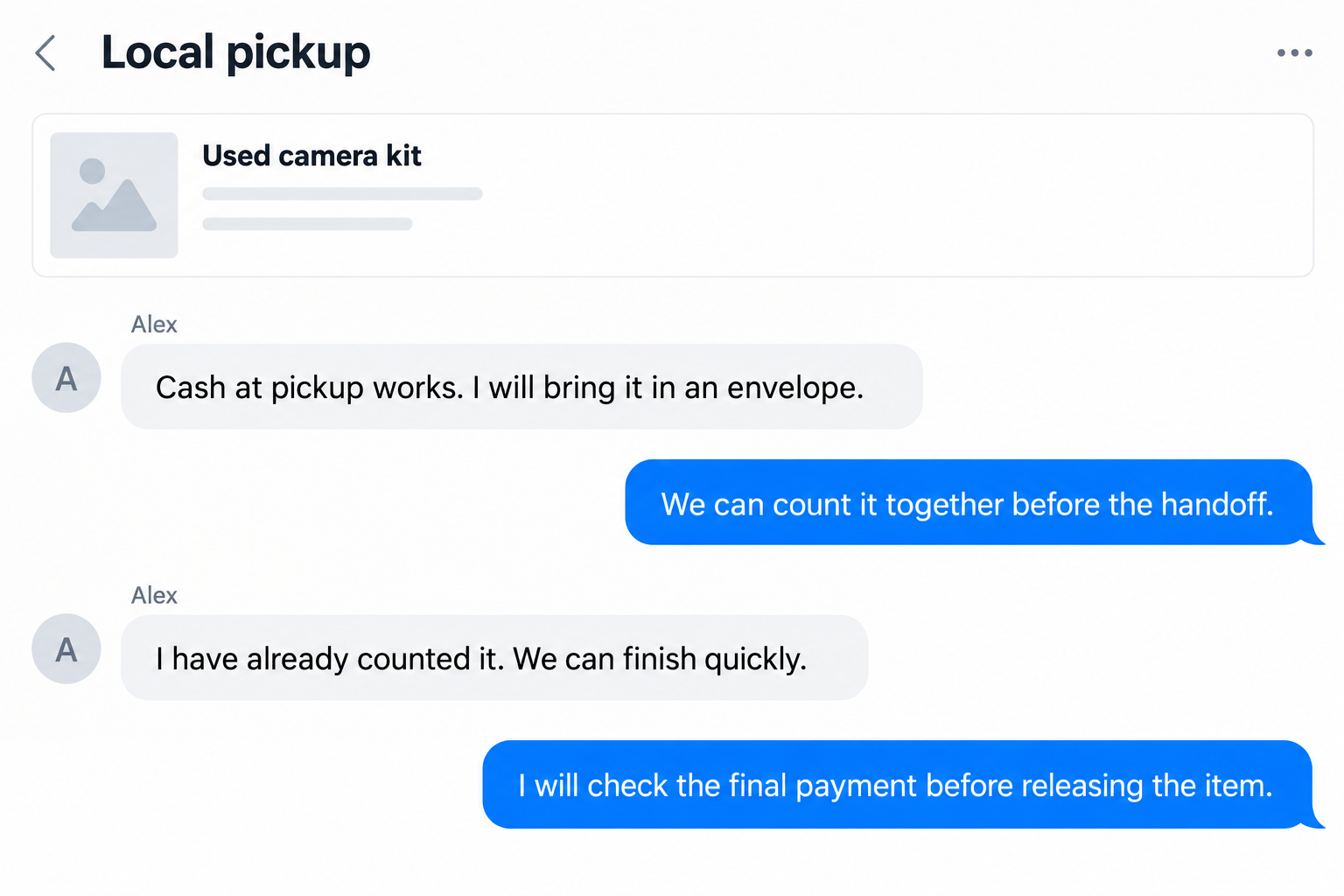
The image above is a fictional conversation illustrating a pickup arrangement. It is not an actual victim’s chat or evidence about a particular marketplace account.
Police have documented the switch during a real sale
Richmond RCMP described a reported envelope swap after a high-value marketplace meeting. The cash was handled repeatedly before the item was released.
The seller later discovered that the returned envelope lacked the agreed amount. The warning does not identify a universal price or a single type of item.
Keep inspection connected to the final handoff
Counting money is useful only if you know what happened to it afterward. Before releasing an item, consider the complete exchange:
- Have you personally checked the final payment?
- Has the buyer handled it again since that check?
- Did a new envelope or bundle enter the exchange?
- Are questions about the item splitting your attention?
- Can you pause safely without being rushed into completion?
Why Cash Can Create a False Sense of Security
You may already be watching for a different scam
Many sellers know to distrust a payment screenshot or a request to upgrade an account. A cash buyer appears to remove those familiar problems.
That does not mean cash is a bad payment method. It means choosing cash changes the checks you need to make; it does not remove them.
A balance in an app needs verification in that app. Physical cash needs your own count, appropriate authenticity checks, and attention to the money ultimately received.
The envelope is packaging, not a receipt. Its thickness, neatness, or familiar appearance cannot tell you whether the agreed payment remains inside.
The social pressure can be stronger than the sleight of hand
After counting together, asking to check again can feel awkward. You may worry that a polite buyer will interpret it as an accusation.
Make the final check part of your normal process, not an argument about character. Explain the arrangement before the meeting so it does not become a surprise.
The check is about the payment, not the buyer’s personality. It protects against an honest counting mistake as well as deliberate deception.
If the situation becomes uncomfortable, you can leave the sale unfinished. You do not owe a handoff merely because the buyer traveled to meet you.
How the Marketplace Cash Envelope Swap Scam Works
Step 1: A buyer arranges a normal-looking local sale
The contact starts through an online listing. Price, collection, and payment are discussed just as they would be for an ordinary secondhand transaction.
There may be no suspicious website or request for a bank login. The dangerous part can happen entirely during the in-person exchange.
A friendly conversation does not remove that possibility. Equally, a brief message or a new account alone is not proof that its owner plans a theft.
Set the meeting and payment checks around what you can verify. Avoid treating conversational warmth as a substitute for checking what changes hands.
Step 2: The buyer displays money that appears to settle the price
Cash comes out, and a count appears to match the agreement. The seller starts to regard the payment as complete before the physical handoff is finished.
In the Richmond report, an envelope containing the payment was produced at the meeting. The parties handled and counted it more than once during negotiations.
This creates a distinction that is easy to miss: seeing enough money is not the same as receiving and retaining that money.
Let the buyer finish examining the item before your final count where practical. Mixing those tasks gives each party more to watch at once.
Step 3: Repeated handling breaks the connection with the earlier count
Questions, renegotiation, or another look at the contents can move attention away from the payment. What felt settled becomes part of the conversation again.
The earlier total may remain in your mind even after the bundle leaves your control. You remember the amount but not every later movement.
A switch does not require the final envelope to look unusual. It only needs you to accept that it contains what you saw previously.
If the buyer takes the money back, treat the inspection as unfinished. Start a fresh check of the payment offered at the end.
Step 4: The item is handed over before the final contents are checked
The seller accepts the envelope and releases the item. At that moment, confidence in an earlier count replaces knowledge of what is now in the seller’s possession.
Do not rely on a promise that you can count later. Later may be after the person and the item have left.
A sealed envelope is not an improvement if it prevents inspection. Nor does a buyer counting aloud remove the need for your own check.
Keep the item with you until the agreed exchange is complete, provided it is safe. Never turn a disputed sale into a physical confrontation.
Step 5: The shortage is discovered after departure
Once the envelope is opened or recounted, the payment does not match the agreement. What appeared to be a completed sale becomes a missing-item report.
The Richmond warning describes that delayed discovery. It does not establish a guaranteed way to identify a suspect from a profile name.
That is why the original listing, conversation, meeting details, and ownership records matter. They connect the online arrangement with the exchange that actually occurred.
Do not assume a familiar-looking profile provides a verified identity. Preserve its address and messages for the platform and police rather than making public accusations.
A Safer Handoff From First Message to Final Count
Agree on a location that gives you time
A monitored public exchange area can make a meeting easier to document and less isolated. Confirm its current location and availability before arranging the trip.
Richmond RCMP recommends visible meeting places and bringing a friend. Its warning also points sellers toward the detachment’s designated exchange zones.
A camera is not a promise that an officer watches every transaction or will authenticate the payment. You still need to conduct your own checks.
If the proposed place changes at the last minute, reconsider the sale. You do not have to follow someone to a quieter location to finish it.
Finish the item inspection before settling payment
Let the buyer ask reasonable questions and inspect the item within the agreed safety plan. Then make the payment check a separate task.
A companion can help watch your belongings while you concentrate. Do not assume their presence replaces your own count or makes a threatening situation safe.
Avoid balancing cash, packaging, accessories, and a conversation at the same moment. An orderly handoff makes a mistake easier to notice without accusing anyone.
If either party needs to restart negotiations, pause the exchange. A new price means a new total to confirm, not an improvised adjustment made while everything moves.
Check the final bundle, not just its outer appearance
Count the amount yourself and check the relevant security features of the notes. Those are different safeguards: correct quantity does not establish genuine currency.
Afterward, retain control of the checked payment until the exchange ends. If it is handled again, do not rely on the old count.
You can use your own empty container after checking the money. That may simplify tracking, but it is not a guarantee against distraction or another form of theft.
For a particularly valuable sale, ask your financial institution in advance about a suitable payment arrangement. Do not assume a branch will supervise a private transaction.
Keep the item traceable without exposing its details publicly
Before meeting, retain photographs, identifying marks, purchase records, and any serial number. Store the complete identifier privately rather than advertising everything needed to copy the item’s identity.
For electronics, follow the manufacturer’s instructions for removing personal accounts and data before transfer. Do not demonstrate your email or banking credentials to a prospective buyer.
Save the agreed price and meeting arrangement. If a last-minute change occurs, keep that message too rather than replacing the earlier conversation.
A simple personal record is enough. There is no need to collect the buyer’s identity documents or make unsupported assumptions about their name, nationality, or intentions.
How This Differs From Other Marketplace Payment Frauds
Counterfeit cash concerns the notes themselves
In a counterfeit-payment case, notes can be present in the correct quantity but lack real monetary value. An envelope swap can remove genuine notes after inspection.
These risks can overlap, but they are not interchangeable. Checking one real note does not establish the rest, and inspecting a bundle does not protect a later handoff.
A payment screenshot is a different kind of reassurance
Someone offering a digital transfer may show a confirmation instead of money. Verify any such payment through your own genuine account, not the image they display.
Do not switch methods under pressure simply to rescue an uncomfortable meeting. Changing the payment route introduces new questions that should be answered before the item leaves.
What to Do if You Have Fallen Victim to This Scam
-
Get to safety before trying to recover the item. Do not chase the buyer, enter their vehicle, or arrange a confrontation after discovering the shortage.
If someone threatens you, use local emergency assistance. A recoverable possession is not worth escalating an encounter that could cause physical harm.
-
Preserve the envelope and make an accurate count. Note what you received, where you checked it, and when you first recognized the problem.
Keep the packaging and contents together where possible. Follow police instructions about handling them rather than marking or discarding items that may be relevant.
Do not guess what the replacement contained if you have not checked. Describe the actual shortage and keep speculation separate from your observations.
-
Report the incident to local police. Provide the listing, complete conversation, profile link, meeting time and place, agreed price, and a clear description of the item.
Include your ownership records and serial number privately. Explain the sequence of counting, handling, and handoff as clearly as you remember it.
Ask for a file or incident number. You can add information later if you remember something useful or discover another message.
-
Identify possible recordings without conducting your own pursuit. Tell investigators about nearby businesses or an exchange zone that might have footage.
You can ask the operator to preserve the relevant period, but do not assume it must release recordings to you. Let police handle appropriate evidence requests.
Share details of any observed vehicle or companion. Distinguish a plate you recorded from a partial number remembered after the event.
-
Save the platform records before blocking the account. Report the listing or buyer through the service’s own tools and keep your confirmation.
A report may help preserve information or restrict an account. It is not a guarantee that a private cash transaction will be reimbursed.
If the stolen item appears in another listing, pass the link to police. Do not organize a second meeting to take it back yourself.
-
Check any relevant insurance and protect exposed data. Describe the circumstances honestly when asking an insurer whether a policy applies. Keep the police reference and ownership evidence ready.
If you also supplied a password or code during the sale, secure that account separately. A cash swap by itself does not demonstrate a hacked device.
-
Use legitimate reporting routes and reject recovery fees. In Canada, the Canadian Anti-Fraud Centre reporting page explains reporting alongside a local police complaint.
A stranger promising to track the buyer for an advance payment has not established that they can help. Do not send more money to recover the first loss.
Frequently Asked Questions
Can an envelope swap happen after I count genuine cash?
Yes. The risk is a later substitution or removal. Verify the final payment and do not treat an earlier count as covering subsequent handling.
Is accepting an envelope itself proof that the buyer is a scammer?
No. Envelopes are ordinary packaging. The safety issue is whether you checked and retained the agreed money before releasing your item.
Does a police exchange zone guarantee the payment is safe?
No. A visible, monitored location is a precaution, not payment authentication. Confirm the zone’s arrangements and still complete your own inspection.
Should I accuse the buyer if they interrupt my count?
No. Pause and explain that you need to finish checking. A distraction can be innocent; you can insist on a clear process without making an accusation.
Will my bank refund money missing from a cash envelope?
Do not assume so. A private cash shortage is not a card transaction to reverse. Report the theft and ask about any relevant insurance or other applicable assistance.
What if I recognize my item in another online listing?
Save the listing address and tell the investigating police. Keep proof of ownership ready and avoid contacting the account to arrange your own recovery.
The Bottom Line
Do not release an item until you have checked the final payment and retained control of it. The Marketplace envelope swap exploits the gap after an earlier count.
If the exchange has already gone wrong, prioritize safety, preserve the conversation and physical evidence, and report the incident. Do not pursue the buyer or pay a recovery stranger.

Join the discussion
0 commentsShare your experience or ask a question about this article.
Discussion
Start the conversation
Have a question or something useful to share? Add the first comment.