


A weight-loss membership starting at $89 a month can sound easier to manage than another appointment, another pharmacy search, and another round of confusing prices.
Before joining altRx, there is a more immediate question than how much weight you might lose: what exactly happens when you press the payment button?
Overview
altRx sells access to a healthcare program
altRx is a telehealth platform advertising weight-management services. Its membership can include clinician access and, when prescribed, medication supplied through independent pharmacies.
This is not simply an online shop selling a bottle of gummies. Clinical eligibility, prescribing, pharmacy fulfillment, and membership billing are separate parts of the purchase.
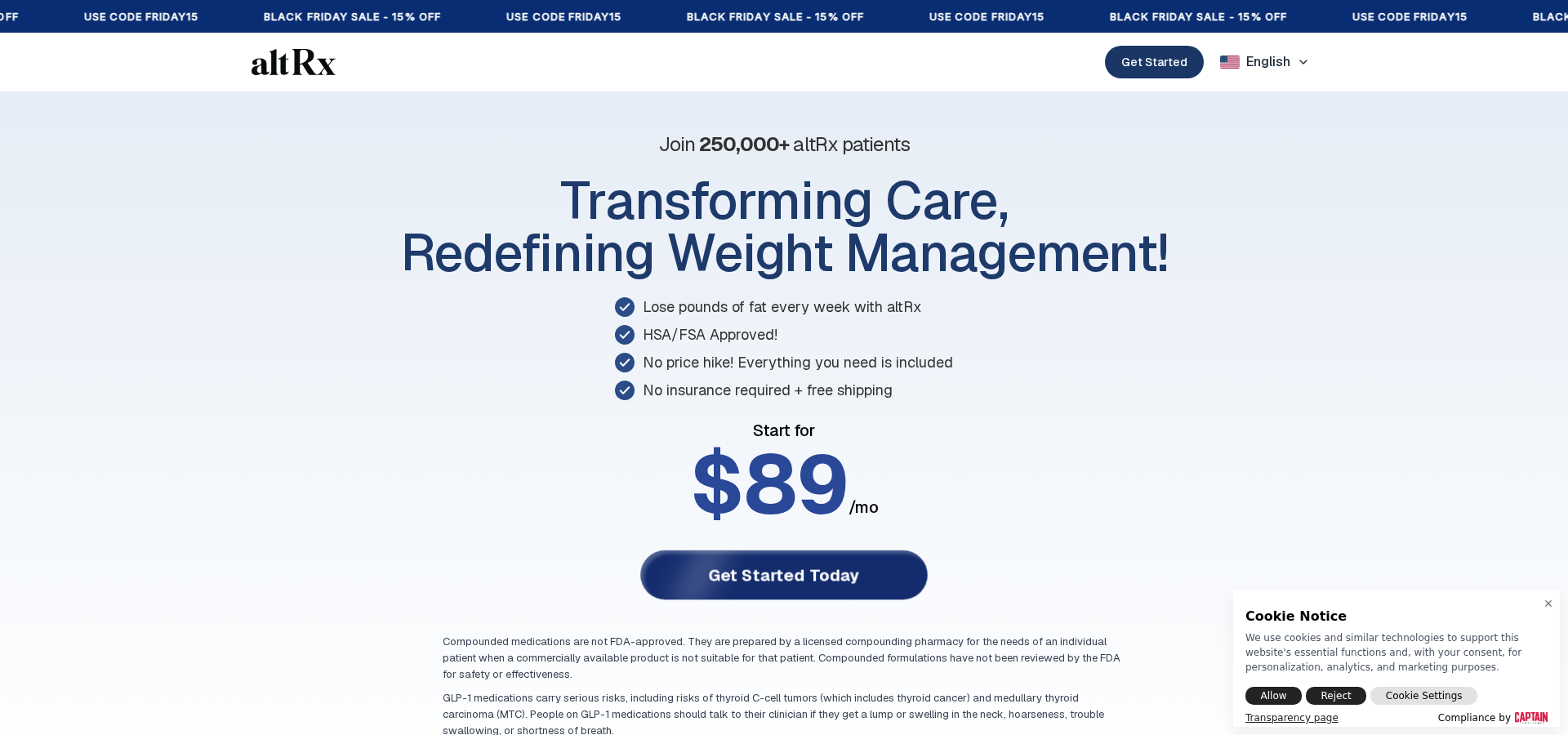
The homepage promotes a starting price of $89 per month. That figure should not be treated as a quote for every treatment or subscription option.
The financial commitment can begin before treatment
The cancellation policy says membership begins when payment is submitted. Failing to finish intake, attend a consultation, or use the services does not ordinarily qualify for reimbursement.
It also describes multi-month plans as indivisible purchases. Canceling stops future billing; it does not normally refund unused months within a paid term.
- Establish the complete upfront charge, not just the advertised monthly equivalent.
- Check medical eligibility and the provider-initiated disqualification exception.
- Allow at least 72 hours before the next billing date to cancel future charges.
- Distinguish an FDA-approved branded medication from an individually compounded preparation.
The concerns are specific, not a claim of a fictitious service
There are concrete reasons to scrutinize this offer: strict payment terms and a June 2026 FDA warning about misleading compounded-drug promotion.
Those findings do not establish that altRx is a nonexistent business or that every patient receives unsuitable treatment. The buying decision still requires more than a discount banner.
The FDA Warning, Without the Exaggeration
The FDA warning dated June 8, 2026 addressed Trinity HealthCare Supply, LLC, doing business as altRx.
The agency said website imagery suggested altRx compounded the pictured drugs when it did not. It also challenged clinically-proven promotional wording concerning compounded semaglutide and tirzepatide.
FDA described the claims as false or misleading and identified misbranding violations. The letter is not a finding that every dispensed vial was contaminated.
The current homepage does disclose that compounded medications are not FDA-approved. Readers should distinguish that present disclosure from the specific earlier conduct described in the warning.
A medication’s active ingredient can be familiar without making every preparation the same approved product. Ask which actual product your clinician proposes and which pharmacy supplies it.
Do not use a sales article to choose a dose or change prescribed treatment. Those decisions belong with a qualified clinician who knows your medical history.
How the altRx Enrollment and Billing Process Works
Step 1: A starting price attracts the appointment-weary buyer
The homepage combines its starting price with support, shipping, and patient-result claims. The overall message is that managing treatment can become simpler.
That convenience may be valuable. But a convenient enrollment process should not make a patient commit financially before understanding eligibility, treatment choices, and cancellation.
Ask whether the displayed amount is billed monthly or represents a monthly equivalent within a longer prepaid plan. Write down the amount charged today.
A discount code changes the price, not necessarily the commitment. It should never replace reading the duration and renewal date beside the purchase button.
Step 2: Payment starts the membership clock
The policy says membership begins at payment, including when the intake process has not been completed. It says resources are allocated for the member’s care.
For a customer, the consequence is important: abandoning the application is not the same as canceling an uncompleted shopping cart.
You might never receive a prescription and still need to address an active paid membership. Do not assume doing nothing will unwind the transaction.
Before payment, understand what service becomes available immediately and what happens if your circumstances prevent you from continuing.
Step 3: A clinician decides whether treatment is appropriate
The site’s disclosures identify OpenLoop Healthcare Partners, PC, and affiliated professional practices as the providers of clinical evaluation and prescribing services.
A prescription is not guaranteed. Approval is a medical decision, not something an advertised starting price should be understood to promise.
Provider-initiated medical disqualification has a specific refund exception: the current term can be refunded less a $35 service fee charged by OpenLoop.
That is not a general cancellation fee or an automatic refund for anyone who changes their mind. Ask whether your situation falls within the exception.
Step 4: The pharmacy fulfills an eligible prescription
The platform lists independently operated pharmacy partners. A recognizable platform name does not remove the need to identify the pharmacy on your own prescription.
Confirm the medication name, strength, dispensing instructions, storage requirements, and a reachable pharmacy contact. If anything looks inconsistent, contact the prescriber before using it.
Medication appearance can differ from promotional imagery. A stock picture is therefore not an adequate substitute for checking the dispensing label.
If the wrong or damaged medication arrives, report the issue promptly. The policy describes replacement handling, which is different from canceling membership because you changed your mind.
Step 5: Stopping treatment does not automatically refund the plan
The refund policy treats the subscription as a bundled service rather than a collection of separately refundable visits, shipments, or months.
Its wording is especially consequential for prepaid packages: unused months, unshipped medication, or services not accessed do not ordinarily produce a partial refund.
That creates a practical mismatch if you want to try the service briefly before committing. A lower monthly equivalent may carry a larger unrecoverable upfront payment.
A clinician advising against further treatment and a customer voluntarily discontinuing are not necessarily handled identically. Get the relevant decision documented instead of assuming.
Step 6: Cancellation must arrive before the billing cutoff
The current terms and cancellation policy both require a request at least 72 hours before the next billing date to stop that charge.
A request inside that window can leave another cycle payable under the policy. Waiting until the day before renewal is therefore a poor strategy.
Use the patient portal or published support route and request confirmation showing the effective date. A support conversation without clear cancellation wording can leave ambiguity.
Keep a copy outside the portal. If access changes later, you will still have the request, timestamp, confirmation, and relevant billing date.
Platform, Prescriber, and Pharmacy Responsibilities
The name on the marketing is not every entity involved
The current terms identify Altrx, Inc. The FDA letter names Trinity HealthCare Supply, LLC, doing business as altRx. Clinical services are attributed to OpenLoop practices.
Those names should be recorded rather than collapsed into a single presumed manufacturer. The materials checked do not explain every corporate relationship between them.
For a dispute, identify who charged the payment, who prescribed, and who dispensed. Each may hold different records and answer a different question.
A business address is not a dispensing location
The current terms give 150 East Palmetto Park Road, Suite 800, Boca Raton, Florida. The warning letter uses a separate Miami address for its recipient.
Neither address should automatically be treated as the pharmacy that prepared your prescription. Use the dispensing label to identify that facility.
Do not ship medication to a marketing-office address in an attempt to cancel. Ask the pharmacy or program for appropriate handling instructions first.
Cancellation should leave a usable written record
The policy publishes care@altrx.com and +1 607-601-6969, alongside cancellation through the online account or patient portal.
These are inspected contact routes, not the result of a test call. This article does not claim that support never answers.
When calling, follow up in writing with the date, order information, and exact request. Do not place unnecessary medical details in an ordinary payment-dispute message.
The prescription must be traceable to its actual pharmacy
The site names pharmacy partners including Red Rock, HealthWarehouse, Precision Medicine, and Triad Rx. A listed partnership does not identify your individual dispensing pharmacy.
Check the label, not a generic partner list. Verify that your prescriber can answer questions about the proposed preparation and its suitability for you.
A pharmacy’s licensing and a medication’s FDA approval are different questions. Neither should be inferred solely from a logo on a membership page.
Reviews Can Help, but the Policy Is Already Important
The Trustpilot page for altrx.com displays a notice that the profile has been removed. It does not currently provide an ordinary browsable customer-review profile.
The notice refers to platform-guideline issues. It does not establish here that a particular review was fabricated or give a current rating to quote.
Do not substitute an old screenshot or another website’s score for a live review history. Ratings and platform actions can change.
When reading complaints elsewhere, distinguish delayed support, clinical ineligibility, medication effects, and disagreement with refund terms. These are not the same problem.
A successful patient’s experience does not remove the financial commitment. Likewise, one unhappy report does not establish the outcome for every patient.
The written policy is enough to justify caution about prepaying. You do not need a dramatic accusation to recognize an arrangement that may not suit your circumstances.
Before Agreeing to a Multi-Month Plan
Ask for an itemized explanation of today’s payment, the length of the paid term, the next renewal date, and how to stop renewal.
If the program offers several medications, establish whether the quoted price covers the treatment you are considering or only an entry-level option.
Ask what happens if your clinician changes the treatment plan. A membership description should not leave you guessing whether another prescription changes the price.
Then consider the money as a commitment rather than a trial deposit. If losing access to unused months would be unaffordable, do not prepay them.
Preserve the policy version accepted at enrollment. A later webpage is useful context, but your receipt and the terms presented to you are essential records.
There is no need to rush because of a holiday promotion. An eligibility question or an unclear cancellation answer is a good reason to pause.
Clinical Help and Billing Help Are Different Conversations
A support representative may be able to cancel a membership without being qualified to explain a medication reaction. A prescriber may address treatment without controlling refunds.
Send each question to the appropriate person. For a billing issue, state the charge, date, agreement, and requested remedy. For treatment, use the clinical contact.
If the issue crosses both areas, keep the records connected. A provider’s recommendation to stop treatment may be relevant, but it should be documented accurately.
Do not describe voluntary non-use as provider-initiated disqualification. That distinction affects the published refund exception and the accuracy of any later dispute.
Similarly, stopping an injection and stopping renewal are different actions. A patient should not have to continue unwanted billing merely because treatment questions remain unresolved.
Request the cancellation confirmation while you pursue clinical answers. Avoid waiting for one department to finish before protecting the next billing deadline.
Keep sensitive medical records out of public reviews. You can describe a billing disagreement without publishing prescription photographs, identification documents, or a complete health history.
If you share documents with a payment provider, ask which details are necessary. Preserve the originals privately and redact unrelated sensitive information from copies where appropriate.
The goal is a clear, documented resolution. Neither a dramatic accusation nor an incomplete support exchange is as useful as records showing what happened.
What to Do If You Joined or Were Charged
- Find your actual paid term.
Download the receipt and identify the upfront charge, program duration, and renewal date. Do not assume an advertised monthly figure describes what was collected.
- Submit cancellation early.
Use the portal or published patient-support contact. State that you want future billing stopped and ask for the effective cancellation date in writing.
- Document medical disqualification precisely.
If a provider found you ineligible, request confirmation and ask how the current-term refund and $35 exception apply. Keep the clinical decision separate from ordinary cancellation.
- Get medication concerns to the right professional.
Contact the dispensing pharmacy or prescriber about a damaged package, incorrect label, or unexpected effects. Do not change your prescribed regimen based on a billing article.
- Keep a concise account of the problem.
Save the policy, payment record, support messages, and relevant deadlines. Explain exactly what was promised and what you received, rather than labeling every disagreement fraud.
- Ask your payment provider about unresolved charges.
If cancellation was not honored or the service materially differed from the agreement, ask about dispute options and deadlines. Outcomes depend on the circumstances and evidence.
- Monitor the next scheduled billing date.
Check that cancellation took effect. Do not assume blocking a payment also ends a contractual membership; preserve both the cancellation and any payment-provider correspondence.
Frequently Asked Questions
Is altRx a confirmed scam?
The available evidence supports scrutiny of its marketing and payment terms, not a blanket claim that the service is fictitious.
The specific concerns are meaningful even without that label.
Does the $89 price cover every treatment?
The homepage presents a starting price. Confirm your treatment option, paid term, total charge, and renewal amount before enrolling.
Can I get my money back if I never complete intake?
The policy ordinarily says no. Membership starts with payment, and non-use does not qualify for a refund. Provider-initiated medical disqualification has a separate exception.
How much notice does altRx require for cancellation?
The current terms require at least 72 hours before the next billing date. Obtain written confirmation rather than relying on an unfinished support conversation.
Are all medications available through altRx FDA-approved?
No. The site discusses compounded preparations and branded options. Ask which you would receive; compounded medications are not FDA-approved.
Is the $35 deduction charged for every cancellation?
No. The policy describes it in the provider-initiated medical-disqualification refund exception. It is not presented as a universal cancellation charge.
The Bottom Line
Do not join altRx on the $89 headline alone or prepay a long plan as though it were a refundable trial.
Understand the clinical pathway and financial commitment first. If already enrolled, document your paid term and cancel unwanted renewal before the 72-hour cutoff.

Join the discussion
0 commentsShare your experience or ask a question about this article.
Discussion
Start the conversation
Have a question or something useful to share? Add the first comment.