

An email says your entitlement to extra AHV benefits is being reviewed. It mentions changes to the rules and invites you to check your dossier.
For someone watching every monthly expense, that’s a message worth noticing. Before opening the proposed portal, look closely at where this review is supposed to lead.
Overview
A benefits review that borrows a federal identity
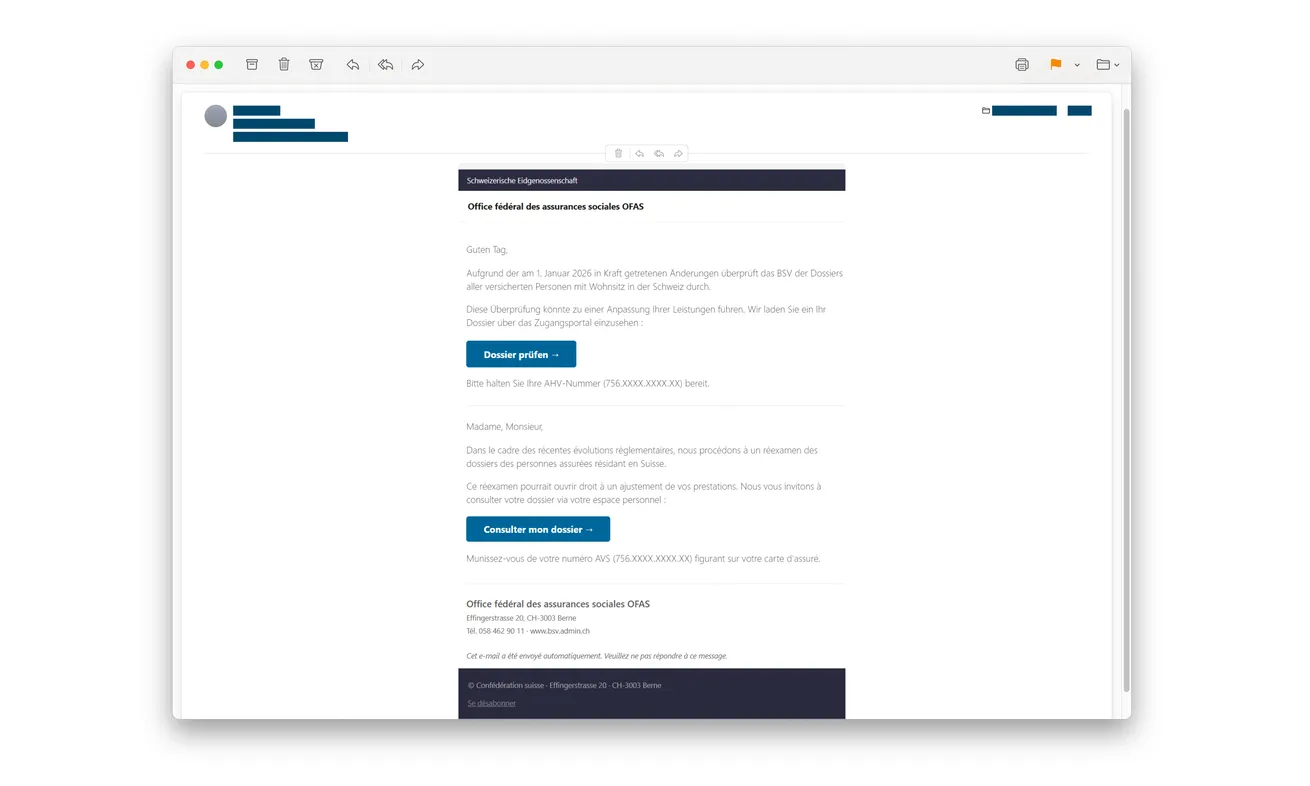
The AHV supplementary benefits email scam impersonates Switzerland’s Federal Social Insurance Office, known as BSV in German and OFAS in French.
The message refers to alleged changes taking effect in January 2026. It asks the recipient to prepare an AHV number and visit a supposed access portal.
That is the sender’s story, not confirmation that the law changed in the way it claims or that you’re entitled to a payment.
The real office is being impersonated. This warning concerns a fraudulent email and fake review website, not the legitimacy of Switzerland’s social insurance system.
The supposed payout becomes a card request
The police warning describes personal questions, an apparent monthly-benefit calculation, a request for bank details, and a reported IBAN verification failure.
The false process then offers another way to verify: provide credit-card details, including the expiry date and security code.
That’s the turn to notice. A page promising incoming benefits is creating a reason to obtain information used for card payments.
The original email above contains the bilingual invitation. The later calculation and payment-information stages are described in the campaign warning, not visible in this opening message.
Keep eligibility questions separate from this link
You don’t have to abandon a genuine benefits inquiry to avoid a phishing message. Take the question to the relevant official service through an independent route.
- An unexpected dossier email doesn’t establish that a review is underway.
- A number displayed by a fake calculator isn’t an official benefit decision.
- A claimed IBAN problem doesn’t authenticate the proposed card alternative.
- Bank information and card information are separate disclosures.
- Any information already submitted should be described accurately when seeking help.
The safest next step is to verify the review outside the email. Don’t finish the false process just to learn whether the promised amount is real.
Why “Check Your Dossier” Can Feel Less Risky Than “Pay Now”
The opening isn’t framed as an unexpected purchase. It sounds like checking whether an official record contains something important for you.
That difference lowers the apparent stakes of the first click. You may think you’re only reading information, rather than starting a financial interaction.
The request to have an AHV number ready adds another familiar detail. A personal identifier can make a website feel connected to an existing administrative file.
But a sender can ask for an identifier without possessing the real record. Asking the right kind of question doesn’t establish the right to receive the answer.
The bilingual presentation can help the message look suitable for a Swiss audience. It still doesn’t authenticate the person or organization operating the link.
Likewise, printed agency details are easy to reproduce. A correct-looking footer isn’t proof that the genuine federal office sent the email.
Don’t spend all your effort judging its visual polish. The more useful test is whether the claimed review can be confirmed through an official channel you choose yourself.
If you already deal with an office about benefits, use its established contact details. Don’t replace that relationship with an unsolicited portal invitation.
How the AHV Supplementary Benefits Email Scam Works
Step 1: The message creates a reason to revisit your entitlement
The email claims a rules change has prompted a review. That gives the reader a reason to act even if no application was recently submitted.
It can also make someone worry about missing money they’re allowed to receive. The invitation sounds helpful rather than threatening.
Treat the alleged policy change as something to check, not something the email has proved. You don’t need to follow its link to ask an official question.
A real change affecting benefits should be investigated through legitimate services. This message doesn’t become genuine merely because changes sometimes occur.
Step 2: A copied portal asks about your circumstances
The linked website imitates the office’s appearance and leads the visitor through a purported review. Personal questions make that review feel substantive.
The danger isn’t limited to the final card form. Information about your identity and circumstances may already have been supplied earlier.
If you stopped at this stage, record which categories you shared. Don’t keep answering because the site says only a few questions remain.
A progress indicator measures what the website chooses to show. It doesn’t establish that an authorized official is examining your file.
Step 3: A calculation makes the promised payment feel earned
The fake process displays an apparent entitlement to a monthly supplement. That gives the earlier questions a satisfying-looking result.
Now the reader isn’t simply hoping for money. The screen appears to have calculated that money is due.
A neat-looking calculation can hide the fact that nobody has verified the website. The next request builds on the confidence that number creates.
Don’t plan around the amount or pass it to relatives as a confirmed benefit. First ask the appropriate official service whether any real decision exists.
Step 4: Bank details are requested for the supposed payout
The page next asks for a bank connection to receive the money. That appears to fit the expectation created by the calculation.
Receiving a payment can legitimately involve account information in the right context. The issue here is that the supposed review portal is fraudulent.
Don’t use the relevance of a field as proof of the website’s identity. An impersonator can ask questions that sound appropriate to its disguise.
If you entered an IBAN, tell your bank what happened. Explain the actual disclosure rather than describing it as a card payment if no card was supplied.
Step 5: A claimed verification failure opens the card form
The site reports that the IBAN check failed. It presents a credit card as the alternative way to complete verification.
This uses a familiar frustration: you’ve nearly finished, but one technical problem remains. The offered workaround appears to preserve the benefit you just saw.
Don’t accept the workaround. A failure message controlled by the same site isn’t an independent bank finding.
Card expiry and security-code requests create a different financial exposure. Supplying them doesn’t establish an entitlement or fix a genuine benefits application.
What the Real Federal Office Says
BSV’s own fraud warning says it does not ask people to confirm personal information such as an AHV number by email or telephone.
It also says the office doesn’t demand money from insured people or issue AHV certificates or cards. Those are useful boundaries when checking impersonating approaches.
Don’t stretch that warning into a rule that no genuine benefits office can ever need information. The identity, purpose, and channel of a request still matter.
If you’re pursuing a real application, continue through the office responsible for it. Ask that office to clarify an unexpected request using previously verified details.
You can describe the suspicious message without sending your AHV number to another unknown address. Genuine support can tell you how to submit sensitive material securely.
Be careful with search results while finding help. Prefer an official address from established paperwork or an independently verified government source.
Don’t rely on the fake email’s own contact footer to resolve the dispute. It is part of the material you’re trying to authenticate.
A False IBAN Error Doesn’t Mean Your Bank Account Is Broken
After a screen says verification failed, it’s natural to focus on correcting the number. That can distract you from questioning the screen itself.
Don’t keep trying different accounts or ask a relative for a card to make the form accept something. That only broadens the potential exposure.
Your bank can help assess information you’ve already shared. The fraudulent page cannot reliably diagnose the status of your actual banking relationship.
Keep the supposed benefit and the alleged error in the same report. Together, they explain why a card request appeared in what looked like a payout process.
If a caller later mentions that error, don’t treat the reference as proof they’re from the bank. They may simply be repeating details from the interaction.
Contact the bank independently before discussing codes, credentials, or a new payment. An incoming call doesn’t become trustworthy because its story sounds familiar.
The immediate objective is to protect disclosed information, not to make the fake portal display success.
Helping a Parent or Relative Check the Message
Start by asking what they saw and what they entered. Avoid leading with blame or a demand to prove they should have recognized the scam.
The promise concerns money they may genuinely need. A patient explanation is more useful than dismissing the entire subject of supplementary benefits.
Separate two conversations: checking legitimate eligibility and responding to the fake website. They can still seek genuine help without returning to this link.
Help them find an official contact, but don’t collect their full financial information yourself. Let the account holder handle sensitive details through the appropriate secure channel.
If a card was shared, prioritize the issuer call. Questions about entitlement can be addressed once the immediate exposure has been reported.
Keep a short timeline together. Include the initial email, the apparent calculation, the IBAN message, and whether a card or code was later supplied.
That account gives support a clearer starting point than saying only that a relative clicked something about a pension.
What to Do if You Have Fallen Victim to This Scam
-
Abandon the false review. Close the portal without completing another verification or trying a relative’s card.
If you only received the message, report it as phishing. Its arrival doesn’t establish that your real benefits record or bank account was accessed.
-
Tell your bank what information was supplied. Distinguish an IBAN and personal details from a complete card number or authentication approval.
Use the bank’s established app, contact number, or branch information. Don’t contact an apparent bank representative through the dossier website.
-
Secure any exposed card. Ask the issuer about blocking or replacing it and checking attempted transactions as well as completed charges.
If a code was entered or a bank request approved, include that fact. Record any displayed amount or merchant without guessing details you don’t remember.
Ask which dispute procedure and deadlines apply to actual unwanted payments. The promised benefit amount isn’t a substitute for your financial records.
-
Protect credentials if the form collected them. Change affected passwords through the genuine services and address reuse where necessary.
Don’t reset unrelated accounts simply because an AHV number was disclosed. Give the relevant institution an accurate description and ask which protective steps fit.
-
Save the invitation and the sequence. Keep the message, destination address, existing screenshots, and relevant bank alerts in a private location.
Don’t post a full dossier, identity number, IBAN, or card details publicly while asking for reassurance. Redact sensitive material before warning others.
-
Check genuine benefits questions independently. Contact the responsible official service through verified details if you need to know whether a real review or payment exists.
Make clear that the email may be fraudulent. Don’t forward its conclusions as though they were a confirmed award or instruction from an authority.
-
Assess any additional device activity. If you downloaded a file or installed software during the encounter, treat that as a separate security concern.
Malwarebytes can help examine suspicious software. AdGuard may reduce exposure to some harmful sites and advertising, but neither verifies benefits eligibility or secures an exposed card.
The documented card lure doesn’t mean every reader’s device is infected. Match cleanup to what actually happened.
-
Report the impersonation and any loss. Use official cyber-reporting information and contact your local police where a formal complaint is needed.
Cybercrimepolice’s incident channel isn’t itself a formal criminal complaint. Preserve the bank’s reference if you’re reporting financial activity.
Don’t pay someone who promises to release the benefit or recover the money after another verification charge. Leave this process behind.
Frequently Asked Questions
Is the real BSV offering extra benefits through this email?
No. The documented email impersonates the office. Check any real entitlement question through the appropriate official service, not the linked dossier page.
Does the claimed January 2026 rule change prove anything?
No. It is part of the email’s explanation. The message doesn’t establish an actual legislative change or a resulting right to a payment.
Why does the fake portal calculate a monthly amount?
The calculation makes the promised payout feel concrete. A number displayed by an untrusted site isn’t an official decision about your eligibility.
Should I give a card because the IBAN check failed?
No. That is the documented escalation in this scam. Stop and ask your bank about any information already disclosed.
What if I entered an IBAN but stopped before the card form?
Describe that exposure to your bank and watch for follow-up contacts using your details. Don’t continue the fake review to see whether it eventually works.
Can I still ask about legitimate supplementary benefits?
Yes. Avoiding this fraudulent link doesn’t require abandoning a genuine inquiry. Reach the responsible service through independently verified contact information.
The Bottom Line
Don’t complete the AHV supplementary benefits review through this scam email. Its failed-IBAN story is used to obtain card information, not confirm a genuine award.
If you shared banking details, a card, or an approval, contact your financial institution promptly. Check legitimate benefits questions separately through official services.

Join the discussion
0 commentsShare your experience or ask a question about this article.
Discussion
Start the conversation
Have a question or something useful to share? Add the first comment.