

Every bull run, every market rally, and every moment of excitement around crypto brings a familiar wave of deception. The promise is always tempting. Free Bitcoin. Free Ethereum. A once in a lifetime giveaway personally backed by Elon Musk.
The sites look polished. The videos feel real. The logos of Tesla and SpaceX inspire instant trust. The countdown timer adds urgency. And the message is simple: send a small amount of crypto and receive double in return.
It sounds incredible because it is. And yet, thousands of people fall for it every single month.
This article exposes the truth behind Elon Musk BTC ETH giveaway scam sites, how these scams operate, why they are so effective, and exactly what to do if you have been targeted or already lost funds.
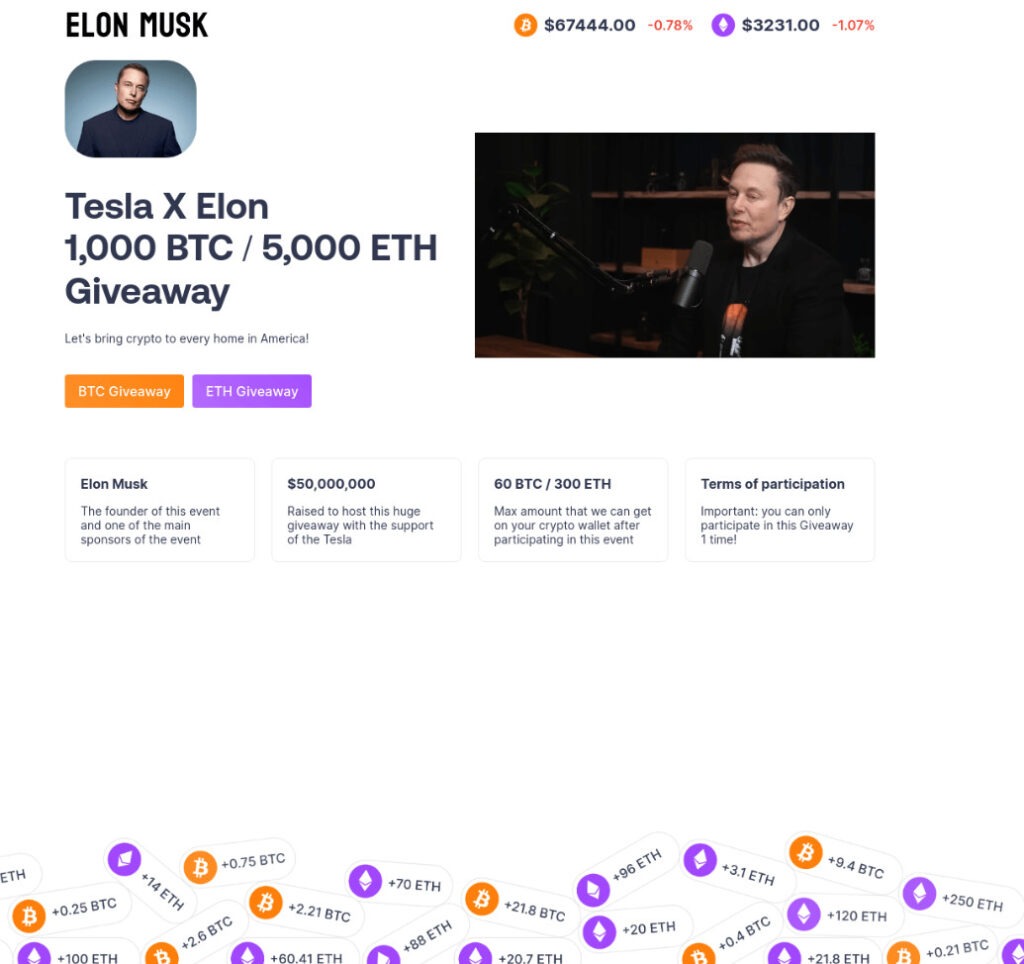
Scam Overview
The Elon Musk BTC ETH giveaway scam is one of the longest running and most profitable crypto scams ever created. It has evolved for years, adapting to new platforms, new technologies, and new social media trends.
At its core, the scam relies on impersonation, authority, urgency, and greed. But the execution is far more sophisticated than most people expect.
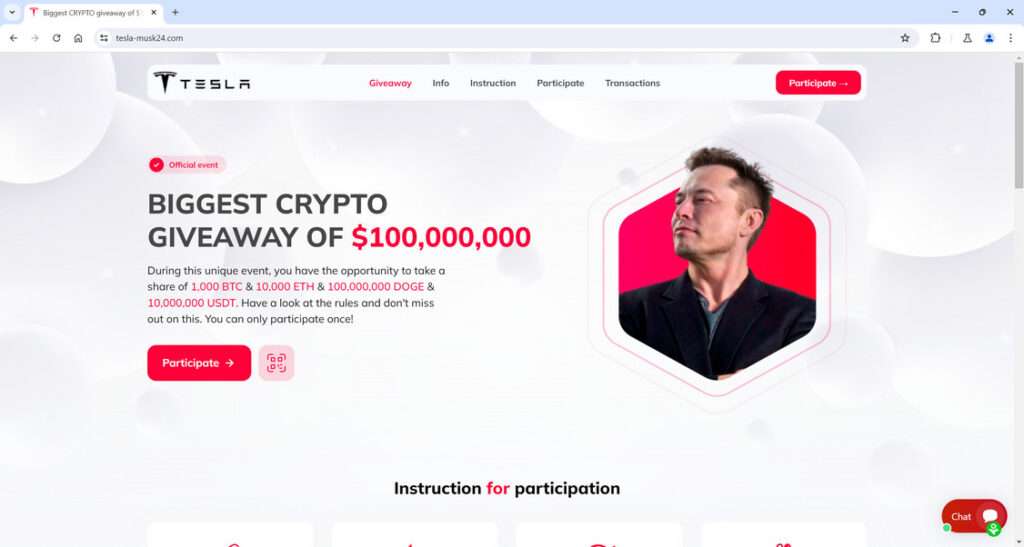
What These Scam Sites Claim
Most scam pages follow a familiar formula. They claim that Elon Musk is hosting a limited time cryptocurrency giveaway to celebrate:
- A Tesla milestone
- A SpaceX launch
- A new X platform feature
- A crypto adoption initiative
- The New Year or a major holiday
- A personal announcement or interview
Visitors are told that Elon Musk is giving away between:
- 300 BTC to 1,000 BTC
- 3,000 ETH to 5,000 ETH
- Sometimes even more, depending on the fake campaign
The scam page often claims that tens of millions of dollars have already been raised or distributed, reinforcing the illusion of legitimacy.
Musk26.com and Similar Scam Domains
Musk26.com is only the latest domain in a very long list of fake Elon Musk giveaway websites.
Other common patterns include:
- MuskEvent.com
- TeslaBonus.org
- SpaceX-Give.net
- ElonCrypto.live
- TeslaXPromo.com
These domains are intentionally short, clean, and authoritative. Many are registered only days or weeks before the campaign goes live. Once the scam is exposed or reported, the domain disappears and a new one replaces it.
The cycle repeats endlessly.
Visual Tricks That Build Trust
Scam sites invest heavily in design. Many look better than legitimate crypto platforms.
Common visual elements include:
- High quality photos of Elon Musk
- Embedded videos of interviews or podcasts
- Tesla and SpaceX logos placed prominently
- Fake live transaction feeds showing incoming and outgoing BTC and ETH
- Progress bars claiming that most of the giveaway funds are already distributed
- Wallet balances that appear to update in real time
None of this is real.
The transaction feeds are simple animations. The progress bars are static scripts. The wallets displayed are controlled entirely by the scammers.
Deepfake AI Videos and Fake Livestreams
One of the most dangerous evolutions of this scam is the use of AI generated deepfake videos.
Victims often encounter:
- YouTube livestreams showing Elon Musk speaking about crypto
- X videos allegedly posted from verified accounts
- Facebook ads with convincing video clips
- Reused podcast footage with altered audio
In many cases, the video shows Elon Musk speaking naturally, with realistic voice patterns and facial movements. The audio is generated using AI voice cloning. The result is frighteningly convincing.
These videos often say things like:
- I am doubling all crypto sent today
- This is a thank you to the community
- Send BTC or ETH and receive double back
- This is a limited time event
No such giveaway has ever existed.
Why This Scam Keeps Working
Despite years of warnings, this scam continues to succeed for several reasons:
- Elon Musk is widely associated with crypto
- Tesla previously accepted Bitcoin
- Musk has publicly discussed Bitcoin and Ethereum
- Social media platforms allow sponsored ads
- Crypto transactions are irreversible
- Victims feel embarrassed and stay silent
The combination of authority and urgency disables critical thinking. Many victims act within minutes, not hours.
The Scale of the Losses
Exact numbers are hard to calculate, but conservative estimates suggest:
- Tens of millions of dollars lost annually
- Thousands of individual victims worldwide
- Losses ranging from $100 to over $250,000 per victim
- Funds rarely recovered
Once the crypto is sent, it is gone forever.
How The Scam Works
Understanding how the Elon Musk BTC ETH giveaway scam works step by step is essential. This is not a single trick, but a carefully engineered funnel designed to guide victims from curiosity to loss in minutes.
Step 1: The First Contact
Most victims encounter the scam through social media.
Common entry points include:
- Sponsored ads on Facebook
- Promoted posts on X
- YouTube livestreams in recommended feeds
- Fake comments under real crypto videos
- Links shared in Telegram or Discord groups
The message is always urgent and emotionally charged.
Examples include:
- Elon Musk is giving away 5,000 ETH today
- Limited Tesla crypto event happening now
- Double your BTC in 10 minutes
- Exclusive giveaway for crypto holders
The goal is to trigger curiosity and urgency simultaneously.
Step 2: The Deepfake or Endorsement Illusion
Once clicked, victims are shown proof.
This proof usually takes the form of:
- A video of Elon Musk speaking
- Screenshots of supposed tweets
- Fake endorsements from Tesla or SpaceX
- Logos and branding that look official
The deepfake videos are particularly dangerous. They often show Musk in a podcast studio, talking naturally about innovation, followed by a crypto pitch.
Victims trust what they see and hear.
Step 3: The Professional Looking Scam Website
The website itself is designed to remove doubt.
Key elements include:
- Clean layout with modern design
- Fast loading pages
- SSL certificates showing a secure connection
- Real time price tickers for BTC and ETH
- Fake statistics like total funds distributed
- Clear call to action buttons like BTC Giveaway or ETH Giveaway
Everything feels polished and legitimate.
Step 4: The Simple Instructions Trap
Scammers know that complicated instructions create hesitation.
Instead, they present three simple steps:
- Log in to your crypto wallet
- Send BTC or ETH to the displayed address
- Receive double within 5 to 10 minutes
The simplicity lowers defenses. Victims think there is little to lose.
Step 5: The Wallet Address Illusion
The wallet address shown on the page is controlled by the scammers.
Often, victims see:
- Multiple wallet addresses rotating
- QR codes for easy scanning
- Messages claiming limited capacity per wallet
- Fake confirmations of previous transactions
Some scam sites even display the victim’s wallet address after sending, creating the illusion that the system has detected the transfer.
This is all fake.
Step 6: The Disappearing Act
Once the crypto is sent, nothing happens.
Victims may see:
- A fake loading animation
- A message saying verification is in progress
- A claim that a minimum amount was not met
- Requests to send more crypto to unlock the return
This is where some victims lose even more.
Eventually, communication stops. The site may go offline. The video stream ends. The ad disappears.
The scam is complete.
Step 7: Laundering the Stolen Crypto
Behind the scenes, scammers move fast.
Funds are typically:
- Split across multiple wallets
- Sent through mixing services
- Converted across chains
- Routed through decentralized exchanges
- Eventually cashed out or held
This makes tracing and recovery nearly impossible.
Psychological Manipulation Behind the Scam
This scam succeeds because it exploits human psychology, not technical weakness.
Authority Bias
Elon Musk is one of the most influential figures in technology and finance. His name alone creates instant trust.
People assume:
- He does not need money
- He supports innovation
- He rewards early adopters
Scammers weaponize that trust.
Scarcity and Urgency
Countdown timers and limited availability messages pressure victims into acting quickly.
Examples include:
- Only 5 minutes left
- Giveaway ending soon
- Wallet capacity almost full
Urgency prevents research.
Social Proof
Fake transaction feeds show other people receiving BTC and ETH.
Victims think:
- Others are getting paid
- This must be real
- I should act now
Even experienced users can be fooled.
Fear of Missing Out
Crypto culture is built around early opportunity.
Scammers exploit that mindset perfectly.
What To Do If You Have Fallen Victim to This Scam
If you have already sent crypto to an Elon Musk giveaway scam site, the situation is painful but there are still important steps to take.
1. Stop Sending Funds Immediately
Do not send more crypto, no matter what the site claims.
There is no verification fee.
There is no minimum requirement.
There is no unlock payment.
Sending more only increases your loss.
2. Secure Your Wallets
Immediately:
- Move remaining funds to a new wallet
- Revoke smart contract permissions
- Change passwords where applicable
- Enable hardware wallet protections if available
Assume your wallet interaction history may be monitored.
3. Document Everything
Save:
- Website URLs
- Wallet addresses used
- Transaction hashes
- Screenshots of the site
- Videos or ads that led you there
- Dates and amounts sent
This information matters.
4. Report the Scam
Report the incident to:
- The social media platform where you saw the ad
- Chain analysis services if applicable
- Crypto exchanges if funds passed through them
- National cybercrime reporting portals
While recovery is unlikely, reporting helps shut down future scams.
5. Warn Others
Consider sharing your experience anonymously on forums or scam reporting sites.
Your story may save someone else.
6. Accept the Reality Calmly
Crypto transactions are irreversible. Most victims do not recover funds.
This is not your fault. These scams are designed to deceive intelligent people.
Learn from it and move forward.
How To Spot Elon Musk Giveaway Scams Instantly
Elon Musk giveaway scams follow repeatable patterns. Once you know what to look for, they become easy to identify within seconds. This section breaks down every major red flag in detail so you can spot these scams instantly, even when they look highly convincing.
The “Send Crypto First” Rule
This is the most important rule, and it never fails.
If a website, video, livestream, or message tells you to send BTC or ETH first in order to receive more later, it is a scam. Always.
Legitimate giveaways do not work this way. There is no such thing as a crypto event where you must transfer funds to unlock rewards.
Scammers rely on the irreversible nature of blockchain transactions. Once sent, your crypto is gone.
Unrealistic Giveaway Amounts
Scam sites often claim giveaways like:
- 500 BTC
- 1,000 BTC
- 5,000 ETH
- $50,000,000 in crypto
These numbers are intentionally extreme. They create excitement and overwhelm rational thinking.
No individual, including Elon Musk, distributes crypto at this scale through random websites. There is no economic or legal reason to do so.
Urgency and Countdown Timers
Urgency is a manipulation tactic, not a feature.
Common phrases include:
- Giveaway ending in 10 minutes
- Only a few spots left
- Wallet capacity almost full
- Last chance to participate
Countdown timers are almost always fake. Refreshing the page often resets them. Their purpose is to prevent you from researching or thinking critically.
Deepfake Videos and Edited Interviews
Modern Elon Musk scams frequently use AI-generated videos or altered footage.
Warning signs include:
- Perfect audio with unnatural phrasing
- Slight lip sync mismatches
- Reused podcast visuals with new audio
- Vague statements about crypto adoption
- Direct instructions to send funds
Even if the video looks real, the message matters more than the visuals. Elon Musk does not instruct people to send crypto to wallet addresses.
Tesla and SpaceX Logo Abuse
Scam sites commonly display:
- Tesla logos
- SpaceX branding
- Claims of corporate sponsorship
- Mentions of official partnerships
None of this is legitimate.
Tesla and SpaceX do not host public crypto giveaways, and they do not ask users to send cryptocurrency through external websites.
Logos are easy to copy. Their presence proves nothing.
Fake Live Transaction Feeds
One of the most convincing tricks is the fake transaction feed.
You may see:
- BTC and ETH amounts scrolling on the screen
- Wallet addresses receiving payouts
- Messages showing people getting double returns
- Animated confirmations of successful transfers
These are pre programmed animations. They are not connected to the blockchain.
Real blockchain explorers exist. Scam sites never link to them.
Wallet Addresses Displayed on the Website
Any website that directly displays wallet addresses and asks you to send crypto is immediately suspicious.
Red flags include:
- QR codes for BTC or ETH payments
- Multiple wallet addresses rotating
- Claims that each user gets a unique address
- Messages saying minimum amount required
No legitimate giveaway operates like this.
Claims of “Doubling” or “Matching” Crypto
Doubling crypto is mathematically and economically absurd.
Scam language often includes:
- Send 0.1 BTC, receive 0.2 BTC
- Send 1 ETH, receive 2 ETH
- We match every transaction
- Instant automatic returns
This is not how crypto works. There is no system that automatically doubles funds without risk or cost.
Ads and Links Instead of Official Announcements
Legitimate announcements from public figures appear on:
- Verified social media accounts
- Official company websites
- Press releases covered by major outlets
Scams appear as:
- Sponsored ads
- Random livestreams
- Comment spam
- Links shared by unknown accounts
If you see the offer only through ads or comments, that is a major red flag.
Poor Grammar Mixed With Professional Design
Many scam sites combine:
- Polished layouts
- Expensive visuals
- Subtle grammar mistakes
- Awkward phrasing
- Generic corporate language
This combination is common in international scam operations. Design quality does not equal legitimacy.
Requests for Additional Payments After Sending
Some victims are told:
- You need to send more to unlock the payout
- Minimum amount not met
- Network fee required
- Verification payment needed
This is a second layer of the scam. There is no payout waiting. Sending more only increases losses.
No Official Terms, Legal Pages, or Verifiable Company Info
Scam sites often lack:
- Real company registration
- Physical addresses
- Verifiable contact information
- Legal disclaimers that can be traced
If terms exist, they are vague, copied, or meaningless.
Domain Names That Feel “Event Based”
Scam domains are often:
- Newly registered
- Named after events or years
- Designed to feel temporary
Examples include names referencing giveaways, bonuses, or special campaigns.
Legitimate companies do not launch major financial events on throwaway domains.
Comment Moderation and Disabled Feedback
On videos or livestreams, scammers often:
- Disable comments
- Delete skeptical messages
- Pin fake success stories
- Ban users asking questions
This controlled environment prevents warnings from spreading.
The One Rule That Never Fails
If you remember nothing else, remember this:
No one will ever give you free crypto in exchange for sending crypto first.
Not Elon Musk.
Not Tesla.
Not SpaceX.
Not any legitimate organization.
If that condition exists, it is a scam. Every single time.
Learning these patterns turns a dangerous scam into something obvious. The goal is not to memorize every trick, but to recognize the behavior behind them. Once you do, these scams lose all power.
Frequently Asked Questions
Is Elon Musk actually giving away Bitcoin or Ethereum?
No. Elon Musk has never run a BTC or ETH giveaway where people must send crypto first to receive more back. Any website, video, or ad claiming that Elon Musk is doubling crypto or giving away thousands of BTC or ETH is a scam.
There are no exceptions to this rule.
Why do these giveaway scams use Elon Musk specifically?
Elon Musk is strongly associated with technology, innovation, Tesla, SpaceX, and crypto discussions. Scammers use his name and image because it instantly creates trust and credibility, especially among crypto users who already follow his public statements.
This is a classic impersonation tactic.
Are the videos of Elon Musk promoting these giveaways real?
No. Most videos are either old footage taken out of context or AI-generated deepfake videos. Modern deepfake technology can realistically clone Elon Musk’s voice and facial movements, making the videos appear authentic even though the message is fake.
If a video asks you to send crypto, it is not real.
Why do these scam sites look so professional?
Scammers invest heavily in design because it increases success rates. The sites often include:
- High quality layouts
- Real time price tickers
- Fake transaction feeds
- Tesla and SpaceX logos
- Countdown timers and progress bars
Professional appearance does not equal legitimacy.
What happens to the crypto after it is sent?
Once you send BTC or ETH to the wallet address shown on the scam site, the funds are immediately controlled by the scammers. They are often split across multiple wallets, mixed, bridged across chains, or routed through decentralized exchanges.
In almost all cases, the funds are gone permanently.
Can I get my crypto back if I sent it?
In most cases, no. Cryptocurrency transactions are irreversible. Unlike banks or credit cards, there is no chargeback mechanism. While you should still report the incident, recovery is extremely rare.
Anyone claiming they can recover your funds for a fee is likely running a secondary scam.
Why do the sites say people are receiving payouts?
The transaction feeds and payout confirmations shown on these sites are fake animations. They are not connected to real blockchain activity. Their only purpose is to create social proof and pressure victims into sending funds.
No real payouts are happening.
Are there any real crypto giveaways that require sending crypto first?
No legitimate giveaway ever requires participants to send crypto in order to receive more. Any promotion that follows a send first, receive later model is a scam by definition.
Real giveaways never work this way.
Why do scammers keep changing domain names?
Scam domains are frequently shut down or reported. Scammers simply register new domains and relaunch the same site under a different name. Domains like Musk26.com are disposable tools, not long-term brands.
This constant rotation helps them avoid detection.
How can I protect myself from these scams in the future?
Follow these basic rules:
- Never send crypto to receive more crypto
- Be skeptical of celebrity endorsements
- Avoid links from ads or comments
- Verify information through official channels
- Assume urgency is manipulation
If something sounds too good to be true, it always is.
Where should I report Elon Musk giveaway scams?
You should report them to:
- The social media platform where you saw the ad or video
- Your national cybercrime reporting agency
- Cryptocurrency exchanges if wallets are involved
- Online scam reporting websites
Reporting helps reduce future victims, even if recovery is unlikely.
Why do smart people still fall for these scams?
These scams are designed to bypass logic and target emotions. They exploit trust, urgency, authority, and fear of missing out. Falling victim does not mean someone is careless or uneducated.
It means the scam worked as intended.
What is the single biggest red flag to remember?
If you are asked to send crypto first, it is a scam. Always.
No exceptions.
The Bottom Line
Elon Musk BTC ETH giveaway scam sites are not giveaways. They are highly engineered theft operations designed to exploit trust, authority, and emotion.
Musk26.com is only the latest example in a long chain of fraudulent domains that promise impossible returns and deliver irreversible losses.
No matter how real the video looks.
No matter how polished the site appears.
No matter how convincing the numbers seem.
Elon Musk is not doubling your crypto.
Tesla is not giving away Bitcoin.
SpaceX is not distributing Ethereum.
If a site asks you to send crypto first, it is a scam. Every time.
Stay skeptical. Stay informed. And protect your assets.









I hate bad people that thinks about them and only them and i hate trump and elon being friends and everyother so call friends to trump i wish that all those bad people could be wiped out of usa and sent to irack who talk is sara that bts is in love with army doing this bts be better presents then trump