It is written in a tone that sounds calm, responsible, and just technical enough to feel “real.” It warns you about an Apple Pay transaction you do not recognize, then adds a scary twist about your Apple ID being placed into some kind of “secure isolation state.”
And right when your brain starts trying to decode the jargon, the text offers a single, simple path forward.
Call Apple Support immediately.
That is the moment the scam is counting on. Not because you are careless, but because you are human. When something threatens your money and your identity at the same time, most people want one thing, fast … make it stop.
Scam Overview
“Apple Threat Notifications” scam texts are a growing style of fake security alert that pretends to come from Apple, usually claiming your Apple ID has been flagged for suspicious activity, locked for security, or restricted due to an unusual Apple Pay charge.
The message often looks more advanced than older Apple ID scams. Instead of plain language like “Your account was hacked,” it may use dense, official-sounding security wording, including references to cryptographic checks, authentication systems, integrity protocols, and “trust anchor signatures.”
That language is not there to inform you.
It is there to intimidate you, impress you, and rush you.
What the scam text typically says
A common variant looks like this (paraphrased in structure and intent):
It asks, “Is this your recent purchase?”
It claims your Apple ID is in a restricted state due to a security failure
It mentions “mandatory cryptographic synchronization” or similar technical terms
It lists a large charge, like $387.61, tied to Apple Pay
It names a location to make it feel real, like Orlando, Florida
It says financial authorizations are suspended for safety
It suggests that if the purchase was legitimate, it will process in 24 hours
If not, it urges you to call “Apple Support” immediately at a phone number
On the surface, it reads like a high-level security system protecting you.
Under the surface, it is a classic phone-based social engineering attack.
Why “Apple Threat Notifications” is such a powerful name
The phrase “threat notification” feels official. It sounds like a structured security program, not a random alert.
It also borrows credibility from real-world concepts. Apple does send legitimate security notifications in certain cases, and Apple also provides real fraud protections for Apple Pay and App Store purchases.
Scammers know this.
So they build a message that feels like it fits into a real Apple process, while quietly steering you away from the only place that matters.
Your actual Apple account settings, your actual purchase history, and Apple’s official support channels that you access independently.
The goal is not the charge, it is the call
The most important thing to understand is this: the “purchase” is often fictional.
Sometimes scammers send these texts to people who have no Apple Pay set up at all. Sometimes they send them to Android users. Sometimes they send them to phone numbers that are not tied to an Apple ID.
They do not need the details to be accurate.
They need the message to feel plausible enough that a small percentage of people call.
That call is where the scam becomes dangerous.
Why the technical jargon is a trap, not a clue
In the variant you shared, the text uses phrases like:
“mandatory cryptographic synchronization”
“secure isolation state”
“trust anchor signatures”
“integrity protocols”
“thorough audit”
To most people, that reads like something a real security team might write.
But that is also the problem.
When a message feels too technical, many readers assume they are not qualified to evaluate it. So they do the “safe” thing.
They call the number.
This is the same psychological trick used in other high-jargon scams. Confuse the target, then offer a single action that feels like the responsible choice.
What happens when you call the scam “Apple Support” number
The phone number in these texts does not reach Apple.
It typically reaches a scam call center or an individual scammer who is trained to impersonate support staff. They may introduce themselves with a name, an employee ID, and a case number.
They will sound confident. They will often sound patient.
Then they will push you toward one of these outcomes:
Getting your Apple ID credentials or one-time verification codes
Getting remote access to your device or computer
Getting you to move money, “verify” a payment method, or “secure” funds
Getting you to buy gift cards and share the codes
The exact script changes based on what you say and what device you use, but the end goal is always the same.
Access, money, or both.
The scam often blends a real Apple URL with a fake phone number
Some versions include a real Apple domain such as getsupport.apple.com or support.apple.com.
That does not mean the message is legitimate.
It is a credibility booster, included to keep you from dismissing it too quickly. Scammers know that many people have learned, “Do not click random links.”
So they present a real link and make the phone call the primary action.
This is a subtle shift, and it works.
Common themes across Apple Threat Notifications scam texts
Even when the wording changes, the scam usually includes these elements:
A trigger event involving money, usually $200 to $500
A “security action” like suspending authorizations or locking the Apple ID
A countdown, like “process within 24 hours”
A sense that you must act fast to prevent damage
A phone number presented as Apple Support
Technical jargon that feels authoritative
Reassuring language like “Your digital safety is our top concern”
That combination is carefully designed. It creates fear, then offers comfort, and then funnels you into the scammer’s preferred channel.
Who is most at risk
Anyone can fall for a well-timed, well-written scam, but these texts are especially effective against:
People who use Apple Pay or store cards in Wallet
People who have subscriptions and recurring Apple charges
Busy parents, professionals, or caregivers who do not have time to investigate
People who have experienced fraud before and respond quickly to alerts
Anyone who feels anxious about account security or identity theft
Scammers do not need to “hack Apple.”
They only need to catch you at the wrong moment.
How this scam differs from simpler Apple ID phishing texts
Older scams were often sloppy, with broken grammar and obvious fake links.
These “Apple Threat Notifications” texts try to feel smarter.
They may include:
Structured formatting
A reference number
Security-sounding terminology
A “process timeline”
Soft, caring language like “With care”
That makes them feel more official, and therefore more dangerous.
Because the more believable the text, the faster people move.
Quick red flags that strongly suggest it is a scam
If you are scanning a message like this, look for these warning signs:
A text telling you to call a phone number for Apple Support
A threat of restricted access unless you act quickly
Technical jargon that sounds dramatic but provides no verifiable details
A claimed charge you cannot confirm inside your Apple purchase history or bank statement
Pressure to stay on the phone while “fixing” the issue
Requests to install remote access tools or screen-sharing apps
Requests for Apple ID verification codes
Any suggestion of gift cards as a security or verification step
Real security processes give you ways to confirm what is happening using your account.
Scams give you a phone number and urgency.
That difference matters.
How The Scam Works
Below is the typical playbook behind Apple Threat Notifications scam texts. The steps are written in the order most victims experience them, and the details are intentionally broken down into smaller chunks so you can see how the pressure builds.
1. The scammer sends a “smart-sounding” alert that creates instant doubt
The first goal is not to prove anything.
It is to make you uncertain.
The text claims something is wrong with your Apple ID. It includes a big number, like $387.61, because that is high enough to hurt, but low enough to feel believable.
Then it adds one or two technical lines about cryptography or authentication, which makes it feel like a real system detected a real problem.
Now you are stuck in a mental loop:
“Is this real? It sounds real. What if it is real?”
That loop is exactly where scammers want you.
2. The message offers a “safe” option that is actually the trap
Once you are worried, the text gives you a simple choice:
If it was you, do nothing.
If it was not you, call Apple Support immediately.
That structure feels reasonable. It also feels urgent.
But notice what it does: it pushes you away from verifying the situation inside your account, and toward a live phone conversation where the scammer has control.
This is the funnel.
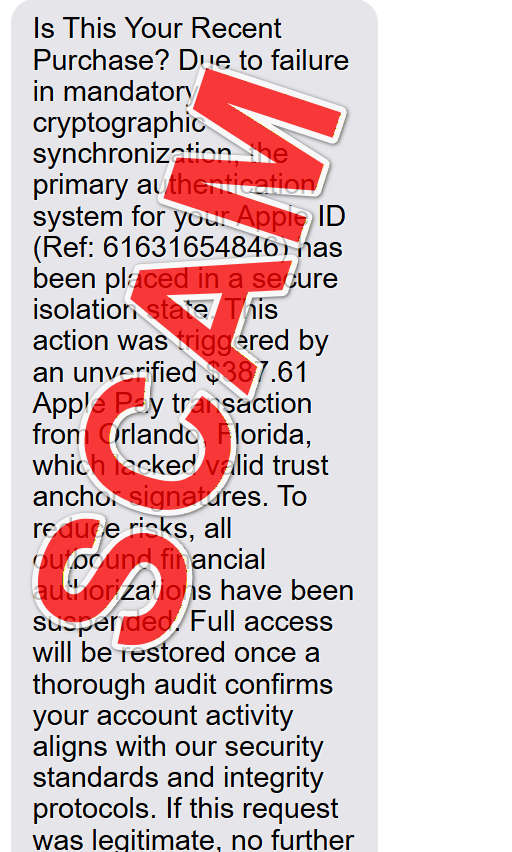
Here is how the scam texts look:
Is This Your Recent Purchase?
Due to failure in mandatory cryptographic synchronization, the primary authentication system for your Apple ID (Ref: 61631654846) has been placed in a secure isolation state. This action was triggered by an unverified $387.61 Apple Pay transaction from Orlando, Florida, which lacked valid trust anchor signatures. To reduce risks, all outbound financial authorizations have been suspended. Full access will be restored once a thorough audit confirms your account activity aligns with our security standards and integrity protocols.
If this request was legitimate, no further steps are necessary — it will process within 24 hours. If it wasn’t you, please call Apple Support immediately at (888) 766-2305.
Need help? Use the support options below:
Apple Customer Care: 1-888-766-2305
Billing Issues: getsupport.apple.com
Your digital safety is our top concern. Please act promptly.
With care,
Apple Threat Notifications
3. On the call, the scammer takes control of the pace and the story
When you call, the scammer does not start by stealing from you.
They start by performing competence.
They may:
Thank you for calling quickly
Repeat the charge amount and location
Ask what device you are using
Ask if you have Apple Pay enabled
Offer a “case number”
Say your Apple ID is in a temporary restricted state
They are building authority.
They are also gathering information that helps them tailor the scam.
If you sound very worried, they push harder. If you sound skeptical, they “verify” more details to calm you.
Either way, they keep you engaged.
4. They escalate the fear just enough to make compliance feel logical
At this stage, they often claim one of these:
Someone is actively attempting to add a payment method
Your Apple ID is being used on a new device
Your iCloud data might be at risk
Your Apple Pay wallet is being “mirrored” or “cloned”
The transaction is pending and could finalize soon
They may use language like “high-risk,” “ongoing attempt,” or “multiple authorization checks.”
Then they switch into reassurance.
They tell you they can fix it, but you must follow steps immediately, while you are still on the call.
This is pressure disguised as help.
5. They request “verification” that becomes a data extraction exercise
The scammer may ask for:
Your Apple ID email address
Your full name
Your phone number
Your billing ZIP or billing details
One-time codes sent to your device
They might frame it as identity verification.
But real Apple Support will not ask you to read out verification codes that are meant to protect your account. Those codes are a common path to account takeover.
If you give the scammer a code, you may be approving a login attempt, a password reset, or a device addition.
In other words, you may be opening the door for them.
6. They introduce the “fix,” which often involves remote access or screen sharing
This is where the scam becomes truly dangerous.
They may say:
Your device must be checked for “malware” or “unauthorized profiles”
They need to “secure” your Apple ID environment
They must “audit” your device to restore authorizations
They can “reverse” the transaction, but they must verify your payment setup
Then they push a tool.
On computers, this is often remote access software like AnyDesk or similar.
On phones, it may be screen sharing, configuration profiles, or guided steps that expose sensitive data.
Even if the scammer does not fully control your device, they can watch you log into accounts, coach you through actions, and pressure you to approve changes.
7. The scam pivots to money, either directly or through gift cards
Once the scammer has access, or once they believe they have enough leverage, they introduce the financial “resolution.”
Common scripts include:
Refund narrative: They claim they will reverse the charge, but you must confirm bank details.
Security hold narrative: They say your account needs a temporary verification payment that will be returned.
Safe account narrative: They claim you must move money to “protect it” from unauthorized transactions.
Gift card narrative: They claim Apple requires a validation token, and you must buy gift cards to confirm identity.
This is where victims lose money.
The scammer will sound calm. They will sound confident. They will talk like a professional who does this all day, because they do.
8. They keep you on the line to prevent outside advice
A common tactic is isolation.
They may encourage you to:
Stay on the phone while you “complete steps”
Not contact your bank until the “audit” is finished
Avoid using chat support because it “delays the process”
Move quickly because “the authorization window is closing”
This is not customer service.
It is containment.
The scammer wants you focused on them, not on verifying information, not on asking a friend, not on taking a breath.
How the “cryptography” wording helps the scammer during the call
That heavy technical language in the text sets a tone.
It makes victims more likely to believe:
The scammer has access to sophisticated internal systems
The issue is too complex to verify independently
The fastest solution is to follow instructions
It also gives scammers an easy way to dismiss your questions.
If you ask, “Where do you see this charge?” they can respond with vague statements like:
“Our integrity platform detected an unverified trust anchor signature.”
It sounds like an explanation, but it is not verifiable, and it is not how real billing disputes are handled.
Why the “24 hours” line is especially manipulative
Many variants say something like:
“If this request was legitimate, no further steps are necessary, it will process within 24 hours.”
That line does two things at once:
It makes the message feel balanced and professional
It creates a time box that makes you feel you must decide right now
You do not want to wait 24 hours to see if your money disappears.
So you call.
The outcome victims often report
Victims commonly experience one or more of these:
Apple ID compromise, including new devices or changes to account settings
Unauthorized purchases, subscription changes, or payment method abuse
Money sent through bank transfers or payment apps
Gift card purchases that cannot be reversed
Stress and confusion from being pressured for hours on the phone
Follow-up harassment after refusing to comply
Even if you did not lose money, the time and anxiety cost is real. Scammers know that fear is expensive.
What To Do If You Have Fallen Victim to This Scam
If you called the number, shared details, clicked anything, installed software, or sent money, you can still take strong steps to protect yourself. Move quickly, but do not spiral.
Stop contact immediately and block the number Hang up and do not answer callbacks. Do not continue the conversation to “figure it out.” Scammers use continued contact to regain pressure and push you into worse decisions.
Secure your Apple ID from official settings, not from links Change your Apple ID password right away using your device settings or by manually navigating to Apple’s official account management pages. Then review:
The list of devices signed into your Apple ID
Trusted phone numbers
Account recovery options Remove anything you do not recognize.
Treat any shared verification code as an emergency If you read a code to someone on the phone, assume they attempted account access. Change your password immediately, sign out of all devices where possible, and re-check your device list after a few minutes to make sure nothing new appears.
If you installed remote access software, remove it and scan your device Uninstall any remote tools they asked you to install. Restart the device. Then run security scans. A practical approach:
Use Malwarebytes to scan for malware and unwanted software, especially on Windows or Mac
Consider AdGuard to reduce exposure to malicious ads and scam pages that often lead to repeat targeting If you are not confident you removed everything, get help from a trusted local technician.
Check your financial accounts and contact your bank or card issuer If you entered card details, logged into banking while sharing your screen, or approved any transfers, call your bank immediately. Ask them to:
Review recent transactions
Flag your account for fraud monitoring
Replace cards if needed
Add extra security checks where available If you sent money, ask about recall or dispute options. Some methods move too fast, but you should still try.
If you bought gift cards or shared gift card codes, report it fast Keep receipts and any packaging. Contact the gift card issuer and report fraud immediately. Recovery is not guaranteed, but speed matters.
Change passwords for any accounts you accessed during the call If the scammer watched you log in, assume they saw what you typed. Prioritize:
Email accounts
Banking and payment apps
Password manager
Any account that can reset other accounts
Look for signs your device settings were changed On phones and computers, check for anything unfamiliar:
New profiles or device management settings
New browser extensions
New apps you did not install
Forwarding rules in your email Scammers sometimes leave small changes behind that help them later.
Document what happened and report it Save screenshots of the text message, the phone number, and any instructions. Keep call logs. Reporting helps carriers and platforms pattern-match these campaigns, even if you do not see an immediate result.
Expect follow-up attempts and stay skeptical After a scam attempt, victims are sometimes targeted again by “recovery scammers” who claim they can retrieve lost funds for a fee. Treat that as another scam until proven otherwise.
Is Your Device Infected? Scan for Malware
If your computer or phone is slow, showing unwanted pop-ups, or acting strangely, malware could be the cause. Running a scan with Malwarebytes Anti-Malware Free is one of the most reliable ways to detect and remove harmful software. The free version can identify and clean common infections such as adware, browser hijackers, trojans, and other unwanted programs.
Malwarebytes works on Windows, Mac, and Android devices. Choose your operating system below and follow the steps to scan your device and remove any malware that might be slowing it down.
Malwarebytes for WindowsMalwarebytes for MacMalwarebytes for Android
Run a Malware Scan with Malwarebytes for Windows
Malwarebytes stands out as one of the leading and widely-used anti-malware solutions for Windows, and for good reason. It effectively eradicates various types of malware that other programs often overlook, all at no cost to you. When it comes to disinfecting an infected device, Malwarebytes has consistently been a free and indispensable tool in the battle against malware. We highly recommend it for maintaining a clean and secure system.
Download Malwarebytes
Download the latest version of Malwarebytes for Windows using the official link below. Malwarebytes will scan your computer and remove adware, browser hijackers, and other malicious software for free.
(The above link will open a new page from where you can download Malwarebytes)
Install Malwarebytes
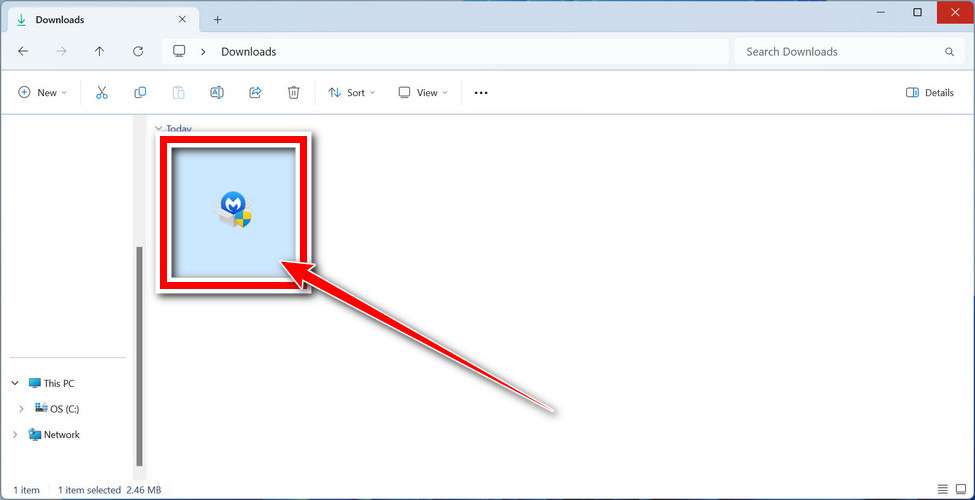
After the download is complete, locate the MBSetup file, typically found in your Downloads folder. Double-click on the MBSetup file to begin the installation of Malwarebytes on your computer. If a User Account Control pop-up appears, click “Yes” to continue the Malwarebytes installation.
Follow the On-Screen Prompts to Install Malwarebytes
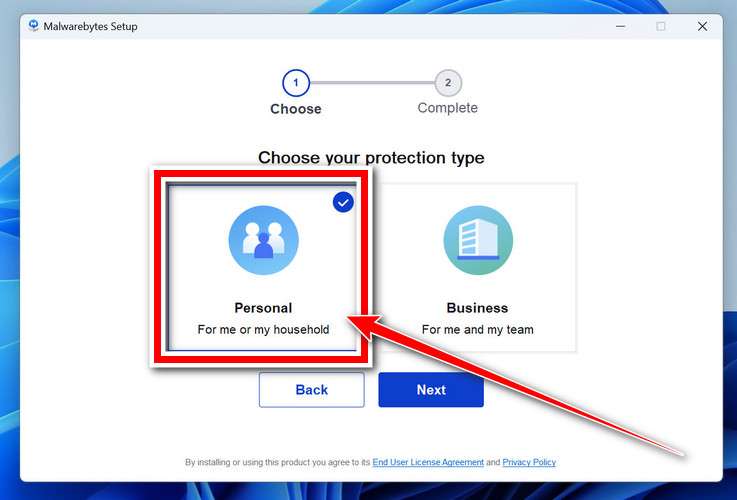
When the Malwarebytes installation begins, the setup wizard will guide you through the process.
You’ll first be prompted to choose the type of computer you’re installing the program on—select either “Personal Computer” or “Work Computer” as appropriate, then click on Next.
Malwarebytes will now begin the installation process on your device.
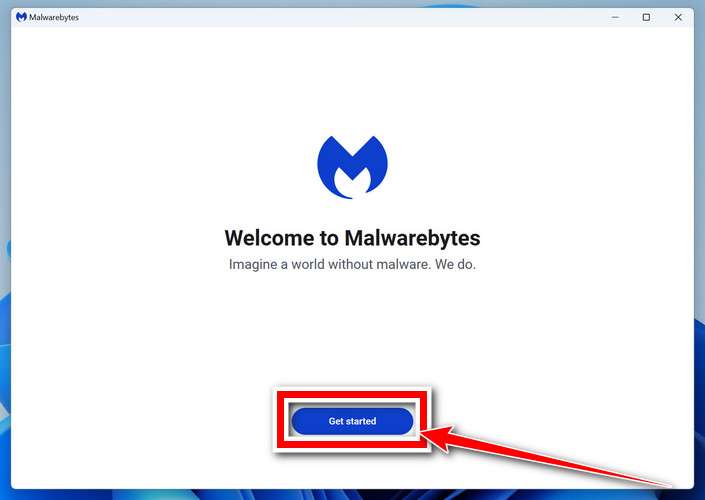
When the Malwarebytes installation is complete, the program will automatically open to the “Welcome to Malwarebytes” screen.
On the final screen, simply click on the Open Malwarebytes option to start the program.
Enable “Rootkit scanning”.
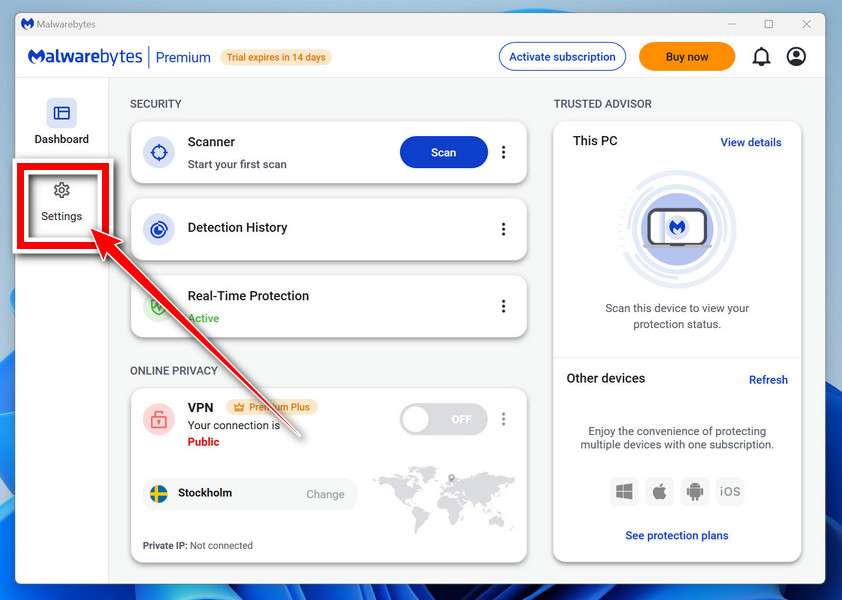
Malwarebytes Anti-Malware will now start, and you will see the main screen as shown below. To maximize Malwarebytes’ ability to detect malware and unwanted programs, we need to enable rootkit scanning. Click on the “Settings” gear icon located on the left of the screen to access the general settings section.
In the settings menu, enable the “Scan for rootkits” option by clicking the toggle switch until it turns blue.
Now that you have enabled rootkit scanning, click on the “Dashboard” button in the left pane to get back to the main screen.
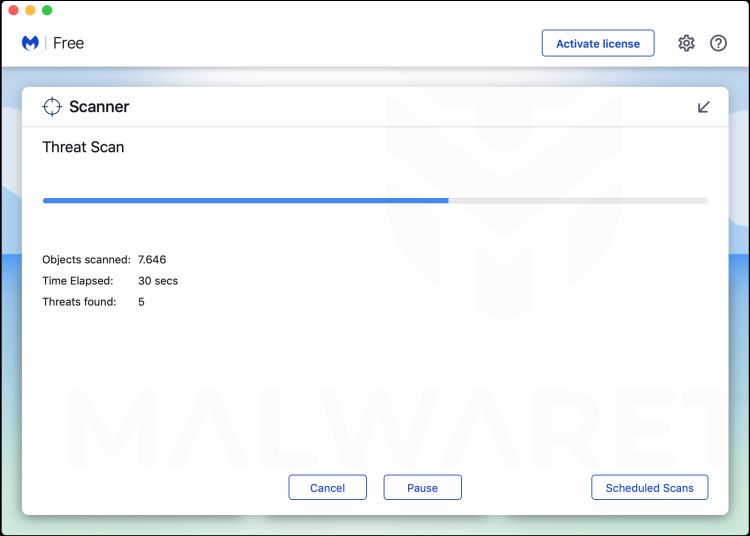
Perform a Scan with Malwarebytes.
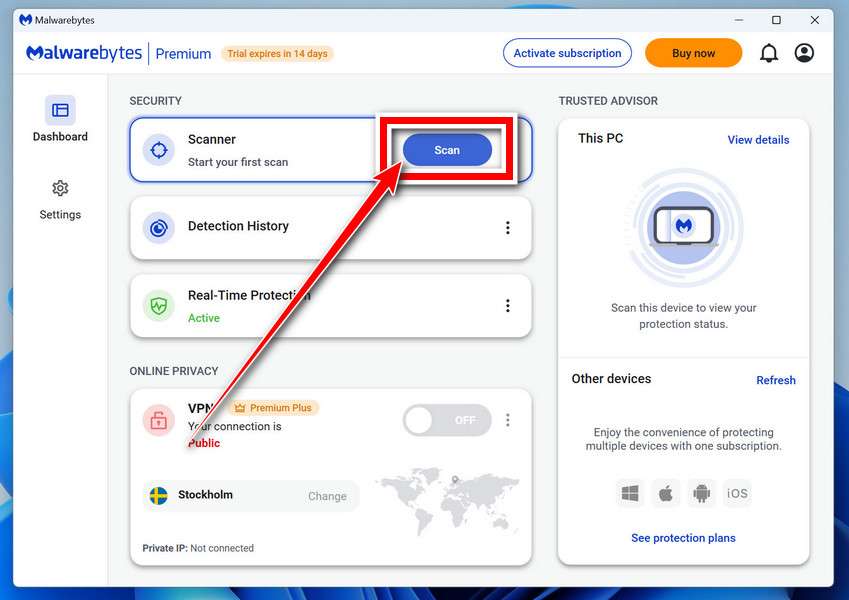
To start a scan, click the Scan button. Malwarebytes will automatically update its antivirus database and begin scanning your computer for malicious programs.
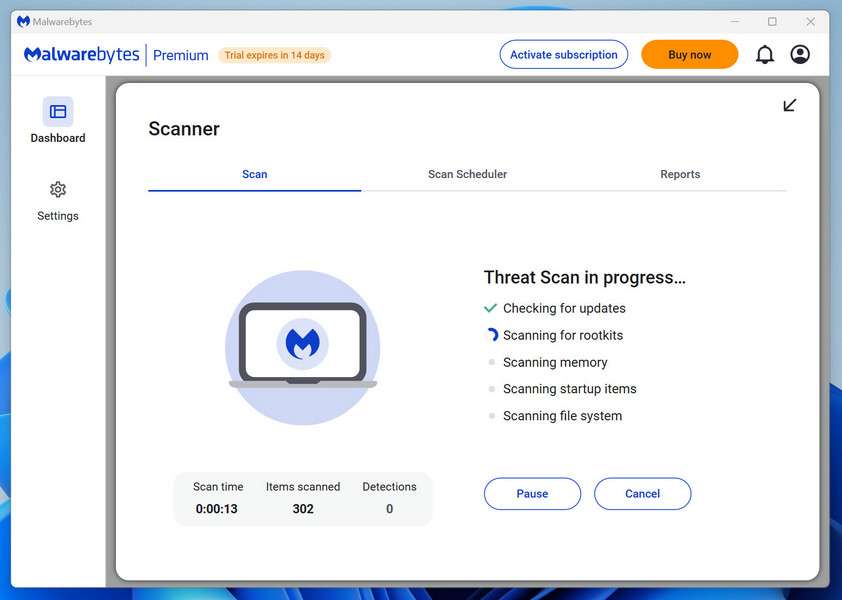
Wait for the Malwarebytes scan to complete.
Malwarebytes will now scan your computer for browser hijackers and other malicious programs. This process can take a few minutes, so we suggest you do something else and periodically check the status of the scan to see when it is finished.
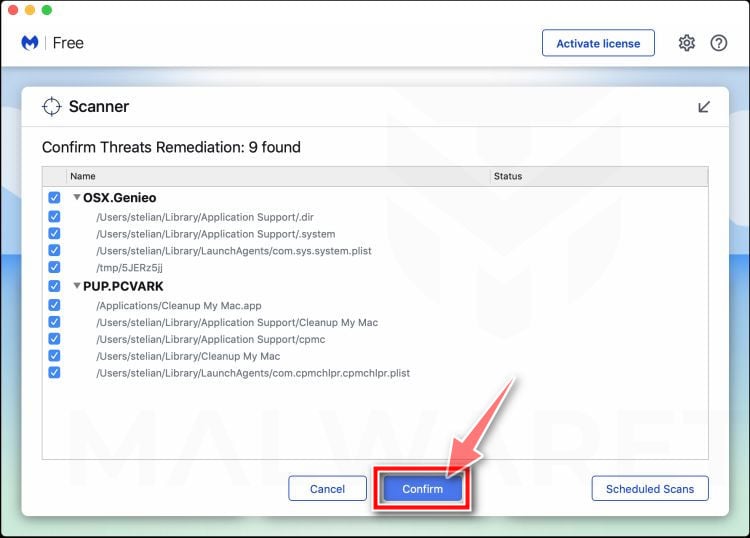
Quarantine detected malware
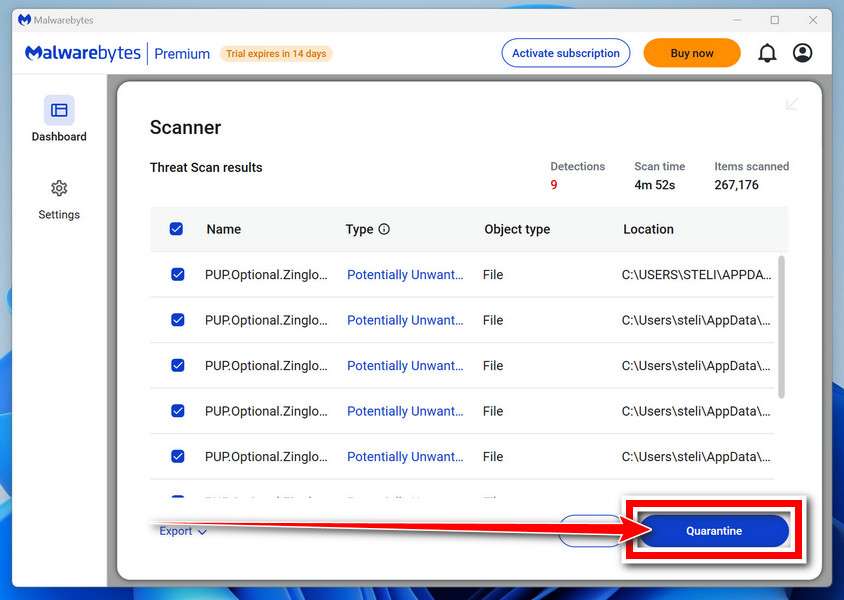
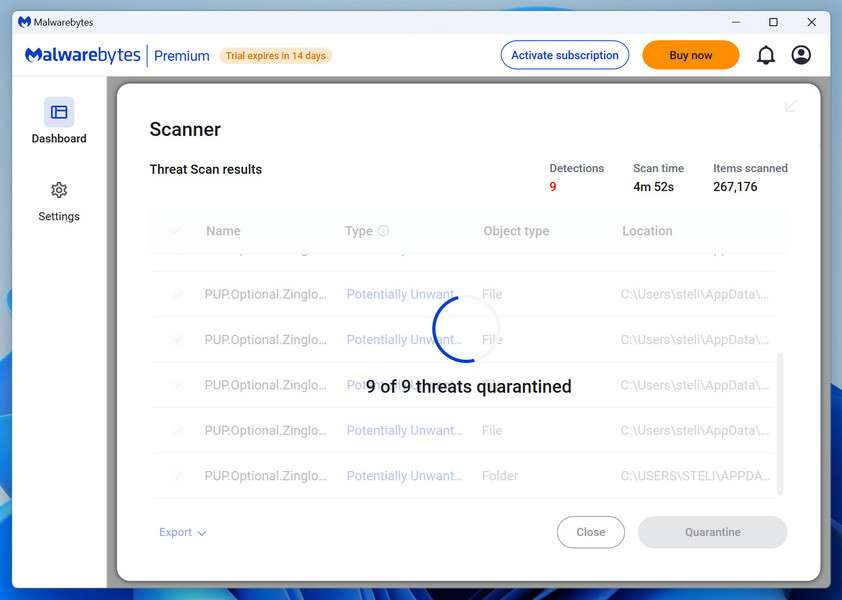
Once the Malwarebytes scan is complete, it will display a list of detected malware, adware, and potentially unwanted programs. To effectively remove these threats, click the “Quarantine” button.
Malwarebytes will now delete all of the files and registry keys and add them to the program’s quarantine.
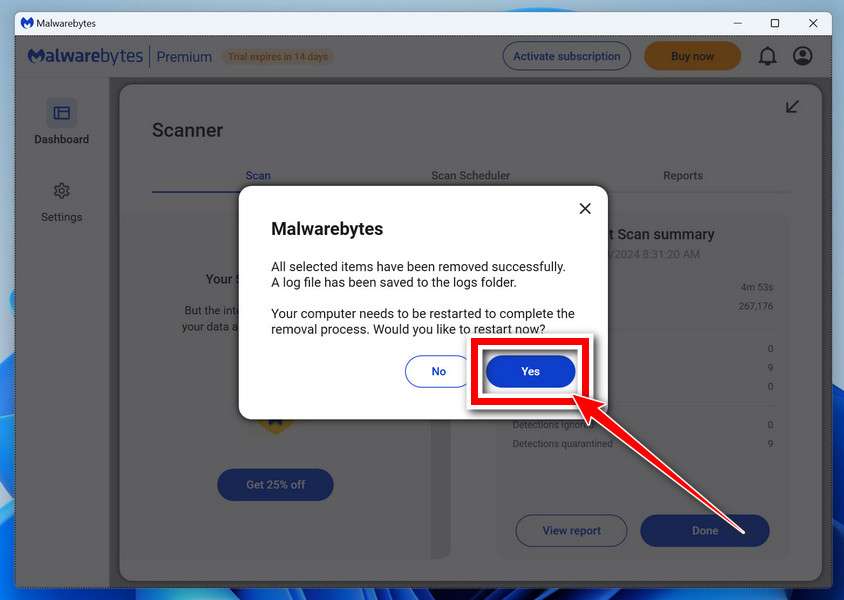
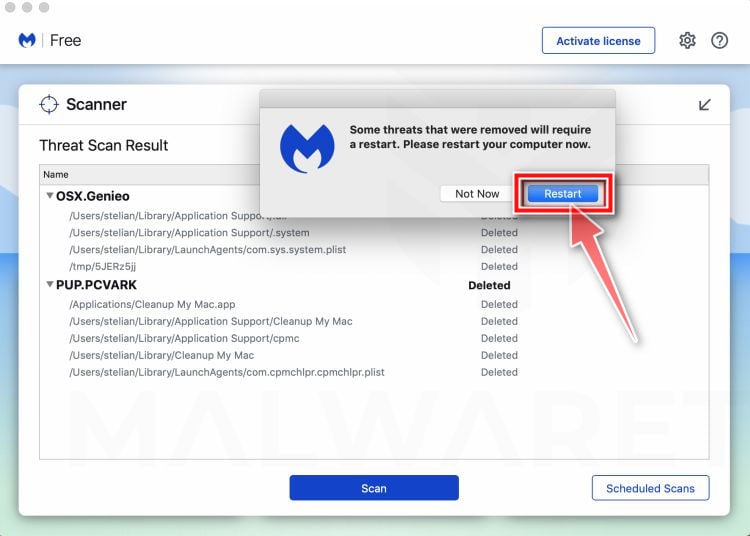
Restart your computer.
When removing files, Malwarebytes may require a reboot to fully eliminate some threats. If you see a message indicating that a reboot is needed, please allow it. Once your computer has restarted and you are logged back in, you can continue with the remaining steps.
Once the scan completes, remove all detected threats. Your Windows computer should now be clean and running smoothly again, free of trojans, adware, and other malware.
If your current antivirus allowed this malicious program on your computer, you may want to consider purchasing Malwarebytes Premium to protect against these types of threats in the future. If you are still having problems with your computer after completing these instructions, then please follow one of the steps:
Malwarebytes for Mac is an on-demand scanner that can destroy many types of malware that other software tends to miss without costing you absolutely anything. When it comes to cleaning up an infected device, Malwarebytes has always been free, and we recommend it as an essential tool in the fight against malware.
Download Malwarebytes for Mac.
You can download Malwarebytes for Mac by clicking the link below.
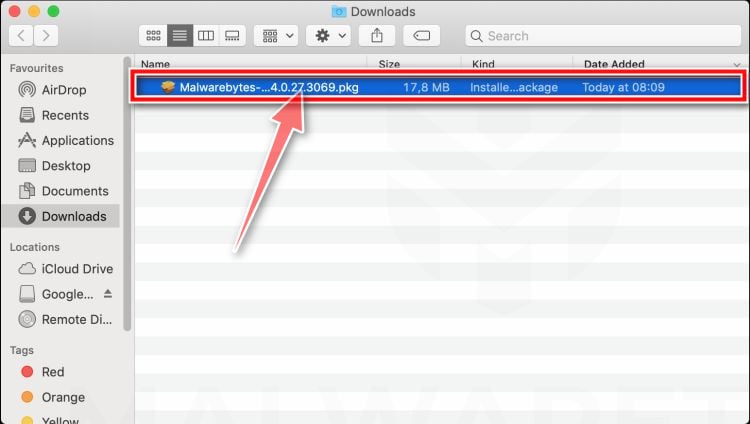
When Malwarebytes has finished downloading, double-click on the setup file to install Malwarebytes on your computer. In most cases, downloaded files are saved to the Downloads folder.
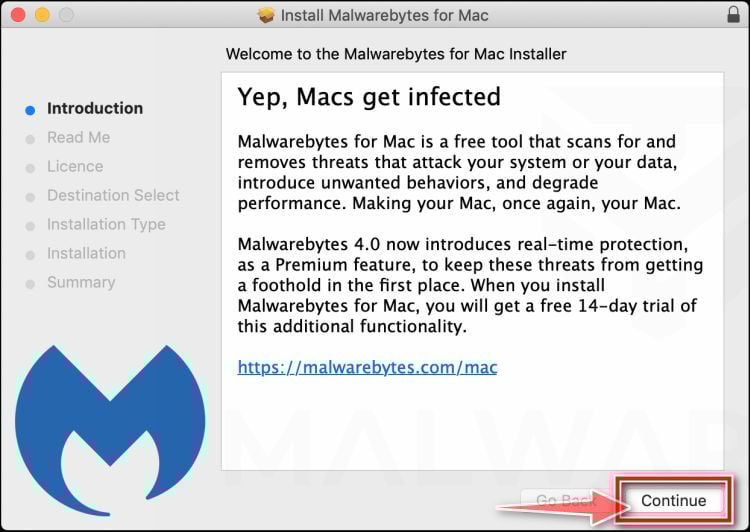
Follow the on-screen prompts to install Malwarebytes.
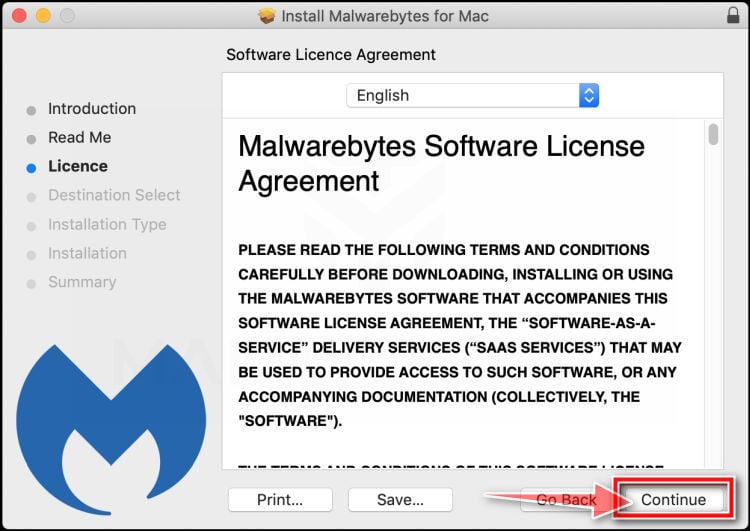
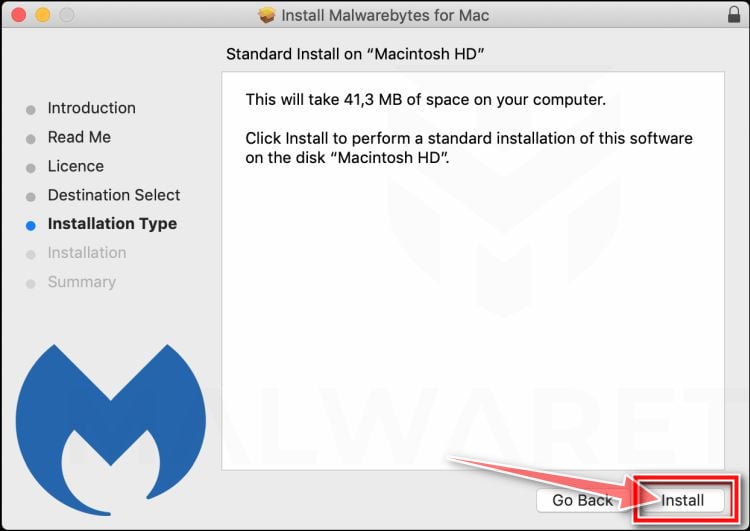
When the Malwarebytes installation begins, you will see the Malwarebytes for Mac Installer which will guide you through the installation process. Click “Continue“, then keep following the prompts to continue with the installation process.
When your Malwarebytes installation completes, the program opens to the Welcome to Malwarebytes screen. Click the “Get started” button.
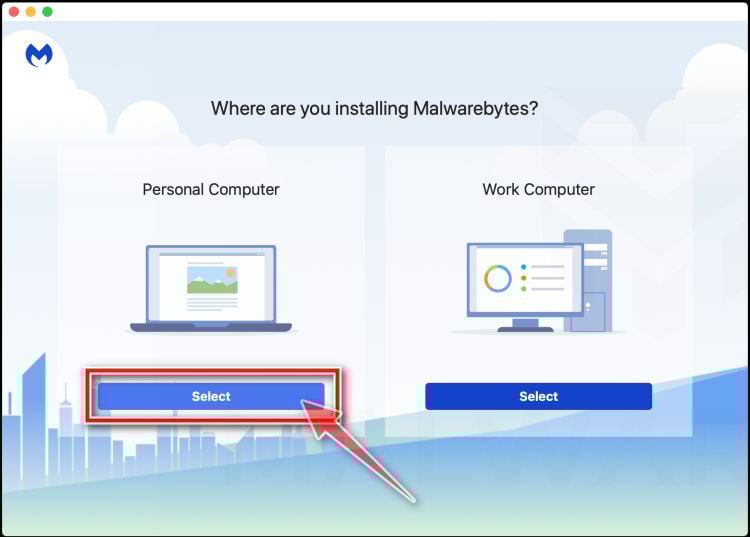
Select “Personal Computer” or “Work Computer”.
The Malwarebytes Welcome screen will first ask you what type of computer are you installing this program, click either Personal Computer or Work Computer.
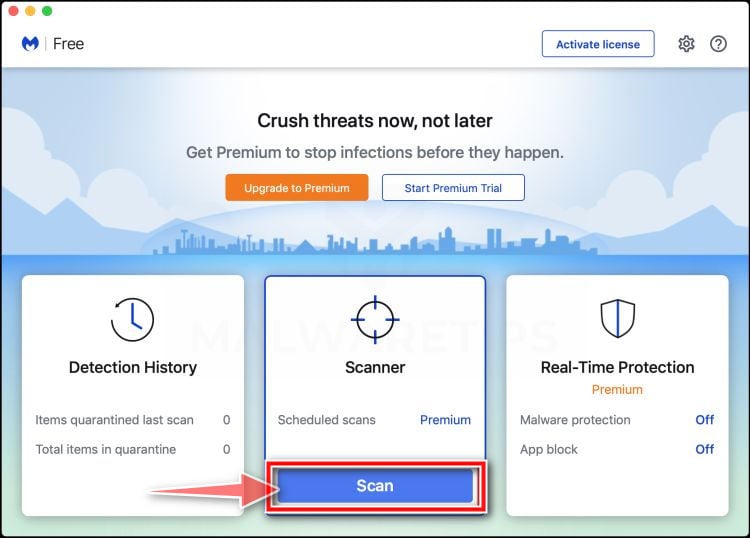
Click on “Scan”.
To scan your computer with Malwarebytes, click on the “Scan” button. Malwarebytes for Mac will automatically update the antivirus database and start scanning your computer for malware.
Wait for the Malwarebytes scan to complete.
Malwarebytes will scan your computer for adware, browser hijackers, and other malicious programs. This process can take a few minutes, so we suggest you do something else and periodically check on the status of the scan to see when it is finished.
Click on “Quarantine”.
When the scan has been completed, you will be presented with a screen showing the malware infections that Malwarebytes has detected. To remove the malware that Malwarebytes has found, click on the “Quarantine” button.
Restart computer.
Malwarebytes will now remove all the malicious files that it has found. To complete the malware removal process, Malwarebytes may ask you to restart your computer.
After scanning, delete any detected threats. Your Mac should now be free from adware, unwanted extensions, and other potentially harmful software.
If your current antivirus allowed a malicious program on your computer, you might want to consider purchasing the full-featured version of Malwarebytes Anti-Malware to protect against these types of threats in the future. If you are still experiencing problems while trying to remove a malicious program from your computer, please ask for help in our Mac Malware Removal Help & Support forum.
Run a Malware Scan with Malwarebytes for Android
Malwarebytes for Android automatically detects and removes dangerous threats like malware and ransomware so you don’t have to worry about your most-used device being compromised. Aggressive detection of adware and potentially unwanted programs keeps your Android phone or tablet running smooth.
Download Malwarebytes for Android.
You can download Malwarebytes for Android by clicking the link below.
In the Google Play Store, tap “Install” to install Malwarebytes for Android on your device.
When the installation process has finished, tap “Open” to begin using Malwarebytes for Android. You can also open Malwarebytes by tapping on its icon in your phone menu or home screen.
Follow the on-screen prompts to complete the setup process
When Malwarebytes will open, you will see the Malwarebytes Setup Wizard which will guide you through a series of permissions and other setup options. This is the first of two screens that explain the difference between the Premium and Free versions. Swipe this screen to continue. Tap on “Got it” to proceed to the next step. Malwarebytes for Android will now ask for a set of permissions that are required to scan your device and protect it from malware. Tap on “Give permission” to continue. Tap on “Allow” to permit Malwarebytes to access the files on your phone.
Update database and run a scan with Malwarebytes for Android
You will now be prompted to update the Malwarebytes database and run a full system scan.
Click on “Update database” to update the Malwarebytes for Android definitions to the latest version, then click on “Run full scan” to perform a system scan.
Wait for the Malwarebytes scan to complete.
Malwarebytes will now start scanning your phone for adware and other malicious apps. This process can take a few minutes, so we suggest you do something else and periodically check on the status of the scan to see when it is finished.
Click on “Remove Selected”.
When the scan has been completed, you will be presented with a screen showing the malware infections that Malwarebytes for Android has detected. To remove the malicious apps that Malwarebytes has found, tap on the “Remove Selected” button.
Restart your phone.
Malwarebytes for Android will now remove all the malicious apps that it has found. To complete the malware removal process, Malwarebytes may ask you to restart your device.
When the scan is finished, remove all detected threats. Your Android phone should now be free of malicious apps, adware, and unwanted browser redirects.
If your current antivirus allowed a malicious app on your phone, you may want to consider purchasing the full-featured version of Malwarebytes to protect against these types of threats in the future. If you are still having problems with your phone after completing these instructions, then please follow one of the steps:
Restore your phone to factory settings by going to Settings > General management > Reset > Factory data reset.
After cleaning your device, it’s important to protect it from future infections and annoying pop-ups. We recommend installing an ad blocker such as AdGuard. AdGuard blocks malicious ads, prevents phishing attempts, and stops dangerous redirects, helping you stay safe while browsing online.
The Bottom Line
Apple Threat Notifications scam texts are not “advanced hacking.” They are advanced pressure.
They use official-sounding security language, a believable charge, and a fake support number to pull you into a phone conversation where scammers can manipulate you into handing over access, sensitive information, or money.
If you get one of these messages, do not call the number. Verify your Apple ID and your purchases through official channels you open yourself, and treat any request for remote access, verification codes, or gift cards as an immediate dealbreaker.
If you already engaged, do not beat yourself up. Cut contact, lock down your Apple ID, scan and clean your devices, and protect your financial accounts. Fast, calm steps are how you turn a scary text into a closed chapter.
FAQ
What are “Apple Threat Notifications” scam texts?
They are fake security alerts sent by scammers that pretend to come from Apple. The texts claim your Apple ID is under threat, restricted, or “isolated” because of suspicious activity, usually an Apple Pay charge. The real goal is to get you to call a phone number that connects you to fake support.
Is “Apple Threat Notifications” a real Apple department?
No. Scammers invent official-sounding team names to create trust and urgency. Apple does not operate account security through random text messages that push you to call a number immediately.
Why does the message sound so technical, with words like “cryptographic synchronization” and “trust anchor signatures”?
Because technical language makes the alert feel legitimate and makes people doubt their own judgment. The jargon is meant to intimidate you into calling, not to provide verifiable information.
The text included a reference number, does that make it real?
No. Reference numbers are easy to fake and are commonly used in phone scams to make the interaction feel official. A real case number only matters when it is created inside official Apple support channels that you initiated yourself.
The message says my Apple ID is in a “secure isolation state,” is that a real thing?
Scam texts often use dramatic phrases like this to create fear. Apple can restrict an account for security reasons, but a text that pushes you to call a number is not a reliable sign of a real Apple action. Always verify through your Apple account settings.
What should I do if the text claims there was an Apple Pay charge like $387.61?
Do not call the number in the text. Instead:
Check your bank or card statement directly
Check your Apple purchase history and subscriptions through your Apple account settings If you see a real unauthorized transaction, dispute it through your bank or Apple’s official support channels you access independently.
The text includes getsupport.apple.com, is the message legitimate then?
Not necessarily. Scammers often include a real Apple link to lower your guard. The scam part is the phone number and the pressure to call it. A real link does not authenticate the entire message.
What happens if I call the phone number in the text?
You will likely reach scammers pretending to be Apple Support. They may:
Ask for your Apple ID email and personal details
Request one-time verification codes
Push you to install AnyDesk or other remote access tools
Try to move you toward payments, bank transfers, or gift cards
Would Apple Support ever ask me to read a verification code to them?
No. If someone asks for a one-time code, assume they are trying to take over your account. Verification codes are meant to protect you, not to be shared.
Why do scammers push AnyDesk or remote access tools?
Because it lets them see what you do, and sometimes control your device. They can guide you into logging into banking accounts, capture sensitive details, change settings, or pressure you into sending money.
Can I be at risk even if I did not install anything?
Yes. If you called and shared personal details, your Apple ID email, or any verification codes, that can still lead to account takeover attempts. If you only read the text and did nothing, your risk is low.
I clicked a link but did not call, what should I do?
If you did not enter any details and did not install anything, you are likely fine. Still, it is smart to:
Close the page
Run a Malwarebytes scan on your computer if you used one
Use AdGuard to reduce exposure to malicious ads and scam pages
Monitor your Apple ID security notifications and your bank statements
What should I do if I gave them my Apple ID password or a verification code?
Act immediately:
Change your Apple ID password
Review your Apple ID device list and remove anything unfamiliar
Check trusted phone numbers and recovery settings
Consider signing out of all devices if that option is available Then monitor for any new login alerts or changes.
What should I do if I bought gift cards and shared the codes?
Report it immediately:
Contact the gift card issuer and report fraud
Keep receipts and card packaging
If you used a credit card to buy them, contact your card issuer and ask about options Gift card losses are often difficult to recover, but speed improves your chances.
How can I check if my Apple ID is compromised?
Warning signs include:
Unknown devices listed under your Apple ID
Password or account settings changed without you doing it
New payment methods added
Unfamiliar purchase history or subscriptions If you see any of these, secure the account immediately.
Why do scammers include a “24 hours” line like “it will process within 24 hours”?
It creates a decision window that pressures you. It also makes the message sound balanced and professional, which increases the chance you will call “just to be safe.”
How do I verify real Apple alerts safely?
Use trusted paths you open yourself:
Check Apple ID security settings on your iPhone, iPad, or Mac
Check purchase history and subscriptions through your Apple account
Contact Apple using official support options, not a number from a text
Will blocking the number stop these scams?
It helps, but scammers rotate numbers constantly. The best protection is recognizing the pattern and refusing to call or share information.
What security tools can help reduce scam risk going forward?
Two practical options:
Malwarebytes to scan and remove malware or unwanted software, especially on computers
AdGuard to block malicious ads, scam pages, and aggressive tracking that often leads to phishing attempts
What is the safest rule to remember with Apple security texts?
Never trust the contact method inside the message. If you are worried, verify from inside your Apple account settings or official Apple support pages you navigate to yourself.
Thomas is an expert at uncovering scams and providing in-depth reporting on cyber threats and online fraud. As an editor, he is dedicated to keeping readers informed on the latest developments in cybersecurity and tech.