

The caller says there is a serious problem with your Australian visa. An error, unpaid fee, or suspicious document has supposedly placed you minutes away from cancellation, arrest, or deportation.
Then the solution appears: pay immediately, reveal your passport details, or follow the officer’s instructions without hanging up. The authority is invented, but the fear it creates can feel very real.
Overview
The caller impersonates Australian immigration authorities
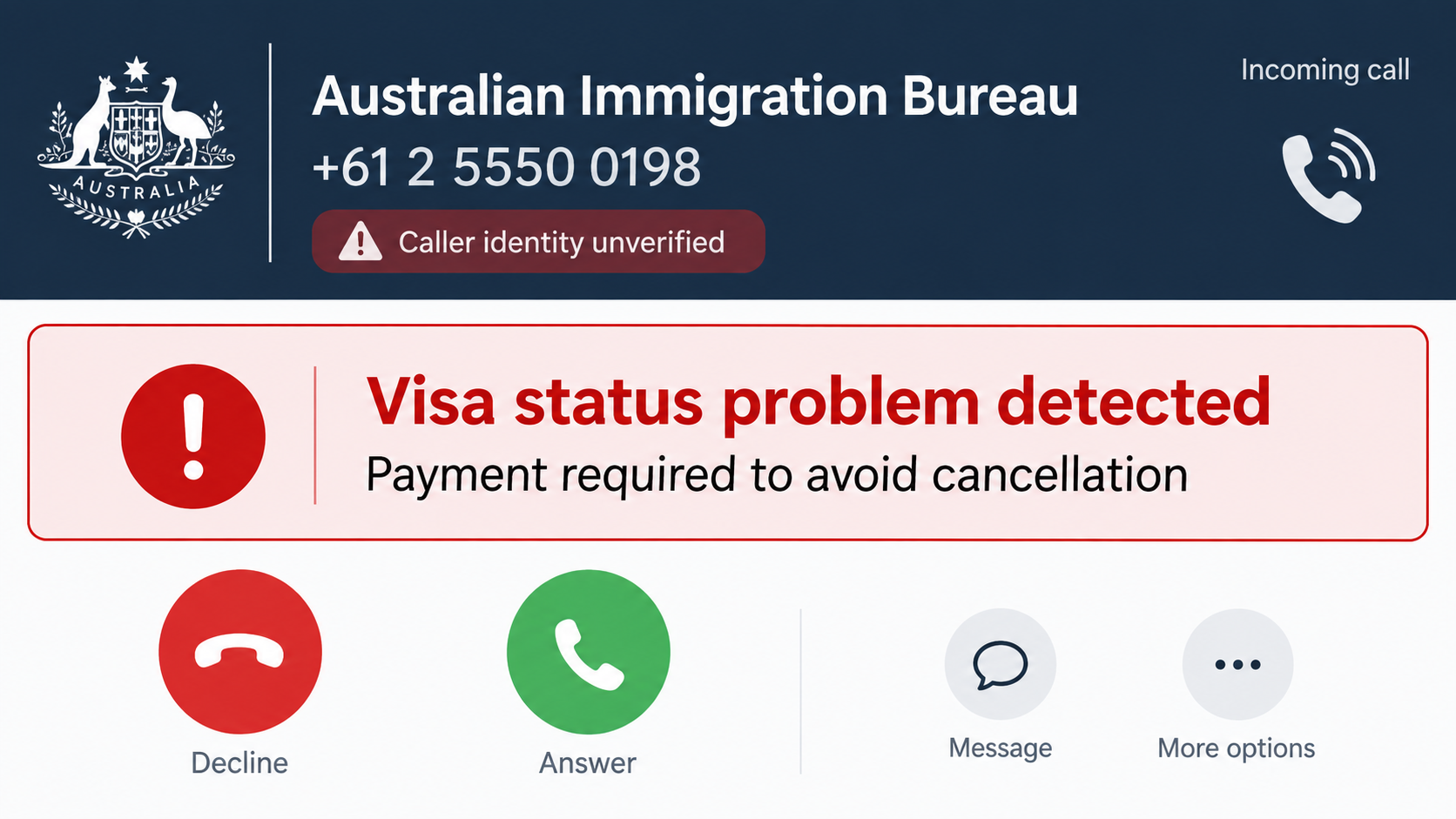
The fraudster may claim to represent the “Australian Immigration Bureau,” Department of Home Affairs, Australian Border Force, a consulate, police, or another official-sounding office. Caller ID can display an Australian or government number.
The vague “Immigration Bureau” name is itself a warning. Australian visa matters are handled through official Department of Home Affairs systems, including ImmiAccount, not a surprise bureau demanding payment by phone.
Threats make the victim afraid to verify
The caller claims a form contains an error, a visa fee is unpaid, identity details are inconsistent, or a criminal case has been opened. They threaten immediate deportation, arrest, account freezing, or permanent ineligibility.
Australia’s Scamwatch says government impersonators commonly use pressure and deportation threats. The Department of Home Affairs has also warned that officials will not ask for extra payments to speed up a visa.
Money and identity data are the real targets
Payment may be requested through bank transfer, cryptocurrency, wire service, gift card, cash deposit, or a payment app. The caller may also ask for passport details, visa numbers, banking information, passwords, or one-time codes.
Even if no money is sent, identity information can be reused for account takeovers, fraudulent applications, and more convincing follow-up calls.
- An unexpected caller reports an urgent visa or immigration problem.
- The caller uses personal information to sound official.
- Arrest, deportation, or visa cancellation is threatened.
- The victim is ordered to stay on the line and avoid other people.
- Immediate payment or sensitive identity details are demanded.
- The real Department of Home Affairs is not involved.
Why Visa Holders Are Vulnerable to This Call
Immigration status affects work, housing, family, study, and the ability to remain in a country. A threat to that status can produce the same panic as a threat of arrest or a frozen bank account.
People navigating a complex visa process may not know which department calls, which fees are normal, or how an official issue would be communicated. Scammers exploit that uncertainty with confident language.
A caller who knows a name, nationality, birth date, employer, or visa type can seem authentic. Those details may come from social media, breached databases, public professional profiles, or earlier scam forms.
Caller ID adds false reassurance. Internet calling tools can display a number chosen by the criminal, including one that resembles or matches a government office.
Language and cultural barriers can increase pressure. A caller may switch languages, claim to understand the victim’s community, or say that involving friends will make the case worse.
The scammer may provide a badge number, case reference, legal section, or callback extension. These details are easy to invent and often cannot be checked while the caller insists that the line remain open.
Legitimate procedures create records. A real visa concern should be verifiable through ImmiAccount, written correspondence, or contact details found on the Department of Home Affairs website.
The safest move is to end the call. Hanging up does not cancel a visa, and a genuine department can be contacted through its official channel.
How the Australian Immigration Bureau Scam Works
Step 1: The victim receives an automated or live call
A recorded message may say a passport or visa has been suspended and instruct the recipient to press a number. A live caller may immediately introduce themselves as an immigration officer.
The call can arrive from a local-looking number or display a government-related name. Neither identifies the true origin of an internet-based call.
Step 2: A serious immigration problem is invented
The supposed officer says the victim submitted false information, missed a payment, used an invalid document, or has an unexplained criminal record. The problem is framed as both urgent and confidential.
The caller may transfer the victim to another “department,” “police officer,” or “supervisor.” Multiple voices create the appearance of a real bureaucracy.
Step 3: Personal details are used and collected
The scammer repeats information already known, then asks the victim to confirm passport numbers, visa details, date of birth, address, employer, bank, and ImmiAccount information.
Questions are presented as identity verification, but every answer gives the criminal more material for fraud.
Step 4: Deportation or arrest is threatened
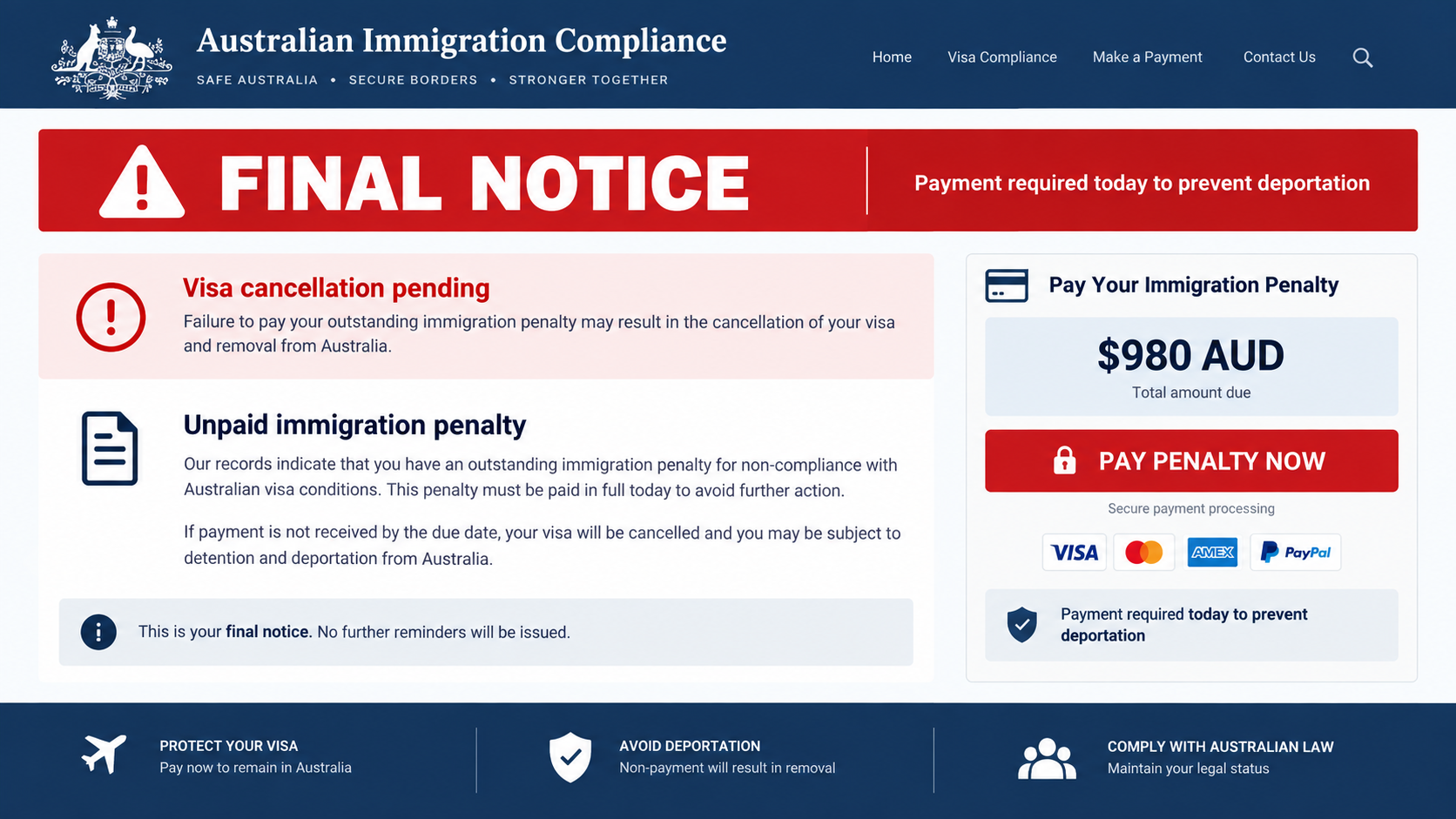
The victim is told that police are on the way, a removal order is active, or the visa will be canceled unless the matter is resolved during the call. The scammer may forbid hanging up.
Fear narrows attention. The victim begins following instructions to avoid the threatened outcome instead of asking whether a government agency would behave this way.
Step 5: Immediate payment is demanded
The caller describes the money as a fine, bond, tax, verification deposit, legal fee, or refundable security payment. They direct the victim to transfer funds, buy gift cards, send cryptocurrency, or visit a bank while staying on the line.
The payment recipient may be a personal account or unrelated business. Any explanation for that mismatch should be treated as part of the scam.
Step 6: The pressure continues until the victim stops
After one payment, another issue appears: a second form, clearance fee, police bond, or currency charge. The promised case closure remains just one payment away.
If the victim refuses, the scammer may intensify threats, call relatives, or return later under a different identity offering legal or recovery help.
What Australian Authorities Actually Say
The Department of Home Affairs provides visa information through its official website and ImmiAccount. Application status and correspondence should be checked there rather than through a link or number supplied by an unsolicited caller.
In a December 2025 warning, Australia’s Home Affairs Minister said an active scam involved people impersonating senior departmental officers and asking for money to speed up visa processing.
The warning states that Home Affairs officials will never ask for extra payments to process a visa faster. It advises recipients of unexpected calls to hang up and call back using a publicly available number.
Scamwatch has documented immigration calls that threaten deportation and demand upfront fees. It advises people not to rely on contact information given by the caller.
A real government body does not require gift cards or cryptocurrency to stop an arrest or preserve a visa. It also does not need a person to keep a phone call secret from family, banks, lawyers, or police.
Visa applications can involve legitimate government charges, but those charges should appear in an official application process. A surprise penalty payable to a stranger is not the same thing.
Registered migration agents can charge professional fees, yet their status can be checked through the Office of the Migration Agents Registration Authority. A caller’s claim of being an agent is not enough.
Home Affairs accepts reports of suspicious visa activity through Border Watch, and scams can be reported to Scamwatch. Those channels can be opened independently from official government pages.
How to Verify a Visa or Immigration Contact
Hang up first. A legitimate case does not become invalid because you ended an unexpected call to verify the identity of the caller.
Open ImmiAccount using the official Department of Home Affairs website. Check the application’s status, messages, requests, and payment history.
Find the Global Service Centre number on the department’s website. Do not call back the number in the voicemail, text, or caller-ID history.
Ask the department whether the named officer, case reference, and alleged issue exist. Share only the information required after you have reached the confirmed government channel.
Check any migration agent through the official OMARA register. Confirm the agent’s name, registration number, contact details, and current status.
Do not click a link claiming to open ImmiAccount. Phishing pages can copy the government login and collect credentials or multi-factor codes.
Read payment instructions inside the authenticated application. Compare the payee and amount with official guidance before authorizing a transaction.
Tell a trusted person what happened. Secrecy and continuous phone contact are manipulation tools, while an outside listener can help spot contradictions.
If the caller says police are involved, contact police yourself using a verified number. Do not accept a transfer from the alleged immigration officer.
Save the voicemail and caller details before blocking the number. Evidence can help authorities connect related reports even when the displayed number was spoofed.
Red Flags During the Call
An immediate threat of deportation or arrest is the clearest warning. Official decisions follow legal processes and documented communication, not a demand that must be paid during one phone call.
A request to keep the line open while visiting a bank or shop is designed to isolate the victim from staff who might identify the scam.
Gift cards, cryptocurrency, wire transfers, cash deposits, and payments to individuals are incompatible with a genuine government fine or visa charge.
The caller may discourage opening ImmiAccount or contacting a lawyer because “the case is confidential.” Real confidentiality does not prevent a person from verifying an official contact.
Threats against family members or claims that police are tracking the phone are intimidation. Do not remain on the line to prove cooperation.
An officer who becomes hostile when asked for written documentation is not demonstrating authority. They are trying to keep control of the conversation.
Accurate personal information does not authenticate the caller. Treat it as evidence that your data may have been exposed, not as proof of government access.
A surprise request to install remote-access software is especially dangerous. It can give the criminal control of the device while the victim logs in to email, banking, or ImmiAccount.
Company, Address, and Fulfillment Checks
Confirm the agency name and official channel
Use the Department of Home Affairs website and ImmiAccount. Do not assume an official-sounding “Australian Immigration Bureau” is a real office.
Government domains and published contact pages should be reached independently, not through the caller’s link or transfer.
Verify the officer, agent, or lawyer
Ask the real department whether the employee and reference exist. Check paid migration assistance through the OMARA register and lawyers through the relevant professional body.
A badge photo, certificate, or email signature can be copied. The independent register is what matters.
Inspect addresses and payment recipients
Compare every office and payee with official records. A personal bank account, crypto wallet, gift-card request, or unrelated company is not an Australian government payment route.
Do not visit an address chosen by the caller while remaining on the line. Contact the department or police independently first.
Check the claimed case inside ImmiAccount
A legitimate request should correspond with your real application and authenticated messages. A caller who cannot point to a verifiable record should not receive information or money.
If access fails, use the recovery and support options linked from the official site rather than accepting help from the caller.
What to Do if You Have Fallen Victim to This Scam
- End the call immediately. Do not make another payment, install software, or follow instructions to keep the matter secret.
- Contact your bank or payment provider. Report the transfer as fraud, ask whether it can be stopped, and secure any account or card details disclosed during the call.
- Secure ImmiAccount and email. Change exposed passwords, enable multi-factor authentication, review contact details, and sign out unknown sessions.
- Protect identity documents. If passport or visa information was shared, contact Home Affairs, monitor for misuse, and follow identity-theft guidance available in your jurisdiction.
- Remove remote access or malicious files. Disconnect the device if the caller controlled it, uninstall the software, and run a reputable scan such as Malwarebytes before using sensitive accounts again.
- Reduce malicious-site exposure. AdGuard can block many known phishing pages and deceptive ads, but it cannot undo a bank transfer or protect a password already submitted.
- Preserve evidence. Save call times, displayed numbers, voicemails, messages, names, badge numbers, payment instructions, receipts, wallet addresses, and remote-access details.
- Report through official channels. Notify Border Watch, Scamwatch, police, and ReportCyber when appropriate. Contact Home Affairs through its published details to verify your real visa status.
- Warn relatives and employers if needed. The scammer may call people connected to you. Explain that no payment or information should be provided without direct verification.
Do not pay an unsolicited agent who promises to recover the money or remove a fake immigration case. Recovery scammers frequently target people who have already demonstrated urgency and willingness to pay.
Frequently Asked Questions
Is there an Australian Immigration Bureau?
Visa and immigration matters are handled through the Department of Home Affairs and related official bodies. A vague bureau name used during a payment-demand call is a major warning.
Will Home Affairs threaten deportation by phone?
Scamwatch warns about callers who use exactly that threat. End the call and check your status through ImmiAccount and independently found Home Affairs contact details.
Can the caller ID show a real government number?
Yes. Caller ID can be spoofed. The only safe verification is to hang up and contact the agency through a number published on its official website.
Does Home Affairs request gift cards or cryptocurrency?
No legitimate visa payment should be made through gift cards, a private crypto wallet, or an unrelated personal account.
What if the caller already knows my visa details?
Personal information can come from breaches, social media, leaked applications, or earlier scams. Secure your accounts and verify the issue independently.
Can paying the fine protect my visa?
No. The demanded fine is part of the fraud. Check the real application in ImmiAccount and speak with Home Affairs or a verified registered migration agent.
The Bottom Line
The Australian Immigration Bureau scam uses an official-sounding identity, personal details, caller-ID tricks, and threats of deportation to create panic. The goal is immediate money, identity data, or access to sensitive accounts.
Hang up, open ImmiAccount yourself, and contact the Department of Home Affairs through its official website. Real immigration questions can be verified; a caller who refuses that pause should receive neither payment nor information.








