

Outlet stores promise the pleasure of finding a recognizable item at a price everyone else missed. A convincing discount can make a new retailer feel familiar within seconds.
Flashoutlets.store attracted attention as an online bargain shop. Its domain history, current availability, and thin business footprint deserve a closer look before anyone pays.
Overview
The store is currently unavailable
Flashoutlets.store did not provide a functioning retail page during our latest check. The connection closed before a normal storefront loaded.
An unavailable website does not prove every past order failed. It does prevent new shoppers and existing customers from checking policies or contacting the seller normally.
The domain has a short public history
Reviewed domain records show that flashoutlets.store was registered on August 22, 2025. Its ownership information was not publicly attributable to a retail company.
A young domain is not automatically fraudulent. Combined with an inaccessible shop and limited company information, it becomes a significant caution signal.
Independent automated checks show substantial risk
Several reputation services assigned extremely low trust ratings. Their methods differ, but they repeatedly highlighted youth, limited traffic, hidden ownership, or weak identity signals.
Our review found:
- The domain was created in August 2025
- The live store failed to load normally during our check
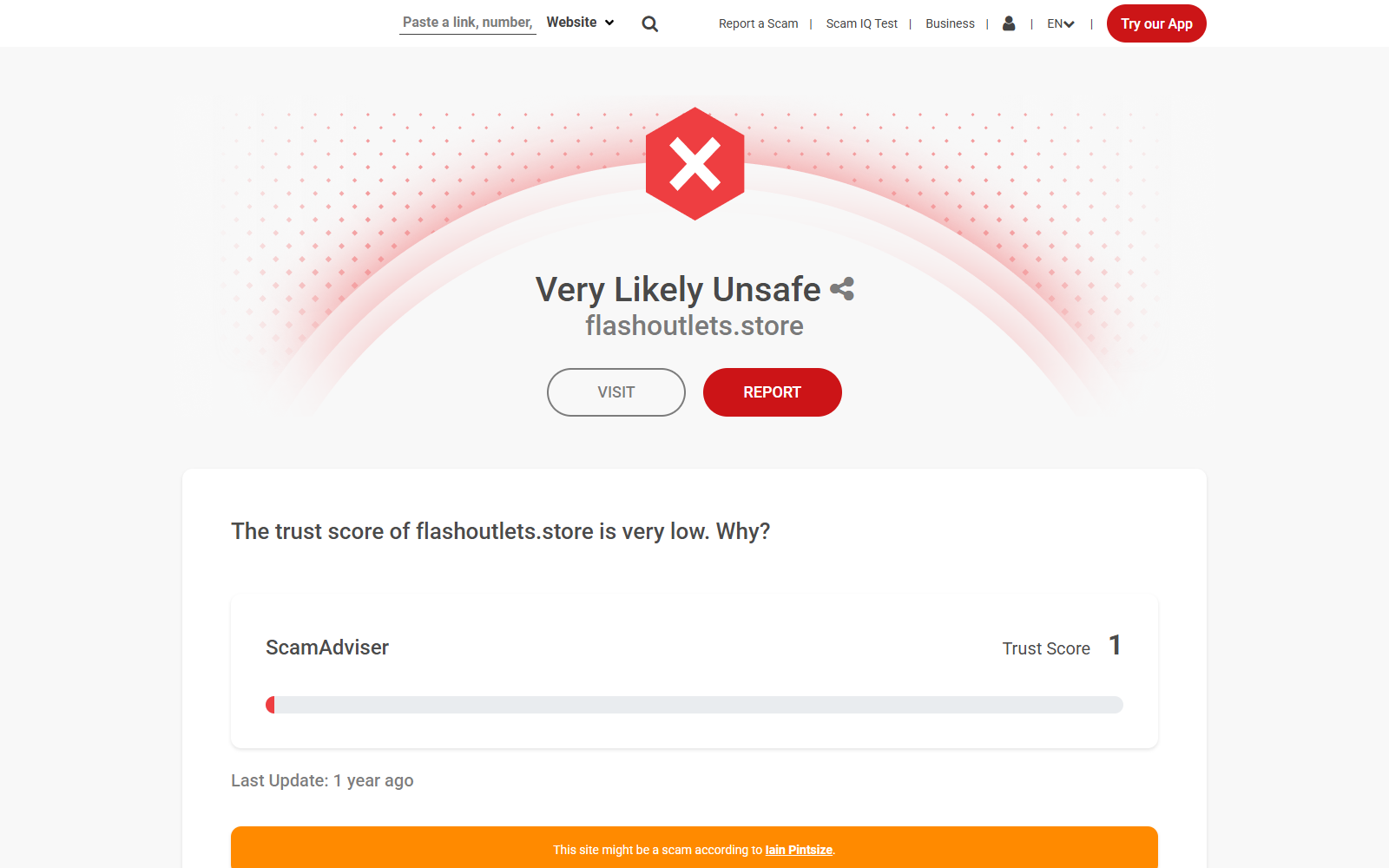
- One reputation service displayed a trust score of 1
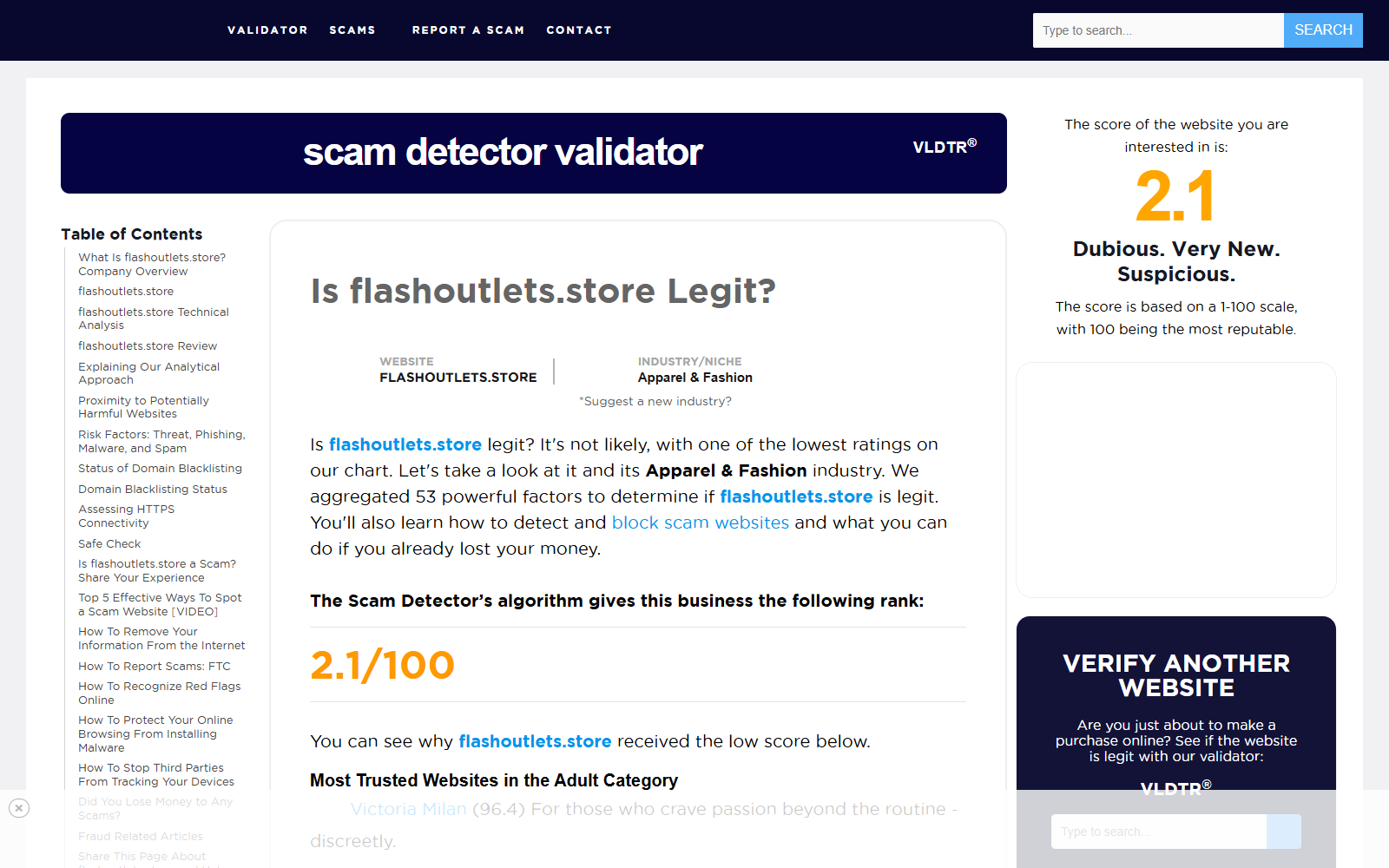
- Another automated review displayed 2.1 out of 100
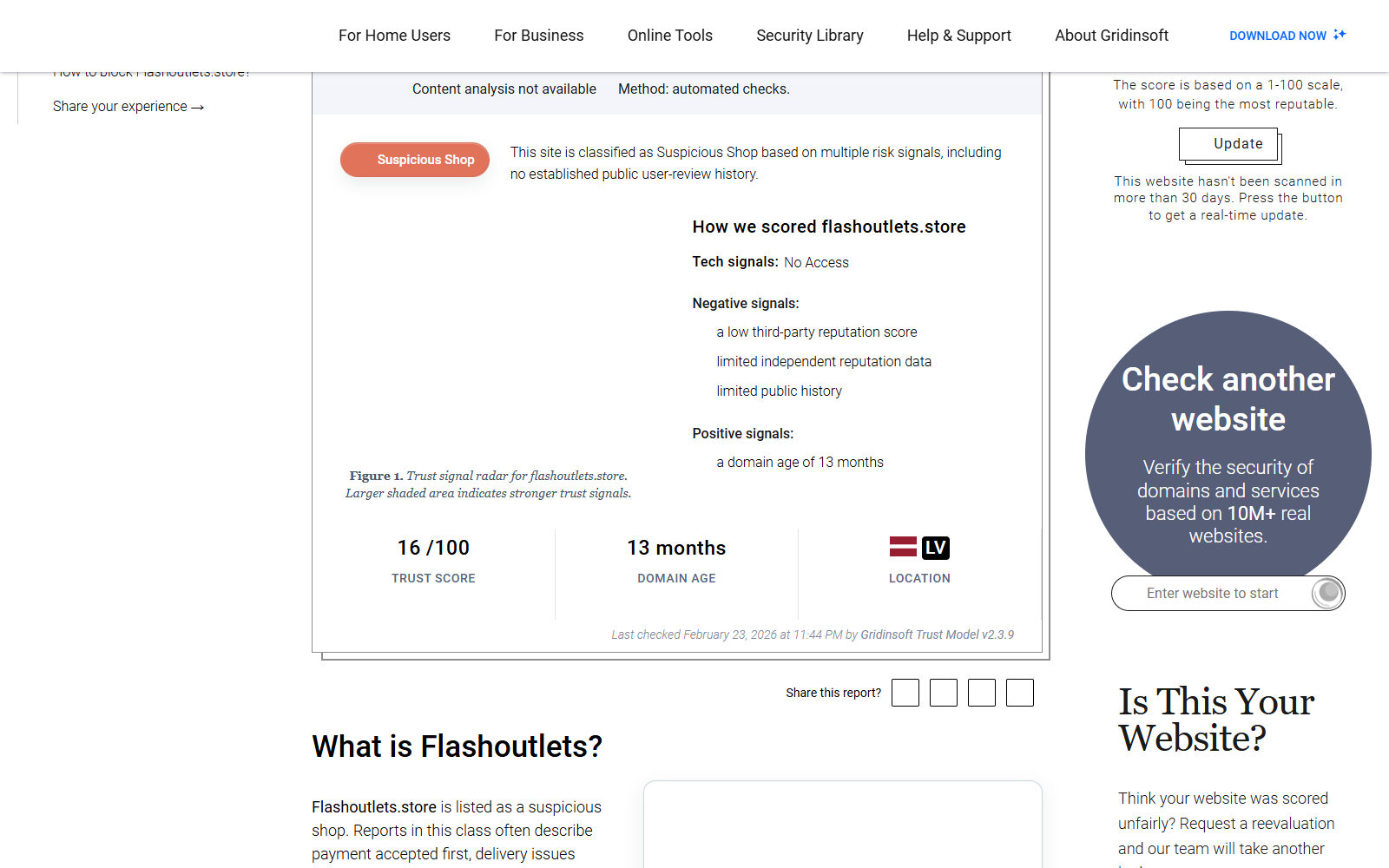
- A separate security service classified it as a suspicious shop
- No current storefront allowed us to verify inventory, policies, or ownership
These indicators support a strong warning. They do not justify inventing customer losses, so this investigation focuses on what can be verified.
Why Outlet-Store Offers Are Easy to Abuse
The word “outlet” gives shoppers a ready explanation for unusually low prices. Overstock, discontinued packaging, warehouse liquidation, and seasonal clearance all sound plausible.
Scam shops exploit that expectation. They copy product photographs, descriptions, customer ratings, and logos from established stores, then add a dramatic discount.
Social-media advertising supplies a constant stream of visitors. People land directly on a product page and may never inspect the rest of the website.
A polished theme is inexpensive and reusable. Product grids, payment icons, countdowns, stock counters, and policy templates can be deployed to a fresh domain quickly.
This creates an information imbalance. The shopper sees hundreds of products, while the operator may provide almost no verifiable identity.
HTTPS does not solve that problem. Encryption protects information while traveling to the site, but it does not establish who receives it.
A lock icon can appear on a trustworthy retailer, a temporary dropshipping store, or a fraudulent checkout. The certificate confirms the domain connection, not business honesty.
The most reliable checks happen outside the store. Search the legal company, address, phone number, domain age, card descriptor, and independent customer history.
Copied policies often expose a network. Another shop name, unrelated email, conflicting jurisdiction, or missing return address may remain inside the text.
A functioning checkout is also not proof. Payment processors can be opened with incomplete or misleading merchant information and later disappear.
What the Current Evidence Tells Us
Flashoutlets.store’s unavailability is the clearest present fact. Buyers cannot examine the exact offer, checkout, or policies that earlier visitors may have seen.
That limitation matters when interpreting third-party ratings. Automated scores are useful signals, not court findings or direct evidence of every transaction.
One service described the site as very likely unsafe and displayed a trust score of 1. It also noted use of a free email address.
Another service gave 2.1 out of 100 and categorized the website as dubious, very new, and suspicious.
A third report assigned 16 out of 100 and labeled it a suspicious shop. Its record listed the domain as approximately 13 months old.
These services analyze combinations such as domain age, ownership visibility, traffic, hosting relationships, technical signals, and known reports.
Scores can be wrong or stale. A legitimate small business may have low traffic and private registration, especially during its first year.
However, a legitimate retailer can answer those concerns through transparency. It can publish an identifiable entity, working contacts, clear policies, and a consistent operating history.
Flashoutlets.store’s current disappearance prevents that verification. The combination justifies avoiding new payments and preserving evidence from any earlier order.
We did not locate reliable evidence establishing what every customer received. Do not assume a low score proves non-delivery in a particular case.
For a payment dispute, the strongest evidence is transaction-specific: the offer, promised date, package, tracking history, correspondence, and mismatch.
How the Flashoutlets.store Scam Pattern Works
Step 1: A high-discount advertisement finds the shopper
The journey commonly begins with a social post showing a desirable product at a price far below established retailers.
The explanation may be clearance, bankruptcy, warehouse overflow, an anniversary, or a closing sale. Urgency discourages outside research.
Step 2: The product page imitates a mature retailer
A familiar commerce template displays professional photographs, variant selectors, testimonials, trust icons, and an apparently large catalog.
Visual completeness can disguise a missing legal entity. Buyers often evaluate page design when they should evaluate the operator.
Step 3: Scarcity pushes an immediate checkout
Low-stock notices, expiring timers, visitor counters, and sale deadlines suggest that leaving the page means losing the deal.
These widgets are easy to automate. Refresh the page later and observe whether the same deadline or inventory magically returns.
Step 4: Payment goes to an unfamiliar merchant
The card statement may display a descriptor unrelated to the storefront name. That can make recognition, support, and charge disputes harder.
Before paying, buyers should know the merchant of record and save the final checkout total, currency, shipping promise, and refund terms.
Step 5: Delivery or refund problems become difficult to resolve
In the broader scam-shop pattern, buyers may receive nothing, a cheap substitute, an incorrect item, or tracking unrelated to their address.
We have not verified that every Flashoutlets customer experienced these outcomes. They are the practical risks created by an untraceable, unavailable seller.
Step 6: The storefront disappears or changes domains
Once complaints and disputes accumulate, an operator can abandon the domain and relaunch the same theme under another name.
The current connection failure is therefore important. It leaves previous buyers without the original policy pages needed to enforce promises.
How to Check an Unfamiliar Online Store
Begin with the price. Compare the exact model, size, condition, and shipping cost through established retailers and the manufacturer.
A discount far outside the market needs a credible explanation. A generic “warehouse clearance” banner is not evidence of genuine inventory.
Search the domain, not only the store name. Fraud networks can reuse branding while moving through different web addresses.
Review the registration date. A site claiming decades of family history cannot credibly operate on a newly created domain without explaining the change.
Look for a legal company in the terms, privacy notice, checkout, and footer. Those locations should agree.
Map the street address and inspect the business listing. A residence, mailbox, vacant lot, or unrelated company requires clarification.
Call the phone number before ordering. Ask about a specific product, return destination, stock location, and card statement descriptor.
Search a distinctive sentence from the policy in quotation marks. Identical wording across unrelated stores can reveal a copied template.
Inspect customer reviews outside the website. Pay attention to dates, reviewer history, photographs, and repeated phrasing.
Use a credit card when appropriate because dispute rights are generally stronger than wire transfers, gift cards, direct cryptocurrency, or payment applications.
Do not let payment logos imply endorsement. A merchant can display brand images without authorization or route payments through an unrelated processor.
Save screenshots before ordering. If the page vanishes, your evidence may be the only record of the promised product and refund policy.
Warning Signs That Matter More Than a Store’s Design
Start with consistency. The company name should match across the footer, privacy notice, terms, receipt, payment screen, and card statement.
Check the domain inside support emails. A retailer using only free mail accounts is harder to authenticate when a dispute begins.
Read shipping estimates carefully. Wording such as “processing may vary” can turn a seemingly fast delivery promise into an undefined wait.
Inspect the cancellation window. Some stores claim orders enter fulfillment immediately, making cancellation impossible even before tracking exists.
Look for return conditions involving unopened packaging, overseas postage, restocking deductions, or authorization that support can simply delay.
Search product images with a reverse-image tool. Identical pictures may appear on established marketplaces at a fraction of the claimed retail price.
Compare specifications line by line. Scam pages often copy descriptions from another model, leaving impossible dimensions or incompatible accessories.
Test navigation beyond the product. Empty categories, broken social links, copied blogs, and unfinished policy placeholders suggest a rapidly assembled shop.
Examine the language around scarcity. A genuine inventory number should change logically, not reset whenever the page reloads.
Use the browser’s address bar, not the logo, to identify the domain. Lookalike spellings can imitate a recognized retailer.
Search the advertised customer-service number. The same number appearing across unrelated stores can indicate a shared disposable operation.
Finally, trust the combined pattern. One weak signal may be innocent, but numerous contradictions should outweigh a beautiful theme or dramatic price.
Taking five minutes to complete these checks is usually easier than recovering money from a seller that no longer answers.
Company, Address, and Fulfillment Checks
No current legal seller can be confirmed
Because the shop no longer loads, we could not confirm a legal company on its present terms, checkout, or footer.
Earlier buyers should examine receipts and statements. The entity that accepted payment is more important than the brand printed in an advertisement.
The address must match the responsible entity
A return address may belong to a fulfillment warehouse, forwarding agent, residence, or unrelated business. None automatically proves headquarters ownership.
Confirm the address through corporate records and obtain written return authorization before sending merchandise.
Free or unresponsive contact details increase risk
A reviewed reputation report noted a free email address connected with the domain. Small businesses may use one, but traceability is weaker.
If email bounces and no phone works, document every attempt. Repeated silence supports a payment dispute more effectively than speculation.
Tracking does not prove correct fulfillment
Some problematic stores provide a tracking number that only confirms delivery within the same postal area. It may not identify the recipient or parcel contents.
Ask the carrier for written confirmation of destination details allowed under privacy rules, package weight, and delivery evidence.
What to Do if You Have Fallen Victim to This Scam
- Save transaction evidence. Keep the advertisement, product page, order confirmation, total, card descriptor, shipping promise, policy, emails, and tracking record.
- Contact the seller once in writing. State the exact resolution requested and a reasonable deadline. Avoid emotional language that obscures the facts.
- Verify the tracking independently. Enter the number on the carrier’s official website, not through an email link. Record weight and destination discrepancies.
- Open a payment dispute promptly. Select the accurate reason, such as non-delivery, unauthorized charge, counterfeit goods, or item materially different from description.
- Do not return blindly. Obtain authorization and confirm the address with the payment provider. Use tracked postage if a return is required.
- Monitor the payment method. Watch for unfamiliar charges or trial billing. Ask the issuer whether replacement is advisable.
- Change reused credentials. If the store password was used elsewhere, replace it everywhere, beginning with email and financial accounts.
- Scan suspicious downloads. If the store installed an application or file, run Malwarebytes and remove unknown extensions or programs.
- Block malicious promotions. AdGuard can reduce risky ads and trackers. Revoke notification permissions granted to the store.
- Report the evidence. Notify the advertising platform, FTC, payment processor, registrar, and relevant consumer protection agency.
Frequently Asked Questions
Is Flashoutlets.store currently working?
It did not load as a functioning store during our latest review. Availability can change, so preserve current and historical evidence.
Does a trust score prove the site is fraudulent?
No automated score proves every allegation. Several very low scores become useful warning signals when combined with the site’s disappearance and limited transparency.
How old is the domain?
Reviewed registration records list August 22, 2025 as its creation date. That gave the store a short public history.
What if my order actually arrived?
Inspect whether it matches the exact model, quantity, condition, and claims. Delivery does not prevent a dispute over counterfeit or misdescribed goods.
Can I recover a card payment?
Possibly. Contact the issuer quickly and provide transaction-specific evidence. Time limits and available dispute reasons vary by provider and jurisdiction.
Should I use the return address from the parcel?
Not automatically. It may be a logistics center without authority to process refunds. Confirm instructions in writing and with your payment provider.
The Bottom Line
Flashoutlets.store combines a young domain, hidden ownership, extremely low automated trust ratings, and a storefront that no longer loads normally.
That evidence supports avoiding the site, but buyers should base disputes on documented order facts rather than assuming one outcome for every transaction.
If you already paid, preserve the vanished offer, contact the payment provider promptly, and do not let an unverifiable return request consume the dispute deadline.








