


An investment account keeps showing strong monthly gains, and an impressive audit appears to back them up. Then a withdrawal takes longer than promised.
For Backward Hat Capital investors, the explanation now involves federal charges and a closer look at what those statements and audit claims actually represented.
Overview
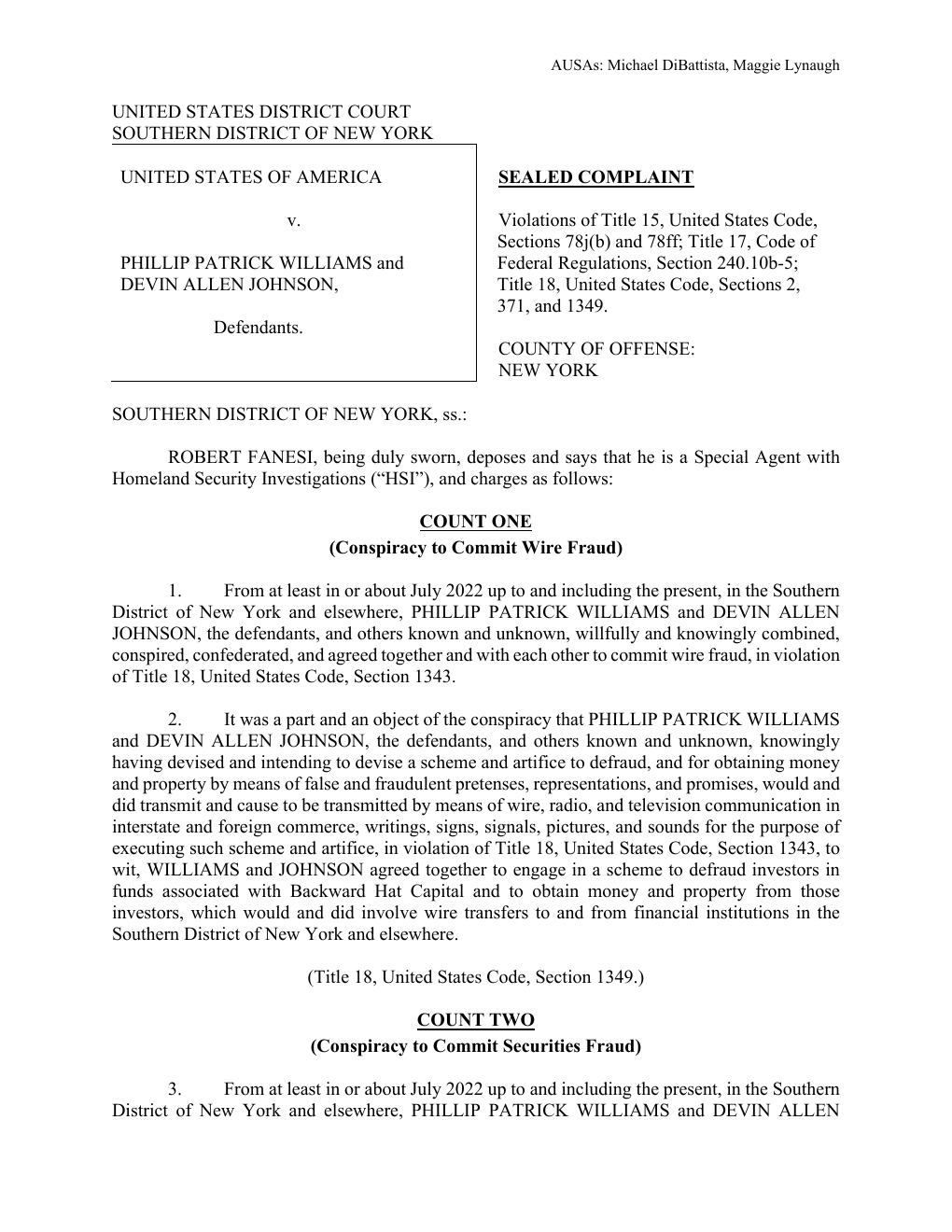
The case concerns an alleged forex investment operation
Federal prosecutors charged Phillip Patrick Williams and Devin Allen Johnson over funds associated with Backward Hat Capital. The charges concern securities fraud and related conspiracies.
The Justice Department announcement describes more than $600 million raised from over 2,000 investors, supposedly for foreign-exchange trading using a proprietary algorithm.
Those are contribution figures, not a final calculation of every investor’s loss. The defendants are presumed innocent unless and until proven guilty.
The complaint challenges returns, cash flows, and audit independence
The nine-page sworn complaint describes investor dashboards, internal messages, bank records, cryptocurrency transfers, and communications concerning a purported independent auditor.
Investigators allege that incoming investor money funded earlier investors’ redemptions, while substantial amounts went to founders and general partners instead of the represented trading activity.
They also allege that monthly rates were selected through internal messages. A reported account gain therefore cannot be treated as independent evidence of trading profits.
Investors have a specific reporting route
The FBI’s Indianapolis office has opened a case-specific investor information form. Reporting can assist the investigation, but it does not guarantee reimbursement.
- Stop making additional contributions while evaluating the official case.
- Preserve statements, agreements, payment records, and promotional material.
- Separate money actually received from dashboard-only reported gains.
- Use official reporting channels rather than unsolicited recovery offers.
- Keep criminal allegations distinct from a final court determination.
What Backward Hat Told Investors
According to the complaint, Backward Hat operated more than twelve funds and presented its strategy as foreign-exchange arbitrage supported by proprietary automation and algorithms.
That description matters because investors were not simply making unsecured personal loans to the founders. They were being shown a particular explanation for generating returns.
The complaint describes offering materials, private placement documents, and partnership agreements that connected investment profits to forex trading. Those representations can be compared with actual fund movements.
Investigators say investor-facing statements commonly reported monthly returns above 6%. The complaint describes dashboard rates between 6.01% and 7.21% from October 2023 through September 2026.
A separate, more aggressive fund reportedly showed higher results. Investigators describe internal records where ordinary funds never fell below 6% from January through August 2026.
The striking feature is not merely a high number. It is the combination of consistent reported gains, claims about how profits arose, and questioned supporting documentation.
A balance display is not a bank statement
A dashboard can record whatever its operator enters. Confirming a displayed figure requires evidence about the underlying assets, transactions, liabilities, and custody arrangements.
How the Alleged Backward Hat Operation Worked
Step 1: A trading strategy gave the investment its explanation
The offering materials described a forex strategy rather than simply asking investors to trust an unexplained income stream. Automation supplied a technical reason for the anticipated performance.
Using an algorithm is not inherently fraudulent, and forex trading is a real activity. The question is whether the represented trading happened with investor money.
Here, investigators allege a material gap between that explanation and the financial records. A plausible strategy description cannot substitute for evidence that it was actually used.
Step 2: Reported monthly returns reinforced confidence
Investors could see statements and dashboard results rather than relying solely on a verbal promise. Regularly updated figures can make an investment feel measurable and established.
The complaint alleges that Williams supplied the percentages used to calculate investor balances. It describes internal messages connecting selected rates to the amounts subsequently reported.
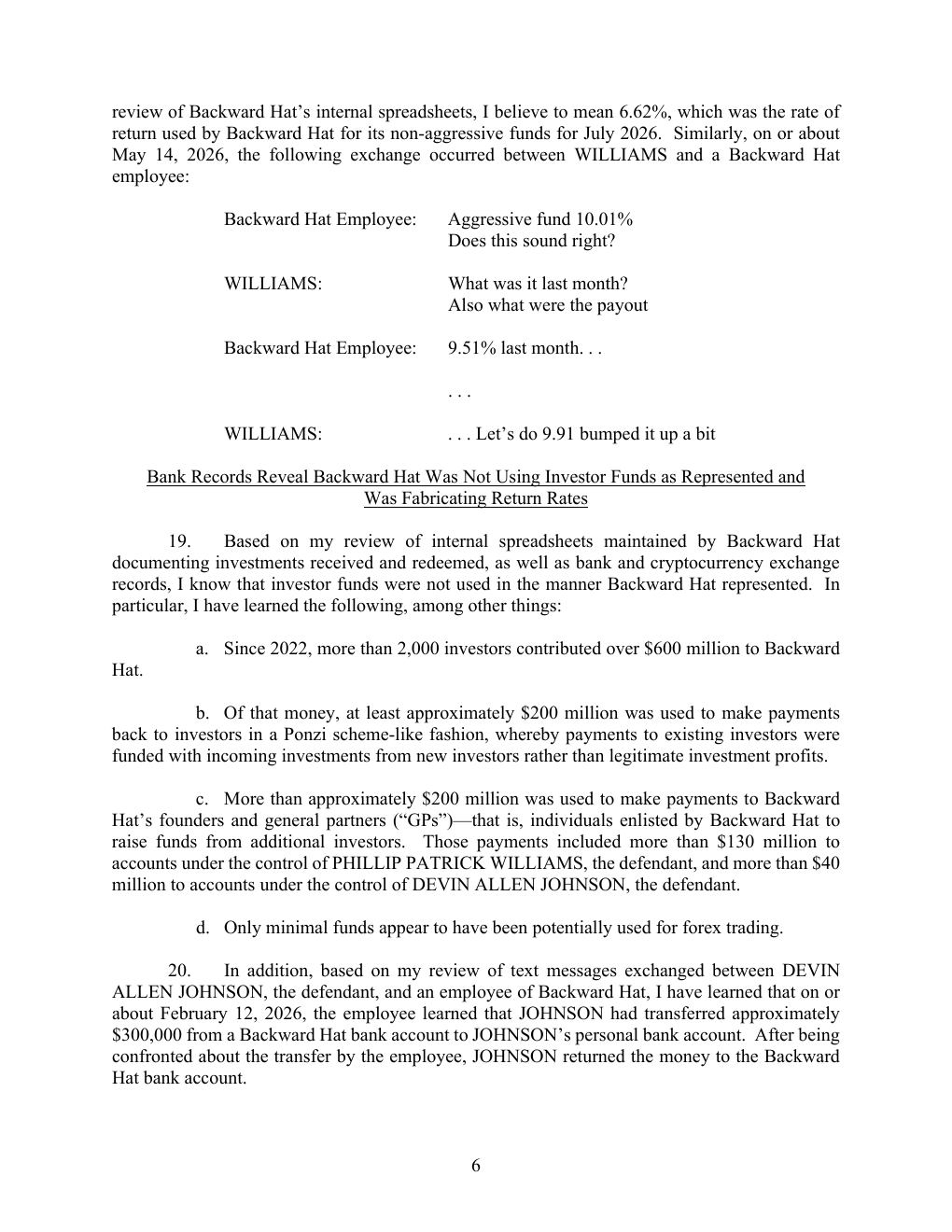
One example concerns a 6.62% rate assigned for July 2026. Another exchange concerns adjusting an aggressive fund’s reported rate after discussing its previous month’s figure.
These are allegations about how particular numbers were produced, not an accusation based only on unusually good performance. That distinction makes the internal communications important evidence.
Step 3: Purported independent audits added reassurance
The complaint describes audit and earnings reports covering several years. Their presentation emphasized independence, financial integrity, governance, and consistent performance.
A prospective investor could reasonably view an outside audit as a check on management’s account of events. The document’s credibility depends partly on that separation.
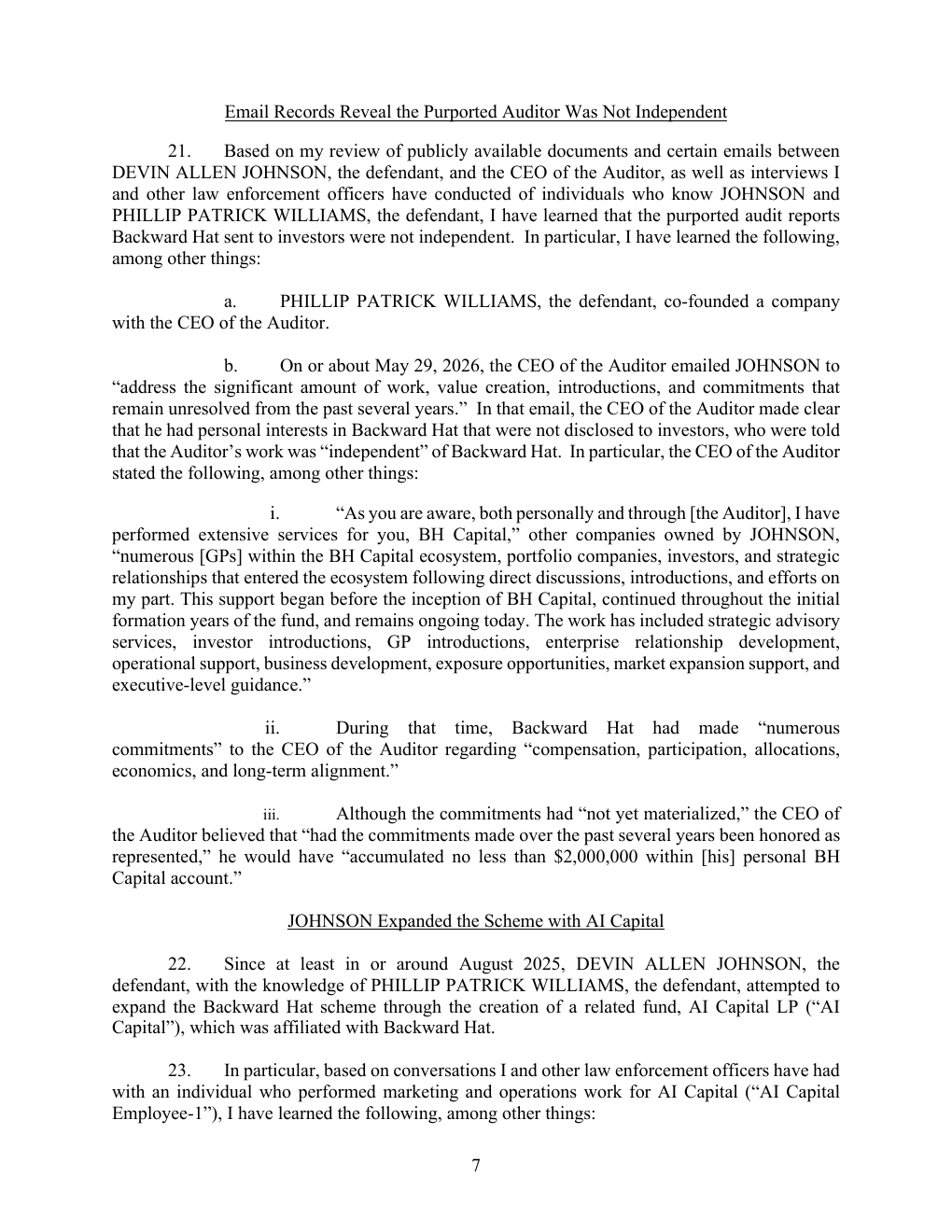
Investigators allege undisclosed relationships and personal financial interests involving the auditor’s chief executive. Those details directly challenge the independence represented to investors.
Step 4: New contributions allegedly funded older redemptions
The alleged money trail is different from a strategy that simply lost money while trading. Investigators say at least approximately $200 million funded payments to investors.
According to the complaint, those payments came from incoming investments rather than legitimate investment profits. That is the Ponzi-like mechanism prosecutors are alleging.
The same complaint describes more than approximately $200 million paid to founders and general partners. Individual founder amounts are included within that broader category.
Do not add every figure together as though the categories were independent. Doing so could double-count money and exaggerate what the filing actually states.
Step 5: A related fund reused the trading story
The complaint identifies AI Capital LP as a related attempted expansion. It says Johnson marketed the fund using Backward Hat’s supposed trading algorithm and history.
Investigators describe a data room containing purported trade records. They also allege a presentation claimed $75 million in funding when the fund had received no investor money.
The allegation concerns that specific representation and related operation. It does not mean every unrelated business using the words AI Capital belongs to this case.
Step 6: Withdrawal delays brought changing explanations
Investigators say Backward Hat had difficulty meeting withdrawal requests during summer 2026. Later communications attributed delays to banking, broker arrangements, transfer processing, and identity verification.
The complaint contrasts those explanations with messages describing efforts to obtain other funding. It alleges that most investor assets had already been dissipated.
The filing also describes communications indicating continued acceptance of investor money into November 2026. A slow withdrawal was therefore not presented merely as a closed historical issue.
Read the Money Figures Without Double Counting
The complaint’s figures explain different parts of the alleged operation. Contribution totals describe money raised, while redemption figures describe a particular reported use of that money.
Payments to founders and general partners form another category. The amounts attributed to Williams and Johnson are subsets, not separate amounts to add again.
None of these figures establishes how much a particular reader can recover. That depends on their transactions and whatever legal recovery processes actually occur.
| Figure in the complaint | What investigators describe | Important limit |
|---|---|---|
| More than $600 million | Capital contributed by more than 2,000 investors. | This is not a final net-loss calculation. |
| At least approximately $200 million | Payments to existing investors funded with incoming investments. | These are alleged flows, not proof of legitimate trading returns. |
| More than approximately $200 million | Payments to founders and general partners. | The named founders’ amounts belong within this category. |
| More than $130 million and $40 million | Amounts attributed to accounts controlled by Williams and Johnson respectively. | Do not add them again to the broader insider-payment figure. |
The Fund, Its Promoters, and the Purported Auditor
The name represents several related investment funds
Backward Hat is described in the complaint as a collection of related entities and funds. Your agreement may therefore name a specific partnership rather than the shorthand brand.
Keep that exact legal name when organizing records or making a report. Do not replace it with a similar name found through a casual search.
A general partner could also raise investor money
The complaint describes general partners enlisted to raise additional investment. A person who introduced an investor may therefore have a role different from the trading manager.
Preserve communications from that intermediary as well as from the founders. The representations you received matter even when the sender did not operate the dashboard.
Audit independence is more than a document title
Investigators say Williams co-founded another company with the auditor’s chief executive. They also describe the executive’s undisclosed expectations concerning compensation and economic participation.
Those alleged ties are the reason independence is challenged. An audit-shaped document, professional terminology, or a confident opinion letter cannot resolve that conflict by appearance alone.
A public filing is not government investment approval
The complaint references company formation documents and SEC filings as part of identifying the participants. That reference should not be converted into a claim of regulatory endorsement.
Investor.gov explains that a Form D filing does not establish SEC approval, licensure, or registration. Official-looking paperwork still requires careful interpretation.
Why a High Monthly Percentage Deserves Context
A monthly figure can look smaller than its annual implication. Repeated gains compound, which makes a steady high monthly claim far more demanding than it first sounds.
As a hypothetical calculation, $1,000 compounded at exactly 6% each month becomes approximately $2,012 after twelve months, before fees or taxes.
That calculation is not a reconstruction of any investor’s account or a promised result. It simply illustrates why a recurring monthly rate needs substantial supporting evidence.
Reporting a gain and earning a gain are different events
The complaint alleges that management selected reported percentages. A smooth performance chart cannot independently establish the trading activity that supposedly produced those figures.
What to Do If You Invested With Backward Hat
-
Do not send additional contributions or payments to solve a delayed withdrawal. Review the official allegations before accepting another explanation from a promoter or intermediary.
Do not assume a proposed replacement fund makes the earlier problem disappear. Preserve any new offer alongside the documents for your original investment.
-
Save your exact agreements, offering materials, statements, and dashboard records. Include the documents explaining the strategy and any audit or earnings reports you received.
Preserve original messages with dates and sender details. A screenshot helps show what you saw, but it should not replace the underlying correspondence when available.
-
Build a transaction list separating contributions, withdrawals actually received, and gains appearing only on statements. Record bank references or cryptocurrency transaction identifiers where applicable.
A clear cash history is more useful than treating the latest dashboard balance as your proven loss. Keep calculations labeled so investigators can understand their basis.
-
Use the FBI’s official investor information form through the link above or the Justice Department’s announcement. Read the form’s instructions before supplying personal information.
The form asks about investment dates, total contributions, expected use of funds, promotional material, and returns received. It also provides instructions for submitting relevant documents.
-
Consider independent advice about your particular legal and financial position. Reporting to investigators is not the same as filing every possible claim or meeting every deadline.
Ask your own bank or payment provider about any available options for recent transfers. Do not assume that a completed transfer can automatically be reversed.
-
Reject unsolicited recovery offers that require an advance payment or wallet secret. Criminal allegations can attract impersonators who promise privileged access to supposedly recovered assets.
The SEC’s investor recovery guidance warns that recovery is uncertain and that harmed investors can be targeted again. Verify every claimed official role independently.
Use Your Records to Choose the Next Step
The choices below help organize information without collecting it. They do not calculate a claim, determine liability, or submit anything to investigators.
I have statements but cannot access the dashboard anymore
Preserve the statements and existing correspondence rather than chasing a new login supplied by a stranger. Include the exact fund name and account references in your records.
I received money before withdrawals became difficult
List those payments separately from your contributions. Receiving a payment does not, by itself, establish that it came from investment profits.
Someone wants a fee to recover my investment
Pause the conversation and verify the claim through an official channel. Do not supply a private key, remote access, or an advance payment to obtain supposed proceeds.
Frequently Asked Questions
Have the Backward Hat defendants already been convicted?
The announcement concerns criminal charges, not a conviction. The defendants are presumed innocent, and the complaint’s account remains allegations to be tested through legal proceedings.
Does the $600 million figure mean investors lost that exact amount?
No, it describes contributions identified in the case. It is not a final net-loss figure or a calculation of what every investor might recover.
Does a dashboard balance prove that trades were profitable?
No, a displayed balance needs independent support. This complaint specifically challenges the origin of reported percentages and the represented use of investment money.
Why does the purported auditor’s independence matter?
An outside assessment can reassure prospective investors. Investigators allege undisclosed personal and business interests that conflict with how that independence was represented.
Is every business called AI Capital connected with this case?
No, the filing describes a specific related fund and its marketing. Similar words in another company’s name do not establish that it shares this operation.
Will submitting the FBI form guarantee my money back?
No, the form helps identify investors and gather information. Reporting, legal claims, recovery of assets, and eventual distributions are separate matters with uncertain outcomes.
The Bottom Line
Do not put more money into Backward Hat while relying on disputed returns or audit claims. The federal complaint raises concrete concerns requiring independent attention.
If you invested, preserve your records, separate actual cash movements from displayed gains, and use the official FBI route. Avoid paying anyone who promises guaranteed recovery.

Join the discussion
0 commentsShare your experience or ask a question about this article.
Community experiences
Did this happen to you?
Your experience could help someone recognize the same scam. Submit a private report for our team to review.
I experienced this tooReports are reviewed before publication. Sharing publicly is always your choice.
Discussion
Start the conversation
Have a question or something useful to share? Add the first comment.