

A French-language email announces an important legal document. It sounds formal enough that leaving it unread feels uncomfortable, even if you weren’t expecting anything.
The download button offers an easy way to settle that uncertainty. Before opening it, take a moment to establish who is actually contacting you.
Overview
An official-sounding label creates pressure to open a document
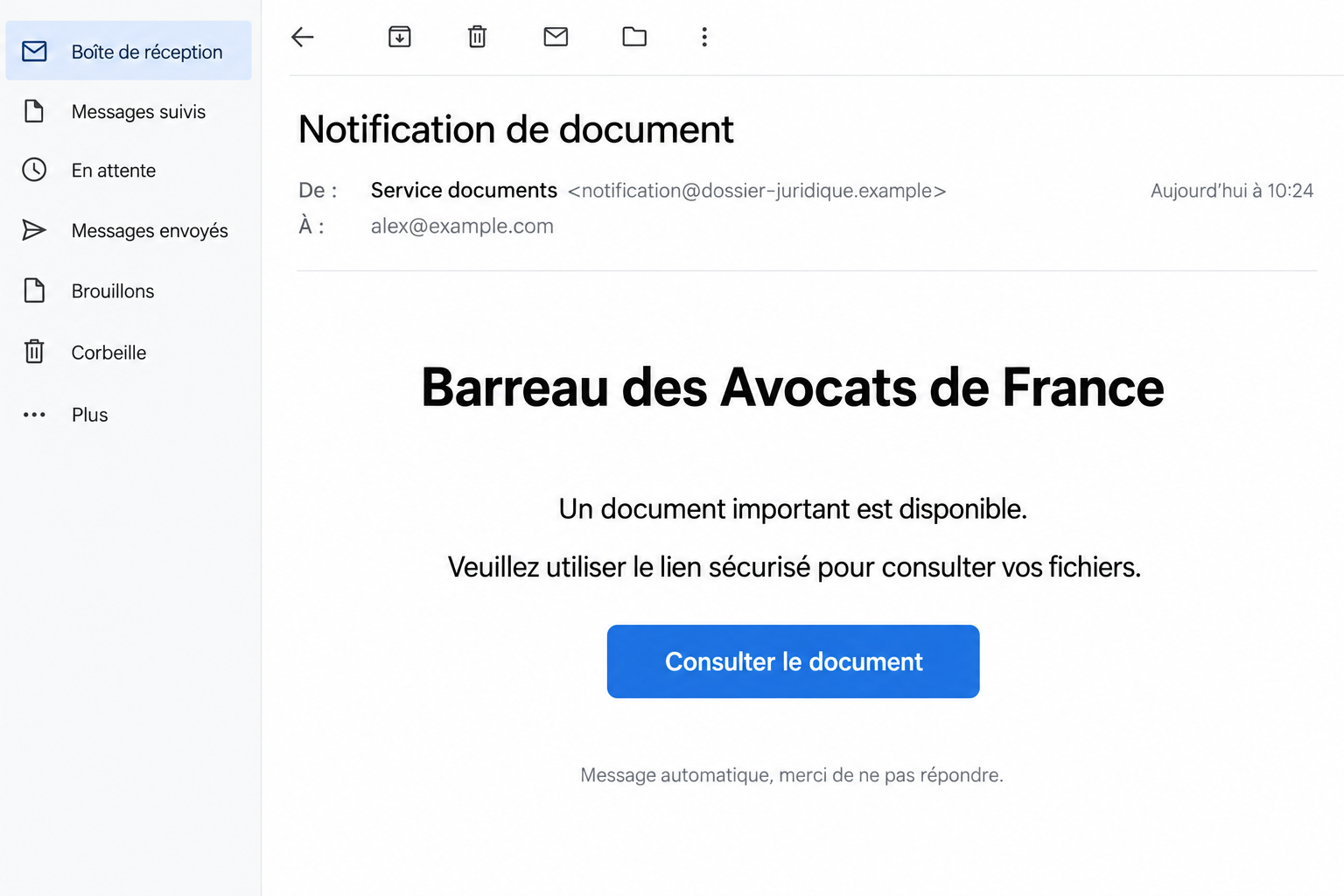
The Barreau des Avocats de France email scam uses a legal-document notification to send recipients toward an unverified link. Its apparent authority is part of the lure.
The reported French message presents an important document and a secure route to access it. A registered-letter theme makes the request feel consequential.
A legal-sounding heading does not identify a particular lawyer, court, or authorized sender. Don’t treat the display name as confirmation that the notice is genuine.
The second-stage risk depends on what the recipient does
The linked destination was reported inactive. There is no established live second-stage form or specific malware payload to identify in this warning.
Document lures can seek credentials, personal information, or a harmful download. Those are possible exposure routes, not proof that all occurred in this campaign.
That limit doesn’t make the message safe. Don’t use its link, and verify any genuine legal matter through an independently identified professional or organization.
The useful checks happen before opening the files
- Identify the specific sender and the matter the document supposedly concerns.
- Use contact details obtained outside the unexpected message.
- Question any request to reveal an unrelated email password.
- Keep genuine deadlines separate from pressure created by an unverified email.
The illustrative image uses fictional contact information. It depicts the notice’s approach without presenting an actual case number, sender address, or legal document.
Why Legal Language Can Make a Phishing Email Harder to Ignore
Most unexpected advertising is easy to close. A document that might concern legal affairs feels different because the cost of ignoring it seems uncertain.
The sender doesn’t need to explain that uncertainty very well. A formal label and a reference to restricted access can encourage the reader to fill the gaps.
You might wonder whether the message concerns a business agreement, a dispute, an estate, or something another family member arranged.
That uncertainty is a reason to verify, not a reason to enter information into whatever page appears next.
A genuine matter should connect to an identifiable person or institution. Ask who is writing, in what capacity, and about which actual file.
Don’t assume you must open a download before you’re allowed to ask those questions. Verification can begin through a trusted telephone number or established correspondence.
Equally, don’t conclude that all electronic legal documents are fraudulent. Legitimate professionals use online systems, and some real communications require timely attention.
The safe approach is to separate the suspected delivery route from the underlying matter. Decline the unverified link while checking whether something genuine needs your response.
If you’re worried about a legal deadline, consult a qualified professional through a verified channel. This email’s appearance cannot determine your legal obligations.
How the Barreau des Avocats de France Email Scam Works
Step 1: Introduce authority before explaining the relationship
The message leads with an institutional-sounding identity. That encourages the recipient to treat the request as official before establishing why it was sent.
A formal greeting, legal vocabulary, and an automated footer can all be typed into an ordinary email. None independently authenticates the sender.
Check whether the communication names a specific professional or actual matter you recognize. A vague notification should not acquire authority simply because it’s uncomfortable.
If you already work with a lawyer, contact that person using your saved details. Don’t assume a newly supplied address is an updated office contact.
Step 2: Make the link seem like the only way to understand
The document-access button promises to resolve the ambiguity created by the notice. Clicking becomes the apparent first step toward knowing whether you should be concerned.
This reverses a safer order. You should establish the source before trusting the destination, rather than asking the destination to explain who sent you there.
The word secure is only a claim. An encrypted connection can protect communication with a website without proving that website represents a legal professional.
Preview the destination if your mail application allows it safely. An unrelated or disguised address deserves a stop, not a trial visit with your credentials.
Step 3: Turn document access into a new request
A fraudulent document route may ask for an email login, additional personal details, or software needed to view the supposed file.
Evaluate each new request on its own. An intention to read a document is not permission to grant access to your mailbox or computer.
If a portal requests a password, ask whose account it is authenticating. A stranger’s document page has no automatic right to an unrelated account secret.
If a page offers a viewer or extension, don’t install it merely because the document appears important. Confirm the actual system through the verified sender.
Step 4: Let uncertainty encourage further interaction
An error page or unavailable file can make the recipient try again, reply, or seek help from a contact included in the notice.
That can keep the conversation inside the sender’s chosen channels. A second address or helpful reply isn’t independent verification if the same claimant supplied it.
Stop the route instead of troubleshooting it. If the document is real, its legitimate sender can explain a safe way to obtain it.
Don’t pay an unexpected release charge or share a verification code to resolve the problem. A new demand needs genuine authority, not another promise.
Checking the Claimed Legal Sender
A broad professional label isn’t a specific identity
France’s legal profession includes actual lawyers and bar organizations. The name in an email doesn’t authenticate any particular one of them.
Ask which professional or body is supposedly involved. Verify that exact identity through an official directory or contact route you find independently.
A genuine institution existing somewhere in France doesn’t validate every message using legal terminology. The specific communication still needs to match its real sender.
Read the actual address and destination
Expand the sender details rather than relying on the displayed name. Check whether the reply address differs from the one you expected.
Don’t use correct spelling as the deciding test. Polished French is compatible with a fraudulent message, just as a typo doesn’t alone settle a genuine sender’s identity.
If the notice was forwarded, ask the person who forwarded it how they verified it. Forwarding can spread uncertainty without resolving the original source.
Keep sensitive case information out of the verification request
You can ask whether an office sent a notice without sending the whole confidential file to an unknown address.
Use the genuine office’s preferred channel and provide only what it needs to locate the communication. Let the verified professional explain any additional requirements.
Avoid public posts containing case details, identity papers, addresses, or correspondence. Seeking help shouldn’t expose information that the original message merely claimed to protect.
Match the Response to the Document Interaction
A blank webpage, a saved file, and an installed viewer shouldn’t be treated as identical incidents. Establish what happened before choosing a remedy.
If a file downloaded but you never opened it, avoid opening it now. Preserve its name and let trusted support decide whether analysis is needed.
If the page requested a login and you declined, don’t assume it obtained your password. Check for other disclosures or permissions without inventing one.
If you entered a secret, record which account it belonged to. Changing a different account’s password won’t recover the access you actually exposed.
If a caller then asked for screen sharing, note whether you allowed it. That interaction can reveal information beyond anything typed into the original form.
Don’t send the entire suspicious document to an unknown person offering analysis. It may contain private material, and their identity still needs checking.
For a genuine professional relationship, ask how documents are normally exchanged. Establishing that expectation makes future unusual requests easier to recognize.
You can describe uncertainty honestly when requesting help. A clear account of the actions you remember is more useful than claiming either total safety or certain compromise.
What to Do if You Have Fallen Victim to This Scam
First, identify what you actually did. Reading the notice, entering a password, and running a downloaded file require different responses.
Don’t reopen a suspicious file to confirm its contents. Use your download history, account records, and saved correspondence to establish the sequence.
If the incident involves your employer or a client’s information, notify the responsible team promptly. Private legal documents may need special handling.
Stop using the document route. Close the page and decline any outstanding installation, notification, or access request.
Keep the original email for reporting, then use your mail application’s phishing controls. Don’t reply to argue with the sender.
Verify any real matter separately. Contact the lawyer, organization, or professional adviser through details you already trust or independently locate.
Explain that an unverified notice arrived. Ask whether they sent it and whether an actual document or deadline requires attention.
Don’t interpret this warning as a legal opinion that every related communication can be ignored. Seek qualified advice about genuine obligations.
Recover any account whose login you disclosed. Open the real service yourself and replace the compromised password.
Review active sessions, recovery contacts, authentication methods, and third-party permissions. End unfamiliar access rather than stopping at the password change.
Check what an exposed mailbox could reveal. Inspect forwarding rules and recent outgoing messages, and look for unfamiliar changes to linked services.
If colleagues or clients received messages from the account, warn them through a separate trusted route. Avoid forwarding the active lure as the warning.
Address files and software according to the device. If you executed a download or installed a viewer, stop using the device for sensitive work.
Run Malwarebytes through a trusted installation route, or follow your organization’s response process. Use the appropriate operating-system section of the guide below.
AdGuard can help reduce some malicious advertising and redirects. It cannot authenticate a legal sender, reverse disclosures, or remove account sessions.
Report financial or identity exposure specifically. Contact the bank if you paid or shared banking access. Explain the transaction accurately and ask about available protection.
If identification documents were disclosed, ask the relevant issuer or local identity-fraud service what precautions fit those documents. Don’t assume all disclosures require the same remedy.
Preserve a private evidence set. Save the email with headers, destination address, downloaded filename, and relevant account or payment events.
Write down approximate times and what you entered. Exclude passwords and other secrets from material sent to a public forum.
Reject follow-up pressure. A person offering to settle the matter, cancel a penalty, or recover a payment still needs independent verification.
Do not share remote access or pay a new fee because someone knows details from the earlier conversation. Familiarity with the incident isn’t authority.
Is Your Device Infected? Run a Free Malware Scan
Slow performance, constant pop-ups, or strange behavior? These are classic signs of a malware infection. The fastest way to find out is to scan your device with Malwarebytes Free — one of the most trusted malware removal tools available.
The free version detects and removes the most common threats, including:
- Adware — the cause of those annoying pop-ups
- Browser hijackers — unwanted redirects and changed homepages
- Trojans and spyware — hidden programs stealing your data
- Potentially unwanted programs (PUPs) — software you never asked for
👉 Select your device below — Windows, Mac, or Android — then follow the simple steps to download Malwarebytes, scan your system, and remove any threats it finds. The scan usually takes 5 to 20 minutes.
Run a Malware Scan with Malwarebytes for Windows
Malwarebytes is one of the most popular and trusted anti-malware tools for Windows — and it’s completely free for removing infections. It catches threats that many antivirus programs miss, including adware, browser hijackers, and trojans. Follow the steps below to scan and clean your PC in just a few minutes.
Download Malwarebytes
Click the button below to download the latest version of Malwarebytes for Windows from the official source. The free version is all you need — it will scan your computer and remove adware, browser hijackers, and other malicious software at no cost.
Download MalwarebytesOfficial installer for Windows 11 and 10. Your download starts right away.Want real-time protection? See Malwarebytes Premium Malwarebytes Free for WindowsScans and removes malware at no cost
-
Install Malwarebytes
When the download finishes, open your Downloads folder and double-click the MBSetup file. If Windows shows a User Account Control pop-up, click “Yes” to allow the installation.

Follow the On-Screen Prompts to Install Malwarebytes
The setup wizard will walk you through a few quick screens:
-
Choose where you’re installing the program — “Personal Computer” or “Work Computer” — then click Next.

-
Malwarebytes will now install on your device. This usually takes under a minute.

-
When installation is complete, the “Welcome to Malwarebytes” screen will open automatically.

-
On the final screen, click Open Malwarebytes to launch the program.

-
Enable “Scan for Rootkits”
Before scanning, turn on rootkit detection so Malwarebytes can find even the most hidden threats. Click the Settings gear icon on the left side of the screen.

In the settings menu, find “Scan for rootkits” and click the toggle so it turns blue.

Done? Click “Dashboard” in the left pane to return to the main screen.
Start the Scan
Click the blue Scan button. Malwarebytes will automatically update its virus database and start checking your computer for malware.

-
Wait for the Scan to Finish
The scan checks your entire system for browser hijackers and other malicious programs, so it can take 5 to 20 minutes depending on your computer. Feel free to do something else — just check back occasionally to see the progress.

-
Quarantine the Detected Threats
When the scan is done, you’ll see a list of everything Malwarebytes found — malware, adware, and potentially unwanted programs. Click the “Quarantine” button to remove all of them at once.

Malwarebytes will now remove the malicious files and registry entries and move them safely into quarantine.

-
Restart Your Computer
Some threats can only be fully removed after a reboot. If Malwarebytes asks you to restart, click Yes. Once you’re logged back in, Malwarebytes has finished removing the threats it found.

That’s it — your Windows PC is now clean of trojans, adware, and other malware, and should be back to running smoothly.
If you are still having problems with your computer after completing these instructions, then please follow one of the steps:
- Run a computer scan with ESET Online Scanner
- Ask for help in our Windows Malware Removal Help & Support forum.
Run a Malware Scan with Malwarebytes for Mac
Malwarebytes for Mac is a free on-demand scanner that removes the malware other security software tends to miss — adware, browser hijackers, and unwanted programs included. Cleaning an infected Mac with Malwarebytes has always been completely free, and it’s our go-to recommendation. Follow the steps below to scan and clean your Mac in just a few minutes.
-
Download Malwarebytes for Mac
Click the button below to download the latest version of Malwarebytes for Mac.
Download MalwarebytesOfficial installer for macOS. Your download starts right away.Want real-time protection? See Malwarebytes PremiumMalwarebytes Free for MacScans and removes malware at no cost -
Open the Malwarebytes setup file
When the download finishes, open your Downloads folder and double-click the setup file to begin the installation.

-
Follow the On-Screen Prompts to Install Malwarebytes
The Malwarebytes for Mac Installer will guide you through a few quick screens. Click “Continue” and keep following the prompts until the installation completes.



When the installation is complete, Malwarebytes opens to the Welcome to Malwarebytes screen. Click “Get started“.
-
Select “Personal Computer” or “Work Computer”
Malwarebytes will ask what type of computer you’re installing it on. Click either Personal Computer or Work Computer, whichever applies.

-
Start the Scan
Click the “Scan” button. Malwarebytes will automatically update its detection database and begin checking your Mac for malware.

-
Wait for the Scan to Finish
Malwarebytes will scan your Mac for adware, browser hijackers, and other malicious programs. This can take a few minutes, so feel free to do something else — just check back occasionally to see the progress.

-
Quarantine the Detected Threats
When the scan is done, you’ll see a list of everything Malwarebytes found. Click the “Quarantine” button to remove all the threats at once.

-
Restart Your Mac
Malwarebytes will now remove all the malicious files it found. Some threats can only be fully removed after a reboot — if Malwarebytes asks you to restart, allow it. Once you’re logged back in, your Mac is clean.

That’s it — your Mac is now free of adware, rogue browser extensions, and other potentially harmful software.
If you are still experiencing problems while trying to remove a malicious program from your computer, please ask for help in our Mac Malware Removal Help & Support forum.
Run a Malware Scan with Malwarebytes for Android
Malwarebytes for Android automatically detects and removes dangerous threats like malware and ransomware so you don’t have to worry about your most-used device being compromised. Aggressive detection of adware and potentially unwanted programs keeps your Android phone or tablet running smooth.
-
Download Malwarebytes for Android.
You can download Malwarebytes for Android by clicking the link below.
Get Malwarebytes for AndroidOpens Google Play in a new tab.Want real-time protection? See Malwarebytes Premium for AndroidMalwarebytes for AndroidScans your phone and removes malware at no cost -
Install Malwarebytes for Android on your phone.
In the Google Play Store, tap “Install” to install Malwarebytes for Android on your device.

When the installation process has finished, tap “Open” to begin using Malwarebytes for Android. You can also open Malwarebytes by tapping on its icon in your phone menu or home screen.

-
Follow the on-screen prompts to complete the setup process
When Malwarebytes will open, you will see the Malwarebytes Setup Wizard which will guide you through a series of permissions and other setup options.
This is the first of two screens that explain the difference between the Premium and Free versions. Swipe this screen to continue.
Tap on “Got it” to proceed to the next step.
Malwarebytes for Android will now ask for a set of permissions that are required to scan your device and protect it from malware. Tap on “Give permission” to continue.
Tap on “Allow” to permit Malwarebytes to access the files on your phone.
-
Update database and run a scan with Malwarebytes for Android
You will now be prompted to update the Malwarebytes database and run a full system scan.

Click on “Update database” to update the Malwarebytes for Android definitions to the latest version, then click on “Run full scan” to perform a system scan.

-
Wait for the Malwarebytes scan to complete.
Malwarebytes will now start scanning your phone for adware and other malicious apps. This process can take a few minutes, so we suggest you do something else and periodically check on the status of the scan to see when it is finished.

-
Click on “Remove Selected”.
When the scan has been completed, you will be presented with a screen showing the malware infections that Malwarebytes for Android has detected. To remove the malicious apps that Malwarebytes has found, tap on the “Remove Selected” button.

-
Restart your phone.
Malwarebytes for Android will now remove all the malicious apps that it has found. To complete the malware removal process, Malwarebytes may ask you to restart your device.
That’s it — your Android phone is now clean — no more malicious apps, adware, or browser redirects.
If you are still having problems with your phone after completing these instructions, then please follow one of the steps:
- Restore your phone to factory settings by going to Settings > General management > Reset > Factory data reset.
- Ask for help in our Mobile Malware Removal Help & Support forum.
Stay Protected: Block Ads and Malicious Sites
Now that your device is clean, keep it that way. Most infections start with a malicious ad or a fake download button — so blocking them at the source is your best defense.
We recommend AdGuard, which blocks malicious ads, phishing pages, and dangerous redirects before they can reach you.
👉 Download AdGuard and browse safely
A Safer Way to Handle Unexpected Legal Files at Work
Decide in advance who receives external legal notices. A shared process reduces the chance that an employee feels personally responsible for solving an unexplained message immediately.
Keep a directory of genuine counsel and established contact methods. A new phone number inside a notice should not silently replace those records.
When a message claims to concern a client, avoid sending client documents back to establish identity. Confirm the professional relationship first.
If a colleague asks you to open the file because their viewer failed, pause. Passing the document between computers can expand an incident without explaining its source.
Use an approved reporting channel so security staff can inspect the message. Don’t upload confidential correspondence to a random public file-analysis site.
Set expectations around urgency. Staff should know that taking a few minutes to verify an unexpected sender is a responsible action, not neglect.
For French-language guidance, Cybermalveillance.gouv.fr explains phishing warning signs and the value of contacting the purported sender through another channel.
A verified document can then be handled through the appropriate business process. Security checks should preserve legitimate work while refusing an untrusted delivery route.
Frequently Asked Questions
Is the Barreau des Avocats de France email safe to open?
Don’t use the unsolicited document link. Establish the actual sender and matter independently before accessing any file or portal.
Does the title prove that an official bar sent it?
No. An institutional-sounding label doesn’t authenticate a specific organization or lawyer. Verify the exact party through an independent official route.
Should I ignore all legal documents after receiving this?
No. Reject the suspicious route while checking whether a real matter exists. Ask a qualified professional about genuine deadlines or obligations.
What if the document page no longer opens?
Don’t troubleshoot through contacts supplied by the notice. An unavailable page doesn’t validate the message or undo anything you already disclosed.
Am I infected because I read the email?
Reading alone doesn’t establish infection. Investigate software exposure if you opened a harmful download, installed something, or observed unwanted changes.
What matters most if I entered my email password?
Recover the real mailbox promptly, revoke unfamiliar access, and inspect its settings. Device scanning alone doesn’t restore control of a disclosed account.
The Bottom Line
Don’t follow the Barreau des Avocats de France email scam’s document link. A formal presentation isn’t verified legal authority.
Confirm any genuine matter separately. If you disclosed information or ran a file, respond to that specific exposure and preserve the evidence privately.

Join the discussion
0 commentsShare your experience or ask a question about this article.
Discussion
Start the conversation
Have a question or something useful to share? Add the first comment.