


A name like Betty Rae sounds like a person you could call: a small jeweler with a workbench, a family story and a reason to sell rings at a discount.
If you’re checking whether Betty Rae Jewelry is legit or waiting on a BettyRae-Jewelry.com order, here’s what is left, and the live John & Mary shop that shares its naming.
Overview
What BettyRae-Jewelry.com was
BettyRae-Jewelry.com was an online jewelry shop that sold under a woman’s name. We first reported on it in July 2025.
The store is gone now. The domain is no longer registered at all, and no archived copy of its pages survives in the Wayback Machine or on urlscan.
The domain name itself, a first name joined to -jewelry.com, matches a family of shops rather than a single business.
That leaves buyers with no product pages, no policies and no contact form to point to. Whatever the store promised can only be shown from your own emails and receipts.
Is Betty Rae a real jewelry brand?
No maker’s website, wholesale listing or brand history connects the Betty Rae name to BettyRae-Jewelry.com, so there is no jeweler behind it you can check.
Similar names do belong to real businesses, such as Betty and Biddy, an Irish costume jewelry company, and Ela Rae, a New York bracelet line. Neither is connected to BettyRae-Jewelry.com.
Is Betty Rae Jewelry legit?
It can’t be treated as a working business. There is nobody to contact, no address on record and no website.
An unfinished order or refund therefore has to go through your bank or PayPal.
- Status: bettyrae-jewelry.com is unregistered and loads nothing.
- Brand: no jewelry label, maker or wholesale account can be tied to the store.
- Pattern: person-named jewelry domains keep appearing, including two registered on the same day in November 2025.
- Current example: John & Mary Jewelry offers free jewelry with paid shipping under a retiring-couple story.
- Your options: a card dispute or PayPal claim, backed by your order emails and payment record.
What Is Left of BettyRae-Jewelry.com
A lookup in the .com registry returns no record for bettyrae-jewelry.com. The name has lapsed, which means anyone could buy it and put a new site there.
If a page ever appears at that address again, it won’t belong to the store you bought from. Don’t log in, pay or send order details to it.
Your own records are the main evidence. Order confirmations, shipping notices, screenshots of the product page and your card statement matter more than anything still online.
Check how the charge appears on your statement. Stores like this often bill under a different name from the website, and that billing name is what your bank will use.
Search your inbox for the store’s name and any support address. Older messages may hold a tracking number or a billing name you missed.
Betty Rae and the First-Name Jewelry Store Pattern
BettyRae-Jewelry.com fits a naming pattern we keep seeing: a first name, or a couple’s names, followed by -jewelry.com. The names suggest a person behind the counter.
Our reports cover several of these stores, including Mary-Jewelry.com, Arlene-Jewelry.com and Sophias-Jewelry.com.
Mary-jewelry.com and arlene-jewelry.com were both registered on November 8, 2025. Same-day registration of two near-identical names doesn’t prove one owner, but it isn’t how small family jewelers start out.
Sophias-jewelry.com, registered in March 2025, follows the same naming.
The newest live example is johnandmary-jewelry.com, registered on May 13, 2026. Our John & Mary Jewelry report covers that store in detail.
Nothing links Betty Rae to John & Mary directly, and Betty Rae’s own pages are gone. The live store simply shows what this kind of name is used to sell today.
If a Parcel Arrives Long After the Store Closed
Orders from stores like this sometimes arrive weeks late, long after the website has gone. A late parcel doesn’t mean the order was what you paid for.
Open it on camera if you can, and photograph the piece, the packaging and the shipping label. Those photos support a not-as-described dispute.
Be careful with texts or emails that ask for a customs or redelivery fee. Fake delivery notices often follow online orders.
Real carriers don’t collect fees through random links, so treat any payment request in a message as suspect until you’ve checked it yourself.
If you’re unsure, look up the tracking number on the carrier’s own website, typed in yourself. Never use a link from an unexpected message.
How Person-Named Jewelry Stores Work
Step 1: A personal story stands in for a business
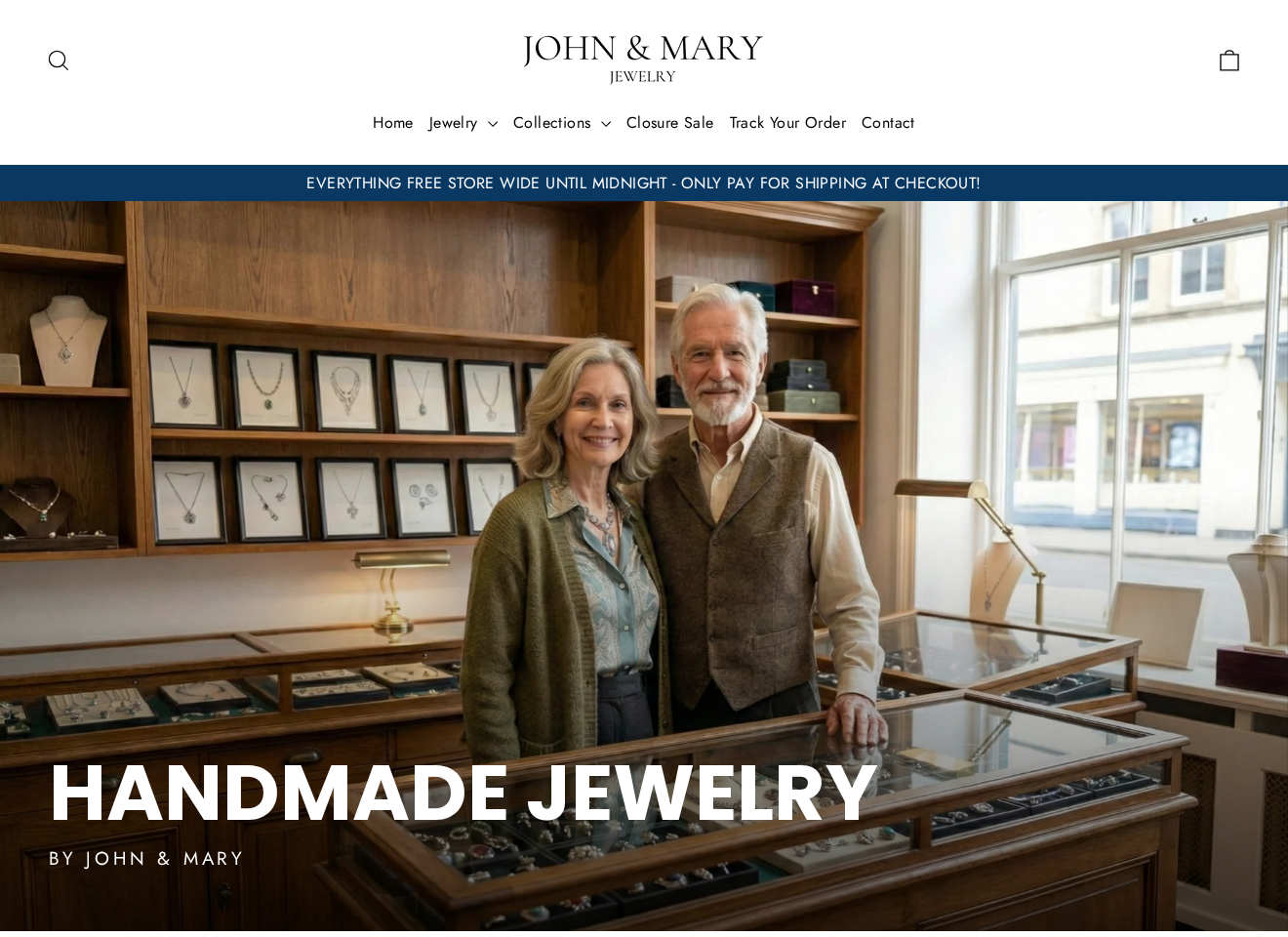
The John & Mary homepage opens on a photo of a smiling older couple in a jewelry shop. The image has the polished look of AI-generated art.
Below it, a personal note describes 38 years in the business and a first ring John made for Mary. It says the couple is retiring and closing the doors.
A story like that does what a company name and address normally do. It makes the seller feel known, so few shoppers go looking for a registration number.
Step 2: Free jewelry, paid shipping
The banner announces that everything is free store-wide until midnight and that buyers only pay for shipping at checkout.
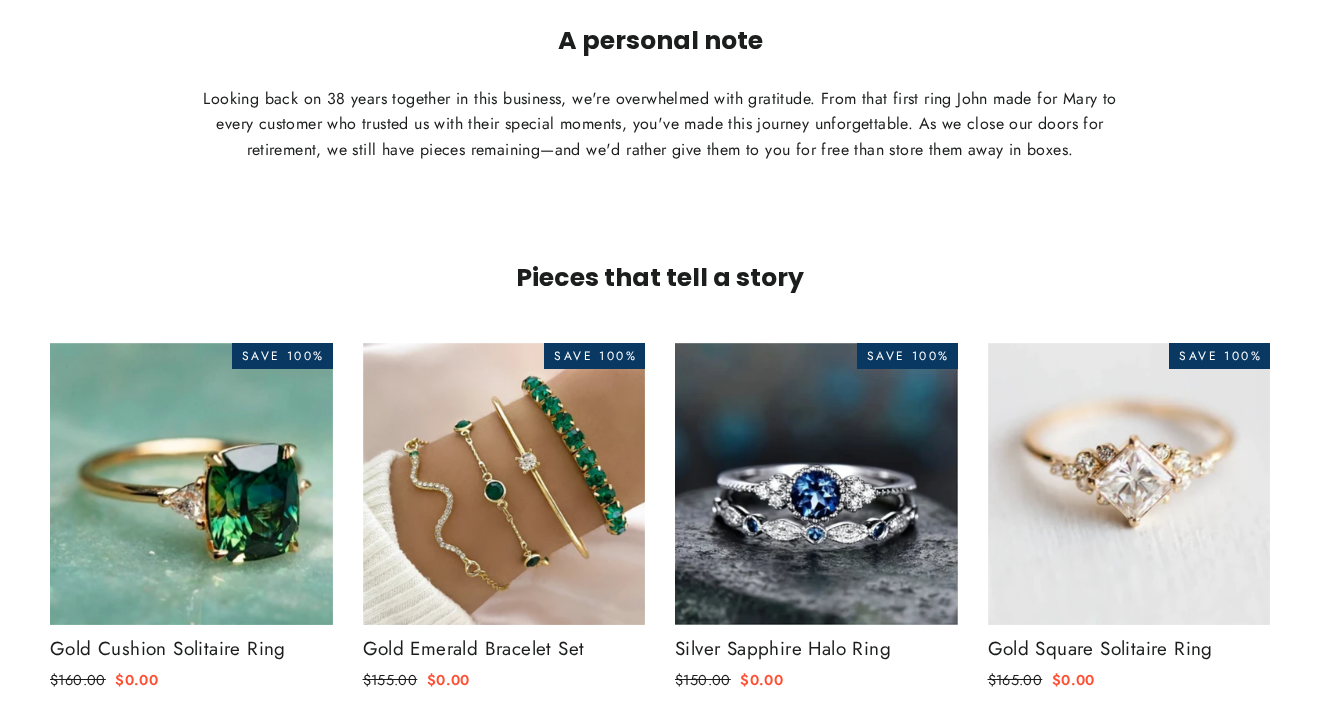
Rings and bracelet sets carry regular prices of $150 to $165, each marked down to $0.00 with a Save 100% badge.
A free item with a shipping charge turns the shipping fee into the real price.
It also means the buyer has already entered card details for a store they know nothing about.
Step 3: A deadline that keeps the clock running
The offer runs until midnight, the menu has a Closure Sale section, and the note says the couple would rather give pieces away than store them in boxes.
Every part of that pitch discourages a second look. A store that is closing tonight can’t be researched tomorrow, which is exactly the point.
Step 4: Support sits on a different domain
The John & Mary contact page sends customers to support@john-mary-jewelry.com. That address uses a different domain from the shop itself.
A split like that makes the store harder to trace and easier to abandon. When the shop domain goes, the support inbox can keep running for the next store.
Step 5: New names keep appearing
Person-named shops come and go quickly. Betty Rae, Mary, Arlene and Sophia are names on domains, not companies you can look up.
For buyers, that rotation matters more than any single name. A warning about Betty Rae won’t stop the next store, but recognizing the pattern will.
The retirement theme isn’t limited to jewelry either. Our report on the Armand Nibosi watch sale covers the same farewell story used to sell watches.
What Free Jewelry With Paid Shipping Really Costs
A free ring with a shipping charge is a sale like any other. The shipping fee is the price, set to cover a cheap item plus a profit.
Pieces sold this way usually come from bulk supplier catalogs. A ring listed at $160 and given away for nothing was never worth $160 to the seller.
The bigger cost can be the card details. Once they’re entered, the buyer depends on a store with no address to charge only the amount shown.
Check your statement for the exact amount and any later charges from the same billing name. Report anything you didn’t approve to your card issuer straight away.
If the parcel never comes, the shipping fee is still a charge for goods not delivered. That is a dispute your card issuer can handle.
Why Person-Named Stores Feel Trustworthy
A first name suggests a real person who would be embarrassed by bad service.
That is why so many short-lived shops are called Betty Rae, Mary or Sophia rather than a brand name.
A retirement or closing story adds sympathy and urgency in one move. Shoppers feel they’re helping a couple, and they feel they must act before the doors close.
Photos finish the picture. A warm image of an older couple in a shop, even an AI-generated one, does more for trust than any return policy.
Real family jewelers leave traces you can check. They have a street address, a local business registration, reviews spanning years and often local press coverage.
A friendly social media page proves little on its own. Pages can be renamed, and a few months of posts cost almost nothing to produce.
If none of those exist, the story is decoration. Judge the store by what you can verify, not by the names on the banner.
Gold, Silver and Gemstone Claims to Question
Jewelry words have specific meanings. Solid 14K gold may be stamped 14K or 585, 18K gold 750, and sterling silver 925.
Gold plated, gold filled and vermeil all describe a thin gold layer over another metal. They are not solid gold, whatever the product photo suggests.
Stone names deserve the same care. Lab-created, simulated and crystal stones aren’t natural emeralds, sapphires or diamonds, and honest listings say which one you’re buying.
If a piece you received carries no metal stamp at all, assume it is base metal until a jeweler tests it.
In the US, the FTC’s Jewelry Guides govern how sellers may describe metals and stones. A listing that skips those details is avoiding a claim it can’t support.
How to Check a Jewelry Store Before You Pay
Start with the maker. A real jeweler has a history you can find outside its own shop: press coverage, a wholesale listing, a workshop address or years of reviews.
Search the store’s name in quotes with the word jewelry. If the only results are the shop and warning pages, there is no brand behind the name.
Read the metal and stone descriptions closely. Solid gold and sterling silver are described with a karat or 925 mark. Vague words like gold tone or crystal mean something cheaper.
Check the domain’s age. A shop registered a few months ago that claims 38 years in business is telling you two different stories.
Look for a returns address before you buy. A store that only says returns are handled by email, with no address, can make a refund depend entirely on its goodwill.
Reverse-search one product photo. Images that appear on dozens of unrelated stores came from a supplier catalog, not a family workbench.
Treat free-with-shipping offers as purchases from an unknown seller. Pay only with a credit card or PayPal, never by bank transfer, gift card or crypto.
What to Do If You Ordered From Betty Rae Jewelry
- Gather everything you have.
Save the order confirmation, shipping emails, tracking number, product screenshots and the card or PayPal record. The store’s pages are gone, so these are your proof.
- Check the billing name and email domain.
Note the merchant name on your statement and the domain that sent your confirmation. Include both when you contact your bank or PayPal.
- Dispute a card charge for goods not received.
The FTC’s guidance says written billing disputes must reach your issuer within 60 days of the statement showing the charge.
- Use PayPal’s resolution center if you paid that way.
Open an item not received or significantly not as described claim. PayPal sets its own deadlines, so file as soon as the expected delivery date passes.
- Describe what actually arrived.
If a cheap piece came instead of the advertised gold or silver, photograph it next to the product screenshot. Ask your bank or PayPal before mailing anything back.
- Don’t pay to recover the money.
Ignore messages offering refund help for a fee or asking you to confirm card details. Contact your bank only through the number on your card.
- Report the store.
US buyers can file at ReportFraud.ftc.gov. Include the domain, the billing name, the support email and your order dates.
How to Spot Fake Jewelry Stores
Fraudulent shopping websites often share common patterns that make them easier to detect once you know what to look for. Before entering personal information or making a payment, take a few minutes to check for these warning signs:
- Unrealistic prices and discounts
If a website offers products at prices far below trusted retailers, it’s often a red flag. Many of these sites advertise luxury or high-demand products at massive discounts to create a sense of urgency. A $300 product listed for $49.99 should immediately raise suspicion. - Recently registered or suspicious domain names
Many fraudulent websites operate on newly created domains that disappear after a few weeks. Look for signs like random characters in the URL, misspellings of well-known brands, or hyphenated domains.
You can check a site’s age with a WHOIS lookup, or run it through our free Scam URL Scanner. - Missing or vague company details
Legitimate businesses clearly display their company name, tax information, phone numbers, physical address, and return policies. Fraudulent sites often provide incomplete, fake, or no company details at all. A lack of verifiable contact information is a major warning sign. - No reliable customer service
Real businesses provide clear ways to contact support—email, phone, live chat, or physical return addresses. Fake stores often list nonfunctional contact forms, invalid phone numbers, or reply with generic automated messages. - Poor website quality and structure
Many fake stores are set up quickly with low-effort templates. Look for poor grammar, spelling errors, low-resolution product images, broken links, or missing legal pages (Terms of Service, Privacy Policy, Return Policy). A sloppy website often signals something isn’t right. - Copied product descriptions and images
Fraudulent sites often lift product listings directly from real retailers or marketplaces. If you reverse image search a product photo and find it on multiple unrelated websites, the listing is likely not original. - Lack of credible reviews or suspicious review patterns
A real store will usually have a mix of customer reviews across different platforms. Warning signs include no reviews at all, obviously fake five-star reviews, or multiple identical reviews posted on the same day. Searching “[website name] reviews” or “[website name] scam” on Google often reveals warnings from other consumers. - Unclear or unfair return and refund policies
Fake stores often use vague language around returns and refunds—or avoid the topic entirely. If you can’t easily find clear instructions for how to return an item or get a refund, proceed with caution. - Aggressive urgency and pressure tactics
Fraudulent websites commonly use fake scarcity (e.g., “Only 2 left in stock!”) or countdown timers (“Sale ends in 10 minutes!”) to push you to buy before you think it through. Legitimate stores don’t rely on fabricated urgency to make sales.
Quick Steps to Verify a Website’s Legitimacy
Before entering payment or personal details on a new shopping website, take a few simple precautions:
- Search for the store’s name along with words like “reviews” or “complaints” on Google and Trustpilot.
- Check the website’s domain registration using Whois.com.
- Use trusted tools to scan for malicious or fraudulent links:
- Malwarebytes ScamGuard – detect scams and unsafe links before they reach you on Android and iOS phone.
- Malwarebytes Browser Guard – block dangerous or fake websites on Windows and macOS browsers.
- Verify the business address on Google Maps to ensure it’s a legitimate location.
- Review the store’s accepted payment methods – credit cards and PayPal are traceable and safer than cryptocurrency or bank transfers.
- Trust your instincts; if something feels off, it’s better not to proceed.
How to Spot Similar Scams on Social Media
Many fraudulent shopping websites rely heavily on sponsored social media ads to draw in large numbers of potential buyers. These ads often promise extraordinary discounts—sometimes up to 90% off—and use emotionally charged language to push users into buying immediately.
They frequently appear on Facebook, Instagram, and TikTok, blending in with legitimate content. However, these ads follow predictable patterns that make them easier to identify once you know what to look for.
Spotting Fraudulent Facebook Ads
Facebook’s advertising platform is a favorite tool for fake online stores because of its massive reach. These ads often feature “unbelievable” offers designed to create urgency and bypass critical thinking. Warning signs include:
- Extreme, unrealistic discounts such as “90% OFF,” “Store Closing Sale,” or “Final Liquidation.” Real retailers rarely discount new products this aggressively.
- Poor grammar, awkward phrasing, or inconsistent language throughout the ad or website, indicating low-effort, mass-produced content.
- Generic stock photos or images with watermarks, suggesting the images were taken from legitimate brands or stolen from other sources.
- Recently created Facebook Pages, which is common for temporary fraudulent campaigns. Check the “Page Transparency” section to see when the page was created.
- Limited or no engagement from real customers. Authentic brands usually have reviews, comments, and visible user interaction.
If an ad raises doubts, search for reviews of the website or reverse image search the product photos to see if they’re copied from elsewhere. Never provide payment information until the site is verified.
Spotting Fraudulent Instagram Ads
Instagram is another major platform used to promote fake shopping sites through eye-catching visuals and short-lived “flash sale” captions. Warning signs to look for:
- New or disposable accounts with few posts and followers, often created just weeks or days before launching ads.
- Lack of tagged users in product posts. Legitimate stores often feature real customers, influencers, or product usage.
- Unsecured checkout pages. If the website linked in the bio does not use HTTPS, do not enter payment information.
- Fake or missing customer reviews. Fraudulent stores rarely have authentic purchase feedback.
- Unclear or restrictive return policies, often hidden or written vaguely to make refunds difficult.
When in doubt, search for independent reviews before buying, and only enter payment details on verified, secure websites.
Catching Fake TikTok Ads
TikTok is increasingly used to promote questionable shopping deals through short, persuasive videos. While many ads look polished, the same red flags apply:
- Links to unknown stores that don’t appear in search results or have no external reputation. Many of these sites are temporary and disappear after a short time.
- No verification badge on the TikTok account. While not every legitimate store is verified, the lack of a badge is one more indicator to check further.
- Aggressive countdown timers or “one-day only” promotions designed to rush decision-making.
- Lack of genuine customer reviews or real user content demonstrating the product in actual use.
- Comment sections filled with complaints or warnings from other users. This is often the first place victims speak up.
TikTok scams often rely on impulse buying. Take a moment to verify the website, read independent reviews, and use trusted browser protection before visiting external links.
Frequently Asked Questions
Is Betty Rae Jewelry legit?
It can’t be verified as a real business. The website is gone, the domain is unregistered and no jewelry brand or maker stands behind its name.
Why can’t I open bettyrae-jewelry.com?
The domain registration lapsed, so the address no longer points anywhere. No other store under the Betty Rae name turns up online.
Are there Betty Rae Jewelry reviews?
None can be found for BettyRae-Jewelry.com, and its pages are gone. Reviews for Betty and Biddy or Ela Rae belong to separate brands.
Is John and Mary Jewelry the same store?
Nothing shows a direct link. It follows the same person-named pattern, with a retirement story and free jewelry if you pay shipping.
Can I still get a refund from Betty Rae Jewelry?
Not from the store, which can’t be reached. Your card issuer or PayPal is the route, using your order emails and payment record as evidence.
What should I check before buying from a small jewelry store online?
Look for a maker you can find elsewhere, a real address, an older domain and clear metal descriptions. Pay by card or PayPal so you can dispute the charge.
The Bottom Line
Betty Rae Jewelry left only a lapsed domain and a name no real jeweler stands behind. Don’t buy from any new site at that address.
If you paid and the order never arrived or wasn’t as described, file a card dispute or PayPal claim with your order emails. Don’t wait.
The name pattern lives on in stores like John & Mary Jewelry. Don’t pay a shipping fee for free jewelry from a seller you can’t trace.
This article is for informational purposes only and should not be relied upon for financial or business decisions. We identify potential scams using research, user experiences, and expert analysis. However, all claims should be independently verified. Mistakes may occur, and legitimate products could be flagged. We strive for accuracy but make no warranties regarding the completeness or reliability of the information.

If you are the owner of the website or product in question and wish to offer clarifications regarding your business or website, please reach out to us via our Contact form.

Reviews & discussion
0 commentsShare a firsthand experience, or ask a question.
Community reviews
bettyrae-jewelry.com
Moderated reader experiences, not an editorial verdict.
Start the conversation
Have a question or something useful to share? Add the first comment.