


You remember the outfit, perhaps the Tietaloja name, and a page that looked like an ordinary clothing shop. Now you’re trying to find it again.
Before trusting another search result or chasing an old order, it helps to separate the storefront you saw from the business that actually took your payment.
Overview
The same address has carried different shops
Tietaloja.com appeared in older archives as Tieta, a Portuguese-language Brazilian beachwear label. Later material shows an English-language clothing storefront using the TIETALOJA name.
The current registration dates to January 2024, after those earlier Brazilian pages. That discontinuity matters, but it does not identify who operated the later shop.
The shopping site no longer opens
A functioning storefront could not be reached at tietaloja.com. Current technical records route the address through other hostnames rather than reveal a usable shop.
An unavailable website leaves an existing customer with a practical problem: the page that once explained an order may no longer be there to consult.
The decision for shoppers
- Do not place a new order through this unavailable offer or assume a similarly named replacement has been verified.
- For an existing purchase, work from the original receipt, payment record, and correspondence rather than an old logo.
- Do not send complaints or parcels to the earlier Brazilian label without evidence that it handled your actual transaction.
The accessible About material does not establish a legal seller behind the later store. An old catalog cannot fill that gap or guarantee delivery.
What the Tietaloja Clothing Website Displayed
A July 2025 archived homepage lists dresses, tops, sets, jeans, and jumpsuits. One example is a crop tank shown at $7.89 beside a $12.59 comparison price.
Its cart text says payment is processed in USD, while its currency menu offers alternatives. The cart also contains an inconsistent CYN display label.
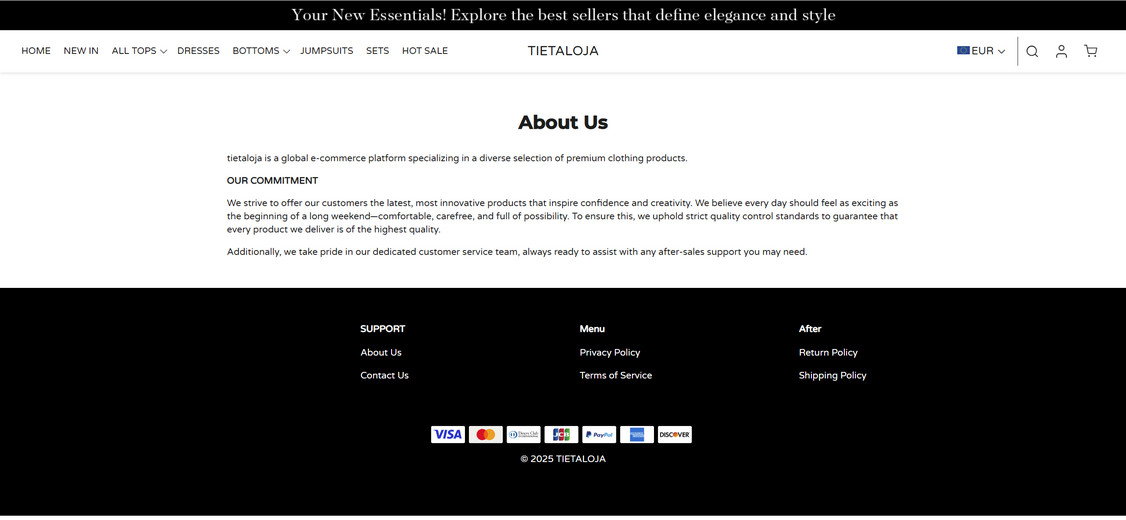
The footer supplies contact, shipping, returns, and terms links. The retrieved archive copies of those linked pages return errors, so their actual conditions remain unavailable.
A quality-and-style promise says nothing about how the garment feels, whether a parcel arrives, or how a return would be handled.

Likewise, a catalog with a working-looking cart is not a sales record. It cannot establish which orders were accepted, when they shipped, or what customers received.
The Older Tieta Label Is Not the Seller to Blame
The earlier Brazilian pages identify Tieta as a separate beachwear business, with Portuguese content, local commercial details, and a different presentation.
Those archived pages help explain confusing search results. They do not make the earlier label responsible for a later English-language shop at the same address.
No established ownership link connects the two. Their different language and merchandise also cannot, by themselves, prove exactly when control changed.
A site can change languages, expand internationally, or redesign without changing owners. Here, the registration history adds context, but it still does not name the later merchant.
If you bought from the English-language store, do not copy a Brazilian contact or address from an old archive into your complaint. Follow your own transaction instead.
That distinction protects you from chasing the wrong business and protects an unrelated business from being accused over a payment it may never have received.
Our separate November 2025 Tietaloja report contains another published storefront image. Its publication date is not proof of a live purchase that month.
Search results, uploads, archived pages, and payment dates are different kinds of records. Keep each in its proper place when rebuilding what happened.
How to Reconstruct a Tietaloja Purchase
Step 1: Start with the payment, not the search result
Locate the transaction in the account you actually used. Note the payment date, amount, currency, and statement description before searching for another website.
The name on a card statement may differ from the shop name. That discrepancy is something to investigate with the provider, not an automatic second fraud allegation.
Keep the purchase confirmation beside that record. A matching order number, amount, or transaction reference is more useful than a familiar-looking storefront name.
Step 2: Identify the promises attached to your order
Look for the dispatch estimate, delivery destination, item description, size, quantity, and return instructions in the confirmation and any material saved when you ordered.
Do not substitute another shop’s policy because it uses the same template. Your complaint needs the promise made for your purchase, not a convenient later example.
If you kept a screenshot, retain the full version with its address and surrounding context. A cropped product photograph alone may not identify the seller.
Step 3: Separate shipment evidence from a status message
Put each tracking reference in date order. Distinguish a label being created, a carrier receiving the parcel, and a final delivery event.
Where possible, check the named carrier’s own service rather than relying entirely on a merchant’s tracking screen. Ask about a disputed delivery through the carrier’s official channels.
A missing package can have several explanations. Present the concrete discrepancy, such as an incorrect destination or no carrier movement, without claiming evidence you do not possess.
Step 4: Establish whether the issue is nonarrival or a return
If nothing arrived, say so clearly. A return requirement for an unwanted dress should not replace the unresolved question of whether any parcel reached you.
If goods arrived, compare them with the actual listing. Photograph a wrong item, missing pieces, damage, or a material difference before wearing, altering, or discarding anything.
A disappointing fit and a completely different product are not the same complaint. The distinction affects what evidence the merchant or payment provider needs.
Step 5: Keep a merchant promise separate from a payment case
A reply offering another shipment or a refund is useful only if it leads to an outcome. Keep the message, but also track the case’s actual progress.
Do not let a sequence of friendly replies obscure the original payment date. The provider can explain which deadlines and procedures still apply to that transaction.
If support stops responding, document the unanswered attempts. You do not need to invent an explanation for the website failure to describe an unresolved purchase accurately.
Who Runs Tietaloja?
The About page identifies a brand, not a legal merchant
The preserved About page describes a global clothing platform and promises quality control and customer service. Its visible copy and footer do not identify a legal company.
That is a material gap for a buyer deciding whom to trust. It is not evidence of what every unavailable legal or checkout page once contained.
An order confirmation, payment account, invoice, or parcel label may provide more precise details. Compare them before associating a similarly named company with the purchase.
Unretrieved policies cannot supply a return address
A footer link labeled Return Policy is not the policy itself. Without its text, there is no supported basis for inventing its deadline, exclusions, or destination.
Written authorization supplied by email can be legitimate. Check that it comes through your established seller correspondence and clearly covers your order before spending money on postage.
Ask for the recipient, complete address, authorization reference, refund amount, and responsibility for shipping costs. If the payment provider directs the return, follow its instructions.
The registrar and hosting chain do not name the retailer
The current tietaloja.com registration lists Gname as registrar and runs to January 2027. A registrar maintains a domain record; it is not automatically the shop’s operator.
Public technical records do not reveal a verified retail company here. They should not be substituted for the legal entity on a receipt.
Missing company details can make a complaint harder to pursue. They do not erase a contract, remove all consumer rights, or prevent a payment-provider inquiry.
Similar store software is not a common-owner finding
Archived code contains XShoppy identifiers. Our Wearzavora and Voguemora reports discuss other storefronts using that platform.
That technical overlap is useful context, not proof that the same person owned the stores. A shared builder does not transfer every allegation between merchants.
The same applies to language inside software files. It does not establish where a garment was manufactured, where an order shipped from, or who took payment.
What the Current Domain Records Actually Show
Tietaloja.com currently points through qazwsx.yreaad.com toward expired.hichina.com. The storefront does not load through that observed route.
The word expired in a hostname is not a complete registration report. Verisign’s yreaad.com record gives an expiration date in October 2027.
Its RDAP record and recursive DNS also show different nameserver information. Those records do not justify saying every domain in the chain has expired.
For a shopper, the immediate result is simpler: there is no functioning store to recommend at the checked address. Do not send a new payment.
If the domain later returns with a catalog, verify the offer afresh. Registration continuing into the future does not authenticate a returning seller or restore an old order.
It is equally wrong to treat a connection error as proof that every earlier payment was fraudulent. An existing complaint should describe the actual order failure.
Where Are the Tietaloja Reviews?
The exact Trustpilot route for tietaloja.com returned a missing-page response. That is narrower than saying no buyer has ever reviewed the store anywhere.
A company might use another trading name, or customers might post elsewhere. A bounded search cannot establish worldwide absence of reviews, advertising, or business records.
For a prospective buyer, the unanswered identity and unavailable storefront are enough to reject this offer. You do not need a claim of universal nondelivery.
For an existing customer, another person’s experience can be context, but it cannot replace your receipt and delivery evidence. Build a complaint around your own transaction.
What to Do If You Ordered From Tietaloja
Keep one complete purchase file. Include the confirmation, payment statement, promised delivery details, tracking history, and messages in their original forms.
Make a separate short timeline for support. Keep original emails rather than saving only isolated screenshots that lose the sender, date, or order reference.
Ask the identified merchant for the remedy that fits. Use an established order conversation or the seller details recorded by your payment provider.
Specify cancellation, missing-order reimbursement, or a remedy for the documented product problem. Do not redirect the demand to Tieta’s older Brazilian business.
Reconcile the actual charge. Compare the authorized total with the settled amount and currency, including any separately identified bank conversion or foreign-transaction fee.
Ask the provider to explain an unexplained difference. A currency selector on a historical page does not establish what was authorized for your particular purchase.
Verify a return before mailing it. Keep written authorization and confirm the destination through the appropriate merchant or payment case, even if the instruction arrives by email.
Retain photographs and proof of dispatch or delivery if a return is required. An arbitrary address found in an old search result is not authorization.
Follow a refund through to the account. Record whether the seller merely offered reimbursement, approved it, or supplied a transaction reference.
Check for the credit itself. If it remains missing, ask the payment provider what details it needs to trace the refund rather than restarting the purchase.
How to Spot Fake Clothing Stores
Fraudulent shopping websites often share common patterns that make them easier to detect once you know what to look for. Before entering personal information or making a payment, take a few minutes to check for these warning signs:
- Unrealistic prices and discounts
If a website offers products at prices far below trusted retailers, it’s often a red flag. Many of these sites advertise luxury or high-demand products at massive discounts to create a sense of urgency. A $300 product listed for $49.99 should immediately raise suspicion. - Recently registered or suspicious domain names
Many fraudulent websites operate on newly created domains that disappear after a few weeks. Look for signs like random characters in the URL, misspellings of well-known brands, or hyphenated domains.
You can check a site’s age with a WHOIS lookup, or run it through our free Scam URL Scanner. - Missing or vague company details
Legitimate businesses clearly display their company name, tax information, phone numbers, physical address, and return policies. Fraudulent sites often provide incomplete, fake, or no company details at all. A lack of verifiable contact information is a major warning sign. - No reliable customer service
Real businesses provide clear ways to contact support—email, phone, live chat, or physical return addresses. Fake stores often list nonfunctional contact forms, invalid phone numbers, or reply with generic automated messages. - Poor website quality and structure
Many fake stores are set up quickly with low-effort templates. Look for poor grammar, spelling errors, low-resolution product images, broken links, or missing legal pages (Terms of Service, Privacy Policy, Return Policy). A sloppy website often signals something isn’t right. - Copied product descriptions and images
Fraudulent sites often lift product listings directly from real retailers or marketplaces. If you reverse image search a product photo and find it on multiple unrelated websites, the listing is likely not original. - Lack of credible reviews or suspicious review patterns
A real store will usually have a mix of customer reviews across different platforms. Warning signs include no reviews at all, obviously fake five-star reviews, or multiple identical reviews posted on the same day. Searching “[website name] reviews” or “[website name] scam” on Google often reveals warnings from other consumers. - Unclear or unfair return and refund policies
Fake stores often use vague language around returns and refunds—or avoid the topic entirely. If you can’t easily find clear instructions for how to return an item or get a refund, proceed with caution. - Aggressive urgency and pressure tactics
Fraudulent websites commonly use fake scarcity (e.g., “Only 2 left in stock!”) or countdown timers (“Sale ends in 10 minutes!”) to push you to buy before you think it through. Legitimate stores don’t rely on fabricated urgency to make sales.
Quick Steps to Verify a Website’s Legitimacy
Before entering payment or personal details on a new shopping website, take a few simple precautions:
- Search for the store’s name along with words like “reviews” or “complaints” on Google and Trustpilot.
- Check the website’s domain registration using Whois.com.
- Use trusted tools to scan for malicious or fraudulent links:
- Malwarebytes ScamGuard – detect scams and unsafe links before they reach you on Android and iOS phone.
- Malwarebytes Browser Guard – block dangerous or fake websites on Windows and macOS browsers.
- Verify the business address on Google Maps to ensure it’s a legitimate location.
- Review the store’s accepted payment methods – credit cards and PayPal are traceable and safer than cryptocurrency or bank transfers.
- Trust your instincts; if something feels off, it’s better not to proceed.
How to Spot Similar Scams on Social Media
Many fraudulent shopping websites rely heavily on sponsored social media ads to draw in large numbers of potential buyers. These ads often promise extraordinary discounts—sometimes up to 90% off—and use emotionally charged language to push users into buying immediately.
They frequently appear on Facebook, Instagram, and TikTok, blending in with legitimate content. However, these ads follow predictable patterns that make them easier to identify once you know what to look for.
Spotting Fraudulent Facebook Ads
Facebook’s advertising platform is a favorite tool for fake online stores because of its massive reach. These ads often feature “unbelievable” offers designed to create urgency and bypass critical thinking. Warning signs include:
- Extreme, unrealistic discounts such as “90% OFF,” “Store Closing Sale,” or “Final Liquidation.” Real retailers rarely discount new products this aggressively.
- Poor grammar, awkward phrasing, or inconsistent language throughout the ad or website, indicating low-effort, mass-produced content.
- Generic stock photos or images with watermarks, suggesting the images were taken from legitimate brands or stolen from other sources.
- Recently created Facebook Pages, which is common for temporary fraudulent campaigns. Check the “Page Transparency” section to see when the page was created.
- Limited or no engagement from real customers. Authentic brands usually have reviews, comments, and visible user interaction.
If an ad raises doubts, search for reviews of the website or reverse image search the product photos to see if they’re copied from elsewhere. Never provide payment information until the site is verified.
Spotting Fraudulent Instagram Ads
Instagram is another major platform used to promote fake shopping sites through eye-catching visuals and short-lived “flash sale” captions. Warning signs to look for:
- New or disposable accounts with few posts and followers, often created just weeks or days before launching ads.
- Lack of tagged users in product posts. Legitimate stores often feature real customers, influencers, or product usage.
- Unsecured checkout pages. If the website linked in the bio does not use HTTPS, do not enter payment information.
- Fake or missing customer reviews. Fraudulent stores rarely have authentic purchase feedback.
- Unclear or restrictive return policies, often hidden or written vaguely to make refunds difficult.
When in doubt, search for independent reviews before buying, and only enter payment details on verified, secure websites.
Catching Fake TikTok Ads
TikTok is increasingly used to promote questionable shopping deals through short, persuasive videos. While many ads look polished, the same red flags apply:
- Links to unknown stores that don’t appear in search results or have no external reputation. Many of these sites are temporary and disappear after a short time.
- No verification badge on the TikTok account. While not every legitimate store is verified, the lack of a badge is one more indicator to check further.
- Aggressive countdown timers or “one-day only” promotions designed to rush decision-making.
- Lack of genuine customer reviews or real user content demonstrating the product in actual use.
- Comment sections filled with complaints or warnings from other users. This is often the first place victims speak up.
TikTok scams often rely on impulse buying. Take a moment to verify the website, read independent reviews, and use trusted browser protection before visiting external links.
Payment Options When the Tietaloja Shop Is Unavailable
Use your provider’s own dispute channel. Explain whether an authorized purchase never arrived or the received goods materially differed. Report a genuinely unauthorized charge separately.
Give the real payment date. For an older order, ask what options remain instead of assuming a fresh complaint resets the filing window.
Check the rules for your account’s country. PayPal’s UK terms allow 180 days from payment for a nonreceipt dispute.
For significantly misdescribed goods, the UK limit is 30 days after delivery or 180 days after payment, whichever comes first.
For UK PayPal disputes, escalate to a claim within 20 days after opening the dispute. Other accounts may differ; follow your case’s instructions.
Respond to the case, not just the seller. Meet document and escalation requests. Ask before switching between PayPal and a card claim; do not pursue both simultaneously.
A missed window is not a guaranteed recovery opportunity. Request a clear explanation of any remaining review or refund-tracing route and keep the response.
Frequently Asked Questions
Is Tietaloja legit?
Do not order through this offer. The storefront is unavailable, and the accessible historical material does not establish a verifiable legal merchant behind the later clothing shop.
Is the Tietaloja clothing website still working?
No usable storefront loaded during the latest check. The observed hosting route fails, but that alone does not explain why or establish permanent closure.
Is Tadestogo legit or connected to Tietaloja?
The checked tadestogo.com route did not load. That cannot authenticate any seller using the name, and no established evidence links that offer to Tietaloja.
Is the English-language Tietaloja shop the Brazilian Tieta label?
No ownership connection has been established. Their use of the same domain at different times is not a reason to send the earlier label complaints about another merchant.
Does an archived Tietaloja page prove an order was accepted?
No. It shows published material, not your transaction. Use the actual confirmation and payment record to establish the item, merchant, amount, and date.
Can I return a Tietaloja order using an emailed address?
Written email authorization can be legitimate. Verify its connection to your order, confirm the refund conditions, and follow any payment-provider return instructions before posting.
The Bottom Line
Do not buy through the unavailable Tietaloja offer. The historical presentation cannot substitute for a functioning store and an identifiable seller who can answer for the transaction.
If you already paid, preserve your order record and ask your payment provider about the remedy and deadline that still apply. Keep the unrelated Brazilian label separate.
This article is for informational purposes only and should not be relied upon for financial or business decisions. We identify potential scams using research, user experiences, and expert analysis. However, all claims should be independently verified. Mistakes may occur, and legitimate products could be flagged. We strive for accuracy but make no warranties regarding the completeness or reliability of the information.

If you are the owner of the website or product in question and wish to offer clarifications regarding your business or website, please reach out to us via our Contact form.

Join the discussion
0 commentsShare your experience or ask a question about this article.
Discussion
Start the conversation
Have a question or something useful to share? Add the first comment.