

An invitation from someone you trust sounds less like an investment and more like neighbors helping one another. There is a board, a waiting position, and a promised turn.
If you are researching the BINT scam or a similar blessing circle, look closely at where that promised payment is supposed to come from.
Overview
What the documented BINT case establishes
BINT stands for Blessings in No Time. The FTC’s case record documents a 2021 action brought with Arkansas against its operators.
The complaint alleged an illegal pyramid scheme and deceptive earnings promises. The case page records a 2023 order and restrictions barring the operators from multi-level marketing.
Those dates matter. This article explains the documented case and the broader recruitment-funded pattern; it does not establish a new BINT operation running today.
Nor does it announce an open refund program. Any current compensation claim should be verified through an official agency channel, not an unsolicited message.
The appeal is community; the risk is the funding structure
A blessing-circle pitch can emphasize generosity, mutual support, or a shared chance to get ahead. None of those values makes deceptive recruitment acceptable.
The concern begins when your promised gain depends on new participants paying in, with each participant expecting their own larger payout later.
Ask where the extra money comes from. A board can rearrange names, but it cannot create income simply by moving people toward its center.
- You pay to enter or obtain a position.
- A larger future payment is presented as your expected reward.
- New members must provide the funds supporting that payment.
- Recruitment is described as helping the group move forward.
- Questions about sustainability receive encouragement instead of a clear funding explanation.
A savings circle is a different question
Do not equate every community savings arrangement with this scheme. A transparent, finite rotating pool does not inherently promise participants more than the group contributes.
Such arrangements can still carry serious trust and default risks. Their rules, participants, and obligations deserve careful assessment.
The distinction here is the promised recruitment-funded gain. Calling money a gift or blessing does not explain how everyone can receive more than they put in.
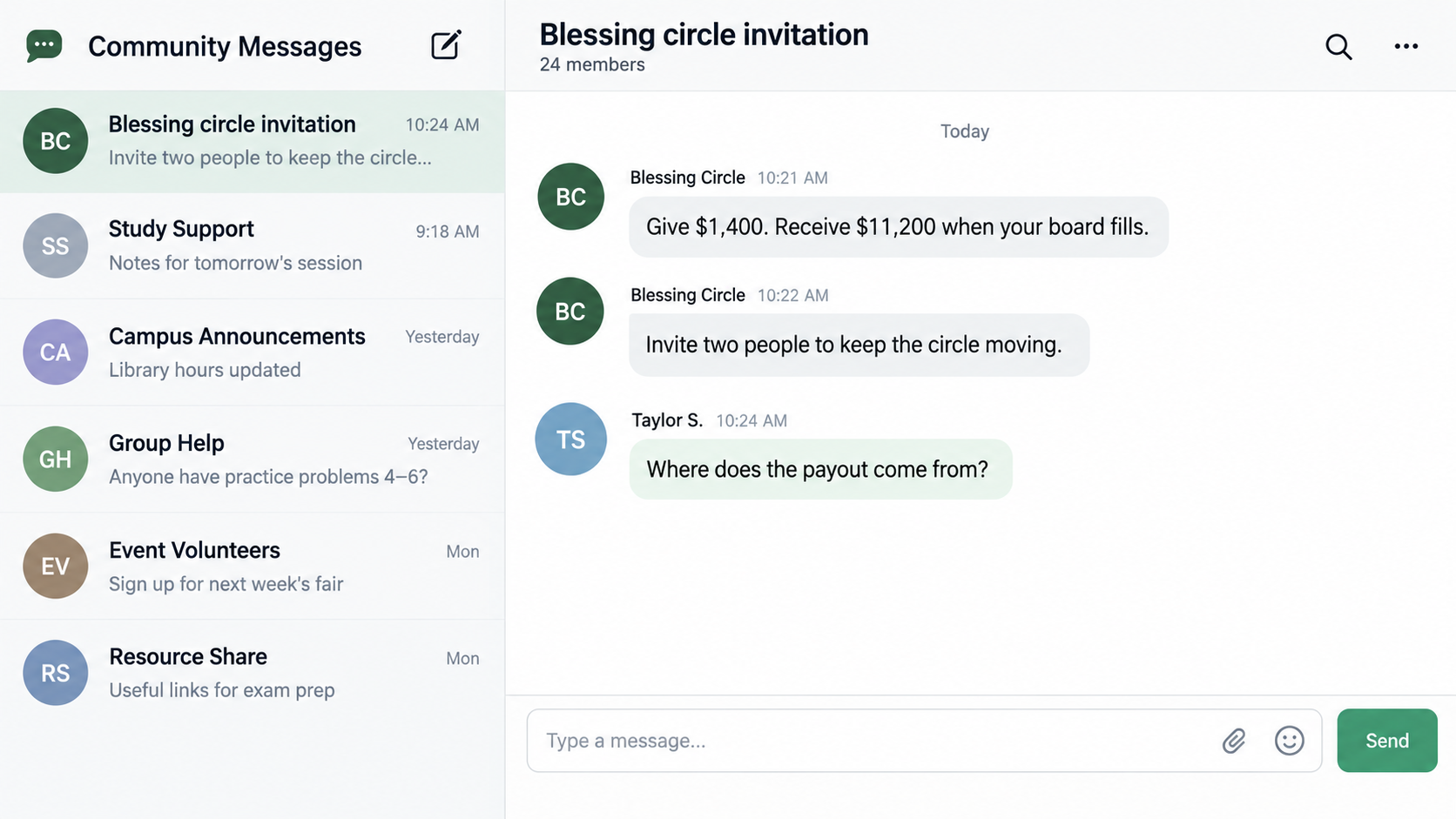
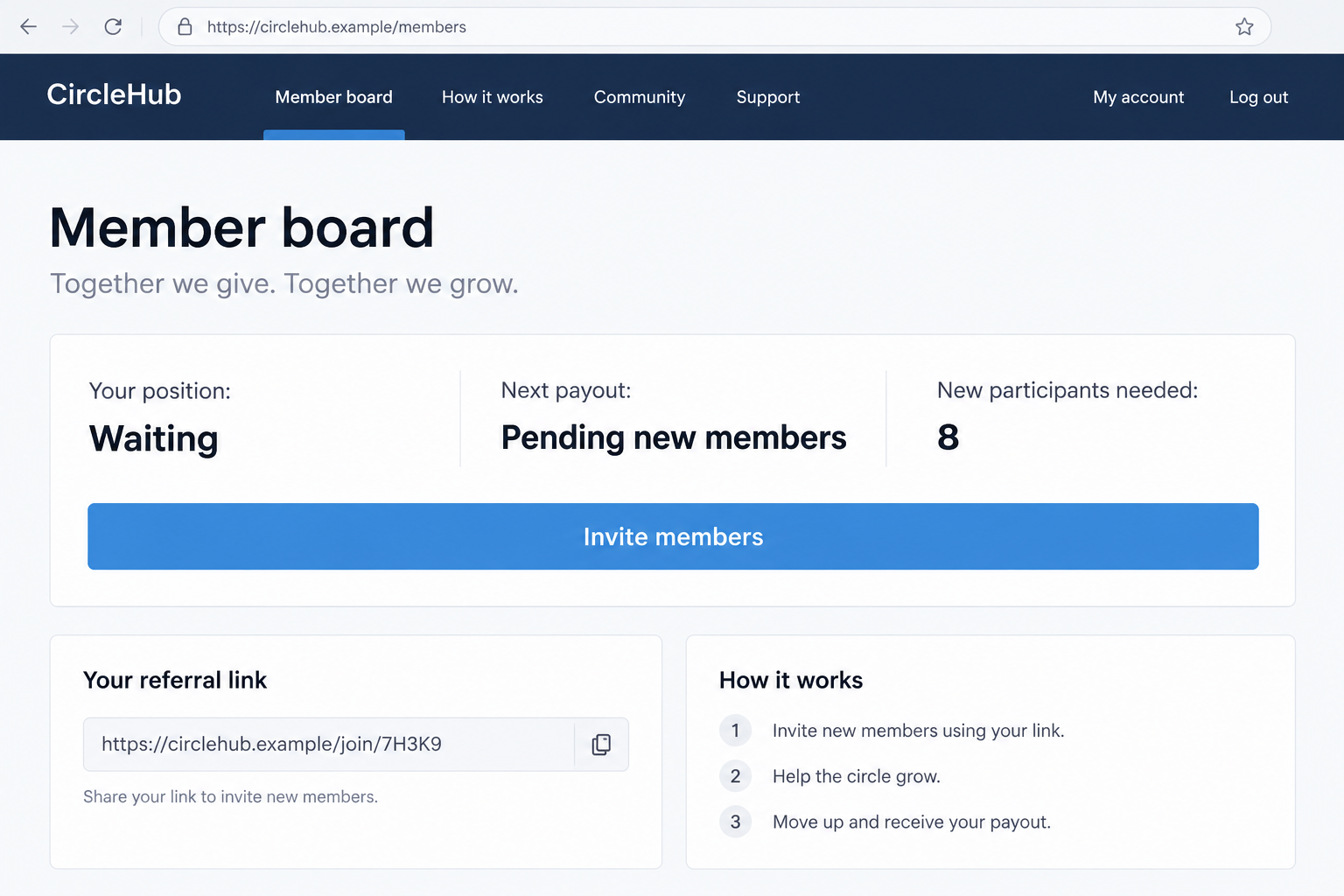
The screens are fictional illustrations of a blessing-circle pitch, not authentic BINT records. Their amounts demonstrate the recruitment arithmetic rather than document a particular participant’s loss.
How the BINT-Style Blessing Circle Scam Works
Step 1: A trusted connection makes the invitation feel safe
A friend, relative, or community acquaintance introduces the idea. Their involvement can make the proposal feel different from an anonymous online money-making advertisement.
The person inviting you might sincerely believe it works. Sincerity does not resolve whether the financial structure can deliver what is promised.
Evaluate the arrangement separately from your opinion of the inviter. You can care about someone and still decline a proposal you cannot independently understand.
Ask for the complete rules in writing before discussing payment. A persuasive voice call is harder to examine later than a clear set of obligations.
Pay attention to unanswered questions. If you are expected to commit first and learn the details afterward, you are being asked to accept uncertainty blindly.
Step 2: An entry payment buys a place on a board
The presentation may use rings, levels, positions, or a sequence of turns. Visual organization can make the arrangement appear orderly and predictable.
But a position is not an asset with independent value. Its value depends entirely on whether someone will eventually provide the promised money.
Distinguish your actual outgoing payment from the future amount displayed beside your name. One has left your control; the other is still a claim.
Read any refund promise carefully. Who is responsible, where is that responsibility documented, and what happens if the group lacks funds?
A promise from an organizer is not the same as money held securely for repayment. Do not assume a reassuring guarantee has been independently backed.
Step 3: Recruitment becomes the way to advance
You are encouraged to bring in more people so the board fills and moves. Helping the group and protecting your own expected payout become intertwined.
This creates an uncomfortable incentive. After paying, someone may feel pressure to promote an arrangement they would otherwise question.
Do not solve that discomfort by passing the risk to friends. Recruiting others does not repair a structure that depends on endless new entrants.
Ask whether a participant can receive the advertised gain without additional recruitment anywhere in the chain. That is different from asking whether you personally must recruit.
An organizer doing the recruitment for you does not create an outside revenue source. The money still has to come from somebody.
Step 4: Early payouts are presented as proof that everyone will benefit
A payment screenshot or a happy participant can seem to settle the issue. Someone received money, so the arrangement appears to work.
That evidence answers only a limited question: whether a particular payment occurred. It does not show that every participant can receive the same result.
The FTC’s blessing-loom warning explains why recruitment-funded boards leave later participants exposed when incoming membership dries up.
Do not accuse every paid participant of knowingly committing fraud. They may misunderstand the structure, but their experience still cannot guarantee yours.
Look beyond testimonials to the complete flow of funds. Include people still waiting, not only those selected to describe a successful turn.
Step 5: Delays create pressure to keep the chain going
When new participants become harder to find, expected payouts can stall. The conversation may shift from the original promise to the need for renewed effort.
A renamed group, reorganized board, or revised schedule does not by itself solve the missing funding. Ask what materially changed about the source of money.
Be especially cautious if additional payments are presented as necessary to preserve your place. You could increase your loss while waiting for the same unsupported promise.
Past participation is not a reason to continue. Stopping new payments and recruitment can protect both your remaining money and people you might otherwise invite.
The Arithmetic a Friendly Presentation Cannot Change
Follow a simple hypothetical example
Suppose a board promises a $11,200 payout funded entirely by eight newcomers contributing $1,400 each. Those eight contributions equal the promised payment.
Nothing in that transaction generates investment income. It transfers the newcomers’ money to one recipient.
If those eight newcomers each expect $11,200 under the same simplified arrangement, their combined expectation is $89,600. That requires another sixty-four $1,400 contributions.
The example deliberately ignores fees and reinvestment. Those details can alter individual outcomes, but they do not create an unlimited supply of new participants.
Some people receiving money is compatible with many others losing it. That is why early payouts do not establish a sustainable opportunity.
Changing the terminology does not change the cash flow
Words such as gift, blessing, support, or rotation can describe an intention. They do not independently establish the legal or financial character of an arrangement.
Ask what participants are actually promised in return for payment. An expected profit tied to incoming recruits deserves scrutiny regardless of the label.
Do not rely on an organizer’s tax or legal assurances. For personal obligations, obtain advice from a qualified professional who is not promoting the group.
A finite savings pool does not promise effortless multiplication
Consider a separate hypothetical: a fixed group contributes agreed amounts and each member receives the pooled amount once under a transparent schedule.
That arrangement redistributes timing rather than promising everyone a multiplied return. It is economically different from funding large gains through ever-expanding recruitment.
It can still fail if participants default or records are poor. Understanding the distinction is not an endorsement of a particular private savings group.
How to Check a Current Invitation
Keep a copy of the rules as they existed when you were invited. Later edits can change payout conditions and make the original promise harder to establish.
Ask whether there are separate fees, repeated contributions, or requirements to rejoin after payment. Record the answers without assuming they apply to every group.
If an organizer refuses to provide a written explanation, do not substitute a friend’s confidence for the missing information. You can decline without accusing that friend.
Start with the exact offer in front of you. A familiar name does not prove it is the historical BINT operation, and a new name does not prove safety.
- Identify the organizer and who receives each payment.
- Request written rules showing every contribution, payout condition, and fee.
- Ask whether outside revenue exists beyond new members’ contributions.
- Check what happens if nobody else joins.
- Verify claimed registration or official approval directly with the named authority.
- Decline pressure to recruit while your questions remain unanswered.
Company registration alone does not certify the promised earnings model. Nor does a social-media group with many members establish that the financial claims are true.
Do not use a small payment as a safety test. An initial success may tell you very little about what happens when the group stops growing.
If you cannot explain the source of everyone’s promised gains without mentioning fresh recruits, pause. That is a fundamental funding question, not negativity.
What to Do if You Have Fallen Victim to This Scam
- Stop contributing and stop recruiting.
Do not send another payment to protect a position, accelerate a turn, or qualify for an alleged refund while the arrangement is suspected fraud.
Tell anyone you invited that you have concerns and are no longer recommending participation. Avoid making promises about what they will recover.
- Save the records before leaving the group.
Preserve invitations, board images, rules, organizer profiles, payment requests, receipts, and statements about earnings or refunds.
Record the dates and recipients of actual transfers separately from displayed or promised payouts. Keep private financial information out of public posts.
- Contact the service that processed your payment.
Use the bank or payment application’s official support process. Explain that you paid into a suspected recruitment-based scheme and ask what options remain.
A completed voluntary transfer may not be reversible. Still, prompt and accurate reporting can help the provider assess the situation and protect your account.
- Submit a clear consumer-fraud report.
U.S. readers can report through ReportFraud.ftc.gov and their state attorney general or consumer-protection office. Include the organizer details and payment trail.
Distinguish your experience from allegations you read elsewhere. A report should explain what you paid, what was promised, and what actually happened.
- Verify any BINT-specific recovery claim with official records.
The historical case record does not itself prove a refund program is currently accepting claims. Check directly before submitting personal information.
Do not pay an unsolicited agent to reserve compensation, activate a payout, or process a guaranteed recovery. Those promises create another opportunity for loss.
- Seek advice if you handled other people’s money.
If you organized a group, collected funds, or made earnings promises, consult an independent qualified lawyer about your circumstances.
Preserve records and avoid deleting conversations. Do not redistribute remaining funds according to advice from an anonymous online commenter or the original promoter.
- Protect relationships while correcting the information.
Contact people you invited privately and calmly. Share the documented concerns without claiming that every participant knowingly intended to deceive anyone.
You can acknowledge a mistaken recommendation while refusing further recruitment. Honest clarification is more useful than trying to earn back losses through somebody else’s contribution.
Why Security Software Is Not the Remedy Here
This scheme can operate through ordinary messages and authorized payments without infecting a device. An antivirus scan cannot make its funding model sustainable.
The priorities are stopping transfers, preserving evidence, reporting accurately, and avoiding renewed recruitment. Device cleanup is a separate issue only if suspicious software was involved.
Do not buy a recovery package because someone says your payout is hidden behind a technical problem. Ask for independently verifiable evidence before considering any service.
When money and community ties are both involved, stepping back can feel disloyal. Protecting others from an unsupported promise is a responsible form of support.
Frequently Asked Questions
What does BINT stand for?
It stands for Blessings in No Time, the program named in the FTC and Arkansas enforcement action documented in the official case record.
Is this an announcement of a new BINT scheme?
No. The verified case concerns a 2021 complaint and 2023 order. A present-day invitation requires its own examination and should not be automatically attributed to those operators.
Does receiving a payout prove a blessing circle is safe?
No. Earlier participants can receive money supplied by later entrants. That does not establish that everyone can obtain the advertised gain.
Is every community savings circle a pyramid scheme?
No. A finite, transparent savings rotation differs from promised profits funded by expanding recruitment. Individual arrangements still need careful evaluation and may carry substantial risks.
Can calling the payment a gift make the arrangement safe?
The label does not resolve the funding or legal questions. Examine what is promised, how payouts are financed, and whether recruitment is essential.
Should I invite more people to recover my contribution?
No. Passing the risk onward can harm others and deepen your involvement. Stop recruiting and pursue appropriate reporting and payment-provider options instead.
The Bottom Line
The BINT scam is a warning about recruitment-funded promises dressed in the language of community. A warm invitation cannot replace a sustainable source of money.
Before joining any similar board, ask what happens when recruitment stops. If the promised return disappears with new arrivals, do not fund the next turn.








