

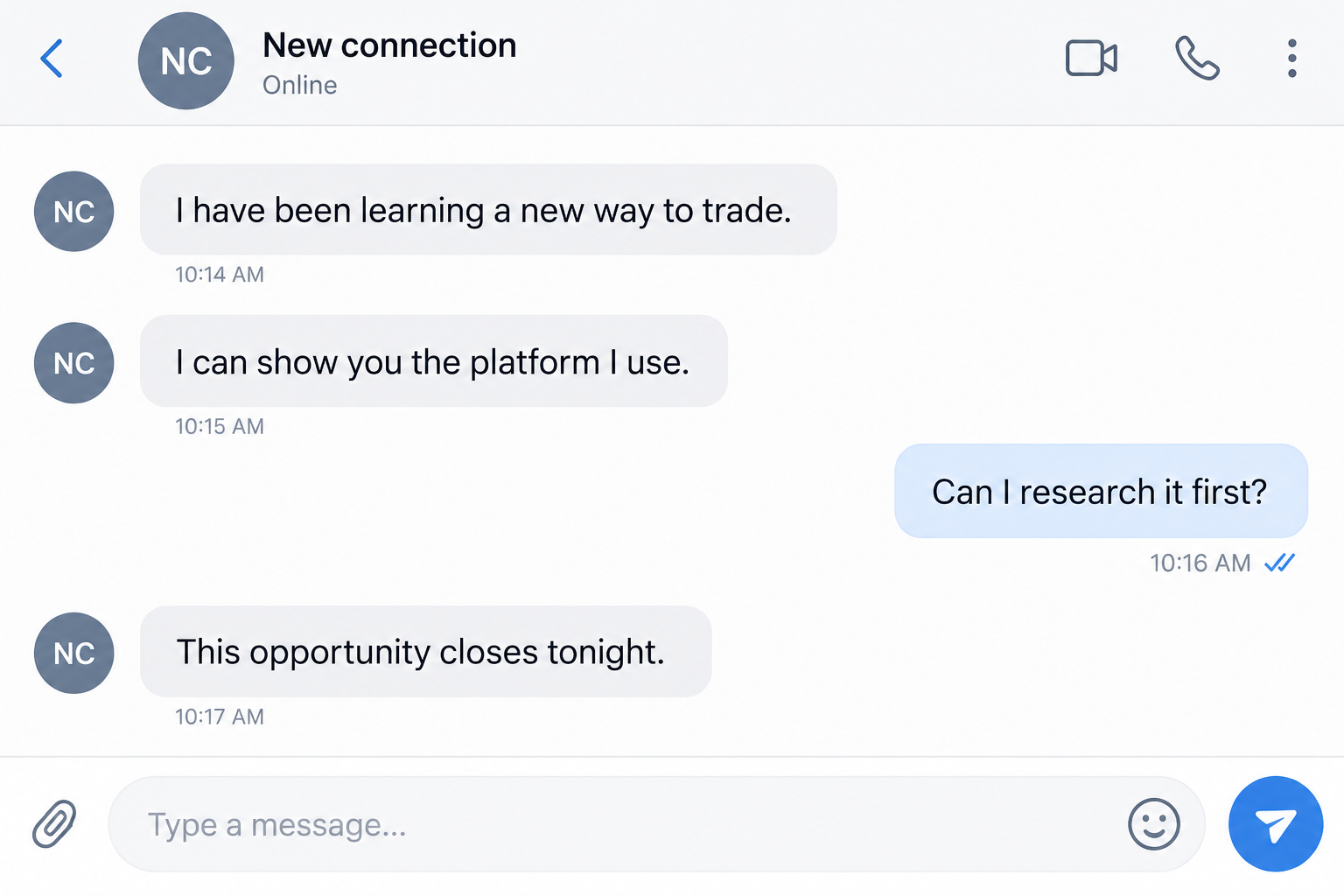
The conversation did not begin with an investment pitch. It began with someone who seemed interested in your day and remembered what mattered to you.
That quiet beginning is why a pig butchering crypto scam can feel different from obvious spam. The financial question arrives after the personal connection.
Overview
A relationship becomes the route to a financial request
This fraud is also called relationship-based or confidence-enabled investment fraud. The phrase pig butchering describes the criminal tactic, not the people harmed by it.
The FBI’s Internet Crime Complaint Center describes a progression from contact and trust to fraudulent investments and demands for additional payments.
The relationship need not be romantic. It can resemble friendship, mentoring, professional networking, or a conversation with someone who apparently contacted the wrong person.
The common thread is borrowed trust. Confidence in a person becomes confidence in a platform that has not been independently verified.
The balance on the screen is not proof of assets
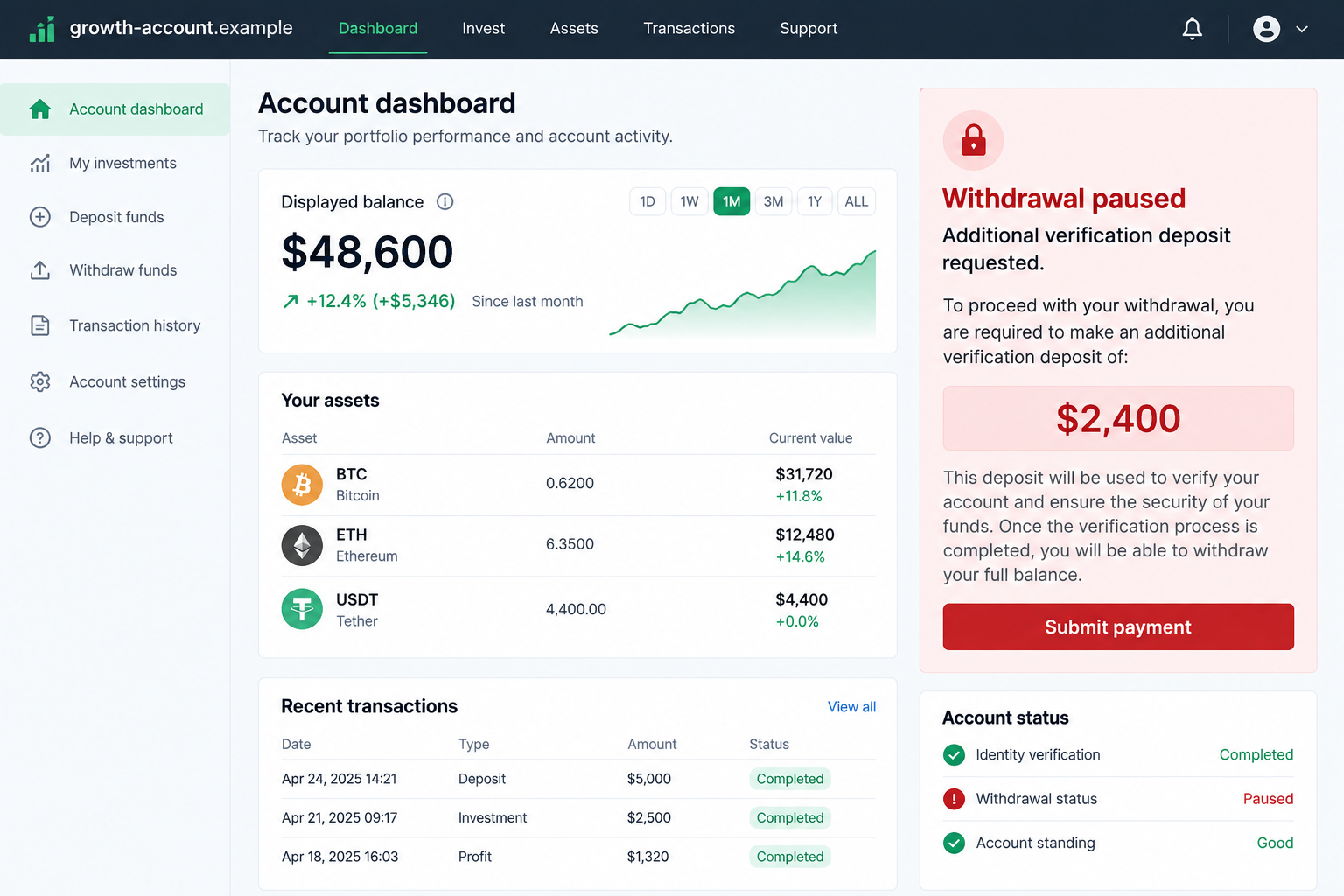
A professional-looking dashboard can display whatever numbers its operator chooses. A growing balance does not establish that investments occurred or that funds remain available.
Some victims receive a small early withdrawal. That can build confidence without demonstrating that later deposits, displayed profits, or the entire platform are genuine.
- The person recommends a particular website or application.
- They guide the movement of money while discouraging independent scrutiny.
- Displayed gains create pressure to increase the deposit.
- Withdrawal requires another payment, often described as verification, fees, or taxes.
- The supposed helper remains involved when the platform’s support gives explanations.
This is a pattern guide, not an accusation against every platform
Cryptocurrency itself is not proof of fraud, and not every online friendship has a financial motive. The deceptive conduct and payment destination matter.
This article does not identify a newly tested platform or reproduce a victim’s private conversation. The example screens and amounts are fictional reconstructions.
If your situation resembles the pattern, pause transfers while you verify it. You do not need certainty about the entire operation before protecting remaining funds.
How the Pig Butchering Crypto Scam Works
Step 1: An ordinary conversation creates access
Initial contact may arrive through a social platform, dating service, or unexpected message. The early exchange can seem unrelated to money.
That matters because obvious investment spam is easier to dismiss. A conversation about daily life creates a different expectation about what follows.
Do not assume the first message reveals the full objective. Equally, do not treat every mistaken text as evidence of an organized criminal group.
The practical boundary is simpler: an unverified online connection should not direct your financial decisions or obtain access to accounts.
Keep that boundary even when the person seems patient. Time spent talking is not the same as independently establishing who they are.
Step 2: Personal trust develops before the investment appears
The contact may share apparent experiences, listen closely, or present an attractive lifestyle. The relationship starts to feel familiar rather than transactional.
Not every detail has to be invented for the manipulation to work. A believable conversation can still contain a dishonest financial recommendation.
Photos and video conversations are not independent verification of a financial business. Even a real person can promote a fraudulent opportunity.
Ask whether you would trust the same investment if it arrived without this relationship. That question separates emotional familiarity from evidence about the money.
If the person becomes upset when you request independent advice, take the reaction seriously. Financial verification should not require proving loyalty to a new contact.
Step 3: A supposedly special opportunity enters the conversation
The person introduces a platform, strategy, or expert connection. You may be told the opportunity is limited or normally unavailable to outsiders.
At this point, evaluate the proposal without relying on the person who introduced it. Their enthusiasm is part of the sales pitch, not a separate check.
Look for an identifiable operating business and relevant authorization in your jurisdiction. Verify records independently and compare the actual domain and contact details.
A copied registration number can refer to an entirely different firm. A company existing on paper does not prove that the website belongs to it.
This is not investment advice. A qualified, independently chosen professional can help evaluate a proposal without sharing the promoter’s interest in your deposit.
Step 4: Real money reaches a destination controlled by someone else
The instructions may begin with a genuine cryptocurrency exchange. Buying crypto there does not authenticate the separate destination to which you are told to transfer it.
Think of those as separate transactions. A legitimate service can process the purchase while the next transfer sends assets to an unverified recipient.
Check the destination rather than relying on the reputation of the exchange used along the way. Ask who controls the receiving account or wallet.
Never provide a wallet recovery phrase or private key to a supposed mentor or support agent. Those secrets can grant control over assets.
Do not follow instructions to mislead your bank about the purpose of a transfer. A request to conceal the arrangement is a reason to stop.
Step 5: Displayed profits encourage larger commitments
The account appears successful, and the contact encourages a larger deposit. You may feel that waiting means missing a chance already proven by your own results.
But results displayed on an operator-controlled website are claims. They require evidence outside that website, especially when withdrawal rights remain uncertain.
An early payout can also mislead. Recovering a small amount does not establish the safety of risking a much larger amount afterward.
Do not borrow, liquidate essential savings, or use someone else’s funds because a dashboard shows gains. Pause and obtain independent advice.
If you have already deposited money, avoid sending more simply to protect the first payment. That can expand the loss without improving your position.
Step 6: Withdrawing creates a new demand for payment
When you try to leave, the platform claims another payment is necessary. Labels can change, but the requested action remains another transfer.
Do not assume a tax label makes the demand official. Verify any genuine tax question with a qualified adviser or the relevant authority independently.
A requirement to send fresh funds to release supposed profits is a major warning sign. The displayed balance should not be treated as money already recovered.
The friendly contact may offer reassurance or claim to contribute toward the fee. That does not make the platform’s demand independently trustworthy.
Stop the payment cycle. The FBI’s victim guidance advises stopping transfers and reporting suspected cryptocurrency investment fraud promptly.
Separate the Person, the Platform, and the Payment
A real identity does not validate an investment
Even if you establish someone’s identity, their financial claims still need checking. They might be dishonest, misinformed, or themselves caught in the arrangement.
Likewise, a video call does not authenticate a website. Avoid collapsing several different questions into the single feeling that the person seems genuine.
Write down what has actually been verified. Distinguish independent records from screenshots, testimonials, and explanations supplied by the promoter.
A real transaction does not validate the dashboard
A blockchain transaction can show that assets moved between addresses. By itself, it does not prove the recipient invested them as promised.
Nor does it establish ownership of the balance displayed inside a separate website. Keep transfer records and account claims in different columns.
This distinction helps when reporting. Investigators need actual outgoing transactions, not just the apparent profit total printed by the suspected platform.
A support conversation is not independent oversight
The same operation may control the chat, website, and customer-support account. Several reassuring voices can still represent one unverified source.
Contact information supplied only inside the platform cannot independently establish its legitimacy. Search for the real organization’s details through authoritative channels.
If verification becomes circular, stop. You should not need the promoter’s approval to consult your bank, a regulator, or someone you trust.
What to Do if You Have Fallen Victim to This Scam
- Stop additional deposits, fees, and release payments.
Do not pay to complete a withdrawal, raise an account tier, or unlock a balance while the arrangement is suspected fraud.
Keep remaining funds separate from the platform and its representatives. An approaching deadline supplied by them should not drive another transfer.
- Contact the financial services actually used.
Notify your bank and the genuine exchange or payment service involved. Use their official fraud channels and give transaction details promptly.
Ask about available holds, recalls, or preservation steps. Some completed transfers cannot be reversed, and no provider should be assumed able to recover everything.
- Preserve both transaction evidence and the conversation.
Save wallet addresses, transaction hashes, dates, asset types, amounts, website addresses, usernames, and payment receipts. Export chats if the application supports it safely.
Keep screenshots of withdrawal demands and displayed balances, but label them as platform claims. Do not mistake those figures for your confirmed financial loss.
- Report through official law-enforcement channels.
U.S. victims can submit details through IC3.gov. Elsewhere, use the appropriate national cybercrime or police reporting service.
Include actual transfers and the sequence of contact. A clear timeline is more useful than an unsupported theory about who controls the entire operation.
- Secure accounts or wallets if access was exposed.
If you shared passwords, change them from a trusted device and review active sessions. If wallet secrets were disclosed, seek reputable wallet-specific security guidance urgently.
Do not enter a recovery phrase into another website recommended by a stranger. Moving remaining assets safely may require careful, account-specific assistance.
- Assess software exposure separately from financial fraud.
If you installed an unfamiliar trading application or remote-access tool, have the device checked. Malwarebytes can help detect certain unwanted or malicious software.
AdGuard can reduce some risky advertising and browsing exposure. Neither tool validates investment balances, reverses blockchain transfers, or substitutes for reporting the financial loss.
- Involve someone supportive and independent.
Tell a trusted person what happened, particularly if you feel pressure to keep paying. Bring them into calls with your bank if that helps.
Shame can keep the situation hidden. You were targeted through manipulation; practical support is more useful than blame.
- Be cautious of recovery approaches.
Do not trust unsolicited offers guaranteeing recovery for an advance fee. Independently verify any claimed investigator, lawyer, or government representative.
A person who knows your loss amount may have obtained that information from the original operation or a public post. Knowledge is not proof of authority.
If Someone You Care About Is Still Sending Money
Make the next decision smaller
Ask for a pause on the next transfer rather than an immediate admission that the whole relationship was false. That can make independent verification less overwhelming.
Offer practical help collecting transaction records or finding the bank’s genuine support channel. Do not use a contact supplied by the person promoting the investment.
If you are contributing family money, keep your own funds out of the arrangement. Helping does not require paying the platform’s supposed release charge.
Agree on a concrete next step, such as a call with the fraud department. A specific appointment is more useful than an argument that repeats indefinitely.
Keep the conversation open
Leading with ridicule can make the person defend the relationship more strongly. Start with the next payment, not a demand that they reject everything immediately.
Ask whether they will pause long enough to speak with their bank or an independent professional. Offer to sit with them while they do.
Focus on verifiable questions: who controls the receiving account, why another payment is required, and which evidence exists outside the platform.
Do not impersonate your relative, take over their accounts, or confront the suspected scammers. Those actions can create additional risks and destroy trust.
Help organize receipts and messages instead. A calm record of the money trail can make the situation easier to understand without demanding an immediate emotional break.
If distress becomes overwhelming, encourage support from qualified local professionals. Financial loss and betrayal can both require care, even after payments have stopped.
Frequently Asked Questions
Does this scam always involve romance?
No. The relationship may resemble friendship, mentorship, professional contact, or a wrong-number conversation. The financial manipulation can follow any of those introductions.
Does one successful withdrawal prove the site is real?
No. A small payout can encourage larger deposits. It does not establish that the displayed balance exists or that future withdrawals will be honored.
What if I bought crypto through a reputable exchange?
The exchange purchase and the onward transfer are separate. A genuine exchange does not authenticate the recipient or an outside investment website.
Should I pay a tax to unlock the account?
Do not rely on an unverified platform’s tax demand. Obtain independent tax advice and avoid additional transfers intended to release supposed profits.
Can police guarantee recovery of cryptocurrency?
No recovery is guaranteed. Prompt reporting and detailed transaction evidence can help authorities assess the case, but outcomes depend on the circumstances.
Should I delete the chat after discovering the fraud?
Preserve relevant evidence before blocking contact. Keep private records rather than posting sensitive documents or financial details publicly.
The Bottom Line
A pig butchering crypto scam turns personal trust into repeated financial risk. The relationship, platform, and payment destination each require independent scrutiny.
If withdrawal depends on another transfer, stop and get outside help. Protecting what remains matters more than satisfying the next demand.








