

Black GLP Freedom speaks directly to women who feel ignored by conventional weight-loss advice and tired of programs that seem disconnected from their lives.
That focused message deserves the same scrutiny as any supplement offer, especially when genetics, hormones, dramatic results, and limited-time bundles appear together.
Overview
What Black GLP Freedom Promises
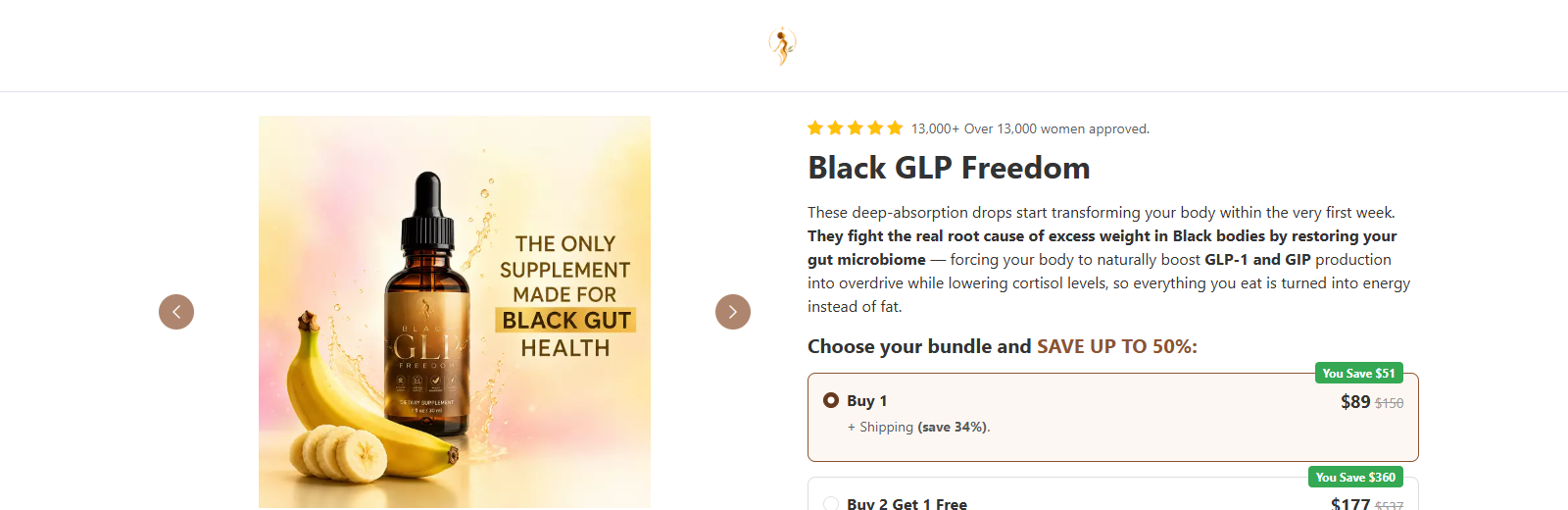
Black GLP Freedom is sold as a liquid supplement designed specifically for Black women seeking weight loss and metabolic support.
The site says its ingredients naturally support GLP-1 and GIP activity, reduce cravings, improve metabolism, and help lost weight remain off.
It also introduces a supposed GG-1 gene connected to Black genetics and repeatedly frames ordinary programs as unsuitable for a distinctive metabolism.
Bundle prices reviewed included $89 for one bottle, $177 for three bottles, and $294 for six bottles.
Why the Presentation Is Concerning
The campaign combines identity-based trust, scientific vocabulary, extraordinary statistics, and urgent package pricing without providing evidence proportionate to those promises.
- The formula is described as designed for Black metabolism.
- The page refers to a GG-1 gene without credible supporting documentation.
- It says 96% of users lost more than 15 pounds in one month.
- Another statement describes Black body hormones as 48 times more powerful.
- The site invokes FDA registration in a potentially confusing way.
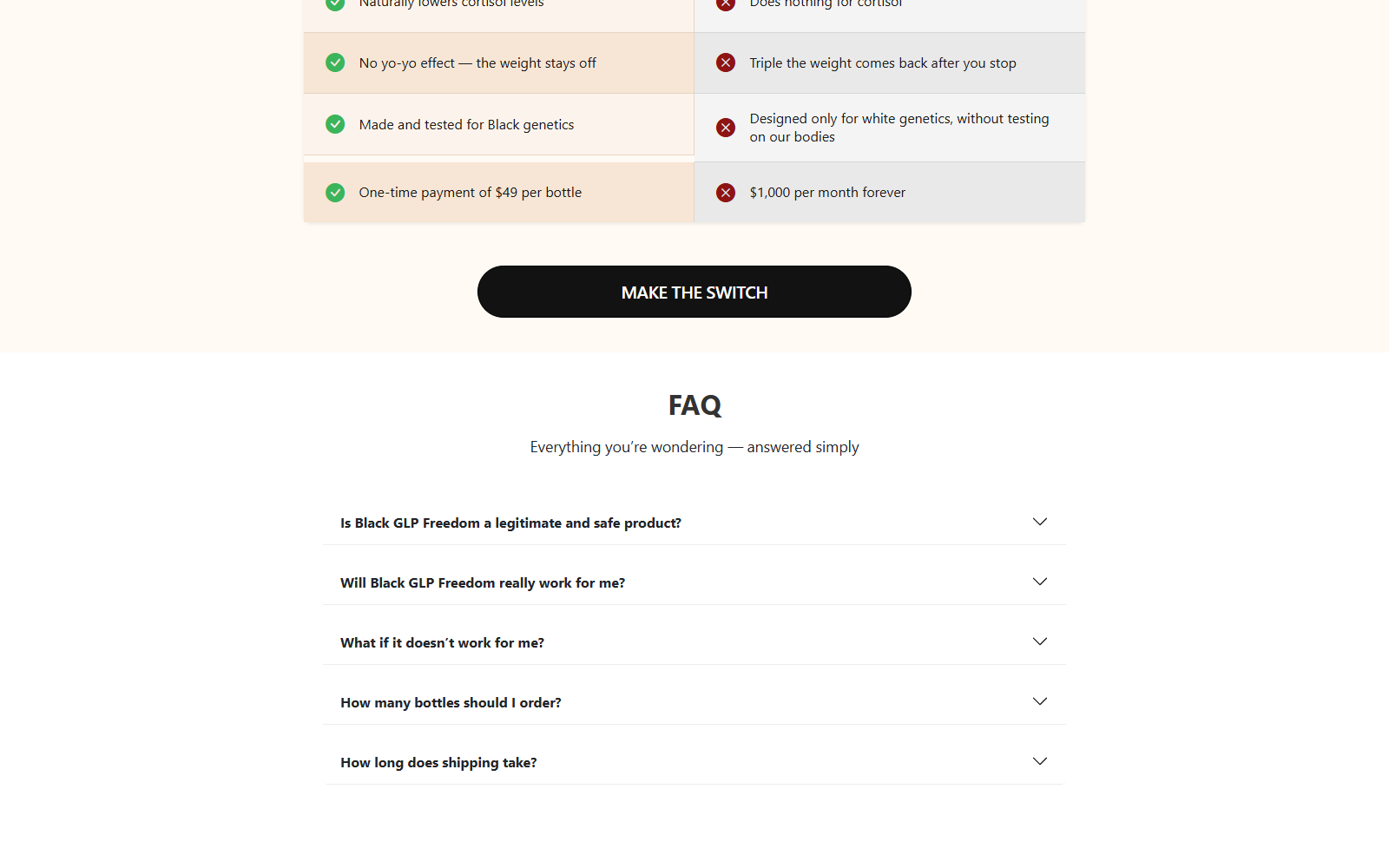
- Guarantee wording alternates between 30 days and 90 days.
- Seller identity and accountability are not prominently explained.
These are not modest wellness statements. They are central reasons a visitor might spend up to $294.
Our Finding
We found no persuasive basis for the site’s most dramatic race-specific biological claims or its claimed monthly success rate.
GLP-1 and GIP are real metabolic hormones. Using their names does not make a supplement equivalent to approved prescription medicines that affect those pathways.
The product may contain familiar botanical ingredients, yet ingredient familiarity does not establish the advertised magnitude, speed, or permanence of weight loss.
Customers should treat the offer as a high-pressure supplement funnel, not a proven personalized metabolic program.
How Real Science Is Turned Into a Sales Story
GLP-1 Is Real, but That Does Not Validate the Drops
GLP-1 helps regulate blood sugar, appetite, and digestion. Prescription medicines targeting this system have been studied, standardized, and regulated as drugs.
A dietary supplement cannot borrow those results merely by mentioning the same hormone. Its ingredients, dose, absorption, effects, and risks require separate evidence.
The sales page does not show that Black GLP Freedom produces drug-like GLP-1 activity or comparable clinical outcomes.
“Supports” can be broad marketing language. Shoppers may nevertheless interpret the presentation as a natural version of popular weight-loss injections.
The GG-1 Gene Claim Lacks a Credible Foundation
The page describes a GG-1 gene as though it explains why Black women gain weight differently and why the formula is uniquely suitable.
We did not find a recognized genetic explanation matching that simple sales narrative in the evidence presented by the seller.
Human metabolism is influenced by many genetic, environmental, medical, social, and behavioral factors. Race is not a single biological switch.
A proprietary-sounding gene label can make a broad claim appear precise, even when the seller does not provide published research supporting it.
Identity-Based Marketing Raises the Stakes
Health disparities and dismissive treatment are real experiences. A marketer can build trust by acknowledging them and positioning a product as overdue recognition.
That emotional connection makes verification more important, not less. Cultural relevance cannot replace ingredient transparency, realistic outcomes, or accountable medical evidence.
A company should not exploit justified frustration with healthcare to sell an inadequately supported solution.

How the Black GLP Freedom Funnel Works
Step 1: The Message Creates Recognition
The page tells visitors that common diets and weight-loss programs were not designed for them.
For someone who has repeatedly struggled, that message can feel validating. Previous disappointments are reframed as a mismatch rather than personal failure.
Validation can be helpful, but it also lowers skepticism when the same page immediately sells the supposed solution.
Step 2: A Simple Genetic Explanation Organizes the Story
The GG-1 narrative turns a complex issue into an understandable cause. The formula is then positioned as uniquely able to address that cause.
Simple explanations are memorable. They also hide uncertainty, competing causes, and the absence of individualized testing.
No online bottle can determine a buyer’s genetics, medications, endocrine status, eating patterns, or medical reasons for weight change.
Step 3: Hormone Names Add Medical Authority
GLP-1 and GIP are familiar from news coverage of prescription treatments. Their inclusion makes the drops sound connected to an established therapeutic breakthrough.
The page does not demonstrate equivalence in formulation, mechanism, dose, clinical benefit, or regulatory review.
This is a common supplement technique: reference a legitimate biological pathway, then allow the consumer to infer far more than the evidence shows.
Step 4: Dramatic Statistics Make Success Feel Typical
The claim that 96% lost more than 15 pounds in one month suggests fast results for almost everyone.
A statistic that precise should come with a study protocol, sample size, participant characteristics, control group, attrition, adverse events, and complete data.
The storefront does not provide that level of support. Without it, the percentage should be treated as advertising, not a reliable prediction.
Step 5: “No Side Effects” Removes an Important Fear
Any active substance can cause unwanted effects, allergies, interactions, or problems for certain users. Natural does not mean universally harmless.
People taking diabetes medicine, blood-pressure treatment, anticoagulants, or other prescriptions need particular caution around metabolism-focused supplements.
A responsible evaluation includes ingredient amounts, contraindications, manufacturing quality, and interaction review, not only a reassuring sentence.
Step 6: Bundles Increase the Initial Commitment
The one-bottle option appears less economical beside three-bottle and six-bottle packages. Savings language encourages shoppers to buy months of supply immediately.
Bulk purchasing raises the amount at risk before the user knows whether the formula is tolerated, useful, or returnable.
We did not find evidence proving every order enrolls the buyer in automatic refills. The verified concern is package pressure, not an assumed subscription.
Step 7: Conflicting Guarantees Complicate the Exit
One area of the site references a 30-day guarantee, while the FAQ describes a 90-day guarantee.
A buyer should not have to guess which promise governs. Different windows can change when support is contacted and whether a request is accepted.
Always save the guarantee shown beside the purchased package and ask for clarification before paying.
Company, Address, and Fulfillment Checks
The Responsible Seller Is Not Prominent Enough
A supplement site should clearly identify the legal entity accepting payment, its physical business address, and reliable customer-service channels.
Black GLP Freedom’s main presentation emphasizes the brand and biological story far more than the operator responsible for refunds and safety complaints.
If a company name appears only deep inside policy text, compare it with the checkout, receipt, card descriptor, and bottle label.
A Return Address Is Not Necessarily Headquarters
Some supplement sellers use third-party warehouses, virtual offices, or fulfillment centers. Those facilities may handle parcels without managing the brand.
Ask where unopened and opened bottles must be returned, who authorizes the return, and whether any disposal or handling fee applies.
Do not mail supplements to an address found in an advertisement. Use a written authorization tied to the order.
Telephone and Email Support Should Be Tested
Call or write before purchasing. Ask who manufactures the drops, where they are produced, and which company appears on the card statement.
Specific questions should receive specific answers. A scripted response that repeats benefits without addressing identity is a warning.
Save all correspondence. Nonresponsive support becomes especially important when a guarantee period is short or disputed.
Manufacturing Claims Need Documentation
Look for a complete Supplement Facts panel, serving size, exact ingredient amounts, lot number, expiration date, manufacturer, and adverse-event contact.
“FDA registered” does not mean the FDA approved the product’s effectiveness. Dietary supplements generally are not approved like medicines before marketing.
A facility registration, when genuine, concerns administrative or manufacturing matters. It does not transform promotional claims into verified medical conclusions.
What the Numbers Do and Do Not Prove
Thirteen Thousand Customers Is Not a Clinical Trial
The page references more than 13,000 women. Sales volume or a marketing community does not establish average weight loss.
Without transparent follow-up, it is impossible to know how many completed the program, stopped early, changed diet, used medication, or reported adverse effects.
One-Month Weight Loss Claims Need Context
Losing more than 15 pounds in one month is significant. For many people, rapid loss may require medical supervision.
Changes on a scale can include water, muscle, and other tissue, not only body fat. A headline does not reveal the composition.
Anyone experiencing sudden unexplained weight change should seek medical advice rather than assuming the drops are working normally.
Permanent Results Are Especially Difficult to Promise
The page suggests weight stays off. Long-term maintenance depends on many factors and cannot be guaranteed by a short supplement course.
A credible permanence claim would require extended follow-up after stopping the product, with clearly reported participation and outcomes.
How to Evaluate a GLP-1 Supplement
Read the Facts Panel Before the Story
Ignore celebrity-style narratives and start with the bottle facts. Identify every active ingredient and amount per serving.
Proprietary blends can conceal doses. If amounts are missing, meaningful comparison with research becomes difficult.
Check Interactions and Contraindications
Bring the ingredient list to a pharmacist or clinician. This is particularly important for pregnancy, diabetes, liver disease, surgery, or multiple medications.
Do not stop prescribed treatment because a supplement advertises a natural alternative.
Buy the Smallest Test Quantity
Bulk savings are irrelevant if the formula causes problems or fails to meet expectations. Avoid six-bottle commitments without reliable experience.
Confirm whether opened bottles can be returned and whether the guarantee covers all packages or only one unit.
Define a Realistic Outcome
Choose measurable goals and a time for professional review. Do not accept shifting explanations when promised results fail to appear.
A legitimate wellness plan should tolerate careful questions and should not depend on guilt, secrecy, or repeated upsells.
Health Risks Buyers Should Consider
Supplements Can Interact With Medication
Botanical ingredients may affect blood sugar, blood pressure, digestion, bleeding risk, or drug metabolism.
Symptoms such as faintness, persistent vomiting, severe abdominal pain, allergic swelling, confusion, or unusual bleeding need medical attention.
Unlisted Ingredients Are a Serious Concern
Products sold with drug-like promises deserve caution because undeclared pharmaceutical ingredients have appeared in parts of the weight-loss supplement market.
This statement does not prove Black GLP Freedom contains an undeclared drug. It explains why trustworthy manufacturing and independent testing matter.
Delayed Diagnosis Can Cause Harm
Weight gain may relate to thyroid disease, sleep disorders, medication, menopause, depression, diabetes, fluid retention, or other conditions.
A race-specific marketing story should not prevent a proper evaluation of symptoms and individual risk.
What to Do if You Have Fallen Victim to This Scam
Supplement problems require both billing evidence and careful attention to possible reactions.
- Stop using the drops after a concerning reaction. Seek urgent help for severe symptoms and bring the bottle or ingredient label.
- Save every version of the offer. Capture genetics claims, success statistics, prices, guarantee wording, checkout totals, emails, and card entries.
- Request the seller’s legal details. Ask for the contracting company, manufacturing source, return address, and exact refund conditions in writing.
- Cancel any unwanted recurring plan. We did not verify universal autoship, but inspect confirmation emails and statements for any renewal language.
- Contact the payment provider. Dispute unauthorized charges, undelivered goods, materially different items, or refusal to honor written refund terms.
- Do not ship without authorization. Obtain the correct destination and reference number, then use tracked postage if a return is required.
- Report suspicious health claims. Send screenshots and packaging details to appropriate consumer, advertising, and health-product regulators.
- Protect your accounts. Change reused passwords and run Malwarebytes if redirects or downloads appeared during the purchase journey.
- Reduce future ad targeting. AdGuard can block many trackers and deceptive placements, although it cannot recover payments or cancel orders.
- Get evidence-based help. A clinician or registered dietitian can evaluate medications, symptoms, realistic goals, and safer options.
Keep the bottle until the dispute is resolved unless a medical professional or regulator tells you otherwise. Lot and label details may be important.
If the guarantee pages conflict, submit the request under the longer promise and include a screenshot showing exactly what you saw.
Frequently Asked Questions
Is Black GLP Freedom an approved GLP-1 drug?
No. It is marketed as a dietary supplement, not as an FDA-approved prescription medicine with equivalent evidence or regulatory review.
Is there really a GG-1 gene for Black metabolism?
The seller uses that label, but we found no credible evidence supporting the simplified gene story presented on the sales page.
Did 96% of users lose 15 pounds?
The storefront states that figure without the transparent study details needed to treat it as dependable clinical evidence.
Does FDA registration mean FDA approval?
No. Registration and approval are different. Supplement products and claims generally are not preapproved like prescription drugs.
Is every purchase an automatic subscription?
We did not verify that claim. Check the checkout, receipt, account, and statements for explicit recurring terms rather than assuming either way.
Which guarantee applies, 30 days or 90 days?
The site displayed conflicting periods. Obtain written clarification and preserve the longer guarantee language before the shorter deadline passes.
The Bottom Line
Black GLP Freedom builds a compelling identity-centered story around real metabolic vocabulary, but its strongest claims are not supported by matching evidence.
The invented-sounding gene narrative, remarkable weight-loss statistic, confusing FDA language, bundle pressure, and conflicting guarantees create serious reasons for caution.
Do not let a personalized message replace personalized healthcare. Verify the company and formula, buy no bulk package under pressure, and discuss meaningful weight changes professionally.

Join the discussion
0 commentsShare your experience or ask a question about this article.
Discussion
Start the conversation
Have a question or something useful to share? Add the first comment.