


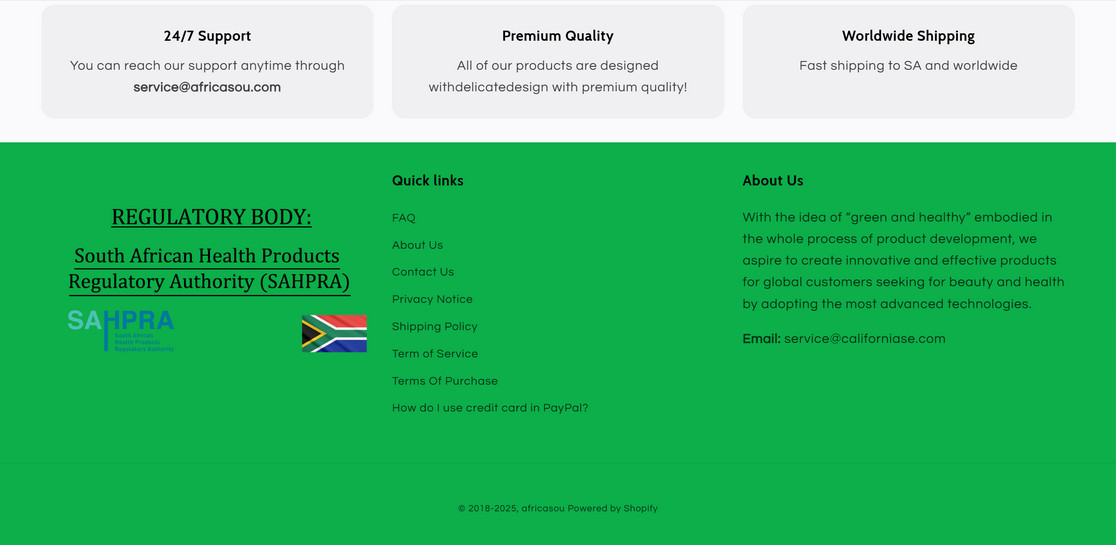
Africasou.com looked like a South African health shop. It priced everything in ZAR, promised local warehouses and showed the logo of the country’s medicines regulator in its footer.
Behind that front, the details didn’t line up. The address, the policies and the regulator’s own warnings all tell a different story.
Overview
What Africasou.com sold
Africasou.com was a Shopify store aimed at South African shoppers. From mid-2025 it sold weight-loss products branded HHVB, described as GLP-1 oral liquids and patches.
The product pages claimed the liquids helped with obesity, diabetes, heart health, sleep apnea and joint problems, with visible results in seven days.
What the store claimed about itself
The footer named SAHPRA, South Africa’s health products regulator, as the store’s regulatory body and displayed its logo. Product pages called it the only official SAHPRA store.
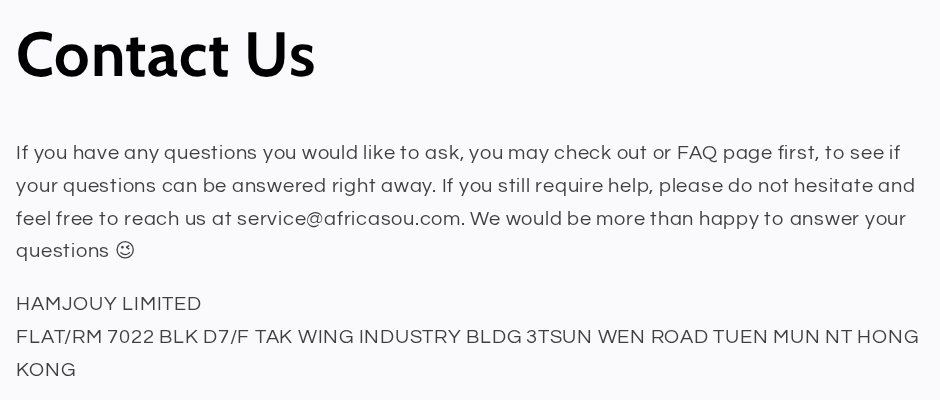
The same pages said the products were made in South Africa and shipped from local warehouses. Its contact page, though, listed a company in Hong Kong.
What the evidence shows
The store’s claims fall apart against its own pages and the regulator’s statements. These are the key points.
- SAHPRA states that no oral GLP-1 liquid carries its approval, and that sellers claiming its backing are making untrue claims.
- The contact page named HAMJOUY LIMITED at a Hong Kong address, not a South African business.
- The shipping policy described one warehouse, a 10 to 20 business day delivery window and a flat $2.99 shipping fee to every country.
- The terms named another website as the company, and the footer listed an email on another domain.
- Africasou.com is no longer registered and doesn’t load.
Is Africasou.com Legit?
No. Africasou.com sold unapproved weight-loss medicines with a false claim of regulatory approval, and it is now gone. Do not order from it or any copy of it.
The central problem is the SAHPRA claim. A store that falsely presents itself as approved by the national regulator is misleading buyers about the safety of what they swallow.
In November 2025, SAHPRA warned the public about GLP-1 products sold online. It said companies were “falsely claiming to be affiliated with or authorised by SAHPRA”.
The same release states, “SAHPRA has not approved any oral GLP-1 solution for consumption.” Africasou’s main products were exactly that: GLP-1 oral liquids.
Our original July 2025 report already warned readers away from the store. The store’s own pages and the regulator’s statement now show why, in far more detail.
Africasou.com Reviews and Complaints
There are no independent customer reviews of Africasou.com on major review platforms, and the store has no Trustpilot page.
That absence doesn’t mean buyers were satisfied. Stores like this often run for a few months, and buyers who lose money may not know where to complain.
The product pages carried glowing testimonials, including one from a buyer who claimed to have been on the brink of death from obesity. None names a verifiable person.
One page quoted an endocrinologist who claimed clinical trials with over 5,000 participants. No study, journal or trial registration was given to support it.
Treat on-site reviews as advertising. On a store that misstates its regulatory status, testimonials carry no weight at all.
What the HHVB GLP-1 Products Claimed
Africasou’s product listings changed over the summer of 2025, but the pitch stayed the same. The products were sold as GLP-1 oral solutions under the HHVB name.
One version, titled HHVB GLP-1 Six-in-One Health Solution Oral Liquid, said it combined tirzepatide with herbal ingredients. Tirzepatide is the prescription drug in Eli Lilly’s Mounjaro and Zepbound injections.
The ingredient list also mentioned apple cider vinegar, moringa, ginkgo biloba, echinacea, probiotics, NAD+ and collagen. No amounts, batch numbers or manufacturer details appeared alongside them.
The weight promises scaled with the order. One box promised up to 5 kg, four boxes up to 20 kg, and ten boxes up to 50 kg.
Prices ran from R 336.97 for one box to R 1,258.97 for ten. A banner claimed 98.8% of customers bought six or more.
The page also promised no recurrence after stopping and called the product a permanent solution to health problems. No medicine for obesity or diabetes works that way.
Other badges claimed a GMP-certified factory and FDA-compliant ingredients. No factory, certificate number or FDA record was named, so neither claim could be checked.
The store also said its products were protected by South African patents and threatened legal action against counterfeiters. No patent number appeared anywhere on the pages.
Our report on the Ourlyard GLP-1 Six in One Oral Liquid covers a product sold under the same name elsewhere.
What SAHPRA Says About These Products
SAHPRA’s November 11, 2025 warning describes this kind of operation closely. It does not name Africasou, but its findings match what the store’s pages show.
The regulator said its investigation found the sellers “are not based in South Africa”. It said the products came from China by post, not from Johannesburg or Cape Town.
It added that the shipped products “are not identical to the advertised products”. Buyers may receive something different from what the page described.
The warning pictured an ad for an HHVB-branded GLP-1 Six-in-One Health Solution Oral Liquid, priced in ZAR and showing SAHPRA’s logo. Africasou sold the same brand and product name.
The pictured page’s address begins with sacath. Its Break Free from Obesity Struggles heading also appeared on Africasou’s Six-in-One product page.
SAHPRA warned that such medicines “may contain dangerous/harmful ingredients” that sellers might not disclose. It advised buying prescribed medicines only from licensed pharmacies.
It also said selling or advertising unregistered medicines breaks the Medicines and Related Substances Act. Our Sacath.com report covers the sacath.com store and that picture.
Why a GLP-1 Oral Liquid Is a Red Flag
GLP-1 medicines are real, effective treatments for diabetes and weight management. In South Africa, they are prescription medicines that must be registered with SAHPRA.
A liquid sold online with GLP-1 in its name is not the same thing. The label borrows the reputation of the real drugs without any of the testing behind them.
Australia’s medicines regulator, the TGA, lab-tested an HHVB GLP-1 Six In-One Health Solution Oral Liquid. Its March 2026 advisory reports “No GLP-1 or analogues identified” and doesn’t name Africasou.
The same TGA list includes an HHVB GLP-1 microneedle patch, with the same result. Our HHVB Six In-One report covers those tests.
The risk goes beyond wasted money. If a product really contained a drug like tirzepatide, taking it without a doctor could cause side effects, especially for people on diabetes medicine.
If it contained nothing active, buyers could delay proper treatment while waiting for results that never come. Either way, the product shouldn’t be taken.
How the Africasou.com Scam Worked
The store combined a local-looking front with an overseas operation. Each step built trust that the facts didn’t support.
Step 1: A South African storefront
Prices appeared in ZAR, with free shipping above R 700. The footer showed the South African flag next to SAHPRA’s name and logo.
Step 2: A medicine-like product with a famous name
GLP-1 drugs are widely known for weight loss. Naming the product GLP-1 and mentioning tirzepatide borrowed the reputation of real prescription treatments.
Step 3: Borrowed authority
The pages claimed SAHPRA certification, an unnamed endocrinologist, clinical trials and a GMP-certified factory. None came with a registration number or source you could check.
Step 4: Bigger orders, bigger promises
Each larger bundle promised more weight loss, up to 50 kg for ten boxes. Daily offers of double product for the first 200 orders added urgency.
Step 5: A long, slow delivery
The shipping policy allowed five business days to dispatch and 10 to 20 business days in transit. That window delays complaints.
It also fits SAHPRA’s finding that such products were posted from China rather than sent from a local warehouse.
Step 6: The domain disappears
Africasou.com is no longer registered. Buyers now have no store, support address or website to contact.
Who Was Behind Africasou.com?
The store’s own pages pointed in several directions at once. None of them led to a South African business.
The store name and the legal name don’t match
The site called itself africasou, but its Terms of Purchase named another website as the Company. That text appears to have been copied from a different store.
The footer of the home page listed support at service@californiase.com, another domain. The contact pages used service@africasou.com instead.
Links to the store’s font files carried a list of other domains, including californiase.com and africasouvip.com. These domains appear to share one Shopify store.
That doesn’t show who ran the store. Most of the .shop names on the list are no longer registered.
Californiase.com was registered again on October 28, 2025, so its current holder may have no link to the store.
The only address was in Hong Kong
The contact page named HAMJOUY LIMITED at an industrial building in Tuen Mun, Hong Kong. A third-party directory lists a Hong Kong company by that name incorporated in 2023.
That address contradicts the made-in-South-Africa and local-warehouse claims. Nothing on the store gave a South African company number or physical address.
In October 2025, France’s medicines agency, ANSM, ordered a company named Hamjouy Limited to withdraw GLP-1 products offered on four other websites. Those decisions give no address.
Our Warm Family GLP-1 drops report lists those ANSM decisions, which don’t mention Africasou.
Support was email only
Africasou listed no phone number, only email. With africasou.com gone, its main support address can no longer receive mail.
The store’s policies also limited changes. Cancellations and address changes were accepted only on the day of the order, before 11 p.m. Pacific time.
No maker, batch or registration number
The product pages named no manufacturer, lot number or SAHPRA registration number. A real registered medicine in South Africa can be checked in SAHPRA’s public database.
How Long Africasou.com Was Online
Security certificates for africasou.com were first issued on June 6, 2025. The Internet Archive captured the home page a week later, on June 13.
Archived product pages show the catalog changing through August, September and October 2025, with new product addresses for each version of the HHVB liquids and patches.
The last certificate was issued in June 2026. The .com registry now has no record of the domain, and the address no longer resolves.
The store’s footer claimed a copyright running from 2018 to 2025. The certificate history and archive records only go back to June 2025.
How to Check a Medicine in South Africa
A few checks would have exposed Africasou’s claims before any order. They apply to any health product sold online in South Africa.
- Look the product up on SAHPRA’s medicines database. A registered medicine has a registration number you can match to its label.
- Be suspicious of SAHPRA’s logo on a shop or product page. The regulator registers medicines; it doesn’t run stores or endorse sellers.
- Buy prescription medicines only from a licensed pharmacy, with a prescription from a doctor who knows your health history.
- Check the seller’s company name and address against the claims on the page. A Hong Kong address behind a made-in-South-Africa label is a contradiction.
How to Spot Fake GLP-1 Stores Like Africasou.com
Similar stores keep appearing under new names. These signs should stop you before you pay.
- A regulator’s logo used as a badge, especially next to claims of being its official store.
- Prescription drug names such as tirzepatide in a product sold without a prescription.
- Weight-loss targets that rise with the number of boxes you buy.
- Local-looking prices paired with an overseas company address.
- Copied policies that name a different website or email domain.
- Claims of permanent cures or no recurrence after stopping.
Similar oral drops have appeared under other names. Our HHVB GLP-1 moringa drops report covers an earlier product with the same brand.
Fraudulent shopping websites often share common patterns that make them easier to detect once you know what to look for. Before entering personal information or making a payment, take a few minutes to check for these warning signs:
- Unrealistic prices and discounts
If a website offers products at prices far below trusted retailers, it’s often a red flag. Many of these sites advertise luxury or high-demand products at massive discounts to create a sense of urgency. A $300 product listed for $49.99 should immediately raise suspicion. - Recently registered or suspicious domain names
Many fraudulent websites operate on newly created domains that disappear after a few weeks. Look for signs like random characters in the URL, misspellings of well-known brands, or hyphenated domains.
You can check a site’s age using tools like WHOIS lookups or ScamAdviser. - Missing or vague company details
Legitimate businesses clearly display their company name, tax information, phone numbers, physical address, and return policies. Fraudulent sites often provide incomplete, fake, or no company details at all. A lack of verifiable contact information is a major warning sign. - No reliable customer service
Real businesses provide clear ways to contact support—email, phone, live chat, or physical return addresses. Fake stores often list nonfunctional contact forms, invalid phone numbers, or reply with generic automated messages. - Poor website quality and structure
Many fake stores are set up quickly with low-effort templates. Look for poor grammar, spelling errors, low-resolution product images, broken links, or missing legal pages (Terms of Service, Privacy Policy, Return Policy). A sloppy website often signals something isn’t right. - Copied product descriptions and images
Fraudulent sites often lift product listings directly from real retailers or marketplaces. If you reverse image search a product photo and find it on multiple unrelated websites, the listing is likely not original. - Lack of credible reviews or suspicious review patterns
A real store will usually have a mix of customer reviews across different platforms. Warning signs include no reviews at all, obviously fake five-star reviews, or multiple identical reviews posted on the same day. Searching “[website name] reviews” or “[website name] scam” on Google often reveals warnings from other consumers. - Unclear or unfair return and refund policies
Fake stores often use vague language around returns and refunds—or avoid the topic entirely. If you can’t easily find clear instructions for how to return an item or get a refund, proceed with caution. - Aggressive urgency and pressure tactics
Fraudulent websites commonly use fake scarcity (e.g., “Only 2 left in stock!”) or countdown timers (“Sale ends in 10 minutes!”) to push you to buy before you think it through. Legitimate stores don’t rely on fabricated urgency to make sales.
Quick Steps to Verify a Website’s Legitimacy
Before entering payment or personal details on a new shopping website, take a few simple precautions:
- Search for the store’s name along with words like “reviews” or “complaints” on Google and Trustpilot.
- Check the website’s domain registration using Whois.com.
- Use trusted tools to scan for malicious or fraudulent links:
- Malwarebytes ScamGuard – detect scams and unsafe links before they reach you on Android and iOS phone.
- Malwarebytes Browser Guard – block dangerous or fake websites on Windows and macOS browsers.
- Verify the business address on Google Maps to ensure it’s a legitimate location.
- Review the store’s accepted payment methods – credit cards and PayPal are traceable and safer than cryptocurrency or bank transfers.
- Trust your instincts; if something feels off, it’s better not to proceed.
How to Spot Similar Scams on Social Media
Many fraudulent shopping websites rely heavily on sponsored social media ads to draw in large numbers of potential buyers. These ads often promise extraordinary discounts—sometimes up to 90% off—and use emotionally charged language to push users into buying immediately.
They frequently appear on Facebook, Instagram, and TikTok, blending in with legitimate content. However, these ads follow predictable patterns that make them easier to identify once you know what to look for.
Spotting Fraudulent Facebook Ads
Facebook’s advertising platform is a favorite tool for fake online stores because of its massive reach. These ads often feature “unbelievable” offers designed to create urgency and bypass critical thinking. Warning signs include:
- Extreme, unrealistic discounts such as “90% OFF,” “Store Closing Sale,” or “Final Liquidation.” Real retailers rarely discount new products this aggressively.
- Poor grammar, awkward phrasing, or inconsistent language throughout the ad or website, indicating low-effort, mass-produced content.
- Generic stock photos or images with watermarks, suggesting the images were taken from legitimate brands or stolen from other sources.
- Recently created Facebook Pages, which is common for temporary fraudulent campaigns. Check the “Page Transparency” section to see when the page was created.
- Limited or no engagement from real customers. Authentic brands usually have reviews, comments, and visible user interaction.
If an ad raises doubts, search for reviews of the website or reverse image search the product photos to see if they’re copied from elsewhere. Never provide payment information until the site is verified.
Spotting Fraudulent Instagram Ads
Instagram is another major platform used to promote fake shopping sites through eye-catching visuals and short-lived “flash sale” captions. Warning signs to look for:
- New or disposable accounts with few posts and followers, often created just weeks or days before launching ads.
- Lack of tagged users in product posts. Legitimate stores often feature real customers, influencers, or product usage.
- Unsecured checkout pages. If the website linked in the bio does not use HTTPS, do not enter payment information.
- Fake or missing customer reviews. Fraudulent stores rarely have authentic purchase feedback.
- Unclear or restrictive return policies, often hidden or written vaguely to make refunds difficult.
When in doubt, search for independent reviews before buying, and only enter payment details on verified, secure websites.
Catching Fake TikTok Ads
TikTok is increasingly used to promote questionable shopping deals through short, persuasive videos. While many ads look polished, the same red flags apply:
- Links to unknown stores that don’t appear in search results or have no external reputation. Many of these sites are temporary and disappear after a short time.
- No verification badge on the TikTok account. While not every legitimate store is verified, the lack of a badge is one more indicator to check further.
- Aggressive countdown timers or “one-day only” promotions designed to rush decision-making.
- Lack of genuine customer reviews or real user content demonstrating the product in actual use.
- Comment sections filled with complaints or warnings from other users. This is often the first place victims speak up.
TikTok scams often rely on impulse buying. Take a moment to verify the website, read independent reviews, and use trusted browser protection before visiting external links.
What to Do if You Have Fallen Victim to This Scam
If you bought from Africasou.com, deal with your health first. The payment steps in the next section cover your bank, card and accounts.
- Stop taking the product. You can’t know what the liquid contains. Keep taking any medicines your doctor prescribed, and show the product to a pharmacist or doctor.
- Get emergency help for severe symptoms. For severe stomach pain, repeated vomiting, fainting or confusion, call 10177 for an ambulance, or 112 from a mobile phone.
- Tell your doctor if you use diabetes medicine. Products claiming GLP-1 effects may affect blood sugar, so your doctor should know what you took.
- Report it to SAHPRA. The regulator asks the public to report suspicious medicine sales and false approval claims through its 24-hour hotline, 0800 204 307.
- Keep the parcel and packaging. Labels and any batch details help a doctor, a pharmacist or SAHPRA identify what you were sent.
More Steps If You Paid a Fake Shopping Site
If you made a purchase or entered personal information this website, acting quickly can help you minimize financial loss, secure your accounts, and prevent further misuse of your data. Follow these steps carefully:
- Contact your bank or payment provider immediately
If you paid with a credit or debit card, call your bank’s customer service line and explain that you placed an order on a website that may be fraudulent. Request to dispute the transaction or initiate a chargeback.
If you used PayPal or another payment processor, file a dispute through their resolution center and provide order confirmations, emails, or screenshots as supporting evidence.
Fast action gives you the best chance of recovering your money and preventing additional unauthorized charges. - Freeze or replace your payment method
If your card or account details were entered on this website, it’s safest to have your bank or provider issue a replacement card. This prevents future unauthorized transactions and protects your financial accounts.
Some banks may also offer temporary holds or fraud alerts, ensuring no additional transactions can be made without your consent. - Run a personal data removal scan
Fraudulent websites often collect personal information such as names, phone numbers, addresses, and emails. This data may be shared with third parties or added to marketing and phishing lists.
A trusted service such as Malwarebytes Personal Data Remover can identify where your information is listed across data broker networks and help you request its removal. - Check your digital footprint
Even if you didn’t lose money, your personal data could already be circulating online. Running a digital footprint scan can help reveal whether your email address, phone number, or other personal information is present in leaks or broker databases.
This allows you to take proactive measures such as changing credentials, monitoring accounts, or setting up alerts before your data is misused. - Change your passwords and enable 2FA
If the same email or password used during checkout is also used on other websites or services, update those credentials immediately.
Choose strong, unique passwords and enable two-factor authentication (2FA) on all important accounts, especially your primary email, banking apps, and social media. This extra security layer makes unauthorized access significantly harder. - Scan your device for potential threats
Many fraudulent sites contain hidden tracking scripts, phishing pop-ups, or files designed to compromise your security.
Run a full system scan using a trusted security solution such as Malwarebytes Free or ESET Online Scanner to make sure your device hasn’t been exposed to malware or spyware during the visit.
If any suspicious files are found, remove them and restart your device. - Check your accounts and statements regularly
Monitor your bank and credit card statements closely for any unauthorized activity. Look for unfamiliar charges, subscription renewals, or repeated small test transactions.
Also review your email inbox and online accounts for password reset notices or sign-in alerts you didn’t initiate. Report anything unusual to your bank or account provider immediately. - Report the incident to the appropriate authorities
Reporting helps law enforcement track fraudulent websites and can support your claim if needed.- In the U.S., file a report with FTC ReportFraud.ftc.gov.
- In the EU, contact Europol or your national cybercrime unit.
- Globally, you can also submit the site to ScamAdviser to help warn other consumers.
Providing the website URL, order details, and communications increases the impact of your report.
- Save all evidence and communication
Keep copies of order confirmations, emails, payment records, chat logs, and screenshots of the website. This documentation can be crucial for supporting your chargeback request, reporting the case, or pursuing legal remedies if needed.
Store everything in one secure folder so you can easily provide it to your bank or relevant agencies. - Be cautious of follow-up contact
After incidents like this, affected individuals may receive fake refund messages, phishing emails, or phone calls pretending to offer “assistance.”
Do not click on unsolicited links, download attachments, or provide additional personal information. If you receive any message related to this website, verify its authenticity directly through your bank or official payment provider channels.
Frequently Asked Questions
Is Africasou.com legit?
No. It sold GLP-1 oral liquids that SAHPRA says it has never approved, while falsely presenting itself as SAHPRA’s official store. The site is now offline.
Was Africasou.com approved by SAHPRA?
No. The regulator has cleared no oral GLP-1 liquid, and it says sellers presenting such products as SAHPRA-authorized are making false claims.
Where was Africasou.com based?
Its contact page named HAMJOUY LIMITED in Tuen Mun, Hong Kong, despite claims of being made in South Africa with local warehouses.
Are HHVB GLP-1 drops safe?
Their contents can’t be verified. SAHPRA warns that unregistered GLP-1 products sold online may contain undisclosed harmful ingredients, so don’t take them.
Can I get my money back from Africasou.com?
Not from the store, which is gone. PayPal disputes must be opened within 180 days and card disputes often within about 120 days, so 2025 orders are likely too late.
Are there Africasou.com reviews from real buyers?
No independent reviews are available. The testimonials on the store named no verifiable people and should be treated as advertising.
The Bottom Line
Don’t buy from Africasou.com or any store selling HHVB GLP-1 oral liquids. SAHPRA has approved no oral GLP-1 solution, and the store’s approval claim was false.
If you paid, stop taking the product, keep prescribed medicines and show the box to a pharmacist or doctor. Ask your bank whether a card dispute is still possible.
This article is for informational purposes only and should not be relied upon for financial or business decisions. We identify potential scams using research, user experiences, and expert analysis. However, all claims should be independently verified. Mistakes may occur, and legitimate products could be flagged. We strive for accuracy but make no warranties regarding the completeness or reliability of the information.

If you are the owner of the website or product in question and wish to offer clarifications regarding your business or website, please reach out to us via our Contact form.

Reviews & discussion
0 commentsShare a firsthand experience, or ask a question.
Community reviews
africasou.com
Moderated reader experiences, not an editorial verdict.
Start the conversation
Have a question or something useful to share? Add the first comment.