

Maison Straver looks like a polished American fashion boutique, complete with seasonal discounts, fast shipping promises, and an elegant storefront.
Behind that presentation, several details deserve a closer look before anyone trusts the photographs, return promise, or company story with their money.
Overview
What Maison Straver Presents to Shoppers
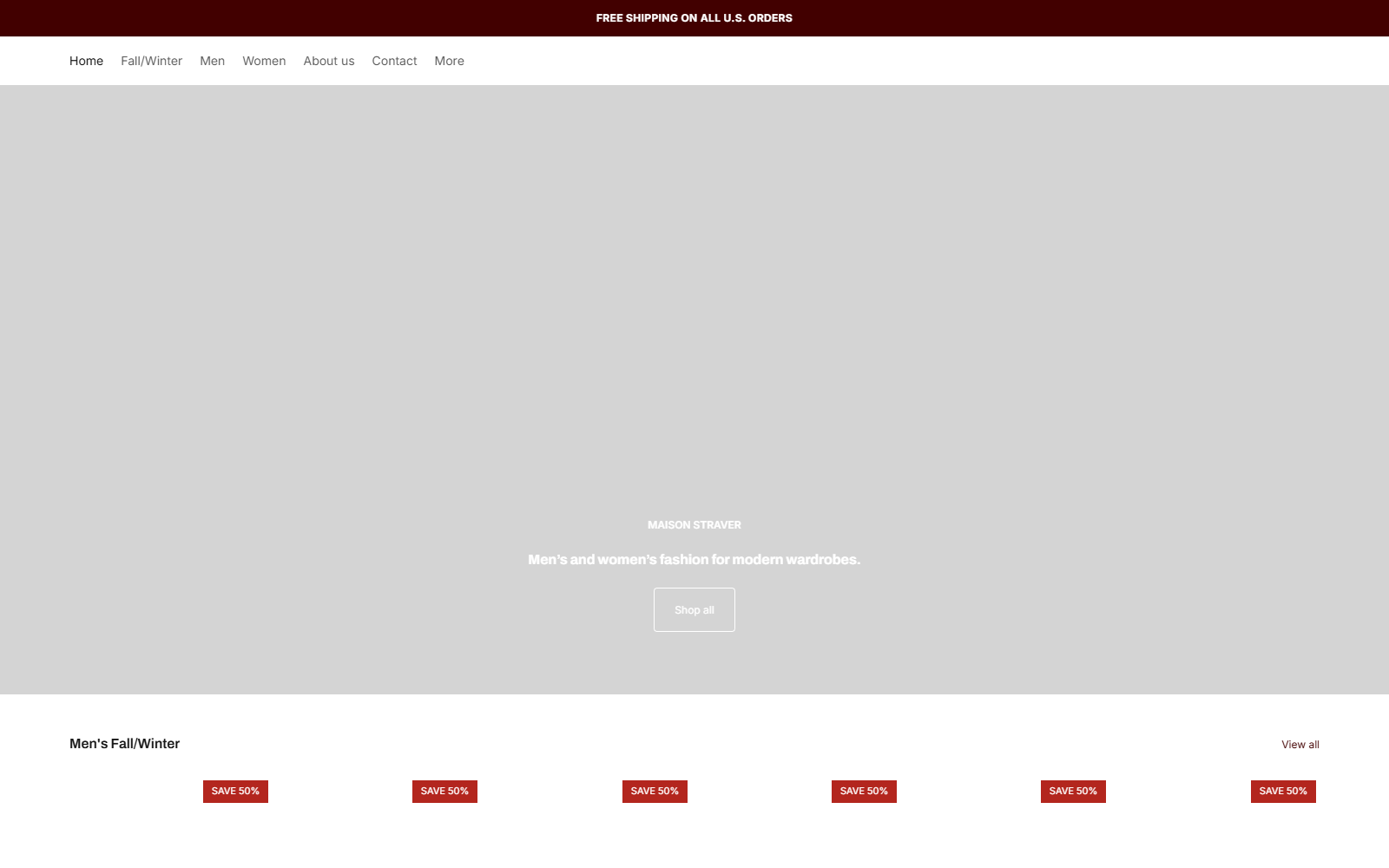
Maison Straver sells men’s and women’s clothing through a professionally designed online store aimed primarily at customers in the United States.
The catalog includes jackets, shirts, dresses, coordinated sets, shoes, knitwear, and seasonal pieces photographed in a refined European fashion style.
Many items appear permanently reduced by 50%, while the top banner promotes free shipping and sales advertised as reaching 70% off.
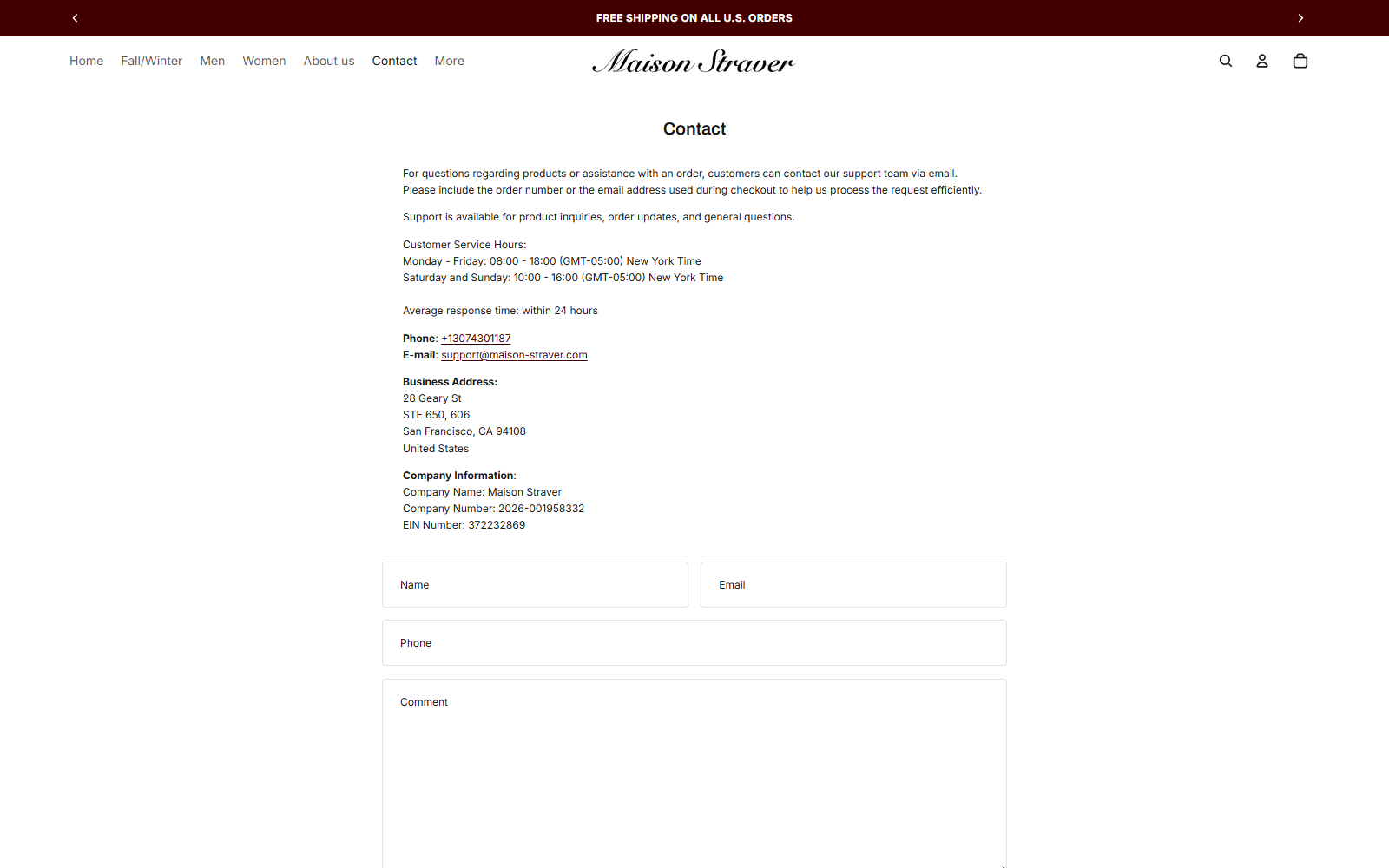
The site also displays a San Francisco address, a United States telephone number, company registration details, and a 30-day return promise.
Together, these elements create the impression of an established domestic boutique with ordinary delivery and customer-service arrangements.
Why the Store Deserves Serious Caution
The strongest concerns do not come from one missing badge or a single angry review. They emerge from several facts pointing in the same direction.
- The domain was registered on July 14, 2026, making the store very new.
- The homepage claims more than 10,000 customers despite that short online history.
- Independent reviews describe products that differ from the photographs and fabric descriptions.
- Several buyers say parcels arrived from China, not a United States fashion operation.
- Customers report being told to pay expensive international postage for returns.
- Reviewers describe partial-refund bargaining instead of a straightforward return process.
- The San Francisco address appears to use a suite and mailbox-style format.
Each point could have an innocent explanation by itself. Their combination creates a meaningful risk that buyers may receive less than they reasonably expected.
Our Verdict
Maison Straver is a functioning store, not merely an empty webpage. Customers report receiving clothing, and the site provides contact and policy pages.
However, receiving a parcel does not settle whether the offer is fair. Product accuracy, origin, return cost, and customer support determine the real transaction.
The evidence reviewed supports treating Maison Straver as a high-risk dropshipping purchase, not as a dependable San Francisco boutique.
We would not rely on the promotional photography, urgency, or 30-day wording without obtaining the actual return country and material details in writing.
What the Storefront Suggests and What Buyers Report
The Boutique Image Is Carefully Constructed
The homepage uses subdued colors, editorial photography, minimal navigation, and restrained product names. Nothing looks like a typical bargain marketplace.
This visual language matters because shoppers often use design quality as a shortcut for judging business quality.
A beautiful theme can be purchased and launched quickly. It does not prove that the seller owns a studio, warehouse, design team, or domestic inventory.
The Product Photographs Set a High Expectation
Fashion purchases depend heavily on texture, drape, thickness, tailoring, and color. A picture communicates those qualities before the written description is read.
Recent reviewers describe receiving polyester garments, thin fabric, or clothing that looked substantially different from the advertised images.
Those reports are individual accounts, not laboratory findings. Yet the repeated picture-versus-parcel theme is directly relevant to any buying decision.
A shopper cannot properly assess value when the delivered material or construction differs from the page that secured the sale.
The Discount Pattern Reduces Comparison Time
Large sale labels appear throughout the catalog, often cutting displayed prices exactly in half. This makes ordinary browsing feel like a limited opportunity.
A crossed-out reference price is meaningful only when the product was genuinely offered at that higher price for a reasonable period.
When nearly everything is perpetually discounted, the sale price may be better understood as the store’s regular selling price.
Shoppers should compare fabric composition, measurements, construction, and reverse-image results instead of calculating savings from the crossed-out number.
How the Maison Straver Shopping Funnel Works
Step 1: Social Advertising Creates the First Impression
Stores in this category commonly reach shoppers through Facebook, Instagram, or other visually driven advertising feeds.
The advertisement usually focuses on a flattering garment image, a closing window, or a seasonal discount rather than the legal entity fulfilling the order.
That emotional first impression follows the shopper onto the website, where the same photography and discount framing reinforce the decision.
Step 2: The Website Feels Like a Local Boutique
The San Francisco address, United States telephone number, local currency, and New York customer-service hours make the operation feel domestic.
Nothing prominent on the landing page tells a buyer that merchandise may be sourced abroad or that a return could require international shipping.
A local-facing storefront is not automatically deceptive. It becomes problematic when fulfillment realities materially change the cost and practicality of a refund.
Step 3: Large Discounts Supply Urgency
The sale banners encourage shoppers to decide while the apparent bargain remains available. Free shipping removes another reason to pause.
Repeated 50% reductions can make unfamiliar clothing seem safer because the customer imagines acquiring a premium item below its normal value.
The crucial comparison is not sale price versus crossed-out price. It is the charged amount versus the quality, materials, and support actually delivered.
Step 4: Polished Photography Carries the Product Claim
Clothing images can imply thick wool, structured tailoring, embroidery, suede, or fluid chiffon even when the description provides limited technical detail.
Buyers naturally assume the delivered garment will reproduce those visible characteristics. That assumption is the center of the offer.
If the item arrives in different fabric or construction, the dispute concerns material representation, not merely personal taste.
Step 5: The Order May Enter Cross-Border Fulfillment
Several reviewers say tracking or packaging indicated shipment from China. That can explain longer delivery times and unfamiliar logistics updates.
Cross-border fulfillment is legal and common. The concern is whether it was disclosed clearly enough for the customer to evaluate delivery and return consequences.
A store can market to Americans while using an overseas supplier. It should still state where orders originate and where unwanted merchandise must be returned.
Step 6: A Return Request Becomes a Negotiation
The written policy tells customers to email support for return instructions and states that customers usually pay return shipping.
Reviewers describe being offered small partial refunds, larger partial refunds, or store credit while they continued asking for a full return.
This bargaining pattern can exhaust customers and consume the 30-day window. It also shifts attention away from the advertised refund process.
Step 7: International Postage Weakens the Remedy
If the return destination is in China, tracked postage can be expensive relative to a dress, jacket, or two-piece set.
The customer may technically retain a return right but lose any practical benefit after postage, tracking, customs documentation, and delivery risk.
That is why the return country must be known before payment. A domestic business address does not necessarily identify the returns warehouse.
Product Quality and Advertising Concerns
Fabric Words Are Not Decorative
Terms such as chiffon, wool, suede, cotton, and embroidered describe material characteristics that influence comfort, appearance, care, and price.
If a listing uses those words, buyers should expect the product composition to support them rather than merely resemble them in a photograph.
Save the exact product title, composition field, sizing table, and pictures before checkout. Store pages can change after an order is placed.
Generic Size Labels Are Not Enough
International suppliers may use measurements that differ significantly from familiar United States sizing. A medium label does not guarantee familiar dimensions.
Measure a garment that fits and compare its chest, waist, hip, sleeve, rise, and inseam values with the listing.
If the page lacks garment measurements or explains only body sizes, ask support for the finished item’s dimensions.
Reverse-Image Searching Can Reveal Reuse
A reverse-image search may locate the same photograph on marketplaces, wholesalers, or stores using different brand names.
That does not prove the Maison Straver listing is fraudulent. It can reveal that the garment is widely sourced rather than exclusively designed.
Compare prices, composition, color options, shipping origin, and customer photographs. Those details often explain what the boutique presentation leaves unclear.
The 30-Day Return Promise Needs Context
Thirty Days Does Not Mean Free Returns
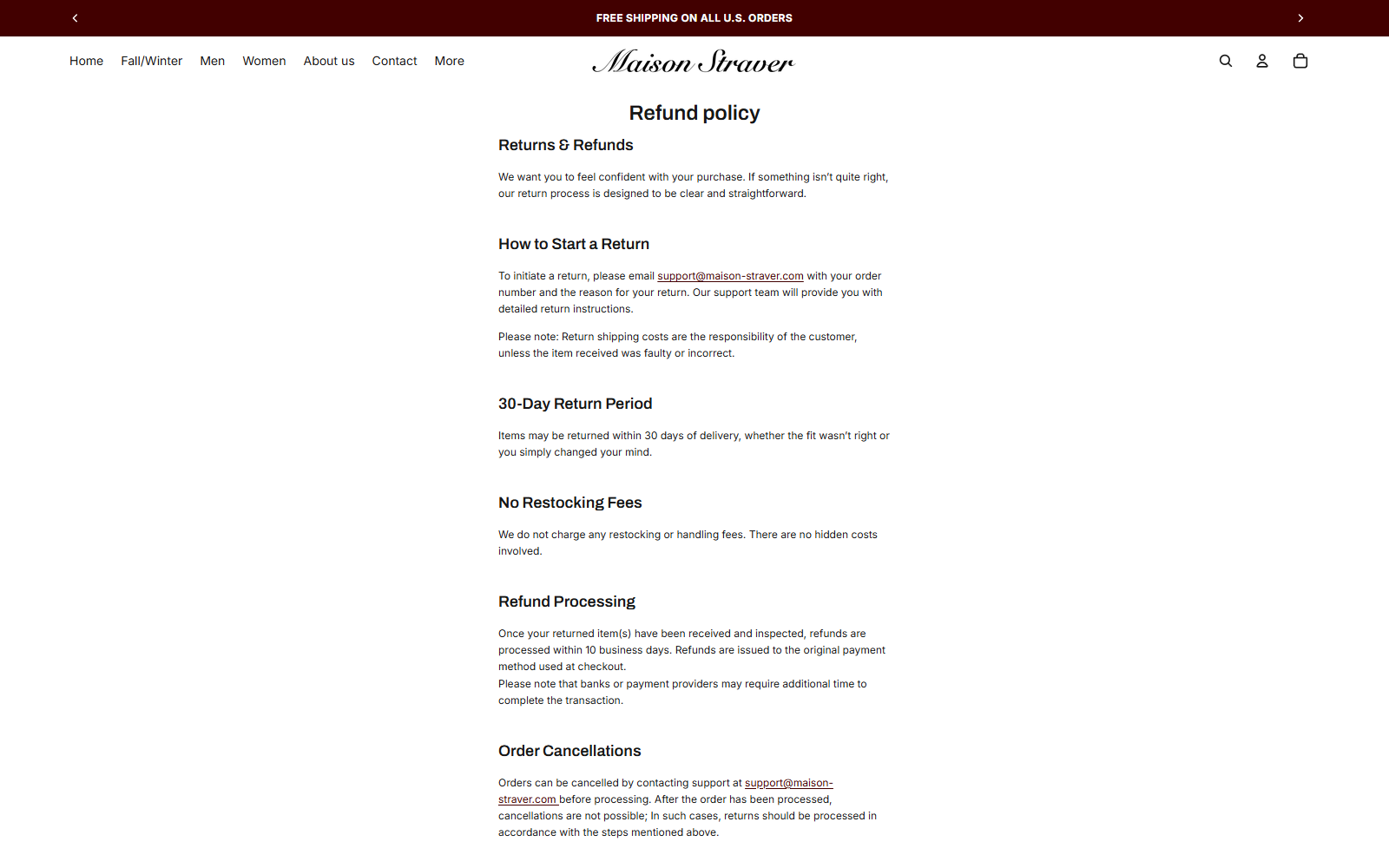
The policy says items may be returned within 30 days after delivery. It also assigns return postage to the customer unless an item is faulty or incorrect.
That distinction can be costly. A seller may classify a disappointing garment as a preference issue rather than acknowledge that it differs from the listing.
Before returning anything, ask the seller to confirm in writing whether it accepts that the item was misdescribed.
The Return Address Is Missing From the Policy
The page instructs customers to email for detailed return directions. It does not publish the destination where unwanted products must be sent.
This omission prevents shoppers from estimating postage before purchase. It also gives the seller control over a crucial part of the remedy.
Ask one direct question before ordering: will my return go to California, another United States location, or an international warehouse?
Partial Refunds Can Be Practical but Should Be Voluntary
A partial refund may make sense when postage exceeds the product’s remaining value and the buyer can still use or donate the item.
It should not be presented as the only realistic alternative when the product materially differs from the advertisement.
Do not accept store credit merely to end the conversation unless you genuinely want another order from the same seller.
Document the Calendar
Record delivery date, first complaint, every seller reply, proposed return address, and approaching dispute deadlines.
A long email negotiation can outlast the store’s return period or the platform’s complaint window if the customer does not track dates.
Send concise follow-ups that repeat the requested remedy and preserve a complete written record.
Company, Address, and Fulfillment Checks
The Domain Is Very New
Public domain records show maison-straver.com was registered on July 14, 2026. That short history conflicts with the confidence of an established-looking boutique.
A new domain is not proof of dishonesty. It means claims about scale, customer volume, and reputation require stronger independent verification.
The site’s statement about serving more than 10,000 customers is difficult to reconcile with such a brief visible online history without additional evidence.
The San Francisco Address Needs Interpretation
The site lists 28 Geary Street with multiple suite-style numbers. An address can receive mail without functioning as a shop, headquarters, or return warehouse.
Buyers should not assume a San Francisco line means clothing is stocked, designed, or shipped from that location.
Ask whether customers can return parcels there. If the answer is no, the operational value of the address is limited.
The Phone and Email Must Be Tested
The site lists a telephone number and support email, which is better than offering only a contact form.
Call before ordering and ask where the exact item ships from, where returns go, and which legal entity appears on the card statement.
Save the response. A specific answer is useful evidence if fulfillment or return instructions later contradict the pre-sale representation.
Fulfillment Appears Separate From the Storefront
Customer accounts repeatedly describe Chinese shipment or return arrangements despite the United States-facing presentation.
That pattern is consistent with dropshipping, where the storefront markets the item while a third-party supplier stores and ships it.
Dropshipping itself is not a scam. Risk increases when sourcing, delivery, product quality, and return geography are obscured until after payment.
How to Shop More Safely
Capture the Entire Offer
Save the product page, material description, measurements, discount, shipping estimate, returns wording, and checkout total before placing an order.
A screen recording that scrolls through the page can preserve context better than several isolated screenshots.
Pay With Strong Buyer Protection
Use a credit card or another payment method that supports disputes for non-delivery and material misrepresentation.
Avoid bank transfers, cryptocurrency, gift cards, or payment methods that leave no meaningful chargeback path.
Begin With One Low-Risk Item
Do not build a large wardrobe order based on promotional images. Test delivery, sizing, material, and support with one inexpensive purchase.
Even then, calculate the possible international return cost before deciding that the experiment is affordable.
Inspect the Parcel Before Removing Tags
Photograph the sealed package, shipping label, garment, tags, fabric label, stitching, measurements, and any defects immediately after arrival.
Keep packaging and do not wash, alter, or wear the item while a return or dispute remains possible.
What to Do if You Have Fallen Victim to This Scam
If your order is missing, misdescribed, or effectively impossible to return, act calmly and preserve evidence before negotiating further.
- Save the original listing. Capture the photographs, product title, material claims, sizing chart, discount, delivery promise, and refund policy.
- Document what arrived. Photograph the parcel, label, garment, tags, measurements, fabric label, defects, and every difference from the advertisement.
- Request the promised remedy. Email the order number, a precise mismatch description, and a direct request for full refund and return instructions.
- Ask for the return country. Obtain the complete address before shipping and ask who pays when the item is faulty or materially misdescribed.
- Reject endless bargaining. A partial refund may be acceptable, but you do not need to accept store credit when the written policy supports a refund.
- Contact your payment provider. Present the saved listing, received item, correspondence, and any refusal to honor the stated policy.
- Track every deadline. Note the 30-day store window and the separate dispute deadline set by your card issuer or payment platform.
- Report misleading advertising. Send evidence to the advertising platform, consumer-protection authority, and marketplace service supporting the checkout.
- Check your device if redirects occurred. Run Malwarebytes after suspicious downloads, notification prompts, browser changes, or unexpected checkout redirects.
- Reduce repeat exposure. AdGuard can block many aggressive advertisements and trackers, although it cannot confirm whether a retailer is trustworthy.
Describe the problem factually. “The listing said embroidered chiffon, but the label and photographs show plain polyester” is stronger than saying the item feels cheap.
Do not mail an expensive tracked return without written authorization. Your payment provider may have specific evidence and shipping requirements.
Frequently Asked Questions
Is Maison Straver a real company?
The website accepts orders and lists business details. The unresolved issue is whether its boutique presentation accurately reflects sourcing, fulfillment, product quality, and returns.
Does Maison Straver ship from the United States?
The site targets United States buyers, but several customer reviews describe shipments from China. Ask for the dispatch country for your exact item.
Can Maison Straver orders be returned?
The policy advertises 30-day returns and generally makes customers pay postage. It does not publish the return destination, which can greatly affect cost.
Why do reviewers mention partial refunds?
Several reviewers describe escalating offers such as small refunds or store credit after requesting returns. These are customer reports, not guarantees of every outcome.
Is the San Francisco address a warehouse?
The site identifies it as a business address. We found no clear evidence that it is the store’s inventory or customer-return warehouse.
What is the safest way to pay?
Use a credit card or protected payment service, keep screenshots, and avoid payment methods that make a dispute difficult or impossible.
The Bottom Line
Maison Straver combines an attractive storefront with the signals shoppers associate with a domestic boutique. The independent experience looks considerably less polished.
A new domain, extraordinary customer-volume claim, repeated product mismatch complaints, overseas fulfillment reports, and costly return allegations create substantial buying risk.
The store may deliver a garment, but that is not the same as delivering the garment represented. Verify materials, origin, and return address before paying.
If the seller cannot answer those basic questions clearly, choose a retailer with transparent fulfillment, domestic returns, and an established independent record.

Join the discussion
0 commentsShare your experience or ask a question about this article.
Discussion
Start the conversation
Have a question or something useful to share? Add the first comment.