

A text message claims to be from the California Highway Patrol and says you have a pending traffic infraction tied to your vehicle. It may warn that this is the “final advisory” before enforcement begins, then push you toward a fake payment page that looks like a California DMV or traffic violation portal.
The message looks serious. The website may look professional. The amount due may be as low as $6.99.
That is the trap.
Scam Overview
The California Highway Patrol Traffic Compliance Notification scam text is a phishing scam that impersonates the CHP, California DMV, or a traffic enforcement system. The goal is to make drivers believe they have a pending violation, then pressure them into clicking a link, scanning a QR code, or paying a small fake fine.
The scam often uses wording like:
- “California Highway Patrol”
- “Traffic Compliance Notification”
- “Pending traffic infraction”
- “Final advisory”
- “Formal enforcement measures”
- “Nonpayment may result in consequences”
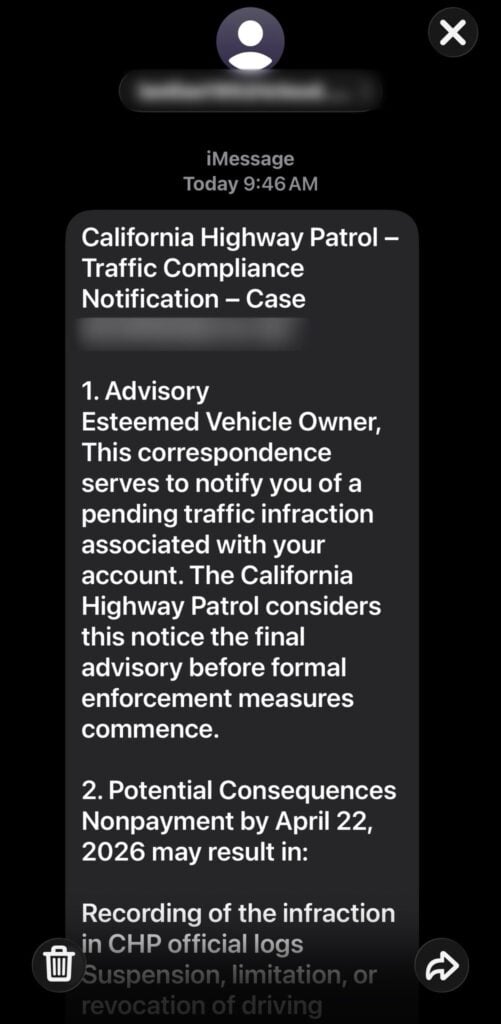
In the example you provided, the message claims to be a California Highway Patrol – Traffic Compliance Notification and addresses the recipient as an “Esteemed Vehicle Owner.” It says there is a pending traffic infraction associated with the account and warns that the notice is the final advisory before enforcement begins.
That language is not normal. It is written to sound official, but it also feels overly formal and generic. Real traffic notices usually contain specific citation details, vehicle information, agency contact information, and official instructions that can be independently verified. Scam messages often rely on broad pressure, strange wording, and fast payment demands.
The fake DMV-style payment page
The scam may redirect victims to a website that looks like a California DMV payment portal.
The scam website may say:
- California DMV-style branding
- “Traffic Violation Notice”
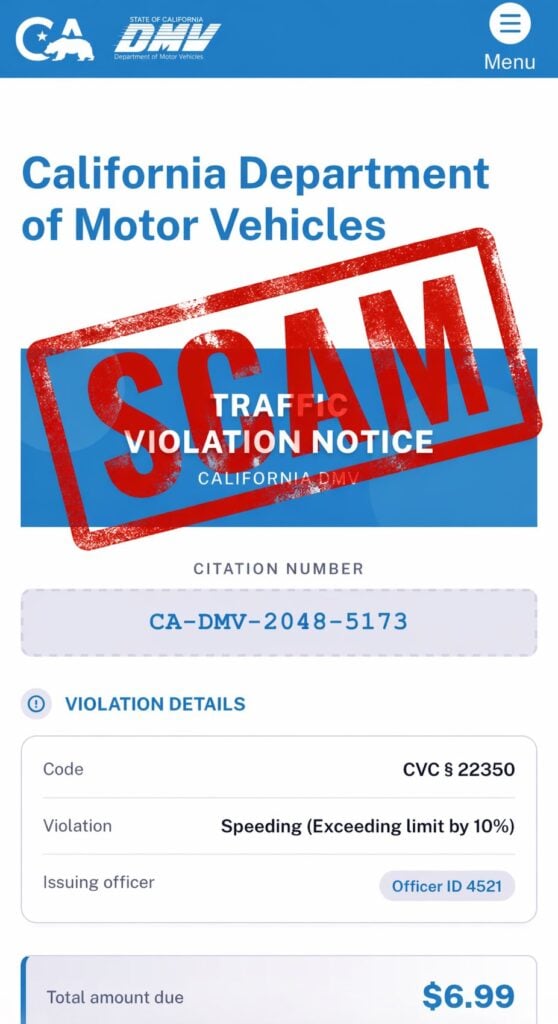
- Citation number: CA-DMV-2048-5173
- Violation code: CVC § 22350
- Violation: Speeding (Exceeding limit by 10%)
- Issuing officer: Officer ID 4521
- Total amount due: $6.99
This is a classic small-fee phishing tactic.
The fake amount is low enough that many people will think it is easier to pay than investigate. But the real goal is not the $6.99. The real goal is your credit card number, CVV, billing address, name, phone number, email, and possibly vehicle information.
California DMV warns that scammers are sending fake texts and links pretending to be from the DMV, and states clearly that the DMV will never ask for personal or financial information by text. The agency also tells people not to open or reply to suspicious messages.
Why scammers impersonate the CHP
The California Highway Patrol name carries authority. Drivers associate CHP with traffic enforcement, speeding tickets, road safety, and official highway patrol activity.
That makes the name useful to scammers.
If the same text came from an unknown sender saying “pay this random fee,” most people would ignore it. But when it says California Highway Patrol, the recipient may hesitate.
That pause is the scammer’s opening.
Recent warnings have noted fake “traffic ticket” texts claiming unpaid violations and pushing recipients toward QR codes or payment links. The CHP has warned that fake unpaid ticket texts are circulating, and reporting has described these messages as fraudulent texts claiming people owe money for unpaid tickets.
Why the message mentions CVC § 22350
The fake site references CVC § 22350, a California Vehicle Code section commonly associated with California’s basic speed law. Scammers often use real legal references to make fake notices look more credible.
This is important:
A real law code does not make the message real.
Scammers frequently include real statutes, fake citation numbers, fake officer IDs, and DMV-style design elements because they know most people will not verify every detail. The legal code is used as decoration. It is there to make the fake portal feel official enough for you to continue.
Why the $6.99 amount is suspicious
The amount due in the example is $6.99, which is unusually low for a real speeding-related matter.
That small number is intentional.
A low payment creates a mental shortcut:
- “It is only $6.99.”
- “Maybe I should just pay it.”
- “It is not worth risking penalties.”
- “I will deal with it quickly and move on.”
That is exactly what scammers want.
The FTC has warned about traffic violation text scams that use official-looking notices, fake case numbers, QR codes, and threats of enforcement to scare people into acting quickly. If victims scan or follow the payment path, scammers may try to steal personal information, credit card details, money, or even attempt malware delivery.
The biggest red flags
This scam has several warning signs:
- The message arrives unexpectedly by text or iMessage
- It claims to be from CHP, DMV, or a traffic compliance office
- It uses overly formal language like “Esteemed Vehicle Owner”
- It threatens enforcement if you do not pay
- It links to a payment page or fake portal
- The payment amount is oddly small
- The website asks for card details
- The URL is not an official government domain
- The notice is not tied to a verifiable citation you received through official channels
California Courts also warns that fake court messages may arrive by text, call, or email, often saying you owe money for a traffic ticket and asking you to pay right away. The court’s guidance is direct: do not click links or provide personal information. (Self-Help Guide to the California Courts)
How The Scam Works
Step 1: You receive a fake CHP-style text
The message usually appears as a text or iMessage. It may claim to be from:
- California Highway Patrol
- Traffic Compliance Notification
- California DMV
- Traffic Violation Notice
- Court enforcement
- Citation processing
The wording may look like this:
“California Highway Patrol – Traffic Compliance Notification – Case [number]. This correspondence serves to notify you of a pending traffic infraction associated with your account.”
The message is intentionally broad. It does not need to prove anything. It only needs to make you worried enough to continue.
Step 2: The message creates fear and urgency
The scam then warns that the notice is final or that enforcement may begin soon.
Common pressure phrases include:
- “Final advisory”
- “Formal enforcement measures”
- “Nonpayment may result in”
- “Action required”
- “Pending traffic infraction”
- “Compliance deadline”
This is social engineering.
The scam tries to make you feel that ignoring the message could lead to penalties, license problems, registration issues, or court consequences.
Step 3: The link sends you to a fake traffic portal
After creating pressure, the message sends you to a website.
That website may look like a California DMV or state traffic page. It may include a fake menu, logo, citation number, violation details, and payment box.
The page in your example shows:
- Citation Number: CA-DMV-2048-5173
- Code: CVC § 22350
- Violation: Speeding (Exceeding limit by 10%)
- Total amount due: $6.99
The design is built to feel familiar. Scammers use official colors, fake logos, and structured forms to create trust.
Step 4: The fake site asks for payment
The site usually asks for a small payment by credit or debit card.
This is the key moment.
Once you enter payment details, scammers may capture:
- Card number
- Expiration date
- CVV
- Billing ZIP code
- Billing address
- Name
- Phone number
Even if the charge is small, the card data can be used later for bigger fraud.
Step 5: The scam may show a fake confirmation
After payment, the site may display a confirmation message.
That confirmation is meant to calm you down and delay action. If you think the issue is resolved, you may not call your bank right away.
Other versions may show a payment error and ask you to try again. That can trick victims into entering another card.
Step 6: Fraud may happen later
The damage does not always appear immediately.
Scammers may:
- Run small test charges
- Attempt larger transactions later
- Sell your card details
- Use your identity information in future scams
- Send more fake DMV, court, or traffic notices
That is why you should treat the card as compromised if you entered it on a fake traffic violation site.
What To Do If You Receive This Text
Do not click the link
Do not open the link, even to “check” whether it looks real.
If you already opened it but did not enter information, close the page and do not return.
Do not pay the fee
A small amount like $6.99 is bait. Paying it can expose your card details.
Do not reply
Replying can confirm that your number is active. That can lead to more scam attempts.
Check the URL carefully
Official California government sites typically use legitimate government domains. Scammers often use lookalike domains, strange endings, misspellings, or non-government URLs.
But do not rely only on the URL. The safest move is to avoid links from unsolicited texts entirely.
Verify through official channels
If you are worried about a real citation:
- Go directly to the official California DMV website by typing it yourself
- Check official court or citation portals independently
- Use contact information from official government websites only
- Do not use phone numbers or links included in the text
What To Do If You Fell for the Scam
1. Contact your card issuer immediately
If you entered your card details, call the number on the back of your card.
Tell them:
- You entered your card details on a fraudulent traffic violation website
- The site came from a scam text
- You want the card blocked and replaced
- You want recent transactions reviewed
Do this even if you do not see suspicious charges yet.
2. Review your transactions
Look for:
- Small test charges
- Unknown online purchases
- Subscription charges
- Repeated declined attempts
- Charges from unfamiliar merchants
Dispute anything you do not recognize.
3. Turn on transaction alerts
Enable alerts for:
- Every purchase
- Online payments
- Transactions over $1
- International charges, if available
Fast alerts can help stop fraud early.
4. Change passwords if you entered login details
If the fake site asked you to create an account or sign in, change that password immediately.
Also change it anywhere else you reused it.
5. Watch for follow-up scams
Once scammers know you interacted, they may send more messages.
Be alert for:
- Fake DMV notices
- Fake court warnings
- Fake refund offers
- Fake bank fraud alerts
- More traffic compliance texts
Do not trust follow-up messages just because they reference the same issue.
6. Save evidence
Take screenshots of:
- The original text
- The sender information
- The link
- The fake website
- The fake citation number
- Any payment confirmation or error screen
This may help with disputes or fraud reports.
7. Report the scam
You can:
- Mark the message as junk or spam
- Block the sender
- Forward the text to 7726 (SPAM) if your carrier supports it
- Report the scam to the FTC through ReportFraud.gov
The FTC recommends not responding to these traffic violation texts and not scanning QR codes or following links from them.
The Bottom Line
The California Highway Patrol Traffic Compliance Notification scam text is a fake traffic violation scheme designed to make drivers panic and pay quickly.
It may use the CHP name, DMV-style branding, CVC codes, citation numbers, officer IDs, and small amounts like $6.99 to look legitimate. But the real goal is to steal your card details and personal information.
California DMV says it will never ask for personal or financial information by text. California Courts warns that fake traffic ticket messages are scams and says not to click links or provide personal information.
If you receive one of these messages, do not click, do not pay, and do not reply.
Verify only through official websites you access yourself.








