

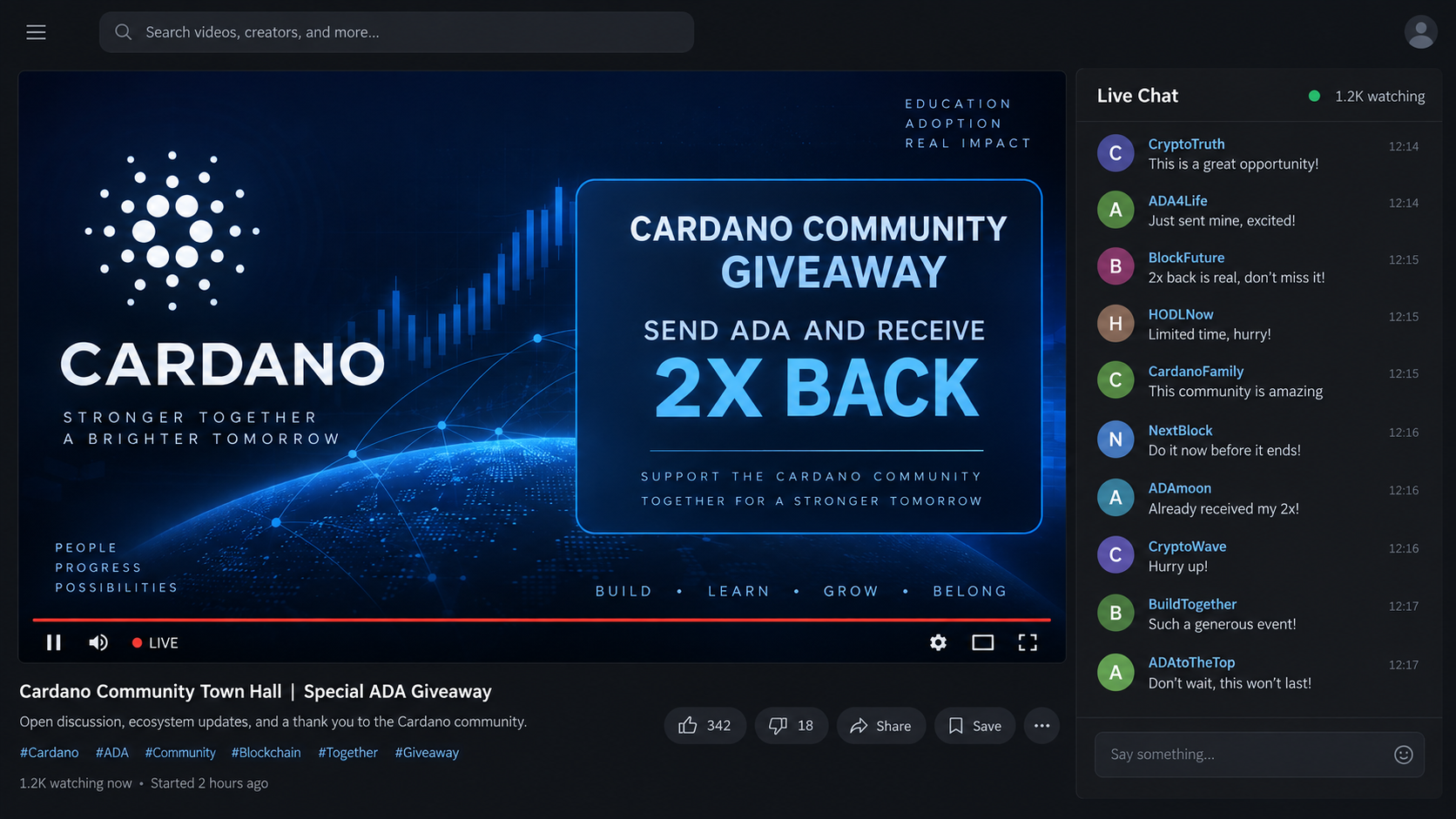
A Cardano YouTube giveaway appears during what looks like a familiar town hall. A banner promises that anyone who sends ADA will receive twice as much back.
It looks like a community event at first glance. The account carrying the video, the moving chat, and the speaker’s face all deserve closer inspection.
Overview
The September 2026 livestream
On September 18, 2026, Input Output Group warned users to avoid its YouTube channel after an apparent takeover. A suspicious livestream promoted a Cardano giveaway.
The broadcast was presented as a Project Catalyst town hall and displayed a supposed opportunity to double crypto sent by viewers.
Reporting described the footage of Cardano founder Charles Hoskinson as suspected AI-manipulated material. The exact technique has not been publicly established by a forensic report.
Why the invitation looked credible
Project Catalyst is a real Cardano community-funding initiative. Its official site describes proposal funding, voting, and genuine town halls.
A real account can also become a false source of information when someone else controls it. The familiar channel name does not authenticate a specific livestream.
Scammers can combine old footage, altered audio, a live badge, a fast-moving chat, and a QR code to make the offer feel like a fleeting official event.
The rule that cuts through the spectacle
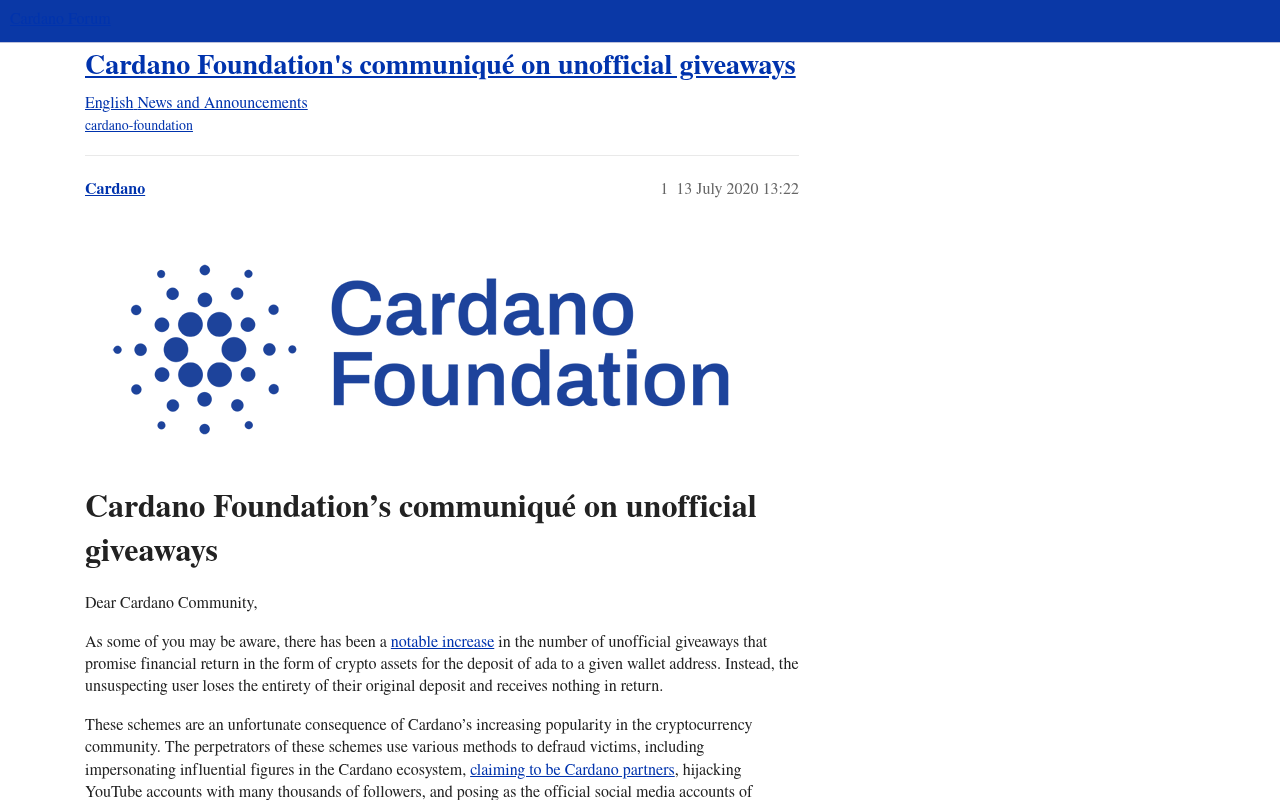
The Cardano Foundation has long warned that officials and partners do not promote giveaways requiring people to send ADA for a return.
The warning applies even if the page seems polished or the video appears on a known channel. No legitimate giveaway needs a preliminary transfer to unlock twice the amount.
- Do not send ADA to an address displayed in a livestream or attached site.
- Do not scan a payment QR code simply because a familiar account posted it.
- Do not enter wallet recovery words into any page reached from the video.
- Check the organization’s current security notice through a separate official channel.
A Real Town Hall Is Not a Wallet-Matching Promotion
Project Catalyst does have real meetings and funding rounds. That reality is why a fake town hall can be persuasive to people already following the ecosystem.
The official program invites proposals and community participation. It does not operate by asking viewers to send personal ADA to a broadcaster’s wallet.
A scammer needs the viewer to confuse a funding initiative with a prize. Both use the language of community and rewards, but their mechanics are entirely different.
Real grants are governed by published rules, submissions, voting, and review. A “send 1, get 2” instruction has none of those safeguards.
The channel incident is also a reminder that account verification is time-sensitive. A verified account reflects platform history, not the honesty of every minute after compromise.
Do not infer from the incident that Cardano or Project Catalyst endorsed the broadcast. The warning from Input Output told users to avoid the affected channel.
Nor should every visible face be declared a deepfake without evidence. Replayed, edited, dubbed, and synthetic footage can all create a false endorsement.
The decisive fact for a viewer is the requested transfer. A video that asks you to send crypto to receive more later is not a legitimate Cardano distribution.
How the Cardano YouTube Giveaway Scam Works
Step 1: Attackers borrow a trusted audience
In this case, the warning concerned an apparent hijack of a known YouTube channel. The public evidence does not establish exactly how access was obtained.
That uncertainty matters. It would be irresponsible to blame a particular employee, password, plugin, or phishing technique without evidence from the operator.
For the viewer, the effect is the same: an account they recognize begins distributing a message the organization did not authorize.
Step 2: The stream imitates a real community event
A town-hall title, Cardano graphics, and Project Catalyst language provide context. Someone scrolling quickly may register the event name before reading the payment demand.
A live marker adds urgency. The promotion feels temporary, as though missing the stream means missing a community-only offer.
Comments can appear enthusiastic, but live chat is not proof of legitimacy. Accounts, messages, and apparent viewer activity can be staged or manipulated.
Step 3: A familiar figure supplies borrowed authority
Reports described suspected manipulated footage resembling Charles Hoskinson. Viewers may interpret the face or voice as personal approval of the offer.
Even authentic archived footage can be reused beside new text. The important question is whether the person actually endorsed the specific wallet transfer.
Input Output’s warning and the Foundation’s longstanding giveaway policy point in the opposite direction. Appearance should not overrule a direct, separate warning.
Step 4: The QR code moves viewers away from scrutiny
A large code is easy to scan before checking the destination. It can take the viewer to a payment page or wallet address controlled by the fraudster.
The page may repeat the project’s visual style and show a countdown, a matching table, or supposed prior transactions. Those elements are marketing, not verification.
Never type a recovery phrase to claim a promotion. Recovery words grant control over a wallet and are not needed for a legitimate community announcement.
Step 5: The victim sends ADA expecting a larger return
The promised exchange is simple: transfer an amount, then receive twice as much back. There is no mechanism requiring a genuine project to collect funds that way.
Blockchain transfers generally cannot be reversed like a card purchase. Once the ADA reaches an attacker-controlled address, the victim may receive nothing.
Do not treat a displayed transaction counter as evidence that others were paid. A scam page can generate convincing numbers without sending anyone a return.
Step 6: Follow-up impostors offer “recovery”
After the giveaway disappears, someone may claim to trace the wallet or recover funds for a fee. This can be a second attempt to take money.
Another impostor may ask for your seed phrase to “validate” ownership. That request would put remaining assets at risk.
Report the incident, document the transaction, and avoid private messages from people who claim special access to the platform or blockchain.
Four Checks for the Channel, Site, and Wallet
The channel name is not the current operator
A compromised channel can retain an old name, subscriber count, and verification badge. Check official statements elsewhere before trusting a new financial instruction.
Cointelegraph reported Input Output’s September 18 warning to avoid the channel and not send funds or personal information.
That warning is more relevant than a platform badge. A badge does not update instantly when an account is taken over.
The destination URL has its own identity
Inspect the domain behind any description link or QR code. A matching color palette and a mention of Catalyst do not make it a Project Catalyst service.
Use a typed or bookmarked official site to compare. Avoid searching for a “claim page” while a scam is trending, because lookalike pages may follow.
A link shortened or hidden inside a code is particularly hard to evaluate. If the destination cannot be checked first, do not open it with your wallet.
Support accounts can be impostors too
Fake moderators may appear in the live chat or send direct messages offering help with the giveaway. They are not automatically linked to the real project.
Real support will not need your seed phrase. If someone asks for it, end the exchange and secure the wallet immediately.
Check support channels through the official Catalyst or Cardano pages, not through a username copied from the livestream description.
The wallet address is the critical transaction trail
A payment address can be copied from the video, destination page, or your transaction record. Preserve it for reporting, but do not send another transfer to test it.
There is no physical fulfillment center or product label to check in this case. The transaction address and off-platform destination are the supply chain.
Do not publish your own wallet recovery words while asking for help. Transaction IDs are useful evidence; recovery phrases are not.
How to Check a Real Catalyst Announcement
Begin at the Project Catalyst website, not at a search ad or a link beneath a video. Look for the town hall schedule and the topic announced there.
A legitimate funding update should explain proposals, voting, or community governance. It should not convert participation into a private payment to an unknown wallet.
Compare the event date, organizer, and channel across the official site and its social accounts. If one source reports a compromise, stop using the affected channel.
Be careful with mirrored event titles. A scammer can copy a genuine town hall name and stream unrelated footage beneath it.
Read the description without clicking. A legitimate meeting link should not be dominated by a “limited giveaway” domain or a payment address.
Search for the exact giveaway claim on the Foundation’s official guidance. The published policy against such promotions is not changed by a livestream overlay.
If a friend shares the stream, send them the official warning rather than arguing over whether the voice sounds authentic. The wallet-transfer request is enough.
Do not feel forced to investigate while the video remains live. A real grant program provides written information that remains available after a broadcast ends.
Why the Scam Can Work Even When Viewers Know About Deepfakes
People often imagine a deepfake as a visibly strange face. In a livestream, the video may be small, compressed, and surrounded by genuine platform controls.
The more powerful deception may be the account itself. A long-standing channel can carry subscriber history, playlists, and familiar comments into the attacker’s session.
A viewer might also arrive from a notification rather than a search. That route feels safer because the platform delivered it from an account they previously followed.
Live chat can intensify the impression that others are participating. Even real viewers may repeat the promotion before anyone has checked it.
Timers and claims of limited matching funds create another nudge. They suggest that verification will cost the viewer money, when verification is what protects it.
The requested transfer is the fixed point that does not depend on video forensics. Sending crypto to receive more is a known fraud pattern described by the Foundation.
Nothing in this analysis requires assuming how the channel was compromised. The public warning and the fraudulent payment request are enough to advise against participation.
If the channel later returns to normal, older scam clips or copied pages may still circulate elsewhere. Verify each new link on its own merits.
For families discussing crypto, explain this as a payment scam rather than a technology puzzle. A person need not understand blockchain mechanics to refuse the demand.
What to Do if You Have Fallen Victim to This Scam
- Stop interacting with the stream. Do not send a second payment to release the first. Leave the page and disregard direct messages from supposed moderators.
- Save the evidence. Record the video URL, channel name, date, screenshots, destination domain, wallet address, and transaction ID. Keep the original wallet record.
- Contact the wallet or exchange you used. Report the destination address and ask what protective or tracing options exist. A refund is not guaranteed.
- Secure any wallet whose recovery words were exposed. From a safe device, move remaining assets to a newly created wallet using guidance from a trusted provider.
- Change compromised account credentials. If you signed into a linked page, reset relevant passwords and revoke suspicious connected applications.
- Check the device. If the page asked you to install an extension or file, scan with Malwarebytes. AdGuard can reduce exposure to known malicious pages and ads.
- Report the stream and transfer. Use YouTube’s report controls and file a complaint with IC3 or your local cybercrime authority.
- Reject guaranteed recovery offers. Anyone promising to reverse an irreversible transfer for a fee is making a claim that needs extraordinary proof.
Act quickly to protect anything still under your control. The value of a report is also in connecting the wallet address and video to a broader investigation.
Frequently Asked Questions
Was the actual Input Output YouTube channel involved?
Input Output warned that its channel should be avoided after an apparent compromise. Public reports described the suspicious livestream on that channel.
Did Charles Hoskinson authorize the giveaway?
No evidence supports authorization. The company warned users not to interact, while the Cardano Foundation says officials do not promote send-ADA giveaways.
Was the video definitely generated by AI?
Reports called the footage suspected AI-manipulated. Without a public forensic analysis, it is safer to describe the technique as unconfirmed.
Is Project Catalyst itself fake?
No. Project Catalyst is a real funding initiative. The fraudulent promotion borrowed its town-hall theme to make a wallet transfer look plausible.
Can a verified channel still post a scam?
Yes. A channel can be compromised. Verify an unusual financial offer through a separate official source, regardless of badges or subscriber counts.
Can sent ADA be reversed?
Usually not through a normal chargeback process. Report the transaction promptly, but avoid anyone promising certain recovery for an upfront fee.
The Bottom Line
The Cardano YouTube giveaway scam used a familiar channel and community-event setting to sell an impossible promise: send ADA now and get more back.
The simplest defense remains the strongest. No official Cardano giveaway requires a transfer first, even when the request appears inside a live video.

Join the discussion
0 commentsShare your experience or ask a question about this article.
Discussion
Start the conversation
Have a question or something useful to share? Add the first comment.