

Coach “$750 gift card” claim pages are designed to look like a simple registration process.
They typically ask for your email and basic details, then require you to complete 3 to 5 sponsored partner offers to “unlock” the reward. That structure is a common red flag for affiliate-driven reward funnels.
This guide explains how these fake Coach rewards sites operate and what to do if you already entered information or started completing offers.
Scam Overview
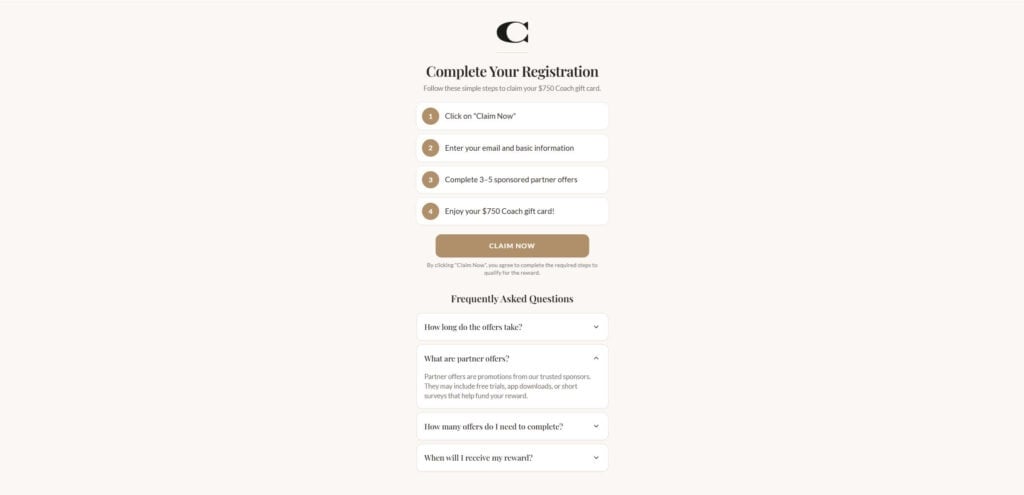
Most fake Coach rewards sites follow a predictable template.
They present a polished, minimal design that feels more like a legitimate registration portal than a scam pop-up. The wording is usually calm and process-driven, not aggressive.
Common elements include:
- A Coach-style logo or branding cues at the top
- A headline that frames the page as a normal sign-up step, like “Complete Your Registration”
- A promise of a $750 Coach gift card
- A short “steps” list that creates momentum:
- Click “Claim Now”
- Enter your email and basic information
- Complete 3 to 5 sponsored partner offers
- Enjoy your $750 Coach gift card
- A prominent button like “CLAIM NOW”
- A small FAQ section that tries to answer objections before you ask them
That structure is intentional.
It is designed to look legitimate long enough for you to take the first step.
Why the $750 number is so effective
A $750 reward sits in a sweet spot for scam marketing.
It is high enough to feel exciting, but not so high that it instantly triggers disbelief the way a $10,000 “winner” message might. It also fits the brand narrative. Coach is a premium brand, so a large gift card feels plausible to some people.
The psychological pull is simple:
- “This could cover a bag.”
- “This might be a real promo.”
- “It only takes a few minutes.”
That is why these pages push you to act quickly. The faster you move, the less time you spend verifying the site.
What these sites usually are in reality
Most Coach $750 gift card pages are best understood as affiliate reward funnels.
They are not typically built to steal your money directly on the first screen. Instead, they push you into third-party offers that generate revenue for the operator.
Here is what that means in plain English.
The site makes money when you:
- Submit your email address and personal info (a monetized lead)
- Register for partner programs
- Install apps through tracking links
- Start trials that require a credit card
- Sign up for subscription services
The “reward” is marketing bait.
The offers are the monetization engine.
Why domains like chgifted.com are a red flag
Coach’s official online presence is tied to coach.com and its verified channels. A separate domain like chgifted.com is not Coach’s official website.
That does not automatically prove malicious intent by itself, but it is a major warning sign, especially when paired with a reward claim that depends on sponsored offers.
A legitimate brand promotion typically has:
- A verifiable official domain presence
- Clear terms and eligibility rules that are easy to confirm
- A support path that leads back to the brand
- Reward delivery details that are not vague
In contrast, reward funnel pages often have:
- A random domain not clearly tied to the brand
- A generic “registration” flow
- A requirement to complete unrelated third-party offers
- Vague reward delivery language and unclear timelines
The mismatch is the story.
The giveaway framing is designed to bypass skepticism
These pages rarely say, “We are an affiliate marketing site.”
Instead, they present themselves like a brand-run campaign. They rely on familiar promotion language:
- “Registration”
- “Eligibility”
- “Claim now”
- “Complete your steps”
- “Partner offers help fund your reward”
That last line is especially revealing.
When a site says partner offers “fund” your gift card, it is admitting the business model: you are being routed through monetized actions to generate revenue.
The page is not awarding a reward because you were selected.
It is trying to earn money off your participation.
The “partner offers” explanation is not there to help you
Many fake Coach rewards sites include a FAQ question like “What are partner offers?”
The answer often sounds friendly and reasonable: partner offers are promotions from “trusted sponsors,” and they may include free trials, app downloads, or short surveys.
This is meant to normalize the next step.
But it also hides the real risk: partner offers can include subscriptions, billing trials, and data collection that follow you long after you close the page.
Why victims often feel trapped in an endless loop
The most common complaint pattern with gift card reward funnels is simple:
You do what the page asks, and you still do not get the reward.
That happens for a few reasons that are built into the system.
1) The finish line can move
The page might say “complete 3 to 5 offers.”
But once you complete three, it may suggest you need five.
Or it may say one of your offers did not qualify.
Or it may push you toward “premium” offers.
2) Tracking becomes an excuse
Affiliate offers rely on tracking. If the system says your completion did not track, the offer can be rejected.
Tracking can fail for normal technical reasons:
- Cookies blocked or cleared
- Private browsing mode
- Switching devices or browsers
- VPN use
- Ad blockers and privacy extensions
But in these funnels, tracking ambiguity also protects the operator. If a reward is not delivered, the site can blame tracking instead of admitting the reward was never realistic.
3) “Pending” and “verification” delays buy time
Instead of giving a clear yes or no, many funnels use delay language:
- Pending
- Processing
- Verification required
- Please wait
That keeps people from reporting immediately and encourages them to keep completing offers “while waiting.”
Where these scam sites come from
Most people do not find these pages through a careful search.
They are commonly delivered through traffic sources optimized for fast clicks:
- Pop-up redirects from low-quality websites
- Sponsored ads with vague “reward” language
- Spam emails or texts claiming you are eligible
- Push notification spam from sites you accidentally allowed
- Redirect chains triggered by clicking fake buttons
The funnel does not need everyone to convert.
It only needs a small percentage of visitors to complete multiple offers to be profitable.
What victims risk when they engage
The damage is not only “you never get the gift card.”
These funnels create real risk in three areas.
Financial risk
Some partner offers are trials that convert into subscriptions.
Common outcomes include:
- A trial that bills you after a short window
- Recurring monthly charges
- Billing descriptors that do not clearly match the offer name
- Customer service that is slow or difficult
Even a small “trial” charge can become a larger recurring problem.
Privacy risk
Email addresses and phone numbers are valuable.
Once you enter them into a funnel and then into multiple offers, your data can spread quickly. Many victims see:
- Increased spam email
- Scam texts about deliveries, refunds, or account issues
- Marketing calls
- More gift card scams using other brands
Security and follow-up scam risk
Once scammers know you engage with reward pages, you become a better target.
Follow-up messages often claim:
- Your reward is waiting
- You need to verify identity
- You must pay a small fee to release the reward
- Your eligibility needs confirmation
These follow-ups are designed to extract more information or money.
Why the Coach brand is used, specifically
Premium brands are especially useful for this kind of scam because they amplify the reward’s perceived value.
A $750 card tied to a luxury or premium brand feels more “real” than the same number tied to an unknown company.
The scam is not about Coach customers only.
It is about using a brand name that lowers skepticism and raises motivation.
The simplest way to evaluate these pages
You do not need advanced technical skills to decide whether to trust a “Coach $750 gift card” page.
Use one rule:
If a gift card is locked behind sponsored partner offers, you are dealing with a monetization funnel, not a straightforward brand reward.
That one detail explains why so many people spend time and get nothing.
How The Scam Works
Step 1: You get pulled in by a fast hook
Most Coach reward scam pages are encountered through a link, not a deliberate visit.
The hook is usually framed as:
- “Claim your $750 Coach gift card”
- “Complete registration to receive your reward”
- “Limited-time Coach rewards”
- “Exclusive gift card opportunity”
The goal is to get you to click before you verify the source.
If the link came from a pop-up, a suspicious ad, or an unexpected message, that is your first warning.
Step 2: The landing page reduces friction
When the page loads, it looks like a controlled process.
It avoids heavy text and focuses on a step list that feels manageable. You are not asked to read. You are asked to follow instructions.
This is classic funnel design:
- Keep it simple
- Keep it clean
- Give one button
- Create a sense of progress
The site is not trying to convince you with evidence.
It is trying to move you forward on momentum.
Step 3: The “Claim Now” button is a commitment trigger
Clicking “Claim Now” is the moment you stop evaluating and start participating.
That psychological shift matters.
Once you take the first action, you feel like you are in the middle of a process. Many people keep going even when later steps feel questionable, because quitting feels like losing progress.
These pages are built to exploit that feeling.
Step 4: Email capture happens early for a reason
Next, you are asked to enter your email and basic information.
This step is framed as necessary for:
- Account setup
- Confirmation
- Reward delivery
- Updates
In practice, it serves two core purposes:
- It ties your activity to a trackable identity for affiliate attribution
- It generates a monetizable lead even if you leave immediately after
Email capture is valuable on its own. It also opens the door to follow-up emails that try to pull you back into the funnel.
Step 5: The site introduces “sponsored partner offers”
This is the pivot point.
Instead of a simple claim form, you are routed to a list of partner offers. The page may call them “required steps,” “deals,” or “offers.”
These offers are how the operator earns money.
Common offer types include:
- Trial subscriptions (often requiring a credit card)
- App installs with in-app subscription prompts
- Product sample deals that charge shipping and later rebill
- Discount clubs with monthly fees
- Survey and sweepstakes registrations that collect data
Some offers may look harmless. Others can create recurring charges quickly.
The reason these offers are included is simple: they pay.
Step 6: The funnel starts with easy offers to keep you from leaving
Many users would leave immediately if the first offer required payment details.
So the funnel often begins with low-friction tasks:
- Email submit forms
- Basic registrations
- App installs
These build compliance.
Once you have completed one offer, the second feels easier. You start to think, “I’m close.”
That is exactly what the funnel wants.
Step 7: The funnel escalates to higher-paying offers
After you complete a couple low-risk offers, the funnel usually promotes offers that pay higher affiliate commissions.
Those are often the offers that carry financial risk:
- Trials that convert quickly into monthly billing
- Subscription services with confusing cancellation paths
- “Small fee” signups that become recurring charges
- Membership programs that rebill automatically
This is the stage where victims most often experience unexpected charges.
The funnel is not designed to protect you from that.
It is designed to maximize conversions.
Step 8: Tracking and “completion” rules become the gatekeeper
Affiliate networks use tracking to confirm completion.
Even when you complete an offer, the system may require:
- A certain time delay before it “credits”
- A confirmed email verification step
- Keeping an app installed for a period
- Completing onboarding inside the app
- Staying subscribed beyond a minimum window
These requirements are often not communicated clearly up front.
That makes it easy for the funnel to say your completion did not count.
If you complain, the common response is implied, even if not stated directly: complete another offer.
Step 9: “When will I receive my reward?” stays vague on purpose
Most fake Coach rewards pages do not give a clear, enforceable delivery promise.
Instead, they use vague language like:
- After you complete the required steps
- Once your completion is verified
- Once partner offers are confirmed
This vagueness protects the operator.
If a reward is not delivered, the system can always claim verification is incomplete, tracking failed, or eligibility conditions were not met.
The less specific the promise, the easier it is to avoid accountability.
Step 10: The follow-up cycle begins
After you engage, many users see a second wave of activity:
- Emails urging you to “finish your steps”
- Messages claiming your reward is pending
- Ads for similar gift card offers across other brands
- Spam calls or texts if a phone number was entered
This happens because your data and your click behavior are valuable.
Once you are in the ecosystem, you can be retargeted repeatedly.
Step 11: Domain rotation keeps the scam alive
Sites like chgifted.com are often part of a broader network of similar domains.
When a domain gets reported or blocked, the operator can launch the same template under a new name.
The branding changes. The offer wall stays the same.
That is why you may see the same “Complete your registration” flow across many brands and reward values.
What To Do If You Have Fallen Victim to This Scam
- Stop immediately and do not complete more offers.
Do not chase the reward. Each additional offer increases the chance of recurring charges and expands where your data is shared. - Take screenshots of the page and the domain.
Capture the URL, the $750 promise, and the “3 to 5 sponsored partner offers” requirement. Save any confirmation screens. - List every offer you interacted with.
Search your email for: “welcome,” “trial,” “subscription,” “receipt,” “invoice,” “membership,” and “billing.”
Write down each company you signed up with. - Cancel trials and subscriptions the same day.
If you entered payment details anywhere, assume it will renew.
Cancel through the merchant’s billing settings and save confirmation.
- Check Apple App Store and Google Play subscriptions.
If you installed apps during the process, review active subscriptions and cancel anything you do not recognize. - Check your card statements for small test charges.
Look for $1 to $20 charges that can be the start of a subscription funnel. Monitor for at least 30 days. - Contact your card issuer if you see unwanted charges or cannot cancel.
Ask about disputing charges, blocking merchants, and replacing the card number if needed.
If your card was used across multiple offers, card replacement is often the cleanest way to stop future billing.
- Secure your email account first.
Change your email password and enable 2-factor authentication. Your email is the reset key for many other accounts. - Change passwords you reused anywhere.
If you used a password you also use on banking, shopping, or social accounts, change those immediately and enable 2-factor authentication where possible. - Expect spam and treat follow-up “reward” emails as suspicious.
Messages that say “finish registration,” “verify your reward,” or “release your gift card” are often designed to pull you back into the funnel. - Disable browser push notifications.
If you are suddenly seeing pop-ups from your browser, go into notification settings and remove permission for unknown sites. - Remove suspicious browser extensions and run a security scan.
Uninstall extensions you did not intentionally add. If redirects persist, reset browser settings and scan for unwanted software. - Report the scam source.
Report the ad, post, redirecting site, email, or text message that sent you to the page. Reporting helps reduce reach. - Warn others using one simple line.
A real brand gift card does not require you to complete sponsored partner offers to unlock it.
Is Your Device Infected? Run a Free Malware Scan
Slow performance, constant pop-ups, or strange behavior? These are classic signs of a malware infection. The fastest way to find out is to scan your device with Malwarebytes Free — one of the most trusted malware removal tools available.
The free version detects and removes the most common threats, including:
- Adware — the cause of those annoying pop-ups
- Browser hijackers — unwanted redirects and changed homepages
- Trojans and spyware — hidden programs stealing your data
- Potentially unwanted programs (PUPs) — software you never asked for
👉 Select your device below — Windows, Mac, or Android — then follow the simple steps to download Malwarebytes, scan your system, and remove any threats it finds. The scan usually takes 5 to 20 minutes.
Run a Malware Scan with Malwarebytes for Windows
Malwarebytes is one of the most popular and trusted anti-malware tools for Windows — and it’s completely free for removing infections. It catches threats that many antivirus programs miss, including adware, browser hijackers, and trojans. Follow the steps below to scan and clean your PC in just a few minutes.
Download Malwarebytes
Click the button below to download the latest version of Malwarebytes for Windows from the official source. The free version is all you need — it will scan your computer and remove adware, browser hijackers, and other malicious software at no cost.
Download MalwarebytesOfficial installer for Windows 11 and 10. Your download starts right away.Want real-time protection? See Malwarebytes Premium Malwarebytes Free for WindowsScans and removes malware at no cost
-
Install Malwarebytes
When the download finishes, open your Downloads folder and double-click the MBSetup file. If Windows shows a User Account Control pop-up, click “Yes” to allow the installation.
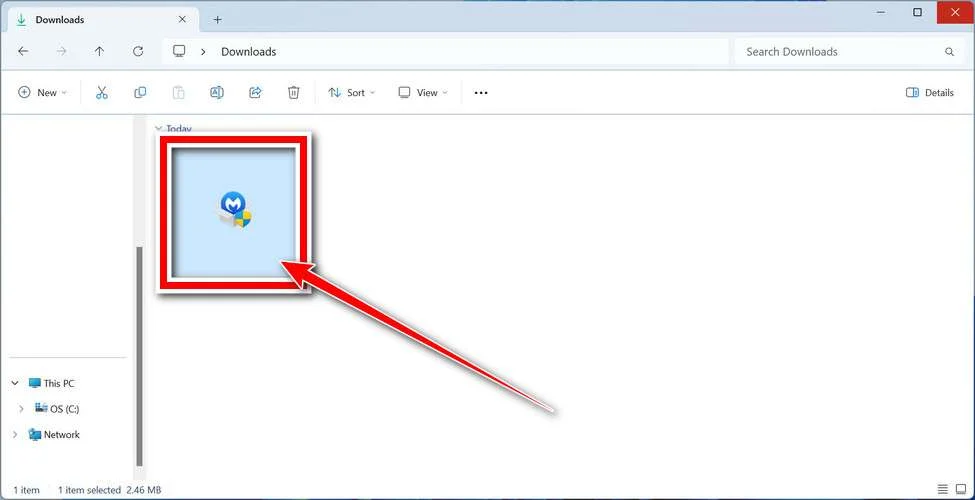
Follow the On-Screen Prompts to Install Malwarebytes
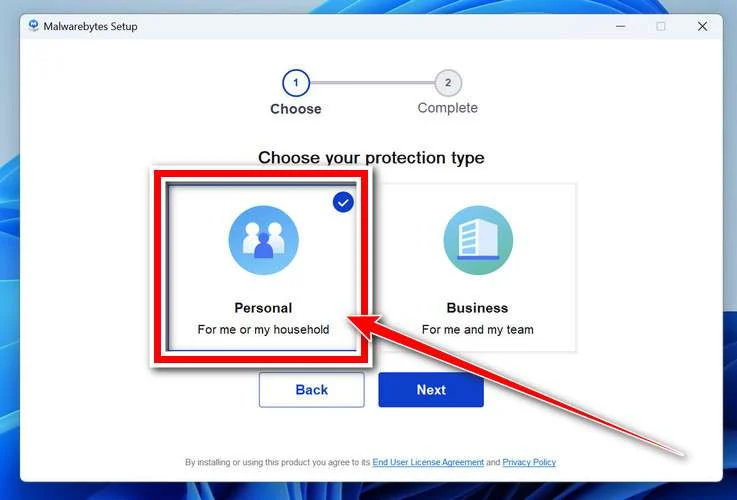
The setup wizard will walk you through a few quick screens:
-
Choose where you’re installing the program — “Personal Computer” or “Work Computer” — then click Next.
-
Malwarebytes will now install on your device. This usually takes under a minute.

-
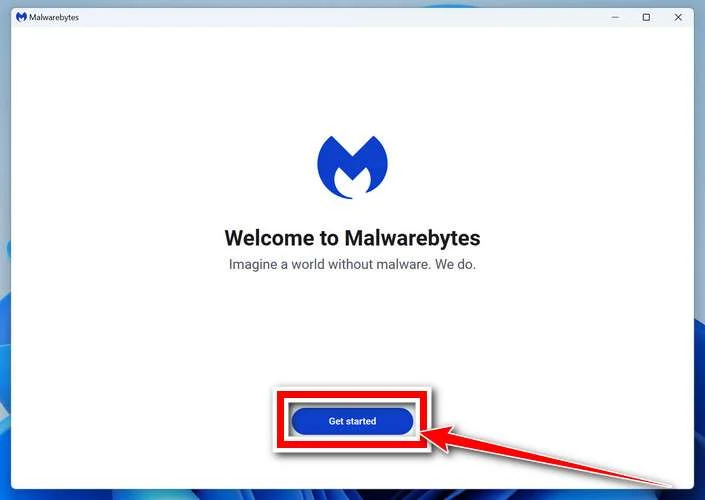
When installation is complete, the “Welcome to Malwarebytes” screen will open automatically.
-
On the final screen, click Open Malwarebytes to launch the program.

-
Enable “Scan for Rootkits”
Before scanning, turn on rootkit detection so Malwarebytes can find even the most hidden threats. Click the Settings gear icon on the left side of the screen.
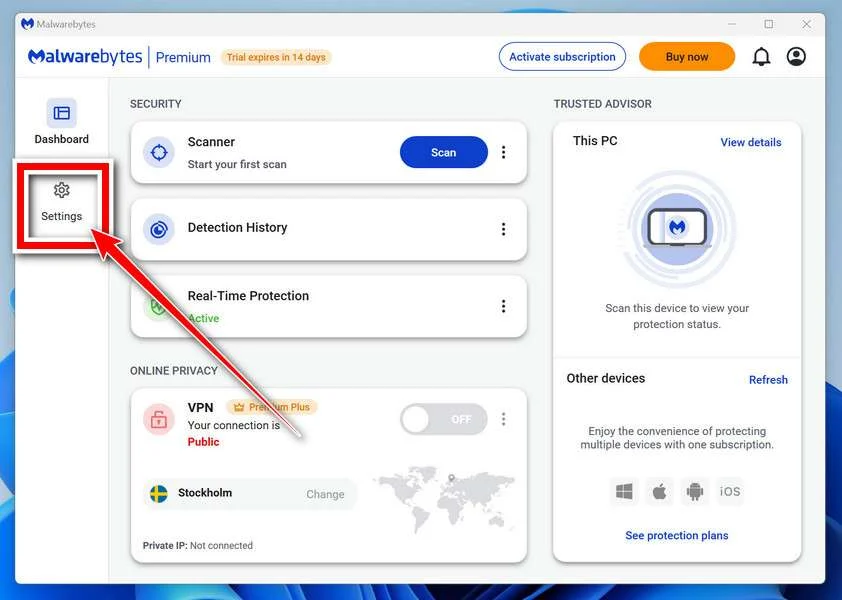
In the settings menu, find “Scan for rootkits” and click the toggle so it turns blue.

Done? Click “Dashboard” in the left pane to return to the main screen.
Start the Scan
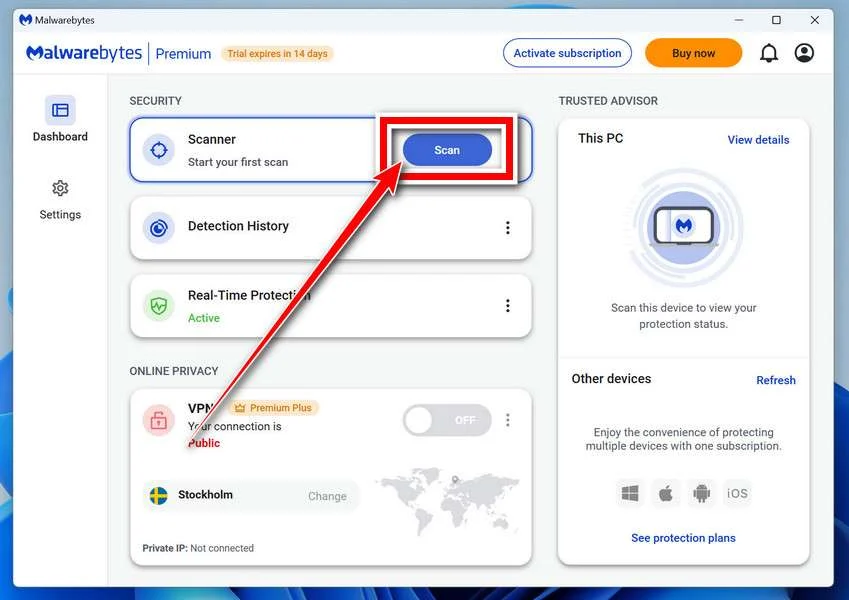
Click the blue Scan button. Malwarebytes will automatically update its virus database and start checking your computer for malware.
-
Wait for the Scan to Finish
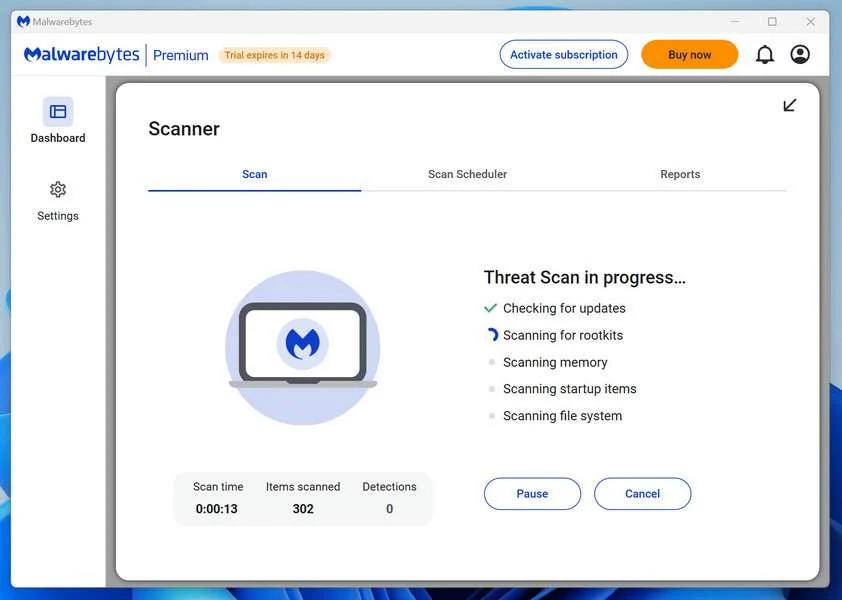
The scan checks your entire system for browser hijackers and other malicious programs, so it can take 5 to 20 minutes depending on your computer. Feel free to do something else — just check back occasionally to see the progress.
-
Quarantine the Detected Threats
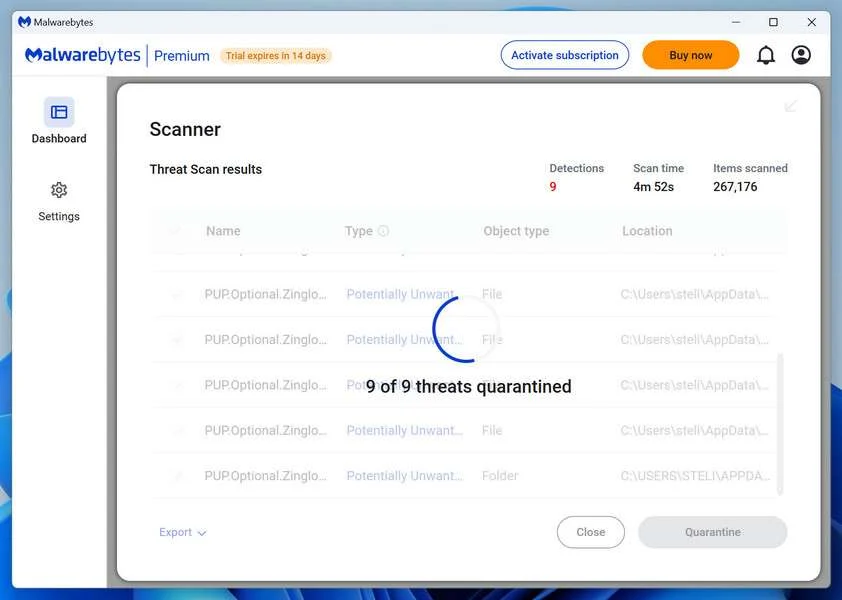
When the scan is done, you’ll see a list of everything Malwarebytes found — malware, adware, and potentially unwanted programs. Click the “Quarantine” button to remove all of them at once.
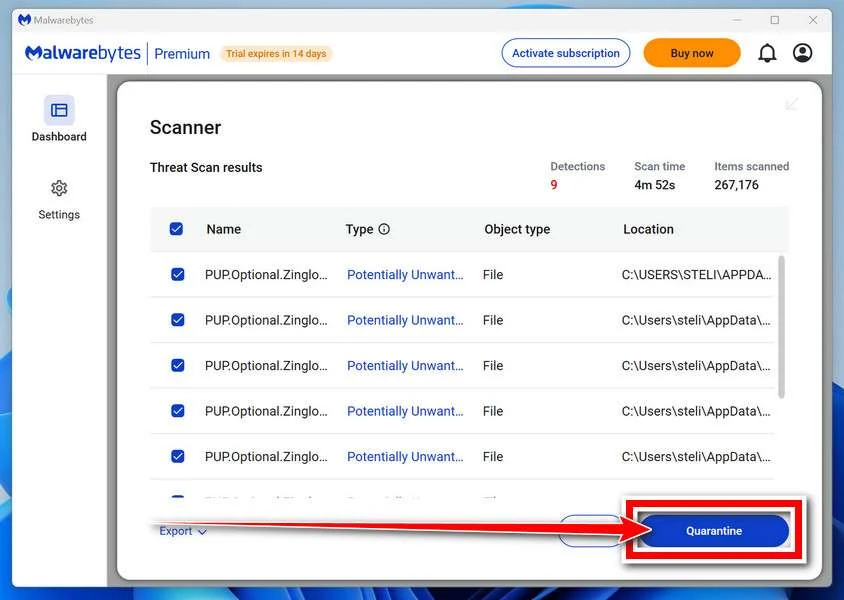
Malwarebytes will now remove the malicious files and registry entries and move them safely into quarantine.
-
Restart Your Computer
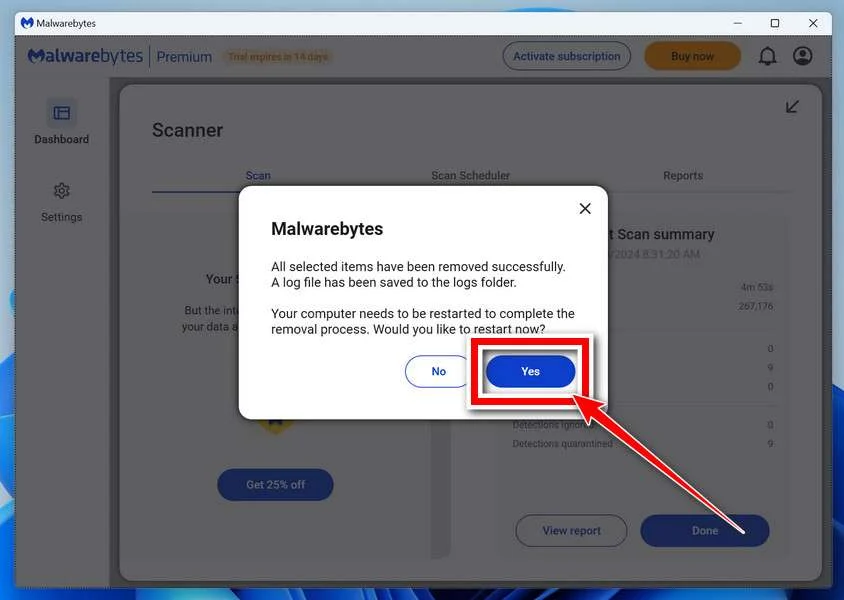
Some threats can only be fully removed after a reboot. If Malwarebytes asks you to restart, click Yes. Once you’re logged back in, Malwarebytes has finished removing the threats it found.
That’s it — your Windows PC is now clean of trojans, adware, and other malware, and should be back to running smoothly.
If you are still having problems with your computer after completing these instructions, then please follow one of the steps:
- Run a computer scan with ESET Online Scanner
- Ask for help in our Windows Malware Removal Help & Support forum.
Run a Malware Scan with Malwarebytes for Mac
Malwarebytes for Mac is a free on-demand scanner that removes the malware other security software tends to miss — adware, browser hijackers, and unwanted programs included. Cleaning an infected Mac with Malwarebytes has always been completely free, and it’s our go-to recommendation. Follow the steps below to scan and clean your Mac in just a few minutes.
-
Download Malwarebytes for Mac
Click the button below to download the latest version of Malwarebytes for Mac.
Download MalwarebytesOfficial installer for macOS. Your download starts right away.Want real-time protection? See Malwarebytes PremiumMalwarebytes Free for MacScans and removes malware at no cost -
Open the Malwarebytes setup file
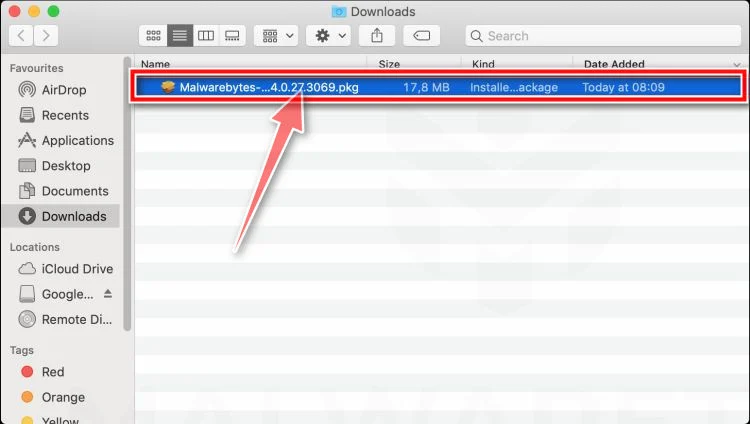
When the download finishes, open your Downloads folder and double-click the setup file to begin the installation.
-
Follow the On-Screen Prompts to Install Malwarebytes
The Malwarebytes for Mac Installer will guide you through a few quick screens. Click “Continue” and keep following the prompts until the installation completes.
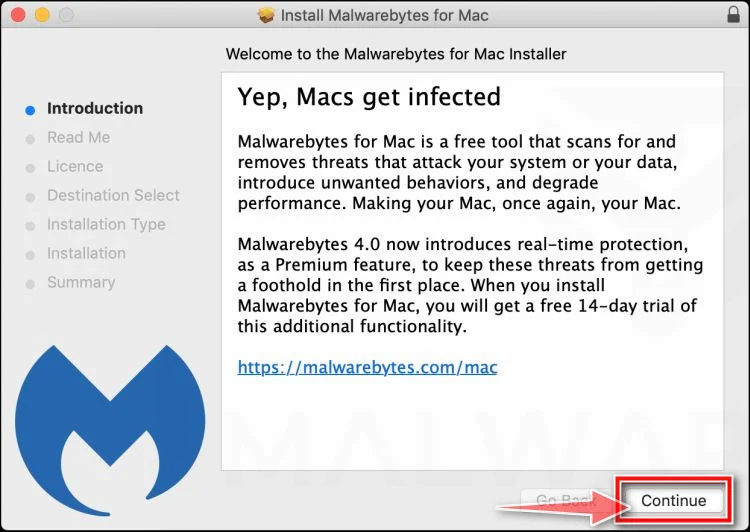
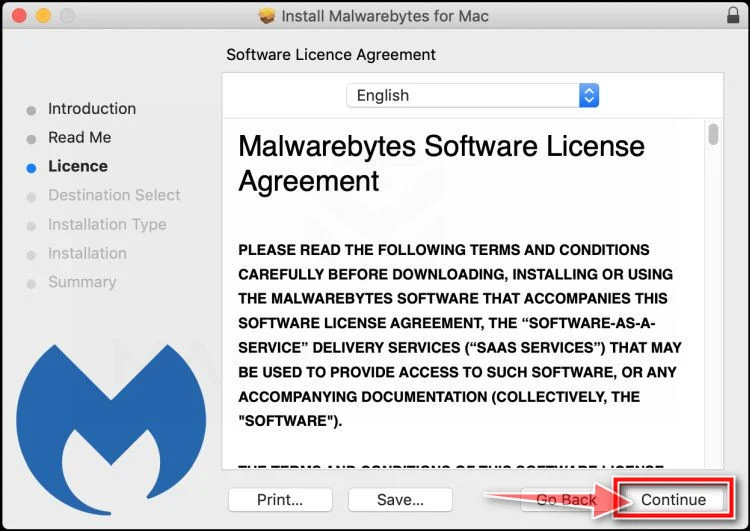
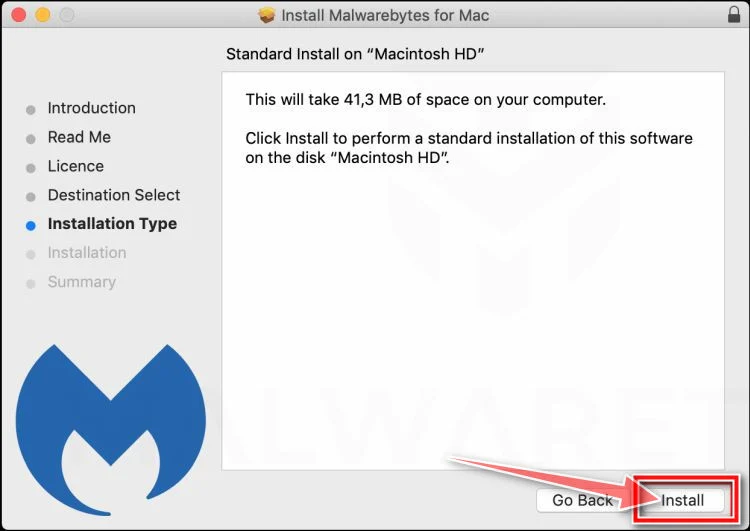
When the installation is complete, Malwarebytes opens to the Welcome to Malwarebytes screen. Click “Get started“.
-
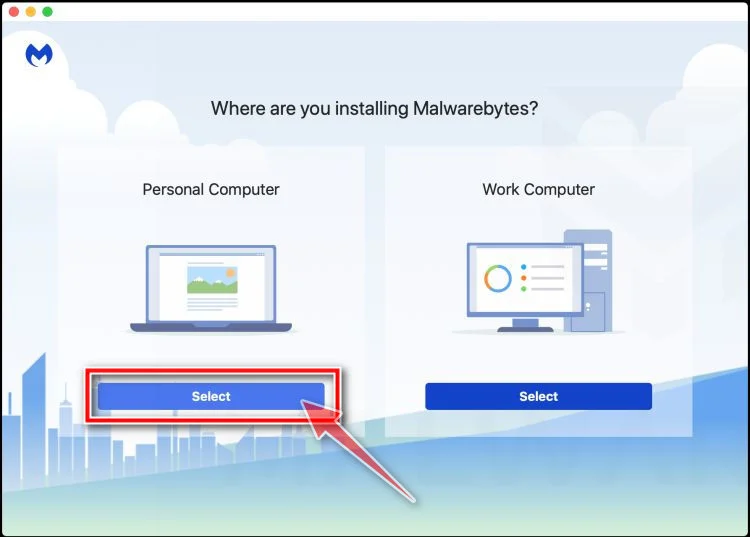
Select “Personal Computer” or “Work Computer”
Malwarebytes will ask what type of computer you’re installing it on. Click either Personal Computer or Work Computer, whichever applies.
-
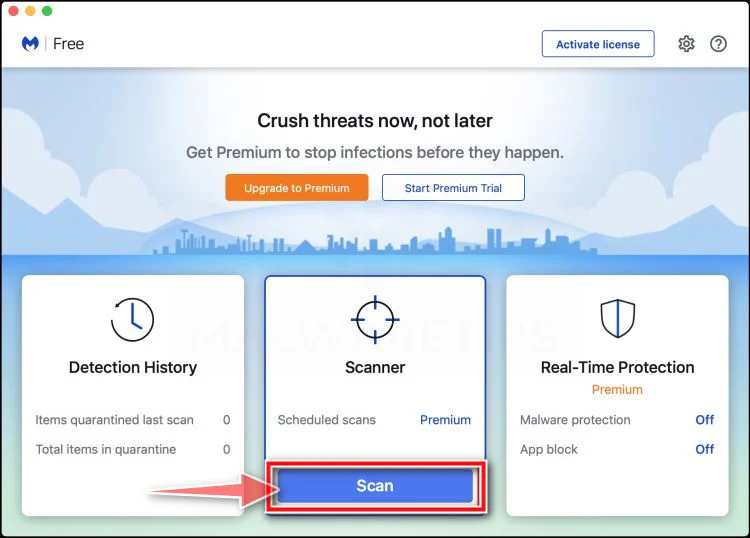
Start the Scan
Click the “Scan” button. Malwarebytes will automatically update its detection database and begin checking your Mac for malware.
-
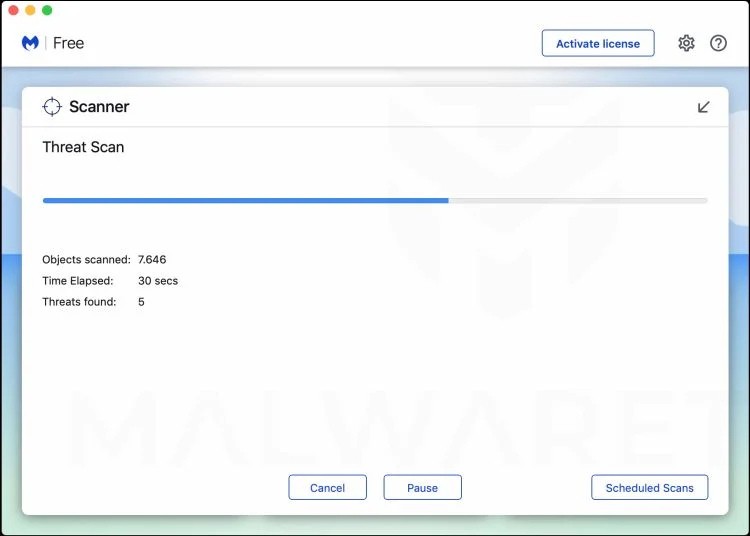
Wait for the Scan to Finish
Malwarebytes will scan your Mac for adware, browser hijackers, and other malicious programs. This can take a few minutes, so feel free to do something else — just check back occasionally to see the progress.
-
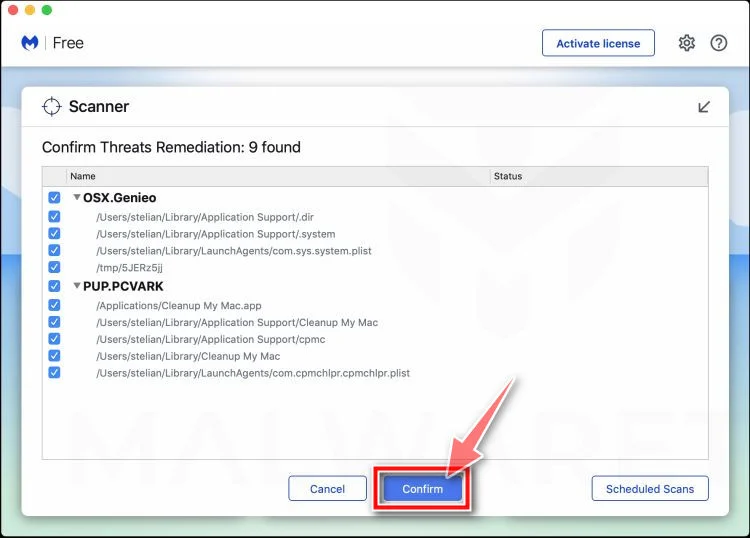
Quarantine the Detected Threats
When the scan is done, you’ll see a list of everything Malwarebytes found. Click the “Quarantine” button to remove all the threats at once.
-
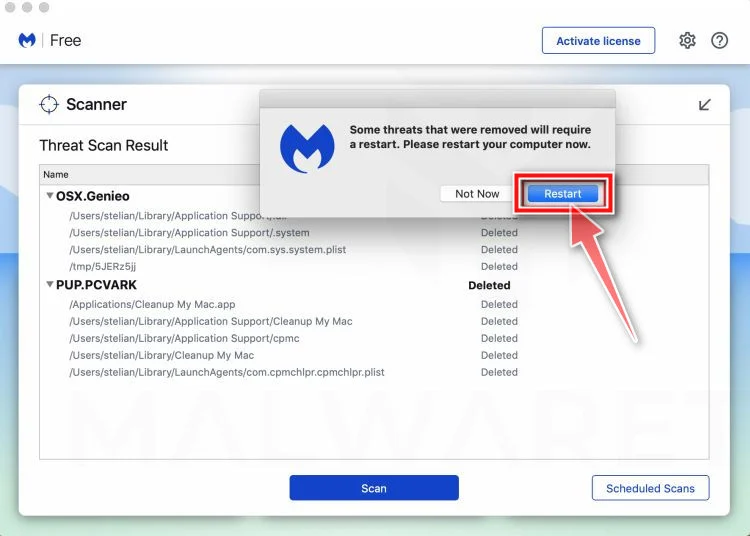
Restart Your Mac
Malwarebytes will now remove all the malicious files it found. Some threats can only be fully removed after a reboot — if Malwarebytes asks you to restart, allow it. Once you’re logged back in, your Mac is clean.
That’s it — your Mac is now free of adware, rogue browser extensions, and other potentially harmful software.
If you are still experiencing problems while trying to remove a malicious program from your computer, please ask for help in our Mac Malware Removal Help & Support forum.
Run a Malware Scan with Malwarebytes for Android
Malwarebytes for Android automatically detects and removes dangerous threats like malware and ransomware so you don’t have to worry about your most-used device being compromised. Aggressive detection of adware and potentially unwanted programs keeps your Android phone or tablet running smooth.
-
Download Malwarebytes for Android.
You can download Malwarebytes for Android by clicking the link below.
Get Malwarebytes for AndroidOpens Google Play in a new tab.Want real-time protection? See Malwarebytes Premium for AndroidMalwarebytes for AndroidScans your phone and removes malware at no cost -
Install Malwarebytes for Android on your phone.
In the Google Play Store, tap “Install” to install Malwarebytes for Android on your device.

When the installation process has finished, tap “Open” to begin using Malwarebytes for Android. You can also open Malwarebytes by tapping on its icon in your phone menu or home screen.

-
Follow the on-screen prompts to complete the setup process
When Malwarebytes will open, you will see the Malwarebytes Setup Wizard which will guide you through a series of permissions and other setup options.
This is the first of two screens that explain the difference between the Premium and Free versions. Swipe this screen to continue.
Tap on “Got it” to proceed to the next step.
Malwarebytes for Android will now ask for a set of permissions that are required to scan your device and protect it from malware. Tap on “Give permission” to continue.
Tap on “Allow” to permit Malwarebytes to access the files on your phone.
-
Update database and run a scan with Malwarebytes for Android
You will now be prompted to update the Malwarebytes database and run a full system scan.

Click on “Update database” to update the Malwarebytes for Android definitions to the latest version, then click on “Run full scan” to perform a system scan.

-
Wait for the Malwarebytes scan to complete.
Malwarebytes will now start scanning your phone for adware and other malicious apps. This process can take a few minutes, so we suggest you do something else and periodically check on the status of the scan to see when it is finished.

-
Click on “Remove Selected”.
When the scan has been completed, you will be presented with a screen showing the malware infections that Malwarebytes for Android has detected. To remove the malicious apps that Malwarebytes has found, tap on the “Remove Selected” button.

-
Restart your phone.
Malwarebytes for Android will now remove all the malicious apps that it has found. To complete the malware removal process, Malwarebytes may ask you to restart your device.
That’s it — your Android phone is now clean — no more malicious apps, adware, or browser redirects.
If you are still having problems with your phone after completing these instructions, then please follow one of the steps:
- Restore your phone to factory settings by going to Settings > General management > Reset > Factory data reset.
- Ask for help in our Mobile Malware Removal Help & Support forum.
Stay Protected: Block Ads and Malicious Sites
Now that your device is clean, keep it that way. Most infections start with a malicious ad or a fake download button — so blocking them at the source is your best defense.
We recommend AdGuard, which blocks malicious ads, phishing pages, and dangerous redirects before they can reach you.
👉 Download AdGuard and browse safely
The Bottom Line
Coach $750 gift card scam sites are built to look like a legitimate registration and reward process, but the core requirement gives them away: complete sponsored partner offers.
That is the business model. The site profits from your signups, your data, and sometimes your subscriptions, while the promised reward remains vague, delayed, or never delivered.
If you land on a page promising a $750 Coach gift card through domains like chgifted.com or similar lookalikes, treat it as a trap. Close it, protect your accounts, and focus on cleanup if you already interacted with any offers.
FAQ
Are Coach $750 gift card claim sites legit?
NO. If a site promises a $750 Coach gift card and requires you to complete “sponsored partner offers” or “required offers,” it is usually a reward funnel, not an official Coach promotion.
Is chgifted.com an official Coach website?
No. chgifted.com is not an official Coach domain. Legitimate Coach promotions would be tied to Coach’s official channels and provide verifiable rules, terms, and support.
Why do these sites ask me to complete 3 to 5 partner offers?
Because that is how the operator makes money. Each completed offer can generate affiliate commission, especially trials, subscriptions, and app installs.
What are “sponsored partner offers” on these pages?
They are third-party promotions that can include:
- Free trials that require a credit card
- Subscription services that auto-renew
- App installs with paid upsells
- Sample offers with shipping fees that may turn into recurring billing
- Survey and sweepstakes signups that collect personal data
Will I actually receive the $750 Coach gift card?
Most people do not. Many users get stuck in “pending” or “verification” loops, or they are told their completion did not track, which pushes them to do more offers.
Why does it say my offer completion is “pending” or “not tracked”?
Affiliate tracking can be used as an excuse to deny credit. The site may blame cookies, ad blockers, VPN use, switching devices, or “incomplete steps,” then encourage you to complete additional offers.
Can these sites lead to unwanted charges?
Yes. Some partner offers involve trials or memberships that convert into recurring billing. Charges may show up later under merchant names you do not recognize.
I only entered my email. Is that still a problem?
It can be. You may see more spam and follow-up “finish your registration” emails. Treat any message asking for additional verification, payment, or personal details with caution.
I entered my phone number. What should I expect?
You may receive scam texts and marketing calls. Be wary of follow-ups claiming you need to confirm your reward or pay a small fee to release the gift card.
I entered payment details for an offer. What should I do now?
Take action quickly:
- Cancel any trials or subscriptions you started and save confirmation
- Check your bank statements for pending or posted charges
- Contact your card issuer if you see suspicious billing or cannot cancel
- Consider replacing your card if you used it on multiple offers
How can I spot a fake Coach rewards page fast?
Look for these red flags:
- The domain is not an official Coach domain
- The reward is unlocked by third-party sponsor offers
- The delivery timeline is vague or always “pending”
- The page uses generic “registration” language instead of official promotion rules
- Support and official terms are unclear or hard to verify
Where should I report these scam sites?
Report them to:
- The platform where you saw the link or ad
- Your browser’s deceptive site or phishing report tool
- Your email provider or mobile carrier if it came via spam message
- Coach customer support to report brand impersonation

Join the discussion
0 commentsShare your experience or ask a question about this article.
Discussion
Start the conversation
Have a question or something useful to share? Add the first comment.