


Your wallet history contains a small transfer you don’t recognize. The address looks familiar, almost like the one you used yesterday.
You weren’t planning to investigate anything. You only wanted to copy a destination, finish a routine task, and get on with your day.
Overview
The history entry can be the bait
MetaMask explains how address poisoning plants a look-alike address somewhere you might trust, usually among previous transactions. The attacker hopes you will copy it later.
As Trezor explains, the entry may involve a negligible amount, a zero-value transfer, or an imitation token. Its purpose is recognition, not generosity.
A blockchain records activity according to its rules. It doesn’t certify that every address displayed beside your activity belongs to someone you intended to pay.
Receiving an entry is different from authorizing access
An unsolicited entry alone does not mean somebody learned your recovery phrase or obtained permission to spend your existing assets.
Actual unauthorized outgoing activity requires a different investigation. Don’t explain away missing assets merely because you also noticed a tiny incoming transaction.
The practical check starts outside that entry
Establish the destination independently, then compare the entire address. Checking only its familiar beginning and ending can miss the exact characters the attacker changed.
- Obtain the intended destination through an independently trusted route.
- Compare every character rather than recognizing shortened address fragments.
- Stop when the source or destination remains uncertain.
- Keep suspicious history separate from verified contact information.
Why a Familiar Address Can Be the Wrong Address
Long character strings are difficult to remember. Wallets often shorten them, showing several characters at each end and hiding the middle.
That presentation helps readers scan activity, but it also encourages a shortcut: recognizing an address by its edges instead of checking its complete contents.
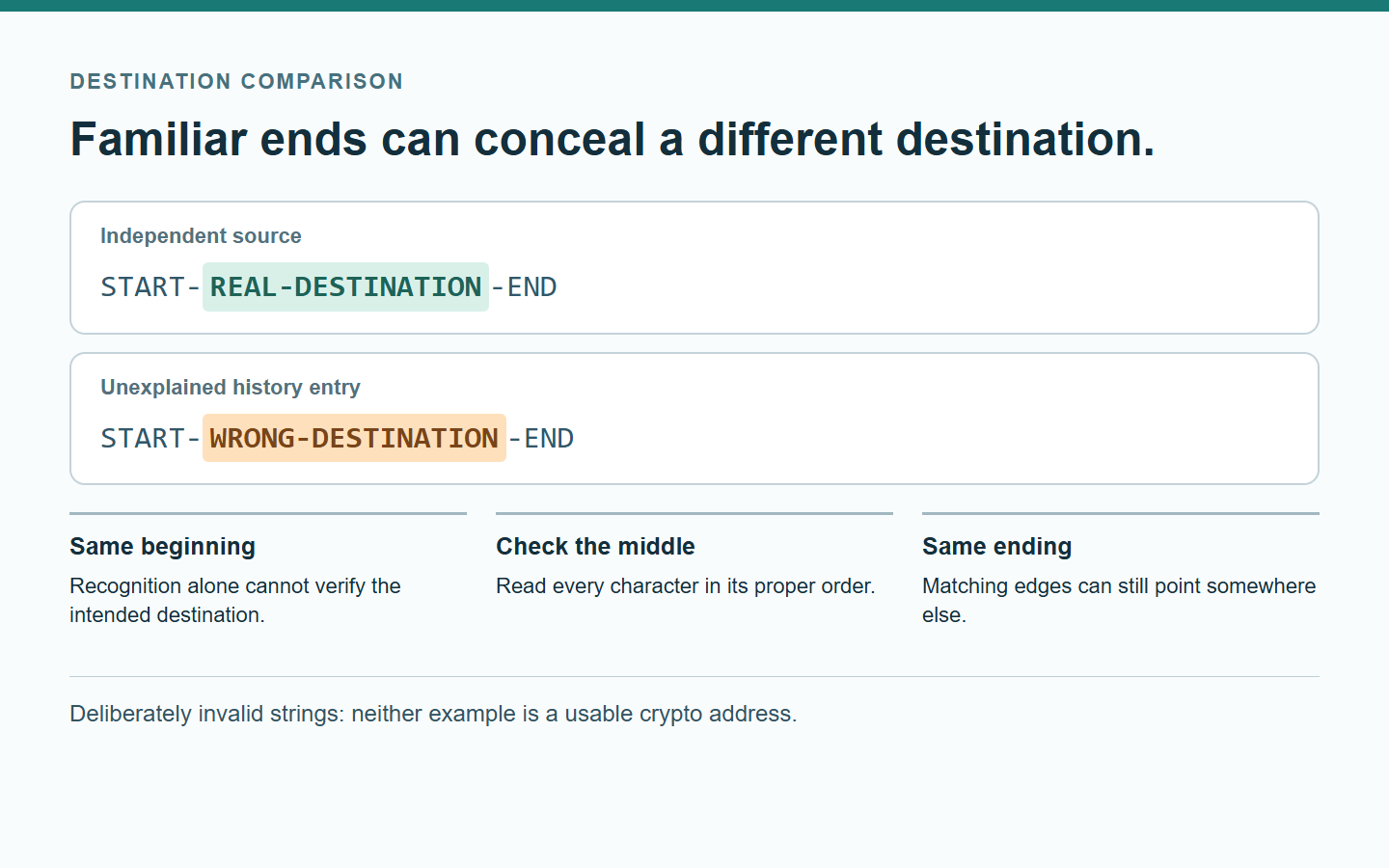
Imagine two deliberately invalid training labels: START-REAL-DESTINATION-END and START-WRONG-DESTINATION-END. Neither label is a usable cryptocurrency address.
If a display showed only START and END, both labels would appear familiar. Expanding the middle reveals why that familiarity is insufficient.
The important question isn’t whether the string looks approximately correct. It is whether it exactly matches the independently established destination for this particular task.
A longer matching prefix doesn’t change that principle. An attacker needs your mistaken recognition, not a mathematically identical address.
Color, an avatar, a nickname, or a remembered transaction amount can make an entry easier to recognize. None replaces verifying its actual destination.
This is also why manually retyping a long address is not the solution. It introduces transcription mistakes without settling whether your original source was trustworthy.
How an Attacker Gets Into Otherwise Genuine History
Attackers create an address with recognizable similarities and arrange activity that makes it appear near something familiar. Your genuine wallet application can display that activity.
The interface doesn’t have to be counterfeit. A real application can faithfully show an unwanted entry, just as a genuine inbox can receive an unsolicited message.
That creates two separate checks: whether the entry describes a real asset, and whether its address belongs to the person you intended.
You don’t need to solve the token’s identity before refusing to copy its address. An unexplained entry is already the wrong source for destination instructions.
A familiar amount is equally insufficient. Someone reproducing a number from public history hasn’t established a relationship with you or your intended recipient.
The same principle applies when the address appears on a block explorer. Moving the entry into another genuine interface doesn’t authenticate the person behind it.
Don’t send money to investigate an unexplained entry. Replying with a transfer, claiming its token, or following its promotional link can create additional exposure.
Use a Destination Source That Answers the Right Question
Start by identifying what you were actually trying to do. Paying another person, moving your own assets, and depositing into an exchange require different confirmation sources.
For another person, use a communication route you already trust. A changed address arriving in an unexpected message needs independent confirmation.
When choosing a confirmation channel, ask who controls both sides of the conversation. A new chat introduced by the same unverified sender is not independent.
Write the question before asking it: which receiving account do I intend, and where did its destination information originate? That keeps the response focused on provenance.
For your own wallet, use its genuine receiving information rather than copying an address from an old incoming or outgoing history row.
For a custodial exchange, use the current deposit instructions inside the genuine service. The relevant network and any required memo or tag still matter.
A copied destination should match the intended recipient on the intended network. An address resemblance alone cannot answer both questions.
A saved contact can remove the temptation to copy history, but only if you verified the contact before saving it.
Saving a suspicious address with a friendly nickname simply preserves the original mistake. An address book is an organizational aid, not an independent investigation.
Destination provenance
Independent recipient confirmation establishes which destination you intended.
Full-character comparison checks whether the displayed destination matches that information.
Transaction history recognition cannot establish either conclusion by itself.
These checks should agree before you authorize anything. When they conflict, stop and resolve the conflict outside the questionable transaction or message.
Walk Through an Ordinary Destination Mix-Up
Suppose you are moving assets between two accounts you control. Yesterday’s history contains the intended destination, so you return there instead of opening its receiving information.
A newer entry has similar-looking address fragments. You copy that entry because it appears closer to the top and seems to match yesterday’s activity.
The first missed check happened before any paste: you treated position in the list as evidence that the address belonged to you.
Now suppose you expand the copied address and compare every character, but against the same suspicious history row. Both copied strings match each other perfectly.
That comparison confirms you copied the row accurately. It doesn’t establish that the row supplied the right destination in the first place.
The correction is to reopen the intended receiving account through its trusted route. That provides a separate source against which the copied string can be checked.
You can apply this reasoning without sending anything. Ask where the original destination came from and whether your comparison source is genuinely independent.
If both sources trace back to the same unexplained entry, you have repeated one claim rather than verified it. Stop and obtain the missing independent information.
Compare the Address Without Turning It Into a Memory Test
Use the complete address, not an abbreviated preview. Expand the display through your genuine wallet’s documented controls if the middle characters are hidden.
Compare it against the independently obtained source in a steady order. Reading from beginning to end helps prevent repeatedly checking only the familiar edges.
Breaking the comparison into consecutive groups can make a long string easier to inspect. Every group still needs checking, including the middle.
Don’t edit the destination to make it resemble your expectation. If the strings differ, investigate the source rather than repairing characters by guesswork.
Check the actual displayed destination after pasting. Verifying the original text alone doesn’t establish what eventually appeared in the destination field.
If a hardware wallet is already part of your normal trusted setup, follow its official instructions for reviewing the destination on its own display.
The hardware display is another checkpoint, not permission to skip establishing the correct recipient. Carefully confirming the attacker’s address still authorizes the wrong destination.
Don’t allow a caller or screen-sharing helper to rush this review. Someone describing the correct procedure can still be supplying a dishonest destination.
Know Which Problem You Are Actually Seeing
| What you notice | What needs checking |
|---|---|
| An unexplained entry appears beside familiar wallet activity. | Check its relevance without borrowing its destination instructions. |
| Pasted text differs from the independently verified original. | Stop sensitive activity and investigate the browsing environment. |
| Your existing assets moved without your intended authorization. | Investigate actual transactions, permissions, and possible secret exposure. |
| An unfamiliar token advertises a claim or refund. | Ignore its invitation and consult genuine provider guidance. |
Address poisoning and clipboard replacement can produce a similar outcome, but they reach it differently. One corrupts your source choice; the other can alter pasted text.
MetaMask’s clipboard guidance explains that malicious software can replace copied addresses and may behave differently depending on where text is pasted.
A successful paste into an ordinary text document therefore doesn’t prove that every destination field will remain unchanged. Keep checking the actual final destination displayed.
Receiving an unwanted transaction isn’t evidence of a device infection. Actual software exposure or changed pasted text creates a separate device-security question.
Likewise, clearing a wallet’s history view doesn’t remove a blockchain record or repair an exposed secret. Tidier presentation and restored security are different outcomes.
What Wallet Warnings Can and Cannot Tell You
Some wallets attempt to recognize suspicious similarities or filter unwanted activity. Their behavior depends on the product and its current implementation.
A warning can interrupt a rushed decision. Its absence cannot establish that an address belongs to your intended recipient or that your device is trustworthy.
Don’t turn the alert into another task to dismiss. Return to the independently verified destination and understand why the application raised the concern.
A different wallet may use different wording or provide no comparable filter. The full-address and source checks still apply without that feature.
Choose the Response That Matches Your Situation
I only noticed an unfamiliar incoming entry.
Leave the entry alone and avoid its links. Check your actual balances and outgoing activity through the genuine wallet, without copying its address.
If nothing else is wrong, receiving that entry alone doesn’t establish stolen secrets. Keep your verified destination sources separate from unwanted history.
I copied an address but haven’t authorized anything.
Discard the unverified destination and pause the task. Obtain the intended address independently, then compare its full contents before considering another action.
If pasted text changes unexpectedly, stop using that environment for financial activity. Investigate the separate device or browser problem through trusted support.
I already completed a transfer to the wrong destination.
Preserve the real transfer details and contact the service involved promptly. Don’t send another payment to test whether the recipient will cooperate.
Report the incident through official channels and reject recovery guarantees. Confirmed blockchain transfers generally don’t provide an ordinary payment-card chargeback.
What to Do If You Already Sent Crypto to the Wrong Address
-
Stop any additional transfers connected with the incident. A promised return, fee refund, or verification payment is not a reason to send more.
Don’t assume the first loss obliges you to finish a conversation. Preserve the records before ending contact with an unverified helper.
-
Record the actual asset, network, amount, destination, date, and transaction hash. Keep the original sending-service receipt alongside any history screenshot.
Preserve the difference between your intended destination and the address actually used. That comparison explains the incident more clearly than calling everything a hack.
-
Contact the exchange or service that handled the transfer through its independently opened support route. Explain what happened and ask what intervention remains possible.
Don’t interpret an acknowledgment as a promise of recovery. The provider’s options depend on the destination, timing, custody arrangements, and available legal process.
-
For US reporting, follow the FBI’s cryptocurrency-victim guidance. Supply the records you have rather than waiting until every detail is perfect.
Keep recovery words, private keys, passwords, and active authentication codes out of public posts. A destination dispute does not require publishing those secrets.
-
Watch for unsolicited recovery offers after discussing the loss. The FBI’s recovery-fraud warning explains why private tracing promises are not government seizure authority.
Knowing your public address or transfer amount doesn’t make someone an authorized investigator. Verify their organization independently before disclosing additional personal records.
Frequently Asked Questions
Does a zero-value transfer mean my wallet was hacked?
An unsolicited zero-value transfer doesn’t establish spending access. Unexplained outgoing activity or disclosed secrets require a separate investigation into what actually happened.
Is checking the first and last characters enough?
No, those are precisely the fragments a look-alike can imitate. Compare the full destination against information obtained through an independently trusted route.
Can I use an address copied from a block explorer?
An explorer can display genuine records containing an unwanted address. Its presence there doesn’t establish that the address belongs to your intended recipient.
Should I send a tiny payment to investigate?
Don’t send money to an unexplained entry. A test transfer doesn’t authenticate the person behind it or establish that a later destination remains correct.
Will hiding the entry remove the risk?
Hiding can reduce clutter where your wallet supports it. It doesn’t verify saved contacts, reverse transfers, or establish that other addresses are trustworthy.
Can a wallet provider reverse an accidental transfer?
A confirmed blockchain transfer generally cannot simply be canceled. Contact the relevant service promptly, preserve records, and avoid anyone guaranteeing recovery for another payment.
The Bottom Line
Don’t use unfamiliar wallet history as your address book. Establish the intended destination independently and compare the entire string, including its middle characters.
If you already used the wrong address, stop further payments, preserve the actual transfer records, and contact the relevant provider through its genuine support route.

Join the discussion
0 commentsShare your experience or ask a question about this article.
Community experiences
Did this happen to you?
Your experience could help someone recognize the same scam. Submit a private report for our team to review.
I experienced this tooReports are reviewed before publication. Sharing publicly is always your choice.
Discussion
Start the conversation
Have a question or something useful to share? Add the first comment.