


A discounted recliner, a compact air conditioner, or a hammock can make a summer shopping ad hard to ignore. CYBX offered all three kinds of temptation.
If you’re searching for Cybx.store reviews now, you may be looking for more than a bargain. Perhaps you’re trying to find the order you already paid for.
Overview
The store sold much more than inexpensive accessories
Cybx.store was an online shop for gadgets, outdoor equipment, furniture, and cooling products. Its archived pages show branded product names and substantial markdowns.
The July 2025 homepage promoted a 40% sitewide sale, free shipping, a money-back guarantee, and a lifetime warranty. Those reassurances made ordering look relatively low-risk.
But the purchases people describe weren’t always small experiments. Complaints involve household equipment, multiple items, and orders financed through a payment plan.
The complaints describe orders that never became deliveries
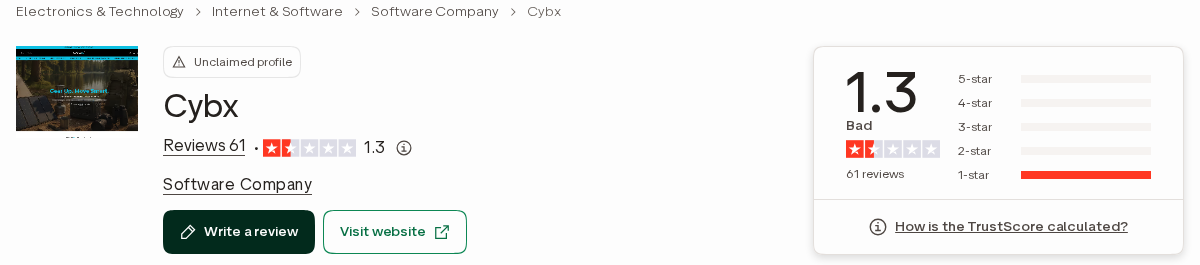
The exact cybx.store Trustpilot profile currently shows 61 reviews, a 1.3 score, and a 100% one-star distribution.
Recent posts describe purchases from July 2025 that still hadn’t arrived months later. Failed tracking and unanswered messages recur in the accounts.
BBB Scam Tracker also contains CYBX reports. Those are consumer allegations, not court judgments, but they give specific transactions to compare with the store’s promises.
The practical answer is to avoid another purchase
Do not place a new order with Cybx.store. Its main and www addresses are currently inaccessible, and the public complaint record gives no sensible reason to risk another payment.
If you already paid, identify what happened to your particular order rather than waiting indefinitely for the website to return.
- Find the product name and original delivery promise.
- Separate an order confirmation from actual carrier evidence.
- Check whether a payment plan remains active.
- Distinguish a promised refund from money actually credited.
What the Archived CYBX Offers Actually Promised
The archived LuxRest listing advertised an electric recliner with a fold-out bed and storage. Its package choices included one unit at $79 and two at $126.40.
Those are historical advertised prices, not a current checkout or an independently tested furniture specification. They help explain why someone might remember the offer so clearly.
The pitch combined several reassurances: American manufacturing, substantial sales activity, a high review count, and a limited quantity supposedly remaining.
That same page displayed a 30-day period starting from delivery, a prepaid return-label promise, and a refund to the original payment method after the return process.
For someone worried about buying furniture unseen, those details could make the decision feel safer. The difficulty comes when the furniture never arrives.
The LuxRest FAQ also asked about dimensions, but answered with a general description of compactness and comfort instead of actual measurements.
That’s a meaningful omission for a reclining sofa-bed. A buyer needs its width, sleeping length, and operating clearance to know whether it will fit their room.
A feature list can create a vivid picture without answering that basic purchase question. Don’t let an attractive price do the work of missing product specifications.
A return guarantee cannot substitute for delivery. A customer without the promised product has a non-delivery problem, not merely an item they changed their mind about.
The archived HyperCool page offered a U-shaped air conditioner and claimed suitability for rooms up to 550 square feet. It used the same $79 single-unit price.
Both listings displayed the same 4.8 rating, 4,164-review count, 1,000-plus daily-order claim, and 19-items-left message. Those repeated figures should not be mistaken for independent sales verification.
The point isn’t that a discount alone proves wrongdoing. It’s that confident product promises and busy-looking sales numbers need to be checked against what customers actually received.
How CYBX Orders Turned Into Delivery Disputes
Step 1: A social-media offer brought the shopper to a broad catalog
Facebook appears in specific CYBX complaints, including a hammock-tent purchase reported to BBB. The customer described being drawn into what looked like a legitimate storefront.
The catalog then supplied familiar shopping signals: named products, payment logos, discounts, and product explanations. A shopper could browse as though dealing with an established general retailer.
That presentation matters because the original purchase may feel ordinary. You don’t necessarily notice a problem until the expected shipping or delivery date passes.
Step 2: Reassuring promises lowered the perceived risk
CYBX’s product pages didn’t ask buyers to accept uncertainty openly. They promised useful equipment, American craftsmanship, supportive service, and an accessible return process.
The return promise included “prepaid return label and instructions.” That’s especially reassuring for bulky furniture that could cost a lot to send back.
Yet a promise on the page still needs a seller willing and able to honor it. It isn’t a reserve fund or automatic payment protection.
Save that wording if it formed part of your purchase decision. It can explain the agreement you thought you were making, even after the listing disappears.
Step 3: Confirmation and tracking kept the order feeling active
A confirmation email acknowledges an order. A tracking number suggests progress. Neither, by itself, shows that your purchased item reached a carrier or your address.
One BBB report filed August 22, 2025 describes a $49 hammock-tent order. The buyer says tracking later disappeared and the support number stopped working.
That buyer also reports being told the company was in Dallas and the goods were American-made, while tracking showed movement from China.
For your order, the useful question is concrete: can the named carrier connect that number with a parcel delivered to the correct destination?
Step 4: The delivery problem outlasted the storefront
Some people were still posting about summer purchases in early 2026. By then, this wasn’t a question of a parcel being a few days late.
Daniel’s February 2026 Trustpilot post says two items never arrived. Dalia’s January account describes a July order, a delivery claim, unusable tracking, and no reply.
These individual accounts describe a serious pattern. The website’s current unavailability makes relying on another routine shipping reassurance even less reasonable.
Move the issue toward a documented resolution. An endlessly changing delivery explanation is not the same as receiving the equipment or recovering the money.
Company, Contact, and Shipping Checks
CYBX was a store name, not a verified manufacturer
The archived contact page supplied a form and support details, but did not identify a registered legal entity or street address in its visible content.
That leaves an important distinction between the CYBX brand and the business accepting a particular payment. Your invoice or financing record may provide a more useful merchant identifier.
Use the exact domain when discussing the purchase. A similar-sounding company or a different business found by a broad name search isn’t automatically responsible for this store.
There really were published support details
Historical pages listed Support@cybx.store and 888-705-7999. Customers therefore had published contact routes, even if obtaining help became another matter.
What matters is what happened afterward. The $49 BBB complainant says someone initially answered the phone, followed later by a number that no longer worked.
Other complaints describe messages going unanswered. Keep the dates and replies from your own correspondence, because a published contact route and useful after-sales support are different things.
The American-made pitch needs more than a slogan
The product pages presented CYBX goods as American-made. The hammock buyer’s reported tracking route raises a legitimate question about the fulfillment story they were given.
That account doesn’t identify every product’s factory or establish a manufacturing country for the entire catalog. It does justify asking the seller to explain the discrepancy.
A country claim should connect to a manufacturer and the actual product, not just a patriotic paragraph reused across unrelated categories.
A delivery dispute is different from an ordinary return
For a missing order, there’s nothing to repackage or inspect. Instructions about keeping a recliner in like-new condition don’t answer where that recliner went.
Don’t spend money shipping an unrelated item to an unconfirmed address because someone says it’s necessary to release your refund. Ask for instructions tied to your actual order.
Don’t let return instructions distract from a missing delivery. The first answer you need is where the purchased item went, not how to send it back.
The Review Badge and the Actual Complaint Record
The archived shop included favorable testimonials under Trustpilot-style labeling. The current company profile tells a very different story from that reassuring presentation.
A customer should be able to follow a rating to the exact business and read the underlying feedback. A number beside a product isn’t enough.
Read the substance of a complaint, not just its headline. Dates, an identifiable product, a communication trail, and a specific missing delivery make an account more useful.
CYBX buyers aren’t just complaining about a scratched accessory. They describe entire purchases, paid for in summer 2025, still missing months later.
If You Used Affirm, Check the Purchase and the Loan
A September 8, 2025 BBB report describes two CYBX purchases through Affirm and lists $1,400 lost. That is the complainant’s account, not an independently audited loss total.
A payment plan adds another record to the problem. A missing parcel doesn’t mean the purchase has been canceled in the lender’s system.
Affirm’s dispute guidance specifically covers undelivered purchases and identifies useful documents, including confirmation emails, delivery promises, and tracking information.
Open the actual purchase in your own account. Ask Affirm what options remain, which documents it needs, and what applies to scheduled payments while the issue is investigated.
Don’t assume that stopping an automatic payment cancels the underlying obligation. Get the account status and any repayment instructions directly from the provider.
Because many CYBX complaints concern 2025 purchases, timing deserves special attention. Ask about an older unresolved order honestly rather than assuming every recovery deadline remains open.
What to Do If Your CYBX Order Never Arrived
Match the complaint to the exact order line.
Identify the item, quantity, payment date, and promised delivery window. If you made two separate purchases, give each its own timeline and record.
This prevents a seller’s reply about one package from being treated as an answer about everything you paid for. An accessory isn’t the same as a missing recliner.
Ask the carrier about the actual destination.
Use the carrier’s independently located official tracking page. If it recognizes the number, ask what delivery evidence it can provide for your parcel.
Keep any response showing that the number is invalid, belongs to a different destination, or doesn’t confirm the item you ordered. Don’t confuse a merchant-generated status with carrier confirmation.
Make the seller answer the missing-delivery question.
Refer to the specific product and delivery promise. Ask whether the item was dispatched, which carrier accepted it, and how the seller will resolve non-delivery.
A reply describing a return period isn’t an answer if nothing arrived. Request a written resolution for the missing goods, not another indefinite instruction to wait.
Check that any promised remedy actually covers the whole purchase.
If someone offers a partial credit, replacement, or cancellation, ask which item and amount it covers. Compare it with the original order rather than a per-item headline.
For financed purchases, check whether the provider has updated the relevant balance. A reassuring merchant message doesn’t automatically change a loan or confirm that a refund completed.
Related Shopping Reports Worth Comparing
Other shopping investigations explain different ways the offer and after-sales experience can diverge. Compare the actual issue, rather than assuming every unfamiliar retailer operates identically.
- Charmfay shows why clothing presentation, delivered quality, and return conditions need separate consideration.
- CherryBetty examines complaints alongside the practical difficulty of arranging overseas returns.
- Newblood66 illustrates the gap between a prominent return promise and its detailed conditions.
These are separate cases, not a claim that the stores share an owner. Each recommendation depends on its own seller documents and complaint record.
How to Spot Fake CYBX-Style Stores
Fraudulent shopping websites often share common patterns that make them easier to detect once you know what to look for. Before entering personal information or making a payment, take a few minutes to check for these warning signs:
- Unrealistic prices and discounts
If a website offers products at prices far below trusted retailers, it’s often a red flag. Many of these sites advertise luxury or high-demand products at massive discounts to create a sense of urgency. A $300 product listed for $49.99 should immediately raise suspicion. - Recently registered or suspicious domain names
Many fraudulent websites operate on newly created domains that disappear after a few weeks. Look for signs like random characters in the URL, misspellings of well-known brands, or hyphenated domains.
You can check a site’s age with a WHOIS lookup, or run it through our free Scam URL Scanner. - Missing or vague company details
Legitimate businesses clearly display their company name, tax information, phone numbers, physical address, and return policies. Fraudulent sites often provide incomplete, fake, or no company details at all. A lack of verifiable contact information is a major warning sign. - No reliable customer service
Real businesses provide clear ways to contact support—email, phone, live chat, or physical return addresses. Fake stores often list nonfunctional contact forms, invalid phone numbers, or reply with generic automated messages. - Poor website quality and structure
Many fake stores are set up quickly with low-effort templates. Look for poor grammar, spelling errors, low-resolution product images, broken links, or missing legal pages (Terms of Service, Privacy Policy, Return Policy). A sloppy website often signals something isn’t right. - Copied product descriptions and images
Fraudulent sites often lift product listings directly from real retailers or marketplaces. If you reverse image search a product photo and find it on multiple unrelated websites, the listing is likely not original. - Lack of credible reviews or suspicious review patterns
A real store will usually have a mix of customer reviews across different platforms. Warning signs include no reviews at all, obviously fake five-star reviews, or multiple identical reviews posted on the same day. Searching “[website name] reviews” or “[website name] scam” on Google often reveals warnings from other consumers. - Unclear or unfair return and refund policies
Fake stores often use vague language around returns and refunds—or avoid the topic entirely. If you can’t easily find clear instructions for how to return an item or get a refund, proceed with caution. - Aggressive urgency and pressure tactics
Fraudulent websites commonly use fake scarcity (e.g., “Only 2 left in stock!”) or countdown timers (“Sale ends in 10 minutes!”) to push you to buy before you think it through. Legitimate stores don’t rely on fabricated urgency to make sales.
Quick Steps to Verify a Website’s Legitimacy
Before entering payment or personal details on a new shopping website, take a few simple precautions:
- Search for the store’s name along with words like “reviews” or “complaints” on Google and Trustpilot.
- Check the website’s domain registration using Whois.com.
- Use trusted tools to scan for malicious or fraudulent links:
- Malwarebytes ScamGuard – detect scams and unsafe links before they reach you on Android and iOS phone.
- Malwarebytes Browser Guard – block dangerous or fake websites on Windows and macOS browsers.
- Verify the business address on Google Maps to ensure it’s a legitimate location.
- Review the store’s accepted payment methods – credit cards and PayPal are traceable and safer than cryptocurrency or bank transfers.
- Trust your instincts; if something feels off, it’s better not to proceed.
How to Spot Similar Scams on Social Media
Many fraudulent shopping websites rely heavily on sponsored social media ads to draw in large numbers of potential buyers. These ads often promise extraordinary discounts—sometimes up to 90% off—and use emotionally charged language to push users into buying immediately.
They frequently appear on Facebook, Instagram, and TikTok, blending in with legitimate content. However, these ads follow predictable patterns that make them easier to identify once you know what to look for.
Spotting Fraudulent Facebook Ads
Facebook’s advertising platform is a favorite tool for fake online stores because of its massive reach. These ads often feature “unbelievable” offers designed to create urgency and bypass critical thinking. Warning signs include:
- Extreme, unrealistic discounts such as “90% OFF,” “Store Closing Sale,” or “Final Liquidation.” Real retailers rarely discount new products this aggressively.
- Poor grammar, awkward phrasing, or inconsistent language throughout the ad or website, indicating low-effort, mass-produced content.
- Generic stock photos or images with watermarks, suggesting the images were taken from legitimate brands or stolen from other sources.
- Recently created Facebook Pages, which is common for temporary fraudulent campaigns. Check the “Page Transparency” section to see when the page was created.
- Limited or no engagement from real customers. Authentic brands usually have reviews, comments, and visible user interaction.
If an ad raises doubts, search for reviews of the website or reverse image search the product photos to see if they’re copied from elsewhere. Never provide payment information until the site is verified.
Spotting Fraudulent Instagram Ads
Instagram is another major platform used to promote fake shopping sites through eye-catching visuals and short-lived “flash sale” captions. Warning signs to look for:
- New or disposable accounts with few posts and followers, often created just weeks or days before launching ads.
- Lack of tagged users in product posts. Legitimate stores often feature real customers, influencers, or product usage.
- Unsecured checkout pages. If the website linked in the bio does not use HTTPS, do not enter payment information.
- Fake or missing customer reviews. Fraudulent stores rarely have authentic purchase feedback.
- Unclear or restrictive return policies, often hidden or written vaguely to make refunds difficult.
When in doubt, search for independent reviews before buying, and only enter payment details on verified, secure websites.
Catching Fake TikTok Ads
TikTok is increasingly used to promote questionable shopping deals through short, persuasive videos. While many ads look polished, the same red flags apply:
- Links to unknown stores that don’t appear in search results or have no external reputation. Many of these sites are temporary and disappear after a short time.
- No verification badge on the TikTok account. While not every legitimate store is verified, the lack of a badge is one more indicator to check further.
- Aggressive countdown timers or “one-day only” promotions designed to rush decision-making.
- Lack of genuine customer reviews or real user content demonstrating the product in actual use.
- Comment sections filled with complaints or warnings from other users. This is often the first place victims speak up.
TikTok scams often rely on impulse buying. Take a moment to verify the website, read independent reviews, and use trusted browser protection before visiting external links.
Escalating a Missing CYBX Purchase
If direct contact has gone nowhere, give your card issuer or payment service the order timeline. Explain that the goods were never delivered.
Tell the provider whether the seller claimed delivery, promised a refund, or stopped answering. Include the carrier’s response so an order-status screenshot isn’t the whole record.
For an older 2025 purchase, ask which remedies remain and what dates govern them. Don’t label an authorized purchase unauthorized simply to fit a dispute menu.
Report suspected deception to your local consumer-protection agency. U.S. buyers can use the FTC reporting portal; payment recovery requires a separate request.
If someone contacts you offering CYBX refunds, verify them through the original provider. Never pay a recovery fee or grant access to your device or bank account.
Frequently Asked Questions
Is Cybx.store a legitimate shop to order from?
Do not order from it. Repeated non-delivery complaints, problematic tracking accounts, and an inaccessible current storefront make another purchase an unacceptable risk.
Is Cybx.store still online?
The main and www addresses currently fail to provide an accessible shop. Archived 2025 pages remain useful for checking an earlier product or promise.
Did CYBX provide a support phone number?
Yes. Archived pages listed 888-705-7999 and Support@cybx.store. Complaints about later disconnection or unanswered messages should not be confused with an absence of published contacts.
Does a CYBX tracking number prove my order shipped?
No. Ask the named carrier whether it recognizes the number and can connect it to your delivery. A confirmation email alone cannot answer that question.
What if I paid for CYBX through Affirm?
Check the specific purchase in your Affirm account and ask about a non-delivery dispute. Confirm the loan’s status and payment instructions directly with the provider.
Can an old CYBX order still be refunded?
Possibly, but recovery depends on the transaction, elapsed time, and provider’s process. Ask what options remain; nobody can honestly guarantee repayment for every old purchase.
The Bottom Line
Do not send Cybx.store another payment. The archive explains the attractive offer; the complaint record explains why buyers are still searching for their missing orders.
If you already bought something, pin down the delivery evidence, pursue the unresolved purchase, and check any linked financing. Don’t let another promise replace a completed resolution.
This article is for informational purposes only and should not be relied upon for financial or business decisions. We identify potential scams using research, user experiences, and expert analysis. However, all claims should be independently verified. Mistakes may occur, and legitimate products could be flagged. We strive for accuracy but make no warranties regarding the completeness or reliability of the information.

If you are the owner of the website or product in question and wish to offer clarifications regarding your business or website, please reach out to us via our Contact form.

Reviews & discussion
0 commentsShare a firsthand experience, or ask a question.
Community reviews
cybx.store
Moderated reader experiences, not an editorial verdict.
Start the conversation
Have a question or something useful to share? Add the first comment.