

A familiar doctor appears to explain why one kitchen herb could protect a fading memory. The video feels urgent and strangely personal, especially for families frightened by dementia.
The Dr. Dale Bredesen rosemary scam borrows a trusted name to make the pitch feel believable.
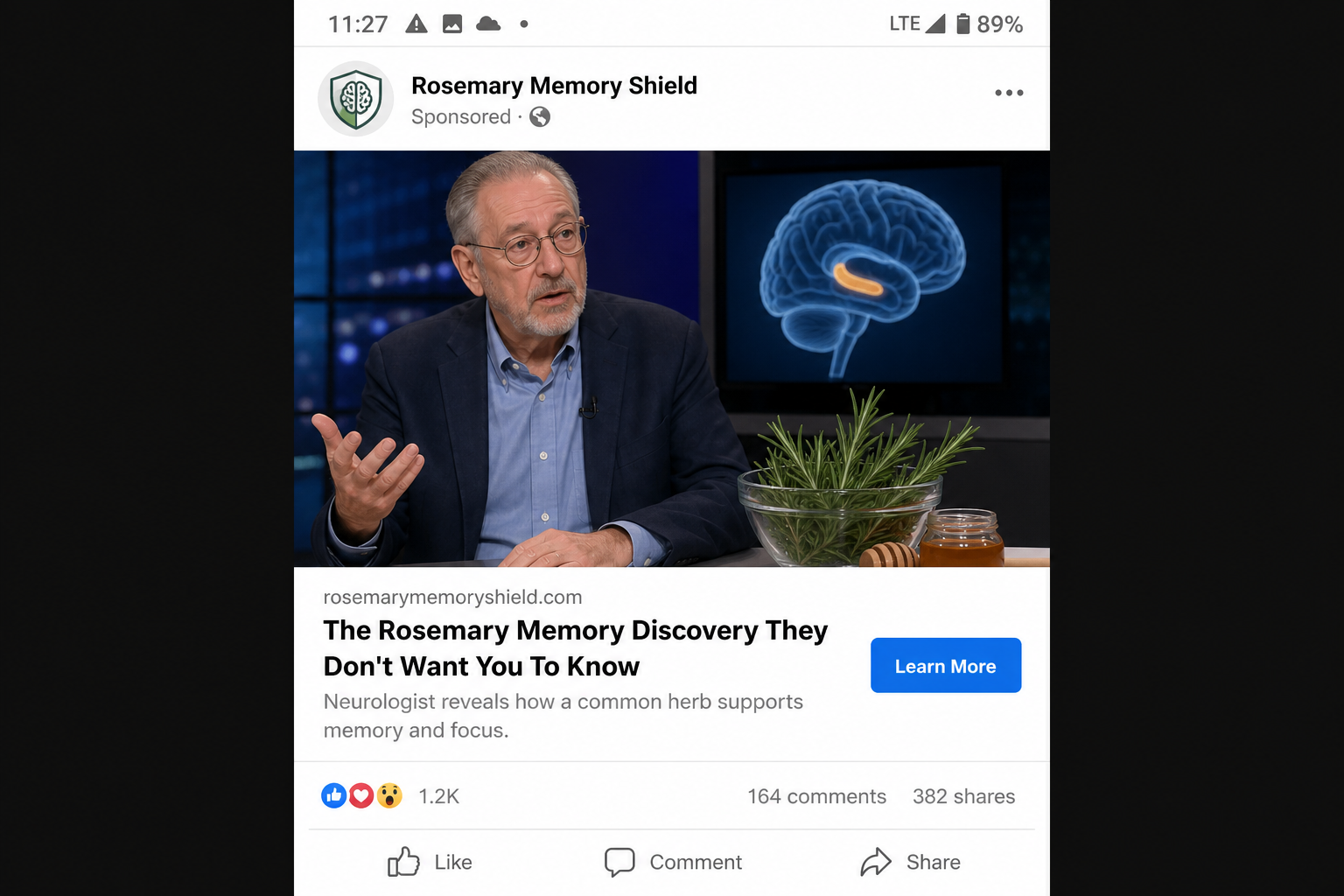
The first ad rarely asks viewers to buy a supplement. It presents a discovery, interview, or supposedly suppressed news clip, which feels more trustworthy than an ordinary product promotion.
Rosemary, honey, and a glowing brain image make the story look simple enough to try at home. That familiar imagery also keeps viewers watching while the video slowly replaces the promised recipe with a commercial offer.
The campaign can change bottle names, narrators, domains, and checkout companies without changing its core argument.
A respected expert supposedly found a hidden cause of memory loss, powerful interests want silence, and only the viewer can still claim the solution.
Overview
Dale Bredesen rosemary scam turns that fear into a long sales funnel. The recipe is the hook, the celebrity footage is fabricated, and the final destination is a bottle of pills that cannot deliver the promised cure.
The campaign borrows Dr. Dale Bredesen's identity
Dr. Dale Bredesen is a real physician and author known for discussing cognitive decline. That public profile gives a fabricated video instant authority, even when the words, voice, and endorsement were never supplied by him.
The deceptive video may place him inside a television interview or pair him with recognizable public figures. AI-generated speech, edited clips, and cloned voices are used to make separate people appear to confirm the same rosemary or honey story.
A realistic face is not evidence of consent. Viewers should look for the claim on the person's verified website or social account, and then check whether the destination domain belongs to that person or an accountable medical organization.
The rosemary recipe is a bridge to Harm Brain capsules
The story begins with a household ritual because a familiar herb sounds safer than an unfamiliar supplement. The viewer expects instructions involving rosemary, honey, or a short morning routine and keeps watching to learn the missing step.
Instead of providing a verifiable recipe and evidence, the presentation introduces a commercial brain-support formula.
Campaigns tied to this pattern have promoted Harm Brain or similarly named memory capsules after spending most of the video discussing a supposedly natural discovery.
That switch matters. Evidence about an individual herb cannot prove that a branded multi-ingredient bottle prevents, treats, or cures Alzheimer's disease.
The finished product would need its own reliable evidence, transparent formula, manufacturer, and lawful claims.
The medical promise conflicts with current evidence
The National Institute on Aging states that there is currently no cure for Alzheimer's disease. It also explains that no vitamin or supplement is recommended to prevent Alzheimer's disease or other forms of cognitive decline.
The Alzheimer's Association similarly warns that no single food, beverage, ingredient, vitamin, or supplement has been proven to prevent, treat, or cure Alzheimer's disease.
Rosemary can be a normal part of food, but that is not the claim made by this sales story.
A supplement disclaimer at the bottom of a page does not neutralize a video that repeatedly promises reversal, restored memory, or protection from dementia. The overall message matters, not only the smallest sentence in the footer.
- Unauthorized AI video makes a real doctor appear to endorse the discovery.
- A television-style presentation hides that the page is a direct-response advertisement.
- Rosemary and honey keep viewers waiting for a recipe that turns into pills.
- Dramatic Alzheimer's claims go far beyond accepted supplement evidence.
- Urgency, package bundles, and phone follow-ups push a larger order.
- The product and website can change while the same emotional script remains.
What the Fake Rosemary Memory Story Claims
One version of the presentation describes a rosemary or honey shield that supposedly protects the brain from a hidden toxin. It frames ordinary memory lapses as proof that a dangerous process has already started and suggests viewers have little time to act.
The narration then creates an enemy. Drug companies, television executives, government agencies, or unnamed medical interests allegedly tried to suppress the discovery because a simple recipe would threaten profits.
That conspiracy story solves an important problem for the seller. If viewers cannot find the discovery in medical guidance, the absence becomes evidence of suppression rather than evidence that the claim is unsupported.
Fabricated celebrity segments add emotional proof. Actors, public figures, and interview hosts may appear to describe family experiences or astonishing recoveries, even though the clips are edited or generated and have no connection to the product.
Near the end, the free ritual becomes inconvenient or incomplete. The narrator says modern rosemary is too weak, the right extract is difficult to prepare, or several ingredients must be combined in exact amounts.
The bottle is presented as the only practical shortcut.
The checkout then emphasizes multi-bottle packages and a guarantee. Some buyers may receive sales calls offering additional bottles or companion products.
Any recurring term or future shipment must be proven from the exact checkout, so consumers should save that screen rather than assume the video told the whole story.
Why the AI Interview and Health Claims Do Not Hold Up
A genuine medical breakthrough would be described in traceable research, not revealed only through a sponsored video that refuses to show its recipe until a checkout appears.
Viewers should be able to identify the study, authors, journal, participant group, dosage, outcome, and limitations.
The campaign does not establish that Dr. Bredesen created, reviewed, or endorsed the advertised capsule. A convincing synthetic voice can reproduce vocabulary and cadence, while lip synchronization can make unrelated footage appear to match the new script.
Celebrity testimony is not clinical evidence even when it is real. When the testimony is also fabricated, it serves only as a trust shortcut designed to stop the viewer from examining the formula, seller, and refund terms.
Rosemary contains compounds that researchers study in different contexts. That does not mean a kitchen mixture reverses Alzheimer's disease, and it does not validate an undisclosed commercial blend.
Promoters frequently slide from early laboratory research to claims about dramatic results in people.
The strongest contradiction comes from the sales page itself.
A footer usually states that the product is not intended to diagnose, treat, cure, or prevent disease, while the long video has already described it as the answer to Alzheimer's disease. Those messages cannot both guide a reasonable buyer.
How the Dr. Dale Bredesen Rosemary Scam Works
Step 1: A frightening memory ad appears in a normal feed
The viewer may be playing a mobile game, reading news, or scrolling social media when a sponsored clip interrupts. The opening mentions forgetting names, losing words, or watching a parent decline.
That framing is intentionally intimate. It turns a general advertisement into what feels like a warning aimed at one family, and it encourages the viewer to watch before discussing the claim with anyone else.
A real doctor's face appears early because recognition lowers resistance. The advertiser's page name can sound medical while revealing little about who purchased the placement.
Step 2: The click opens a fake television-style report
The destination resembles a news interview rather than a store. A presenter asks questions, a doctor explains a discovery, and familiar public figures may appear in supporting clips.
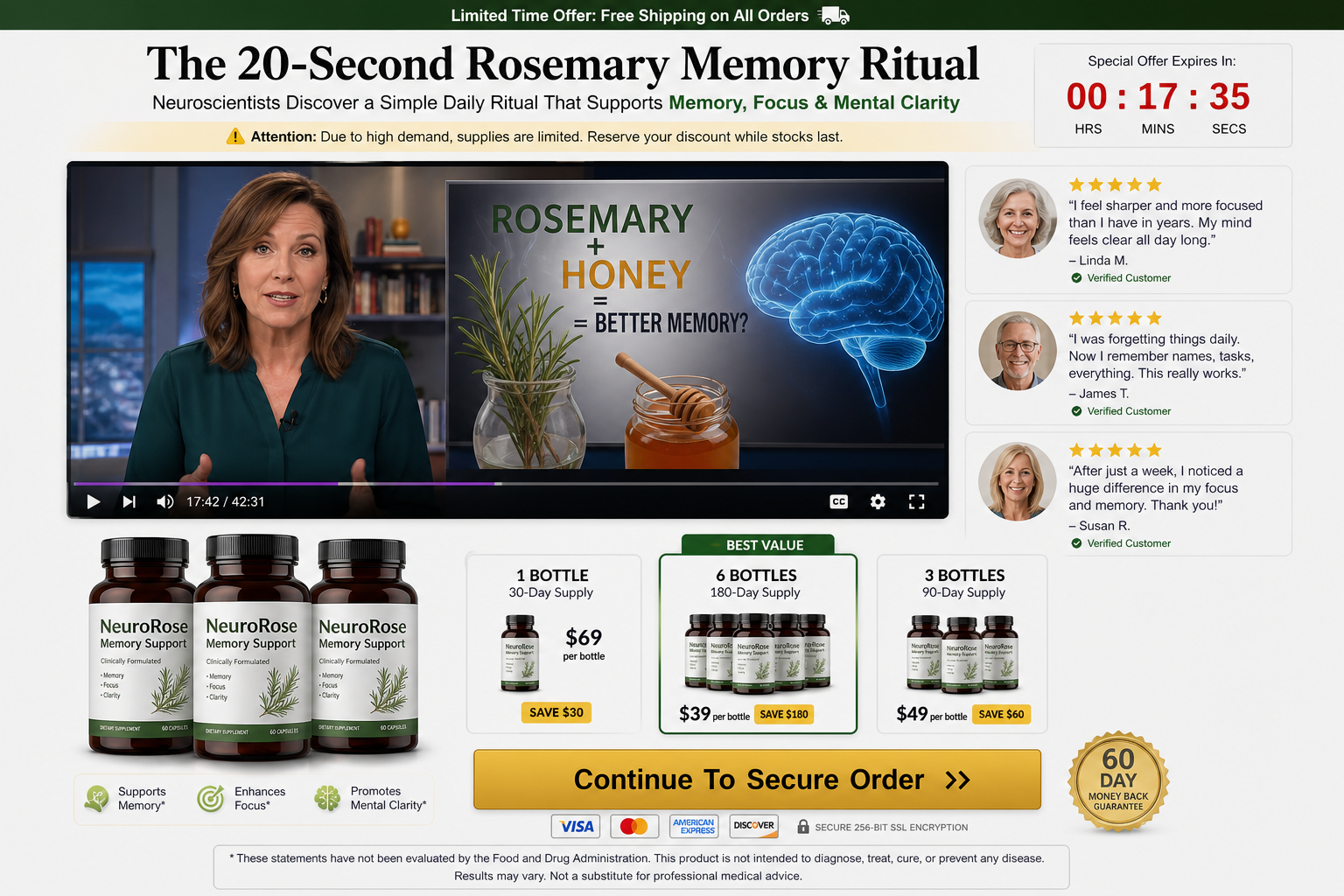
The page often disables normal video controls. Viewers cannot easily skip ahead, check the transcript, or see how long remains before the offer begins.
Logos, studio graphics, and lower-third captions can be fabricated in minutes. None proves the interview aired on the network or program it imitates.
Step 3: AI voices deliver claims the real people never made
Synthetic audio lets the script place precise product claims in a trusted person's mouth. Small visual errors may appear around lips, teeth, blinking, jewelry, or the edge of a face, but newer clips can look smooth on a phone.
The safer test is contextual. Search the exact claim through verified channels, check whether reputable medical organizations report the discovery, and see whether the public figure links to the same domain.
If the only copies come from ads, affiliate pages, or anonymous video hosts, the apparent endorsement has not been authenticated.
Step 4: A rosemary and honey recipe stretches the watch time
The narrator keeps promising a simple recipe but delays the useful details. Personal stories, villains, scientific-sounding explanations, and repeated warnings fill the gap.
Long watch time increases emotional commitment. After 30 or 45 minutes, closing the page can feel like wasting the effort already invested.
The recipe also makes the final product seem natural before the viewer has seen its ingredients or manufacturer. The bottle inherits trust from the kitchen imagery.
Step 5: The free discovery becomes a supplement order
The presentation eventually claims that preparing the correct mixture is difficult or that ordinary ingredients lack the required concentration. Harm Brain or another memory formula appears as the convenient answer.
Package cards make the largest bundle look medically sensible by labeling it a six-month protocol or best value. The per-bottle figure receives more visual attention than the full amount charged today.
A countdown and low-stock message add pressure even though the seller can reset them for every visitor. A health decision should not depend on a browser timer.
Step 6: Checkout details are harder to see than the promise
The buyer may encounter order bumps, shipping protection, faster processing, or companion supplements. Some funnels also request a telephone number that can be used for a later sales call.
Recurring billing must be disclosed, but the exact term can sit beside a checkbox or below the main button. Save the complete page, receipt, and terms so the authorization can be compared with later card charges.
Do not treat a 60-day badge as an automatic refund. The written policy may require every bottle, prior authorization, tracked shipping, and a deadline measured from the order date.
Step 7: New names keep the same campaign alive
Once complaints expose one product, the operator or affiliates can change the label, doctor, celebrity, and domain. The next advertisement may promise a spice, mineral, nighttime drink, or three-second kitchen ritual.
That is why searching only the bottle name is not enough. Search exact sentences from the ad, the support number, return address, card descriptor, policy wording, and images.
The durable warning is the journey from fake authority to miracle recipe to expensive supplement. The name on the final bottle is the easiest part to replace.
Company, Address, and Fulfillment Checks
The celebrity name hides the real seller
The doctor shown in the video is not necessarily the merchant. Identify the legal entity accepting the payment, then compare it with the names in the terms, privacy policy, receipt, package, and card statement.
If those identities do not match, the buyer may have no clear party responsible for claims, ingredients, billing, and refunds. A brand printed on a bottle is not a company record.
Do not call a phone number shown inside the fake interview. Locate contact details through the seller's formal policies and test them before paying.
A return warehouse is not headquarters
Search the listed address in maps, property records, and business filings. It may be a fulfillment warehouse, virtual mailbox, residence, unrelated company, or location shared by dozens of supplement labels.
A fulfillment center can receive packages without formulating the supplement or controlling the sales video. Listing one as the only address creates the appearance of a U.S. company while leaving ownership unclear.
Ask which legal entity owns the brand and where it is registered. If support will provide only a warehouse address, accountability remains incomplete.
Silent support makes a guarantee almost useless
Call or email before ordering and ask whether the line handles the exact product, whether billing repeats, what must be returned, and where the refund is processed. Save the response.
Scam operations often use generic inboxes, disconnected numbers, or agents who answer only sales questions. After payment, victims may receive scripts, partial refund offers, or instructions that consume the return window.
If no one can confirm the product-specific terms in writing, the guarantee should not influence the purchase.
An opaque supplement supply chain can be dangerous
Check for a complete Supplement Facts panel, exact amounts, lot number, manufacturer or responsible distributor, warnings, and a way to report an adverse event. Vague natural and doctor-formulated language proves nothing.
Many private-label supplements are mass-produced through global supply chains, including factories in China and other countries.
Country of origin alone does not prove danger, but hidden sourcing and missing testing make contamination, substitution, and incorrect dosage harder to detect.
Never combine an unknown memory supplement with prescription medicine without a clinician or pharmacist reviewing the exact label. Stop using it and seek medical advice if symptoms develop.
Why the Rosemary Alzheimer's Story Feels So Convincing
Dementia creates fear, guilt, and urgency. Families want to act before more time is lost, and a gentle kitchen ritual feels easier to accept than uncertainty about a complex disease.
The video gives that fear a recognizable guide. A real doctor appears to translate science into a simple story, while celebrities make the result feel socially proven. AI lets the advertiser manufacture both layers without permission.
The conspiracy narrative then blocks skepticism. Questions become evidence that the discovery is controversial, and missing research becomes proof that powerful groups removed it.
A better response is slower and less dramatic. Verify the speaker, identify the merchant, read the full label and terms, and discuss memory concerns with a qualified healthcare professional who can look for treatable causes and evidence-based options.
Warning Signs to Watch For
- A real doctor appears only in sponsored clips hosted by unrelated domains.
- A fake television report promises a cure that major medical organizations do not recognize.
- The recipe is repeatedly delayed until a supplement offer appears.
- The video claims suppression by drug companies or government agencies.
- The bottle is introduced without a traceable finished-product clinical trial.
- A countdown and low-stock meter pressure a medical purchase.
- The checkout emphasizes a per-bottle price while charging for a large bundle.
- The company, return warehouse, and payment descriptor are difficult to connect.
The sharpest warning is the contradiction between the emotional promise and the legal disclaimer. If a video says Alzheimer's disease can be reversed while the footer says the product does not treat disease, trust the disclaimer and leave the page.
What to Do if You Have Fallen Victim to This Scam
- Save the complete sales path. Capture the ad, video URL, claims, bottle label, package choice, checkout total, recurring terms, receipt, support details, and card descriptor before the pages disappear.
- Cancel in writing immediately. Tell the seller you cancel the order, optional products, telephone upsells, subscriptions, and future shipments. Ask for a confirmation number and the exact amount being refunded.
- Call the card issuer. Explain what you authorized and identify any extra, duplicate, or recurring charges. Ask about blocking the merchant, replacing the card, and the deadline for a dispute.
- Do not rely on a verbal refund promise. Keep email records and tracking. Before returning bottles, confirm the address, authorization number, deadline, required contents, processing fee, and whether the issuer wants you to ship them.
- Speak with a healthcare professional. Bring the bottle or complete ingredient panel to a doctor or pharmacist, especially if you used it with prescriptions or experienced dizziness, rash, stomach problems, blood-pressure changes, or confusion.
- Arrange a proper memory evaluation. Sudden or worsening memory changes can have different causes. A supplement video cannot diagnose them, and delaying appropriate care may allow a treatable issue to continue.
- Run Malwarebytes if you installed anything. If the page required a browser extension, video player, remote-support tool, or downloaded file, scan the device with Malwarebytes and remove detected threats.
- Use AdGuard to reduce repeat exposure. AdGuard can block many malicious ads and tracking redirects, but it is not a substitute for verifying a doctor, domain, seller, and checkout.
- Report the campaign. Report the ad to the platform and the misleading health or billing claims to the FTC. Include screenshots and ignore anyone who later offers paid recovery services.
Frequently Asked Questions
Did Dr. Dale Bredesen endorse the rosemary cure in these ads?
The campaign has used unauthorized AI-style depictions and edited video. Do not accept an ad as proof of endorsement. Verify any statement through Dr. Bredesen's authenticated channels and check whether he links to the exact seller.
Can rosemary cure or reverse Alzheimer's disease?
No reliable evidence shows that a rosemary recipe cures or reverses Alzheimer's disease. The National Institute on Aging says there is currently no cure, and no vitamin or supplement is recommended to prevent cognitive decline.
Is Harm Brain proven to treat dementia?
We found no reliable finished-product evidence establishing Harm Brain as a treatment or cure for dementia. A branded supplement cannot inherit proof from general research on one ingredient.
How can I recognize an AI doctor video?
Look for unnatural lip movement, changing teeth, odd blinking, mismatched lighting, abrupt voice rhythm, and missing original footage. More importantly, verify the exact claim through the person's official channels.
Does a 60-day guarantee make the order safe?
No. A badge does not show how refunds work. Read whether all bottles must be returned, who pays shipping, whether fees apply, and when the return must arrive.
What if I already gave the site my phone number?
Expect possible sales calls and do not confirm more payment details. Ask to be placed on the do-not-call list, block persistent callers, and contact your issuer about any charge you did not authorize.
The Bottom Line
The Dr. Dale Bredesen rosemary scam is not a hidden medical breakthrough. It is a sales narrative built from a real doctor's identity, synthetic media, kitchen ingredients, and fear about Alzheimer's disease.
The bottle name may change, but the test stays simple. If an extraordinary cure appears only in an ad, the speaker cannot be verified, and the merchant hides behind a fulfillment address, do not enter payment information.
Families deserve honest guidance, not manufactured hope. Save the evidence, stop questionable billing quickly, and take memory concerns to qualified professionals who can discuss what is known, what is uncertain, and what care is appropriate.

Join the discussion
0 commentsShare your experience or ask a question about this article.
Discussion
Start the conversation
Have a question or something useful to share? Add the first comment.