

An official-looking Bittrex notice says an outstanding balance is waiting inside a new verification system. A personal access code and a firm deadline make the recovery sound both exclusive and urgent.
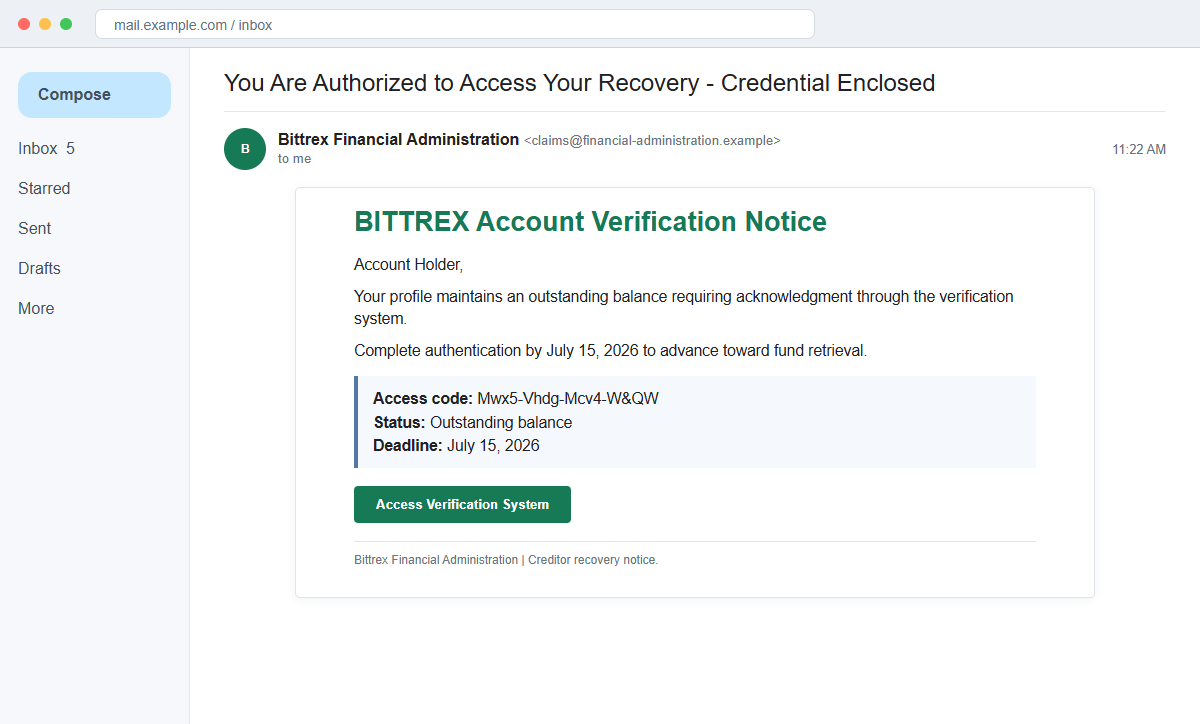
The Bittrex Account Verification email scam exploits real public liquidation proceedings to create a false asset-recovery opportunity. The destination can push former users toward a fraudulent wallet connection instead of a legitimate creditor process.
That distinction matters. A person who once held assets on Bittrex may reasonably expect updates, and the surrounding legal language can resemble genuine creditor correspondence.
Do not connect a wallet or sign a transaction from an unsolicited recovery email. Open the verified liquidation information independently and confirm every instruction with the appointed administrators.
Overview
The email claims an outstanding Bittrex balance exists
The subject says the recipient is authorized to access recovery credentials. The body claims Bittrex Global established a verification infrastructure so account holders can confirm financial positions and retrieve remaining assets.
No trustworthy balance is shown through an authenticated account. The message simply states that the recipient's profile has funds requiring acknowledgment.
Liquidation language makes the claim feel credible
The email refers to administrative proceedings, Joint Liquidators, creditor rights, privacy, and a final authentication date. These are real-sounding concepts placed around an unverified button.
Bittrex Global has had genuine liquidation processes and official creditor communications. Scammers exploit that public history, but accurate background details do not authenticate a particular message or website.
The recovery route may be a wallet drainer
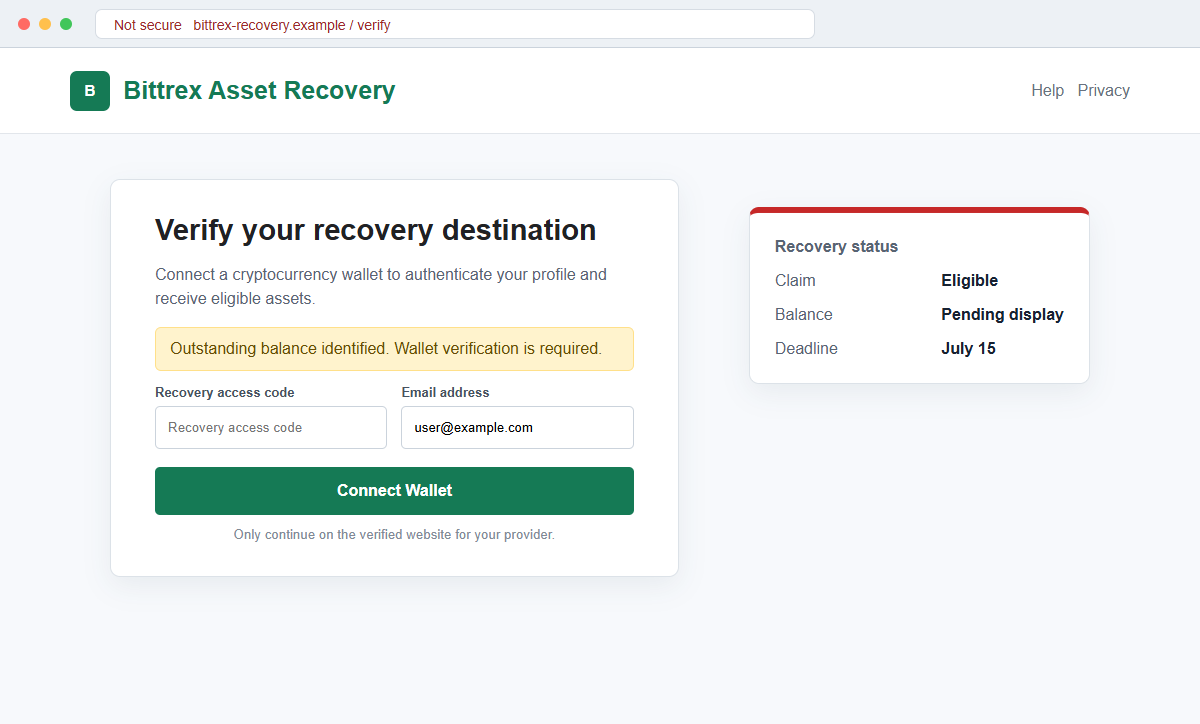
Access Verification System can lead to a site that asks visitors to connect a cryptocurrency wallet and approve a signature or token permission. A malicious approval can give the operator authority to transfer accessible assets.
Crypto transfers are usually irreversible. A victim may lose tokens within seconds, and the scammer can move them through additional addresses before the owner understands what was signed.
- The subject says recovery credentials are enclosed.
- The email claims an outstanding Bittrex balance exists.
- Bittrex Financial Administration is presented as the sender.
- A deadline of July 15, 2026 creates pressure.
- Access code Mwx5-Vhdg-Mcv4-W&QW is supplied.
- Joint Liquidators and creditor rights are referenced.
- Access Verification System is the main button.
- The destination may request a wallet connection instead of a creditor login.
Why Real Liquidation Proceedings Create a Convincing Cover Story
Bittrex customers have encountered different legal entities, jurisdictions, deadlines, and claim procedures. That complexity makes it difficult to judge a new message from memory alone.
Some former users may genuinely wonder whether forgotten tokens, a residual balance, or an admitted claim remains. The possibility of recovering assets gives the email a personal emotional pull even when no amount is documented.
Legal wording can discourage ordinary skepticism. References to data rights and appointed liquidators sound specialized, so recipients may assume they lack the expertise to question the route.
The access code creates artificial exclusivity. It looks like a credential generated for one creditor, although the same code can be distributed to many recipients as part of the lure.
A deadline discourages consultation. The recipient is told the opportunity will disappear, even though legitimate insolvency processes publish notices, contacts, and procedures through established official channels.
What the Official Bittrex Global Process Actually Shows
Official Bittrex Global creditor information describes formal Proof of Debt procedures and directs affected users to verified creditor updates and portals operated with the Joint Liquidators. Those routes should be opened independently.
A June 2026 creditor update stated that unresolved issues remained before the court and that administrators could not provide a specific timetable for unpaid claims.
That is different from a surprise email promising immediate retrieval through a private code.
The genuine process separates Bittrex legal entities and jurisdictions. A message that does not clearly identify which company, claim record, and administrator it concerns should not be trusted with a wallet.
Connecting a wallet is not the same as proving a creditor claim. A page can use the language of authentication while asking the visitor to sign permissions that affect assets unrelated to any Bittrex balance.
The campaign's observed destination was unavailable during later review, so it is important not to invent its exact transaction flow.
The verified risk is the fraudulent recovery route, with a wallet drainer assessed as a likely mechanism for similar pages.
How the Bittrex Account Verification Email Scam Works
Step 1: A recovery authorization email arrives
The recipient is told that prior administrative proceedings have reached a stage where financial positions can be confirmed. The message assumes the reader recognizes the Bittrex name and may have funds at stake.
It does not demonstrate a real account relationship through a securely authenticated portal. Possession of an email address is treated as proof of creditor status.
Step 2: Public liquidation details lend authority
References to Joint Liquidators, privacy rights, and asset recovery mirror the vocabulary of genuine insolvency communications. The accurate-sounding context lowers suspicion.
Scammers can copy public facts without gaining access to official records. Each message and domain must still be authenticated separately.
Step 3: A deadline turns uncertainty into urgency
The email says authentication must be completed by July 15, 2026 and that no later action will be facilitated. Fear of losing a claim pushes the reader toward the button.
A deadline mentioned only in an unsolicited message should be confirmed against official creditor notices. Do not assume that silence will forfeit assets.
Step 4: A supplied code creates a private-session illusion
The access code looks random and individualized. The reader is told to use it to authenticate a profile and begin withdrawal.
A code printed in a mass email can be decorative or shared. It does not prove that a recovery system generated a protected session for the recipient.
Step 5: The verification page requests a wallet
The fraudulent site may display a balance or eligibility message and ask the visitor to connect MetaMask or another wallet as a destination mechanism.
A displayed balance can be fabricated in the browser. Connecting a wallet does not verify that assets exist in a liquidation estate.
Step 6: A signature or approval grants harmful authority
The page can request a token approval, permit signature, or transaction described as verification. The visible explanation may not match the permission encoded in the request.
Once signed, a malicious contract can transfer approved tokens to an attacker. A seed phrase request is even more dangerous because it exposes complete wallet control.
Step 7: Stolen assets are moved and recovery scammers follow
The operator can transfer assets through multiple addresses and exchanges. Blockchain visibility does not provide a built-in reversal or chargeback.
Victims may then receive messages promising recovery for an upfront fee. These follow-up offers often exploit public transaction records and the victim's urgency.
Company and Checkout Checks
Identify the exact Bittrex legal entity
Determine whether the claim concerns Bittrex Global Bermuda, Liechtenstein, or another entity. Compare the message with notices published by the relevant official administrators.
A generic Bittrex Financial Administration signature is not enough. Genuine correspondence should map to a documented company and proceeding.
Use the verified creditor portal
Reach creditor updates through bookmarked official pages or the appointed administrator's known website. Do not search only the email's wording and click a sponsored or copied result.
Confirm the domain, contact details, claim identifier, and published deadline before entering information.
Read every wallet request before signing
A legitimate-looking interface can still request broad token allowances or transfers. Inspect the requesting domain, contract, network, assets, and approval scope in the wallet prompt.
Never enter a seed phrase, private key, or backup words into a recovery website. Legitimate administrators do not need them to identify a creditor.
Confirm instructions with the administrators
Send the suspicious message to the verified liquidation contact and ask whether the access code and deadline are genuine. Use contact details found outside the email.
Preserve headers, URLs, wallet prompts, transaction hashes, and receiving addresses if any interaction occurred.
Warning Signs to Check Before You Act
- A balance is promised without an authenticated account record.
- The email uses a generic Bittrex Financial Administration identity.
- A private access code arrives unexpectedly.
- The deadline appears only in the message.
- The exact Bittrex legal entity is unclear.
- The route differs from published creditor portals.
- A wallet connection is required to view or prove the claim.
- A fabricated balance appears immediately after connecting.
- The site requests a broad token approval.
- A signature is described vaguely as verification.
- A seed phrase or private key is requested.
- Support pressures the visitor to act before contacting administrators.
Real liquidation procedures rely on documented claims, named legal entities, and verified administrator channels. They do not need the secret keys to a separate wallet. Stop before connecting or signing and confirm the process independently.
What to Do if You Have Fallen Victim to This Scam
- Change the exposed password immediately. Open the official Bittrex Global creditor information and verified Joint Liquidators' portal opened independently through a saved bookmark or its official application, not through the Bittrex account verification message. The password entered during that bittrex-account dApp should never be used again. Give every affected service a different replacement.
- If a seed phrase or private key was entered, create a new wallet on a clean device and move remaining assets before the attacker does. Never import the exposed recovery phrase into another wallet and assume it has become safe. Check every supported chain because one recovery phrase may control assets and accounts beyond the network first shown by the fake Bittrex page. Include obscure tokens and NFTs that the main wallet view may hide.
- Revoke suspicious token approvals created by the fake Bittrex verification page. Review the connected-sites list and recent transactions using a trusted block explorer, then disconnect every application you do not recognize.
- Secure the email and exchange accounts associated with the wallet. Use unique passwords, hardware-backed multifactor authentication, and a direct bookmark to the real service. Remove unknown sessions, API keys, and withdrawal addresses.
- Record transaction hashes, wallet addresses, domains, messages, and screenshots. Give those immutable details to the exchange, wallet provider, police, or cryptocurrency fraud-reporting service without paying anyone to inspect them.
- Secure any wallet exposed to the recovery site. Revoke suspicious token approvals and disconnect the site. If a seed phrase or private key was disclosed, create a new wallet on a clean device and move remaining assets immediately. Never share the new recovery phrase with anyone.
- Run a complete Malwarebytes scan if the fake liquidation process installed a wallet extension, desktop client, or update. Remove unrecognized software and rebuild the wallet only after the device is clean.
- Use AdGuard or another reputable DNS blocker to stop some known wallet-drainer domains and malicious crypto ads. It cannot judge a signature request, so read the transaction and permissions before approving anything.
- Report the phishing message. Use the mail provider's Report Phishing control and notify the verified Bittrex Global liquidation contact, the wallet provider, relevant exchange, and IC3 or local police. Archive the full source of the message involved in this bittrex-account approval scam. Sender paths and authentication results may reveal useful infrastructure.
- Tell contacts who received crypto messages from the compromised account. Ask them to ignore balance claims, verification links, token offers, and requests to connect a wallet until you confirm control through another channel.
- Do not pay a blockchain recovery expert who guarantees the return of stolen funds. Transactions may be traceable without being reversible, and a demand for an upfront crypto payment is a common recovery scam.
Frequently Asked Questions
Is the Bittrex Account Verification email genuine?
No. The documented campaign impersonates Bittrex liquidation correspondence and promotes an unverified recovery system that may function as a wallet drainer.
Are the Bittrex liquidation proceedings real?
Yes, genuine proceedings and creditor processes exist. Scammers borrow those public facts, so recipients must use only verified administrator notices and portals.
Does the access code prove I have a balance?
No. A code in an unsolicited email can be shared or fabricated. A valid claim must be confirmed through the official process for the correct legal entity.
Is connecting a wallet by itself dangerous?
Connecting reveals wallet information and can lead to deceptive signature requests. The greatest danger occurs when the user approves a malicious permission or discloses recovery words.
What if I signed a transaction?
Disconnect the site, revoke suspicious approvals, move remaining assets if necessary, preserve the transaction hash, and contact the wallet provider or exchange immediately.
Can someone recover crypto already sent to a drainer?
Recovery is difficult and cannot be guaranteed. Report quickly to exchanges and law enforcement, and ignore anyone demanding an upfront fee or seed phrase to recover funds.
The Bottom Line
The Bittrex Account Verification email scam combines a real liquidation story with a fraudulent recovery route. Legal language, a private code, and a deadline do not prove that an outstanding balance exists.
Use the official creditor information for the correct Bittrex entity and confirm instructions with the appointed administrators. Never connect a wallet merely to discover whether a claim is real.
If a wallet was exposed, revoke approvals and protect remaining assets immediately. Do not let a second recovery scam turn the original loss into a larger one.

Join the discussion
0 commentsShare your experience or ask a question about this article.
Discussion
Start the conversation
Have a question or something useful to share? Add the first comment.