

An email appears to come from your own address. Its author says your personal and financial information has been bundled into a file ready for sale.
You supposedly have one day to buy it back with Bitcoin. Before treating the demand as evidence of a breach, examine what the message actually shows.
Overview
A supposed personal dossier becomes a Bitcoin demand
The darknet data sale email scam claims someone holds a package of sensitive information and will sell it unless you pay.
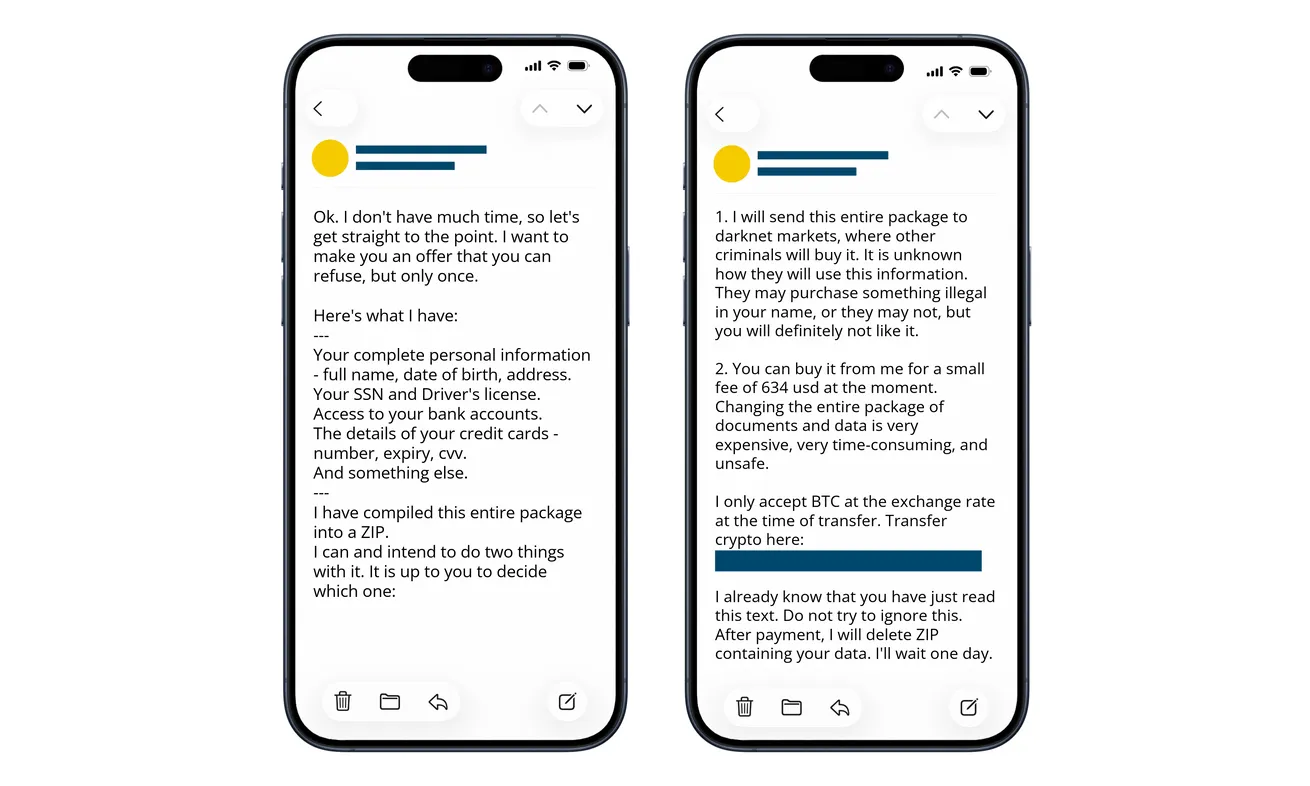
The original example demands $634 in Bitcoin. It lists identity, banking and card information, then promises to delete a ZIP file after payment.
Those statements are the sender’s claims. A list of frightening data categories isn’t a demonstration that the sender possesses your actual records.
Authorities identify a bluff and a forged sender
Police document the data-sale extortion campaign, including a short deadline, unsupported possession claims and messages made to look self-sent.
The Swiss federal cybersecurity office independently calls the campaign a bluff. It explains that the apparent sender address can be forged.
This isn’t the same as saying genuine breaches never occur. Independent signs of account misuse deserve attention, but the threatening email doesn’t establish them.
Don’t buy back information on the stranger’s terms
Refuse the payment and preserve the threat if needed for reporting. Check real account activity through your existing providers, not by negotiating with the sender.
- Don’t send Bitcoin to prevent the claimed sale.
- Don’t assume your mailbox was accessed from the displayed From address.
- Don’t provide identity documents to challenge or correct the dossier.
- Report an existing payment to the platform used and police.
- Investigate genuine account alerts separately from the extortionist’s story.
Why the List of Data Feels Like Proof
The email names information most people understandably want to protect: birth dates, addresses, identity records, bank access and credit-card details.
Listing those categories makes the claim feel extensive. But naming a type of information is much easier than showing a genuine record belonging to the recipient.
Notice the difference between “I have your card details” and evidence of an actual unfamiliar transaction. The first is an assertion; the second needs a provider’s investigation.
The email wants you to skip the missing evidence and start deciding what privacy is worth. That’s the decision it needs you to rush.
A price lower than the imagined cost of identity theft can make payment feel practical. That comparison depends on believing the sender’s unverified premise.
The deadline adds urgency before you can challenge it. You may feel there’s no time to contact a bank or ask someone you trust.
There’s no reason to let the person making the threat set your response schedule. The email hasn’t established control over your accounts or documents.
Take the message out of that private conversation. A trusted person or appropriate security contact can help you assess it without answering the extortionist.
How the Darknet Data Sale Email Scam Works
Step 1: The sender claims to possess a complete private file
The email presents a broad collection of personal and financial information as something already gathered. The sample says it has been compiled into a ZIP.
That archive description makes the story tangible without supplying the archive. It encourages you to imagine a finished product waiting to be traded.
Don’t fill gaps in the story by replying with correct details. Telling the sender your address is wrong or an account is closed can disclose new information.
You also don’t need to send a document to prove which identity is yours. Verification shouldn’t mean handing more records to the person threatening you.
Step 2: An apparently self-sent message suggests mailbox access
Some versions display the recipient’s own address as the sender. That can look like evidence that somebody already controls the inbox.
Authorities explain the forgery: a displayed sender address can be spoofed. It doesn’t require the sender to demonstrate access to your real mailbox.
The useful distinction is between an address printed in a message and an authenticated account session. Don’t accept the first as proof of the second.
If you want to check the account, open the provider independently and review available security activity. Don’t use the threat’s instructions to perform the check.
Actual unfamiliar sessions or changed settings deserve a genuine security response. Their existence should be established separately, not inferred from the From field.
Step 3: A darknet-sale threat turns fear into a purchase decision
The sender offers two outcomes: pay to have the file deleted or let other criminals buy it. The email portrays payment as regaining control.
The sample’s $634 demand is one example, not a fixed amount in every message. A different figure can carry the same deception.
Paying can’t verify possession, deletion or future conduct. The sender can promise to remove a file without showing that it existed or that copies are gone.
Don’t treat a Bitcoin transfer as a privacy service with enforceable delivery. It would be money sent under a threat, not an independently verified protective measure.
There is no useful test payment. A smaller amount or negotiated discount doesn’t resolve the underlying absence of trustworthy evidence.
Step 4: A one-day clock discourages independent help
The email says time is short and claims to know you’ve read it. That makes the threat feel active and personally monitored.
The statement isn’t proof that the sender has a reliable timer or control of your device. It’s another claim inside the message.
Don’t keep reopening it to watch the deadline. Save what’s needed, report it and move to independent account checks if you have a reason for concern.
A countdown doesn’t make the alleged dossier authentic. Letting the sender’s deadline pass isn’t the same as authorizing a genuine release of your data.
What Seeing Your Own Email Address Really Tells You
An email reader displays sender information drawn from message fields. Those fields aren’t a complete record of which account actually sent the message.
Gmail’s spam guidance discusses spoofed addresses and suspicious messages. Similar-looking or unverified sender information requires caution, not automatic acceptance.
You don’t need to become an email-forensics expert to refuse the demand. The absence of technical knowledge doesn’t create an obligation to pay.
For a work mailbox, send the message through the established reporting channel. An administrator can examine the headers without asking you to negotiate with the sender.
For a personal mailbox, use the provider’s own security page if you want to review access. Don’t follow account-repair links from related unexpected messages.
Check what the actual account records show. A frightening sender field and a real security notification are different pieces of information.
If you see an unfamiliar login, changed recovery information or messages you didn’t send, use the provider’s compromised-account process.
Keep those observations separate from the extortion text. A real account issue still wouldn’t establish every claim about a complete identity-and-banking dossier.
This Isn’t a Reliable Data-Breach Notification
A genuine breach notice should be verified through the organization concerned. This email instead asks the threatened person to buy silence from an anonymous sender.
Don’t use it to identify which company supposedly lost your information. It doesn’t establish the source, scope or date of a real exposure.
If you already received an authentic notice from a bank, employer or other provider, follow that organization’s independently verified guidance.
Receiving this bluff doesn’t cancel a real incident elsewhere. Equally, hearing about a real breach doesn’t automatically authenticate a stranger demanding Bitcoin.
The distinction protects you from both overreaction and dismissal. Respond to verified facts while refusing the extortionist’s unsupported demand.
Don’t search alleged darknet markets to see whether the package appears. A stranger’s threat isn’t a reason to visit hostile sites or download claimed evidence.
If a sender later provides a file or link as proof, don’t open it casually. Preserve the communication and ask an appropriate professional how to handle it.
The documented message doesn’t establish installed malware. Any separate download or installation needs its own assessment, rather than an invented infection diagnosis.
What Changes if You Already Paid?
A payment doesn’t establish that the original dossier was real. It does establish a financial loss or pending transfer that needs prompt reporting.
Contact the exchange or service used to send the cryptocurrency. Ask whether any action remains possible and provide the relevant transaction reference.
Be accurate about the route: a bank-funded purchase of cryptocurrency and a later on-chain transfer are different events. The provider needs to know what actually happened.
Don’t assume a completed Bitcoin transfer has an ordinary card-style reversal. Ask the relevant platform what options exist without relying on a guaranteed recovery promise.
Save the destination, amount, time, transaction identifier and communications. Keep account credentials and recovery phrases out of the report.
If the sender asks for more to confirm deletion, stop. The first payment doesn’t make a second promise more reliable.
Someone offering paid tracing or recovery may also approach after you discuss the loss publicly. Don’t give them remote access or your wallet secrets.
You can seek help without advertising all your financial records. A private report to the platform and police is more useful than a public transaction dossier.
Helping Someone Who Is Frightened by the Message
Start by explaining the specific bluff. The sender has listed data categories and demanded money, but hasn’t demonstrated the claimed complete file.
Don’t ridicule the recipient or ask why they believed it. Fear can make a familiar email address and a deadline feel persuasive.
Offer to sit with them while they check their genuine provider’s security activity. Keep the threatening message out of the navigation process.
If they haven’t paid, help them stop contact and report it. If they have, organize the transfer details for the service and police.
Agree that nobody will send another payment while the incident is assessed. That removes the next decision from the extortionist’s countdown.
For a shared financial account, involve the responsible account holder. They need the facts promptly, not an alarming claim that every record has definitely been stolen.
A calm, concrete explanation is more reassuring than promising that no data breach could ever affect them. Keep reassurance attached to what this message actually proves.
What to Do if You Have Fallen Victim to This Scam
-
Don’t pay or negotiate. Stop responding to the demand, including offers to reduce the price or send a small verification payment.
If no money or information was sent, report the message as spam or phishing and remove it after preserving any needed evidence.
-
Check real account security independently. Use your email provider’s established account route, particularly if you notice unfamiliar activity outside the threat.
Change an exposed or reused password through the genuine service and review available multifactor protection. Don’t send a new password to the sender.
-
Report any cryptocurrency payment immediately. Contact the exchange or payment service you used and explain the extortion.
Supply the amount, destination, transaction reference and time. Ask about any remaining protective action without assuming the transfer can be reversed.
-
Preserve evidence for police. Keep the original message, sender information, demand and payment records in a private location.
For work email, notify the internal security team through its approved process. Don’t forward the threat widely with private account details attached.
-
Investigate actual financial misuse separately. Contact your bank or card provider if genuine records show unfamiliar transactions or exposed credentials.
A data category named by the sender isn’t a transaction record. Explain what is confirmed and what is only an unverified claim.
-
Refuse further deletion or recovery fees. Another payment won’t make the sender’s assurances verifiable.
Ignore strangers promising guaranteed recovery in exchange for a fee, wallet secret or remote-control session. Seek assistance through established institutions.
-
Get support instead of watching the countdown. Share the situation with a trusted person who can help you take the practical steps.
Don’t let embarrassment keep the incident secret if you’ve paid or need account help. The email was designed to pressure recipients into acting alone.
Frequently Asked Questions
Does the email prove someone has my private data?
No. Authorities identify this campaign as a bluff. Its list of information categories and deletion promise don’t demonstrate possession of a real dossier.
How can it look as though I sent the email myself?
The displayed sender address can be forged. It isn’t, by itself, evidence that someone signed in to your genuine mailbox.
Is the $634 demand the same in every message?
No. That figure appears in the original example. The mechanism is the false data-sale threat, not one universal ransom amount.
Will paying guarantee that a ZIP file is deleted?
No. Payment can’t verify that the file existed, that copies were removed or that the sender won’t demand more.
Should I ignore an actual breach notice from my bank?
No. Verify genuine notices through the organization independently. Refusing this extortion demand is different from responding to a confirmed incident.
Who should I contact after sending Bitcoin?
Contact the platform used for the payment and police promptly. Preserve transaction details and reject anyone guaranteeing recovery for another advance payment.
The Bottom Line
Don’t pay the darknet data sale email’s demand. Its spoofed-sender presentation and supposed dossier don’t establish the breach it wants you to believe.
If you paid, contact the payment platform and police now. Check any independent account-security concerns through genuine providers, without negotiating over the claimed file.

Join the discussion
0 commentsShare your experience or ask a question about this article.
Discussion
Start the conversation
Have a question or something useful to share? Add the first comment.