

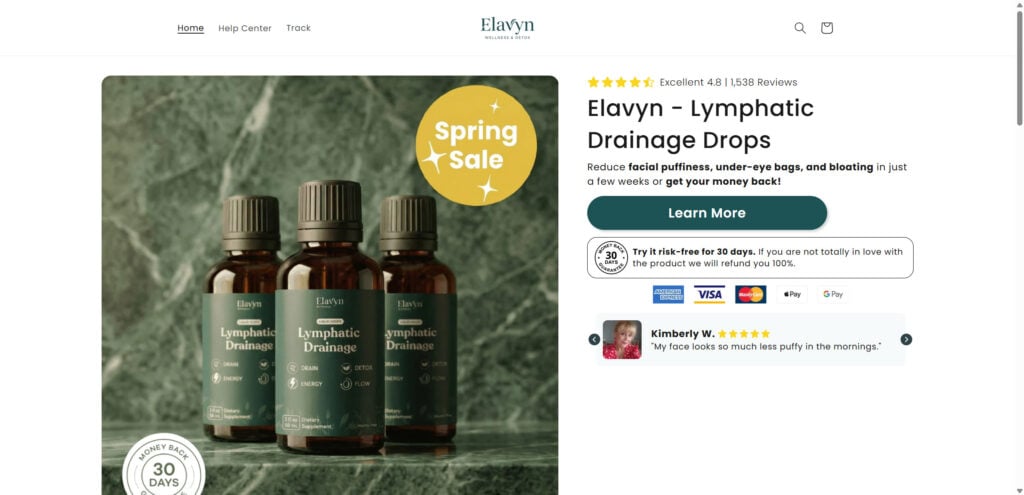
Elavyn Lymphatic Drainage Drops are promoted as a natural liquid supplement that can reduce facial puffiness, under-eye bags, bloating, swelling, and fluid retention “in just a few weeks.”
The site looks clean. The product sounds gentle. The testimonials are written to feel personal and convincing.
But the deeper you look, the more Elavyn appears to follow the same high-risk supplement funnel pattern: broad health claims, vague “detox” language, unverifiable testimonials, generic herbal-drop ingredients, and refund terms that are less simple than the sales pitch suggests.
This does not mean no product exists. It means the product is being marketed in a way that deserves serious caution.
Scam Overview
Elavyn presents its product as Elavyn Flow+, a lymphatic drainage liquid supplement. The website claims it can reduce puffiness, under-eye bags, bloating, swollen legs, and fluid retention. It also claims a 4.8 rating from 1,538 reviews and says buyers can try it risk-free for 30 days.
What the site wants buyers to believe
The site suggests Elavyn can help with:
- facial puffiness
- under-eye bags
- bloating
- rings feeling tight
- swollen legs
- fluid retention
- post-menopausal puffiness
- toxin buildup
- poor lymphatic drainage
It also claims the formula contains “cutting-edge drainage ingredients” and says the specific combination of botanicals is “clinically proven to restore lymphatic drainage from the inside out.”
What it appears to be
Based on the ingredients shown on the page, Elavyn appears to be a liquid herbal supplement containing common botanicals such as:
- burdock root
- calendula flower
- echinacea flower
- cleaver herb
- astragalus root
- red clover
Those ingredients are not unique to Elavyn. Similar “lymphatic drainage drops” are widely available on marketplaces and wholesale platforms, including products using burdock, echinacea, calendula, cleavers, and related herbal blends. Alibaba listings specifically advertise OEM lymphatic drainage drops with echinacea, cleavers herb, burdock, and calendula, while Amazon listings show comparable lymphatic drainage drop products with similar ingredient themes. (Alibaba)
That strongly suggests Elavyn is not a revolutionary new formula. It looks more like a private-label herbal supplement sold with premium positioning.
Major Red Flags
1. The claims go beyond what a simple supplement can realistically prove
The main claim is that Elavyn can reduce puffiness, under-eye bags, bloating, and swelling in weeks. The site then goes further by claiming ingredients can “flush out toxins,” “transform stiff tissue back into supple cells,” reopen lymphatic “entry ports,” and move stuck fluid into the drainage system. (Elavyn)
That is not normal, cautious supplement language.
Those are strong physiological claims. A seller making them should provide serious evidence, not just testimonials and ingredient descriptions.
2. “Lymphatic drainage” is being used as a trendy marketing hook
Lymphatic drainage is a real concept. The lymphatic system helps maintain fluid balance and supports immune function. Cleveland Clinic describes it as a system of organs, vessels, and tissues that protects against infection and helps maintain healthy fluid balance.
But that does not mean a dropper bottle can “restore lymphatic drainage” or “flush toxins” from the body in a clinically meaningful way.
Manual lymphatic drainage massage is used in specific contexts, especially swelling and lymphedema, but UCLA Health notes that while lymphatic drainage massage is a proven treatment for lymphedema, people should not count on it for weight loss or detoxification if they are otherwise healthy.
That distinction matters. Elavyn appears to borrow the credibility of a real therapeutic concept, then stretches it into a broad beauty-and-bloating supplement promise.
3. “Detox” language is a warning sign
The Elavyn page claims burdock root “purifies your lymphatic system by flushing out toxins that have built up.”
That type of “toxins” claim is common in supplement marketing, but it is usually vague. The National Center for Complementary and Integrative Health says detoxes and cleanses are promoted for toxin removal, weight loss, or health, but only a small number of low-quality studies exist on detox programs in people.
In other words, “detox” is not proof. It is often a sales phrase.
4. The ingredient claims sound scientific but lack product-specific evidence
The site describes each ingredient as if it has a precise mechanical effect:
- burdock root flushes toxins
- calendula transforms stiff tissue
- echinacea reduces inflammation that keeps lymphatic entry ports closed
- cleavers gets stuck fluid flowing
- astragalus strengthens lymphatic vessels
- red clover helps eliminate excess fluids naturally
Those claims are not backed on the page by clear product-specific clinical trials, published studies, dosage data, or certificates of analysis.
A serious supplement brand should show:
- exact ingredient amounts
- full Supplement Facts panel
- clinical references
- batch testing
- lab reports
- manufacturer details
- safety warnings
- contraindications
Elavyn’s page leans much more heavily on claims than proof.
5. “Recommended by dermatologists” is claimed without visible verification
The page says Elavyn is “Formulated By Experts, Recommended By Dermatologists.” (Elavyn)
That sounds authoritative, but the site does not visibly identify:
- which dermatologists recommend it
- whether they are paid endorsers
- their credentials
- whether they evaluated the exact formula
- what evidence they reviewed
Without verifiable names and disclosures, this is authority positioning, not proof.
6. The product category is crowded with similar private-label drops
Search results show many similar lymphatic drainage drops using overlapping ingredient lists, including burdock root, echinacea, elderberry, calendula, cleavers, dandelion, and other herbs. Some are sold on Amazon, Walmart, Alibaba, and other marketplaces.
That matters because Elavyn is presented like a unique solution, but the product type appears widely commoditized.
The likely model is:
- source or white-label a generic lymphatic support liquid
- add a polished brand name
- write strong puffiness and drainage claims
- run social ads
- sell at a premium price
This is the same structure seen in many dropshipping supplement operations.
7. The refund policy is not as effortless as “risk-free” sounds
The product page says: “Try it risk-free for 30 days” and claims buyers will be refunded 100% if they are not in love with the product.
The refund policy is more restrictive in practice:
- the item must be received back within 30 days of delivery
- the customer must contact support before returning it
- the customer must confirm they accept return shipping costs
- the customer pays return shipping
- original shipping costs are non-refundable
- refunds are issued only after inspection
- partial refunds may be granted in some cases
- the policy still contains template text: “within [Insert Number, e.g., 5-10] business days”
That unfinished template text is a serious trust issue. A professional supplement brand should not have placeholder wording in its refund policy.
8. The terms page contains placeholder legal language
Elavyn’s terms page says the governing law is “[Insert State of Jurisdiction, e.g., the State of New York], United States.”
That is another major red flag.
It suggests the legal pages were copied from a template and not properly completed. For a company selling ingestible health products, careless legal documentation is not a small problem.
9. The site itself admits the product is not medical
Elavyn’s Terms of Service state that its products are not medical devices and are not intended to diagnose, treat, cure, or prevent any disease. (Elavyn)
That disclaimer is important because the sales page still heavily implies benefits related to swelling, fluid buildup, puffiness, drainage, and toxin removal.
The FDA says dietary supplement claims must include a disclaimer that the FDA has not evaluated the claim and that the product is not intended to diagnose, treat, cure, or prevent disease, because only a drug can legally make disease-treatment claims.
10. Company transparency is limited
Elavyn lists Sollume LLC, a phone number, an email address, and a Wilmington, Delaware address.
That is better than a completely anonymous store, but the site still does not clearly provide:
- manufacturing facility details
- lab testing certificates
- named experts
- ingredient sourcing
- product registration details
- independent review links
- clinical evidence for the exact formula
For an ingestible supplement making strong lymphatic and swelling-related claims, that is not enough transparency.
How This Operation Appears to Work
Step 1: Use a trending wellness phrase
“Lymphatic drainage” is currently popular on social media. It is associated with de-puffing, beauty routines, detox, facial sculpting, and feeling lighter.
That makes it easy to sell.
Step 2: Connect it to visible insecurities
The page targets issues people can see and feel:
- puffy face
- under-eye bags
- bloating
- swollen legs
- tight rings
- post-menopausal fluid retention
These are emotionally persuasive concerns.
Step 3: Use testimonials instead of hard evidence
Elavyn’s page includes testimonials claiming reduced puffiness, rings fitting again, under-eye bags almost disappearing, and swollen legs improving.
That kind of testimonial copy can be effective, but it does not prove the product works.
Step 4: Frame common herbs as a breakthrough
The ingredients are familiar herbs, but the page describes them with technical-sounding mechanisms.
That makes the formula feel more advanced than it likely is.
Step 5: Offer a money-back guarantee to reduce hesitation
The sales page says “risk-free,” but the refund policy requires the buyer to pay return shipping and get the product back within 30 days.
That creates friction after purchase.
Is Elavyn Lymphatic Drainage a Scam?
Not necessarily a fake-product scam
The product may exist. Buyers may receive a bottle of herbal drops.
But it is high-risk
The operation raises multiple concerns:
- exaggerated lymphatic and detox claims
- beauty and swelling claims without clear clinical proof
- generic herbal-drop product category
- private-label style product positioning
- strong testimonials that are not independently verified
- template errors in refund and legal pages
- return costs placed on the customer
- limited public evidence for “dermatologist recommended” claims
The most accurate classification is:
Elavyn appears to be a high-risk private-label supplement sold with exaggerated lymphatic drainage and de-puffing claims.
Should You Buy It?
For most buyers, caution is warranted.
Reasons to avoid it
- The claims are stronger than the proof shown
- Similar products are widely available under other names
- The refund policy is not truly frictionless
- The legal pages contain placeholder text
- The product is not medical, despite medical-adjacent claims
- “Detox” and “toxins” language is vague and often unsupported
If you still consider buying it
Treat it as a basic herbal supplement, not a proven treatment for:
- lymphedema
- chronic swelling
- circulation problems
- kidney, liver, or heart-related fluid retention
- hormone-related swelling
- unexplained bloating
- persistent under-eye bags
If swelling is sudden, painful, one-sided, severe, or associated with shortness of breath, chest pain, pregnancy, kidney disease, liver disease, or heart disease, seek medical care rather than trying a supplement.
What To Do If You Already Ordered
1. Save the product page
Take screenshots of:
- “reduce facial puffiness”
- “under-eye bags”
- “bloating”
- “swollen legs”
- “clinically proven”
- “recommended by dermatologists”
- “30-day money-back guarantee”
- testimonials
- ingredient claims
These may help if you need to dispute the purchase.
2. Review the refund window immediately
Do not assume “risk-free” means easy.
The policy says the returned product must be received back within 30 days of the original delivery date, and the customer pays return shipping.
Act early.
3. Check whether the product matches the advertising
When it arrives, inspect:
- bottle label
- ingredient list
- supplement facts panel
- manufacturer information
- warnings
- expiration date
- dosage instructions
- country of origin
If the label does not support the claims made on the page, document that.
4. Do not rely on it for medical swelling
Do not use these drops as a substitute for medical evaluation if you have:
- swollen legs
- sudden puffiness
- persistent fluid retention
- unexplained bloating
- high blood pressure
- kidney, liver, heart, or thyroid conditions
The site’s own terms say the product is not intended to diagnose, treat, cure, or prevent disease. (Elavyn)
5. Watch for side effects
Herbal extracts can still cause reactions or interact with medications.
Stop use and seek advice if you notice:
- rash
- itching
- stomach pain
- diarrhea
- dizziness
- worsening swelling
- allergic reaction
- changes in urination
- unusual fatigue
- trouble breathing
6. Request a refund in writing
Send a clear message to support and keep a copy.
Example:
I am requesting a refund for order #[number]. The product does not match the results and claims advertised. Please provide return instructions and confirm the refund timeline in writing.
7. Escalate if support stalls
If support does not respond, refuses a fair refund, or delays until the return window becomes impossible, contact your payment provider.
Use evidence showing:
- the product claims
- the refund promise
- the refund policy
- your order confirmation
- your support emails
The Bottom Line
Elavyn Lymphatic Drainage Drops are not a proven breakthrough for puffiness, bloating, swollen legs, under-eye bags, or lymphatic “detox.”
They appear to be a generic herbal drop product sold through a polished Shopify-style funnel with strong wellness claims, emotional testimonials, vague detox language, and a refund policy that is more restrictive than the “risk-free” pitch suggests.
The product may arrive.
That does not mean the claims are reliable.
The safest conclusion is simple:
Elavyn looks like a high-risk lymphatic drainage supplement operation using exaggerated de-puffing and detox claims to sell a private-label herbal drop product at a premium price.

Reviews & discussion
0 commentsShare a firsthand experience, or ask a question.
Community reviews
Elavyn Lymphatic Drainage Drops
Moderated reader experiences, not an editorial verdict.
Start the conversation
Have a question or something useful to share? Add the first comment.