

Velarux is marketed as a ready-to-use anti-snoring mouthpiece that claims to stop snoring, improve sleep, open the airway, and even help with sleep apnea. The site presents it as doctor recommended, FDA approved, risk-free, and trusted by more than 100,000 customers.
That sounds convincing.
But the closer you look, the more it resembles a high-risk dropshipping funnel built around a cheap generic anti-snoring mouthpiece, exaggerated medical-style claims, and aggressive sales tactics.
Scam Overview
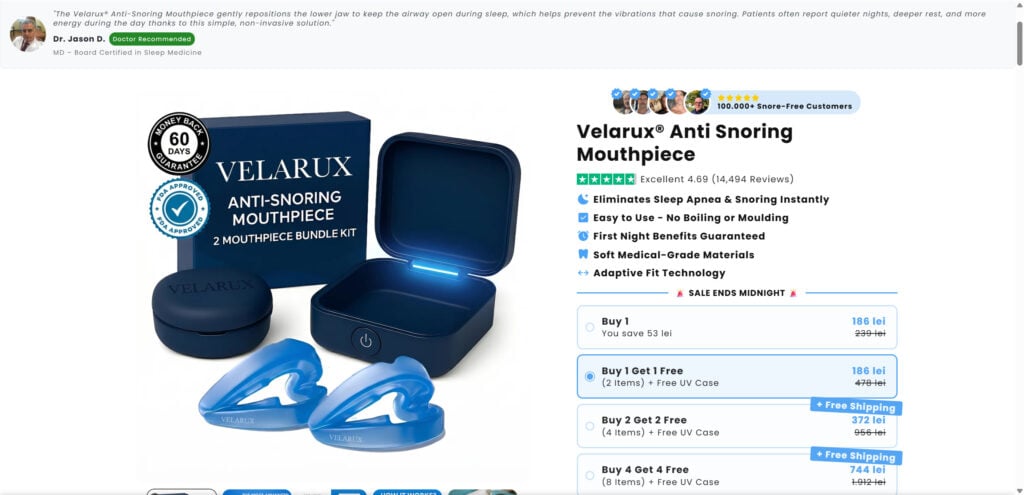
Velarux appears to be sold through multiple websites, including Velarux.net and Velaruxstore.com. The product page on Velaruxstore.com repeatedly uses banners claiming “100.000+ happy customers,” “Stop snoring or get your money back,” and “FDA Approved.” It also lists the product as having 14,494 reviews and claims it can eliminate sleep apnea and snoring instantly.
That alone should raise concern.
A generic mouthpiece may reduce snoring for some people. But claims about sleep apnea, first-night results, FDA approval, and dentist-level precision are much stronger than what a basic online mouthguard can realistically guarantee.
What Velarux Claims
The product page claims it can:
- Eliminate sleep apnea and snoring instantly
- Deliver first-night benefits
- Reposition the jaw to open the airway
- Provide the same precision as a dentist-fitted device
- Fit all users with a one-size-fits-all adjustable design
- Work without boiling or molding
- Be safe for long-term nightly use
- Provide a 60-day money-back guarantee
The site also includes a “doctor recommended” section quoting a “Dr. Jason D.” described as a board-certified sleep medicine MD.
The problem
The page does not provide enough verifiable proof for those claims.
It does not clearly show:
- a full medical device clearance record
- independent clinical trial data for this exact product
- verified identity of the quoted doctor
- proof of the 100,000+ customer claim
- proof that the displayed reviews are independent
- proof that the device is equivalent to a dentist-fitted appliance
That makes the sales page look more like persuasion than evidence.
Major Red Flags
1. “FDA Approved” is used as a trust weapon
The site repeatedly displays “FDA Approved!” across the top banner and later says Velarux is made in an FDA-registered facility.
Those are not the same thing.
The FDA specifically warns that “FDA registered” language may be used to mislead consumers, and that facility registration does not mean the FDA approved, cleared, or authorized the facility or its device.
That is a major issue.
If a product claims FDA approval, buyers should be able to verify the exact product name, manufacturer, and clearance or approval record. A vague “FDA approved” banner on a landing page is not enough.
2. It claims to eliminate sleep apnea instantly
The product page says “Eliminates Sleep Apnea & Snoring Instantly.”
That is an extremely aggressive claim.
Sleep apnea is not just annoying snoring. It is a medical condition involving breathing interruptions during sleep. A generic mouthpiece bought from a Shopify-style store should not be treated as a guaranteed sleep apnea solution.
Oral appliances can be legitimate treatment options, but the American Academy of Dental Sleep Medicine says that if oral appliance therapy is chosen, a doctor writes a prescription and refers the patient to a qualified dentist who makes and manages a custom-fit appliance.
That is very different from buying a one-size-fits-all mouthpiece from a viral product page.
3. “Same precision as a dentist-fitted device” is highly questionable
Velarux claims users get the same precision as a dentist-fitted device at a fraction of the cost.
That claim is difficult to accept.
A proper oral appliance for sleep apnea is usually:
- custom-fitted
- adjusted over time
- monitored by a dental sleep professional
- selected based on the patient’s condition
- checked for comfort, bite changes, jaw issues, and effectiveness
A one-size-fits-all product sold online cannot realistically provide the same clinical control as a dentist-made device.
4. The product is presented as “no boiling or molding,” but still claims adaptive fit
The site says Velarux requires no boiling or molding and comes ready to use. It also says it uses “Adaptive Fit Technology.”
That sounds convenient, but it raises an obvious question:
How can a mouthpiece fit many different jaw shapes, dental arches, bite patterns, and airway needs without proper molding or professional adjustment?
A loose or poorly fitted mouthpiece may be uncomfortable, ineffective, or cause jaw and tooth issues.
5. The review numbers are huge but hard to verify
Velarux claims:
- 100,000+ happy customers
- 14,494 reviews
- Excellent 4.69 rating
- Trustpilot-style review blocks
The issue is not simply that large numbers are used. The issue is that the page appears to host and control much of the social proof itself, while also using testimonial-style blocks that read like sales copy.
When a product page makes medical-style claims, review numbers are not enough. Buyers need independent proof.
6. There is subscription or recurring-purchase language in the checkout area
One of the biggest red flags appears directly on the product page.
Near the add-to-cart section, the site displays language saying the item is a “deferred, subscription, or recurring purchase” and that by continuing, the buyer authorizes charges at the prices, frequency, and dates listed until the order is fulfilled or canceled if permitted.
That is concerning because the product page itself is framed like a one-time mouthpiece purchase.
For consumers, this creates risk of:
- unexpected recurring billing
- confusing checkout terms
- hard-to-cancel charges
- accidental acceptance of subscription-style terms
Anyone ordering should check the checkout page carefully before paying.
7. Bundle pricing can lead to more units than expected
Velarux uses bundle offers such as:
- Buy 1
- Buy 1 Get 1 Free
- Buy 2 Get 2 Free
- Buy 4 Get 4 Free
The page also adds a free UV case offer.
This is a classic high-conversion tactic. It increases the average order value and may confuse buyers about how many items they are actually purchasing.
For a product placed in the mouth, ordering 4 or 8 units also raises hygiene, return, and refund questions.
8. Refund language sounds easy, but the policy is stricter
The sales page says the product is risk-free and promises a full refund with “no questions asked.”
The refund policy is more restrictive. It says the item must be returned in the same condition as received, with tags, and in its original packaging. It also says customers must contact support first, wait for return instructions, and that items sent back without approval will not be accepted.
That matters because a mouthpiece is a hygiene-sensitive product. Once used, returning it may become difficult even if the sales page sounds simple.
9. Contact information is thin
The contact information page lists only an email address and says support is available 24/7. It does not provide a visible company address, phone number, founder, registered business entity, or manufacturer details.
For a product making sleep apnea and FDA-related claims, that level of transparency is weak.
10. The product resembles generic anti-snoring mouthpieces
Anti-snoring mouthpieces are widely available from wholesalers and generic suppliers. Alibaba listings show many anti-snoring mouthpiece products, including basic mouthguards and snoring devices, with prices as low as a few dollars or less per unit depending on quantity.
That does not prove Velarux uses a specific supplier. But it does show that this product category is heavily commoditized and easily rebranded.
The likely business model is simple:
- source a cheap mouthpiece
- create a premium-looking brand
- make strong snoring and sleep apnea claims
- add urgency and bundle offers
- sell at a large markup
Why the Sleep Apnea Claims Are Especially Risky
Snoring and sleep apnea are not the same thing
Snoring can be harmless in some cases, but it can also be a sign of obstructive sleep apnea.
Sleep apnea may involve:
- breathing pauses
- choking or gasping at night
- poor sleep quality
- daytime fatigue
- high blood pressure risk
- cardiovascular strain
A mouthpiece ad should not encourage people to self-treat potentially serious symptoms without proper diagnosis.
Oral appliances can help, but they should be managed properly
Oral appliance therapy is real. The issue is how Velarux frames itself.
The American Academy of Dental Sleep Medicine describes oral appliance therapy as a treatment option where a doctor and qualified dentist are involved in selecting, fitting, and managing a custom appliance.
That is not the same as a mass-market mouthpiece sold with “instant” claims.
How This Dropshipping Operation Appears to Work
Step 1: Use a common product category
Anti-snoring mouthpieces are easy to source and rebrand.
Step 2: Add medical-style claims
The product is presented as a solution for snoring, airway obstruction, and sleep apnea.
Step 3: Use authority signals
The page uses:
- “FDA Approved”
- “Doctor Recommended”
- “Board Certified Sleep Medicine”
- “Trustpilot-style” review sections
- large review counts
Step 4: Push urgency and bundles
The top banner says sale ends at midnight, while the offer includes buy-one-get-one and larger bundles.
Step 5: Use refund promises to reduce hesitation
The page repeatedly says there is a 60-day guarantee.
Step 6: Create friction after purchase
Returns require support approval, original condition, original packaging, and inspection before refund approval.
Is Velarux a Scam or Legit?
It is probably not a fake-product scam
A buyer may receive a physical anti-snoring mouthpiece.
But the operation looks high-risk
The major problems are:
- aggressive sleep apnea claims
- questionable “FDA approved” wording
- generic mouthpiece category
- weak company transparency
- large unverifiable review claims
- subscription/recurring-purchase language
- return policy limitations
- bundle tactics that may lead to unwanted units
The most accurate verdict is:
Velarux appears to be a high-risk dropshipping-style anti-snoring mouthpiece sold with exaggerated medical claims and unclear proof.
Should You Buy It?
For most people, caution is warranted.
Reasons to avoid it
- It claims to eliminate sleep apnea instantly
- FDA wording is questionable
- It is not clearly dentist-fitted or professionally managed
- It may not fit properly
- It may cause jaw discomfort or tooth pressure
- Returns may not be as easy as the sales page implies
- The checkout language includes subscription or recurring-purchase wording
If you still consider buying it
Do not use it as a replacement for medical evaluation.
Especially avoid relying on it if you:
- wake up gasping or choking
- have diagnosed sleep apnea
- use CPAP
- have high blood pressure
- have heart disease
- have TMJ, jaw pain, loose teeth, dentures, implants, or significant dental work
Speak with a doctor or dentist first.
What To Do If You Already Ordered
1. Check for recurring charges
Because the product page includes subscription or recurring-purchase language, check your order confirmation and payment account immediately.
Look for:
- subscription
- recurring purchase
- deferred purchase
- next billing date
- payment authorization
- auto-renewal language
If anything looks wrong, contact support and your payment provider immediately.
2. Confirm how many units you bought
Check whether you selected:
- Buy 1
- Buy 1 Get 1 Free
- Buy 2 Get 2 Free
- Buy 4 Get 4 Free
Bundle pages can be confusing. Save the order confirmation.
3. Save all product claims
Take screenshots of:
- “FDA Approved”
- “Eliminates Sleep Apnea & Snoring Instantly”
- “First Night Benefits Guaranteed”
- “100,000+ Happy Customers”
- “Doctor Recommended”
- “60-Day Money Back Guarantee”
- “same precision as a dentist-fitted device”
- subscription or recurring-purchase language
These may help if you need to dispute the charge.
4. Do not use it if you have serious symptoms
If you wake up choking, stop breathing during sleep, or have diagnosed sleep apnea, do not treat this as a replacement for proper care.
Talk to a medical professional.
5. Inspect the product before use
Check:
- packaging
- materials
- odor
- instructions
- fit
- whether it looks professionally made
- whether there are safety warnings
- whether it has real manufacturer information
If anything looks unsafe, do not put it in your mouth.
6. Stop using it if you notice problems
Possible issues include:
- jaw pain
- tooth pain
- gum irritation
- bite changes
- drooling
- choking sensation
- mouth sores
- worsening sleep
- continued gasping or breathing pauses
Stop using it and seek advice from a dentist or doctor.
7. Start refunds early
The policy says returns must be requested first by email and items sent back without approval will not be accepted.
Do not wait until the 60-day window is nearly over.
8. Dispute if necessary
If you were charged for more units than expected, enrolled in recurring billing, denied a refund unfairly, or received a product that does not match the claims, contact your bank or payment provider.
Use the reason:
- item not as described
- misleading advertising
- unauthorized recurring billing
- product not suitable for advertised purpose
Bottom Line
Velarux is not clearly a complete fake.
The mouthpiece may arrive.
But the product is being sold with serious warning signs:
- bold “FDA Approved” claims
- sleep apnea treatment language
- instant-result promises
- generic product category
- thin company details
- subscription-style checkout wording
- aggressive bundle offers
- refund conditions that may be harder than advertised
The safest conclusion is this:
Velarux looks like a dropshipping-style anti-snoring mouthpiece promoted with exaggerated medical claims and high-pressure sales tactics. Anyone with real snoring or sleep apnea symptoms should seek proper medical or dental guidance instead of trusting a viral mouthpiece ad.








