

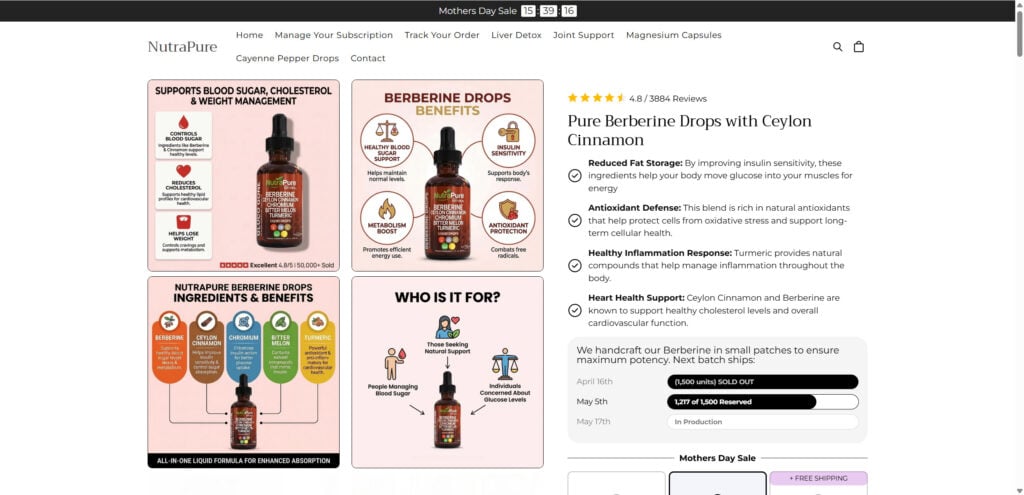
NutraPure Berberine Drops with Ceylon Cinnamon are being marketed as a powerful liquid supplement for blood sugar, cravings, weight loss, energy, metabolism, and A1C support.
The site presents the product as a superior alternative to capsules, claiming that regular berberine pills barely absorb while NutraPure’s liquid formula delivers better results. It also compares the product against diabetes medications like metformin and Ozempic-style injections, which is a major red flag for a dietary supplement
The product may exist. But the way it is sold looks like the same dropshipping supplement playbook under a new name: generic formula, inflated health claims, dramatic testimonials, subscription risk, urgency tactics, and refund language that does not fully line up across the page.
Scam Overview
NutraPure is not presented like a normal supplement brand. It is presented like a high-conversion sales funnel.
What the site wants buyers to believe
NutraPure claims its Berberine Drops can help with:
- Blood sugar control
- A1C improvement
- Weight loss
- Reduced cravings
- Better energy
- Insulin sensitivity
- Metabolic health
- Cholesterol support
- Inflammation support
The product page includes testimonials claiming dramatic results, such as A1C dropping from 6.8 to 5.4, blood sugar control being “better than metformin,” and 18 pounds lost without trying. (NutraPure)
What it appears to be
Based on the product type and supplier-style patterns seen with similar products, this appears to be another private-label liquid supplement built around common ingredients:
- Berberine
- Ceylon cinnamon
- Chromium
- Glucomannan
- Apple cider vinegar
- Gymnema
- Turmeric
The issue is not that these ingredients cannot have any biological effects. The issue is that the product is being marketed with results that sound closer to disease treatment than ordinary supplement support.
That is where the risk begins.
Major Red Flags
1. The product makes strong blood sugar and A1C claims
NutraPure’s product page repeatedly refers to fasting glucose, A1C, diabetes, prediabetes, insulin, and metformin. It claims users may see fasting glucose drops within 2–3 weeks, reduced cravings within 7–10 days, weight loss after 4–6 weeks, and full benefits over 8–12 weeks.
That is not casual wellness language.
When a supplement implies measurable improvements in A1C, fasting glucose, insulin resistance, or diabetes-related outcomes, buyers may interpret it as a treatment alternative. That is dangerous if people delay medical care or change prescribed medication without supervision.
The FDA states that dietary supplements making structure/function claims must carry a disclaimer that the product is not intended to diagnose, treat, cure, or prevent disease, because only drugs can legally make disease-treatment claims.
2. The page directly compares the drops to metformin and Ozempic
This is one of the biggest warning signs.
The NutraPure page claims berberine studies show effects “about as well as the diabetes drug metformin,” while also comparing its drops against Ozempic-style injections by mentioning price, prescriptions, injections, nausea, and shortages.
That style of comparison is a powerful sales tactic because it suggests the product is a natural, cheaper, easier alternative to prescription diabetes or weight-loss drugs.
Even when the page tries to soften the claim by saying it is not “exactly the same as Ozempic,” the comparison is already planted in the buyer’s mind. That is exactly how supplement funnels push medical-adjacent promises while trying to avoid direct legal responsibility.
3. “Liposomal delivery” is used as a premium claim
NutraPure claims standard berberine capsules have only 5% bioavailability and that its liposomal liquid delivery increases absorption by up to 8x. It repeats this idea throughout the page to justify why the product is supposedly better than cheaper capsules.
That sounds scientific, but the problem is evidence.
A serious supplement brand making that claim should show:
- Product-specific absorption testing
- Certificate of analysis
- Batch-level testing
- Independent lab name
- Clinical data for this exact formula
- Clear dosage of active berberine
- Proof that the liquid is truly liposomal
Without that, “liposomal” becomes a marketing label rather than proof of superior performance.
4. The testimonials are too dramatic to trust at face value
The page includes testimonials claiming:
- A1C dropped from 6.8 to 5.4
- A1C dropped from 7.1 to 5.9
- Fasting glucose fell from 118 to 92
- Blood sugar control became better than metformin
- A doctor started recommending the product
- 18 pounds lost without trying
These are medical-style outcomes, not ordinary product reviews.
Testimonials can be persuasive, but they are not clinical proof. The FTC’s health-products guidance says health-related claims must be truthful, not misleading, and supported by science. The same principles apply to supplement advertising.
If a testimonial implies typical results, the seller needs reliable evidence that buyers can generally expect those outcomes. Otherwise, the testimonials may mislead consumers.
5. Review numbers and testimonial content look highly sales-driven
The product page claims 4.8 / 3884 Reviews, then fills the page with highly polished customer stories that read like long-form ad copy.
Common themes include:
- “My doctor couldn’t believe it”
- “Saved me from insulin”
- “My doctor is now recommending it”
- “Better than metformin”
- “Lost weight without trying”
- “This gave me my life back”
Those lines are designed to remove doubt and make the buyer feel that the product is already proven by thousands of people.
The problem is that site-controlled reviews are not the same as independent, verifiable customer feedback.
6. The guarantee language is inconsistent
NutraPure presents a 60-day guarantee in several places. The FAQ says buyers can get a refund if they do not see improvement in blood sugar, energy, or weight within 60 days.
But another section says: “If you’re not 100% satisfied within the first 30 days, just send it back to us and we’ll give you a full refund.”
That is a material inconsistency.
Is it 30 days or 60 days? Does the bottle need to be returned? Are opened bottles eligible? Does “no hassle” actually mean no hassle?
When a product page gives conflicting refund windows, buyers should assume the stricter version may be enforced.
7. Subscription risk is built into the store structure
The NutraPure site includes a “Manage Your Subscription” link in the navigation, and the product FAQ says customers can choose auto-refill and “cancel anytime.”
That means subscription billing is part of the business model.
This creates risk because supplement funnels often use:
- Pre-selected auto-refill boxes
- Bundle offers that obscure the real quantity
- Monthly rebilling
- Cancellation deadlines
- Email-only support
- Delayed cancellation responses
Even if the site says “zero pressure,” the presence of subscription infrastructure means buyers need to check carefully before ordering.
8. The “small batch” scarcity language looks like pressure marketing
NutraPure claims it handcrafts berberine in “small patches” and shows batch-style scarcity language such as:
- “1,500 units sold out”
- “1,217 of 1,500 reserved”
- “In production”
This is designed to make buyers feel the product is scarce and in demand.
Whether the numbers are real or not, the tactic is clear: push the customer to buy before thinking too long.
This is common in dropshipping and supplement funnels.
9. The product may be the same formula under a new name
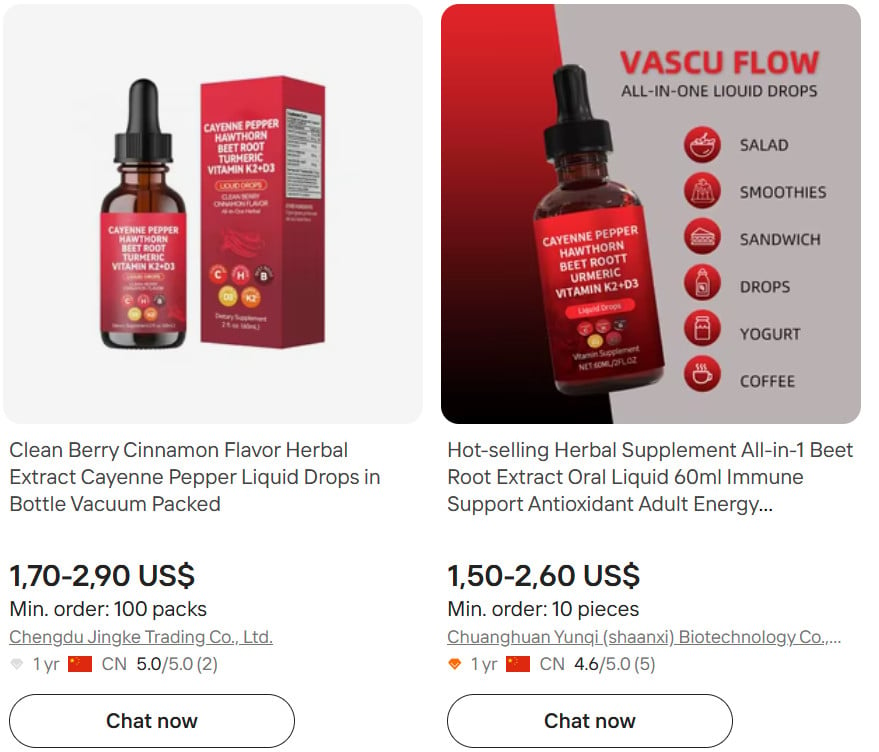
Based on the pattern you flagged, NutraPure appears to use the same general strategy as other liquid berberine/cinnamon drops sold under different brand names.
The similarities include:
- Liquid dropper bottle format
- Berberine + Ceylon cinnamon positioning
- Blood sugar and weight-loss claims
- Large review counts
- “Liposomal” or “absorption” language
- Auto-refill subscription option
- Aggressive testimonial blocks
- Money-back guarantee framing
That does not automatically prove the products come from the same seller. But it strongly suggests this is a repeat product funnel using a familiar formula and a new brand name.
How This Operation Works
Step 1: Pick a trending ingredient
Berberine is popular because it is widely discussed online as a natural blood sugar and weight-loss supplement.
That gives sellers an easy marketing angle.
Step 2: Add a stronger hook
Instead of selling normal capsules, the page claims capsules barely absorb and that liquid liposomal drops are much better.
This makes the product feel special.
Step 3: Use medical-adjacent claims
The page references A1C, fasting glucose, metformin, Ozempic, prediabetes, Type 2 diabetes, insulin, and blood sugar readings.
This makes the product feel more powerful than a regular supplement.
Step 4: Add testimonials that sound life-changing
The testimonials suggest people avoided insulin, beat prediabetes, lost large amounts of weight, and impressed their doctors.
This builds emotional trust.
Step 5: Introduce subscription and repeat-use logic
The product is framed as something users may take for months, cycle, maintain, or buy “forever.”
That supports repeat billing.
Step 6: Use guarantee language to reduce hesitation
The page promises refunds, but the guarantee language is inconsistent between 30 and 60 days.
That creates confidence during purchase, while potentially leaving room for stricter return enforcement later.
Is NutraPure Berberine Drops a Scam?
Not necessarily a fake-product scam
You may receive a bottle of liquid supplement.
The product may contain berberine, cinnamon, and other ingredients.
But it is high-risk
The bigger concern is the marketing and sales model.
NutraPure Berberine Drops show multiple warning signs:
- Disease-adjacent blood sugar claims
- A1C and glucose testimonials
- Comparisons to metformin and Ozempic
- Claims of 8x absorption without visible product-specific proof
- Subscription infrastructure
- Conflicting refund language
- Review content that reads like ad copy
- Likely private-label/drop-ship style positioning
The most accurate classification is:
A high-risk supplement funnel selling a likely generic berberine drop product with exaggerated health claims and potential subscription concerns.
Should You Buy It?
For most people, caution is warranted.
Reasons to avoid it
- The claims are stronger than the proof shown
- It discusses blood sugar outcomes in ways that may mislead consumers
- Testimonials imply medical-level results
- Subscription billing may be involved
- The guarantee language is inconsistent
- Similar formulas may be available under other names
If you still consider buying it
Do not treat it as a replacement for:
- Diabetes medication
- Metformin
- GLP-1 medications
- Blood sugar monitoring
- Medical care
- Diet and lifestyle changes recommended by your doctor
If you have diabetes, prediabetes, take blood sugar medication, blood pressure medication, blood thinners, or have liver or kidney issues, speak with a doctor before using any berberine supplement.
What To Do If You Already Ordered
1. Check whether you were enrolled in auto-refill
Look for:
- “Subscription”
- “Auto-refill”
- “Manage Your Subscription”
- “Recurring”
- “Next billing date”
- “Cancel anytime”
If you see any recurring billing, cancel immediately and save proof.
2. Review the refund window
The page references both 60 days and 30 days, so do not wait.
Act as if the shorter window applies.
Save screenshots of both guarantee statements.
3. Save the product claims
Take screenshots of claims about:
- A1C
- fasting glucose
- weight loss
- metformin comparisons
- Ozempic comparisons
- 8x absorption
- 5% capsule bioavailability
- doctor testimonials
- money-back guarantee
These are useful if you need to dispute the charge.
4. Do not stop prescribed treatment
Do not stop or reduce diabetes medication because of these drops.
Berberine may affect blood sugar and can interact with medication. NutraPure’s own FAQ tells users to consult a doctor before combining it with diabetes medication.
5. Monitor for side effects
Possible issues may include:
- stomach cramps
- gas
- diarrhea
- nausea
- dizziness
- low blood sugar symptoms
- medication interactions
Stop use and seek medical advice if you experience concerning symptoms.
6. Dispute the charge if necessary
If you are charged again, receive extra bottles, cannot cancel auto-refill, or the seller refuses a refund despite misleading claims, contact your card issuer or payment provider.
Use documentation showing:
- what the page promised
- what you ordered
- what you were charged
- what you received
- how support responded
The Bottom Line
NutraPure Berberine Drops are not a proven breakthrough for diabetes, A1C reduction, weight loss, or metabolic repair.
They appear to be another version of the same liquid supplement funnel: a familiar berberine and cinnamon product sold under a new name with aggressive claims, dramatic testimonials, urgency messaging, and subscription infrastructure.
The product may arrive.
That does not make the marketing reliable.
The safest conclusion is simple:
NutraPure Berberine Drops look like a high-risk private-label supplement marketed with exaggerated blood sugar and weight-loss claims, and buyers should be especially careful about subscriptions, refund terms, and medical claims.








