

The Eloura CerviSoft Pillow is marketed as a migraine-relief and cervical decompression pillow that can help users “wake up pain-free,” reduce morning migraines, and support the C1–C3 area of the neck while sleeping.
The product may be real. A buyer may receive a memory foam cervical pillow.
The problem is the way it is being sold.
The site uses strong medical-style claims, “clinical evidence” language, large review numbers, “as seen in” logos, and a 90-night guarantee to make the pillow look like a serious migraine solution. But once you look closer, the operation raises several red flags.
Scam Overview
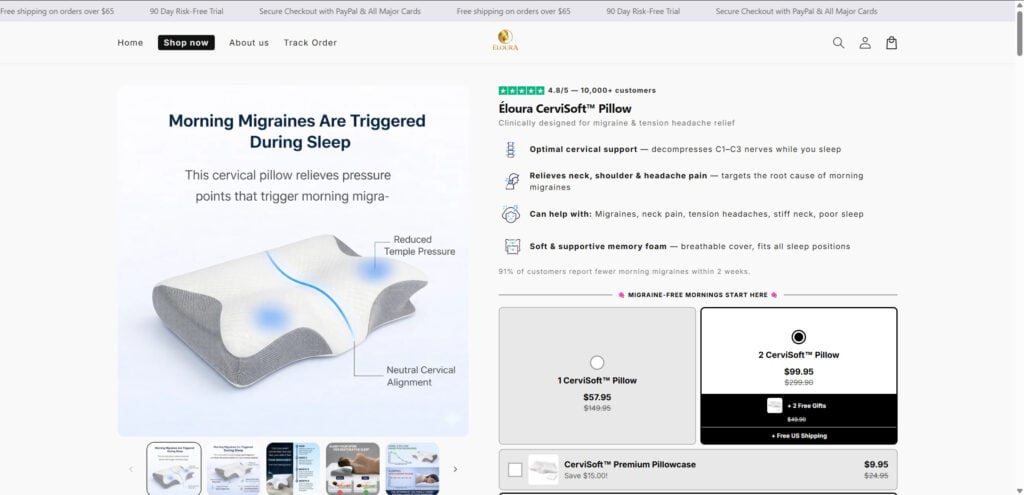
Eloura presents the CerviSoft Pillow as a specialized migraine-relief pillow, not just a comfort product. The product page claims it is “clinically designed for migraine & tension headache relief,” decompresses C1–C3 nerves, targets the root cause of morning migraines, and helps with migraines, neck pain, tension headaches, stiff neck, and poor sleep. It also claims that 91% of customers report fewer morning migraines within two weeks.
That is a very aggressive pitch for a pillow.
A cervical pillow may help some people sleep more comfortably. It may reduce neck strain for certain users. But promising migraine relief, nerve decompression, reduced medication use, and root-cause targeting moves the product into health-claim territory.
What Eloura Claims
The site claims the pillow can:
- Decompress C1–C3 nerves while you sleep
- Relieve neck, shoulder, and headache pain
- Target the root cause of morning migraines
- Reduce morning migraines
- Reduce light sensitivity
- Reduce medication use
- Improve sleep quality
- Work as “8 hours of passive decompression therapy”
The page also states that “most headaches don’t start in your head — they start in your neck,” and claims that pillow-related cervical compression causes morning migraines before the user wakes up.
What it actually appears to be
At its core, this appears to be a contoured memory foam cervical pillow.
That does not automatically make it useless. Cervical pillows are a real product category. Many people buy them for neck support, side sleeping, shoulder pressure, or posture comfort.
But the issue is that Eloura is not just selling comfort. It is selling migraine relief with medical-style certainty.
Major Red Flags
1. The migraine claims are stronger than normal pillow claims
The product page claims the pillow can help with migraines, tension headaches, stiff neck, poor sleep, and “pain-free mornings.” It also says the pillow targets the root cause of morning migraines by decompressing cervical nerves.
That is a big leap.
A pillow can support the neck. It cannot reliably diagnose why someone has migraines. Morning headaches can be linked to many causes, including migraine disorders, sleep apnea, medication overuse, bruxism, stress, dehydration, blood pressure issues, and other medical problems.
Cleveland Clinic describes cervicogenic headache as head pain that originates in the neck, but also notes it can come from issues affecting the cervical spine such as injury, arthritis, or slipped disks. Treatment may include physical therapy and medications.
So yes, neck-related headaches exist. But that does not mean a mass-market pillow can “stop migraines at the source” for most buyers.
2. The “clinical evidence” page raises questions
Eloura has a “Clinical Evidence” page that describes a “12-week randomized controlled trial,” “312 participants,” three international study sites, and publication in January 2026. It names a “Sleep & Headache Research Consortium” and presents extensive study-style data.
The problem is that this “clinical evidence” is hosted on the seller’s own website. The page does not clearly provide a journal link, DOI, clinical trial registration number, named authors, or independent publication details that a reader can easily verify from the page itself.
That matters because the claims are very strong. The page reports large effects, including a 73.4% reduction in morning migraine days and an 82% responder rate for the CerviSoft group compared with 14% for the control group.
Those are dramatic results. A claim that strong should be independently verifiable.
3. The site’s own disclaimer weakens the sales pitch
The footer disclaimer says the Eloura CerviSoft Pillow is not a medical device and is not intended to diagnose, treat, cure, or prevent any disease or condition. It also says statements have not been evaluated by the FDA, testimonials may not reflect typical results, names/photos/stories may be modified or dramatized, and individuals shown may be models.
That is important.
The sales page heavily emphasizes migraine relief, nerve decompression, reduced medication use, and pain-free mornings. But the disclaimer says the product is not medical and should not replace professional advice.
That creates a major gap between the marketing impression and the legal disclaimer.
4. “As Seen In” logos are used without clear proof
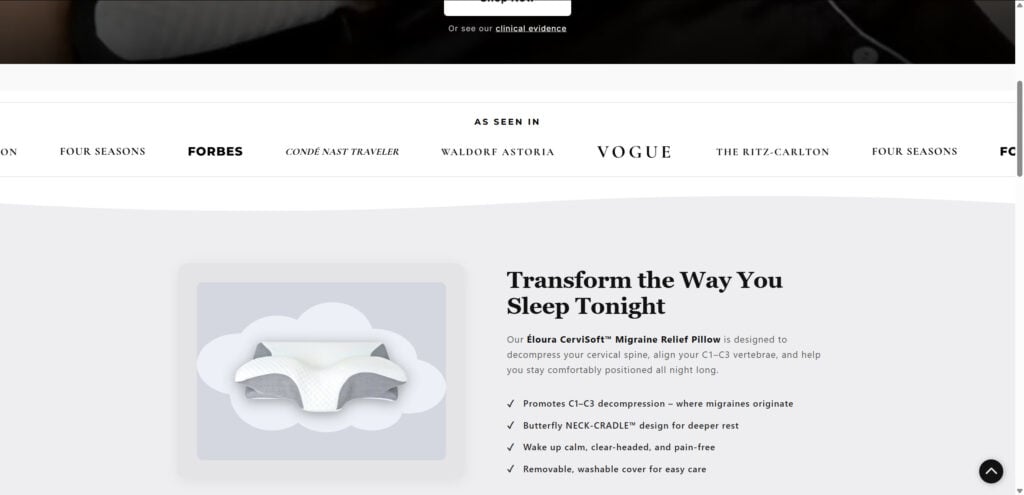
The homepage displays “As Seen In” style names including Vogue, Forbes, Condé Nast Traveler, The Ritz-Carlton, Four Seasons, and Waldorf Astoria.
The issue is not simply that logos appear. The issue is that the page does not clearly link to independent articles, hotel partnerships, press mentions, or proof that those brands actually featured or endorsed this pillow.
That kind of logo strip is common in high-conversion ecommerce pages because it creates instant credibility.
Without proof, it is just a trust signal.
5. The review numbers and testimonial style look sales-driven
The product page claims 4.8/5 from 10,000+ customers, then later says “Why 12.000+ Others Love It.” It also includes testimonial-style snippets such as “5 migraines a week down to 1,” “Canceled my chiropractor,” and “8 years of migraines… morning ones are basically gone.”
Those testimonials are powerful, but they read like conversion copy.
The FTC says health-related product claims should be truthful, not misleading, and supported by science. The same principles apply to health-related products beyond supplements, including health equipment and related consumer products.
If testimonials imply typical health results, the advertiser needs evidence that consumers can generally expect those results.
6. Generic cervical pillows are widely available
The broader product category is not unique. Wholesale marketplaces list many cervical, orthopedic, butterfly, and memory foam neck-support pillows at low bulk prices. Alibaba listings show ergonomic cervical pillows, winged designs, butterfly pillows, and memory foam neck-support pillows from suppliers.
That does not prove Eloura uses a specific supplier.
But it does show that this is a commoditized product category. A seller can take a generic cervical pillow, add premium branding, add medical-style copy, and sell it as a breakthrough migraine solution.
7. The “90-night trial” is not completely frictionless
The sales page repeatedly says “90-night risk-free trial,” “no questions asked,” and “refund every penny.”
The refund policy says return requests must be made within 90 days of delivery, the product should be in reasonable condition, and the customer is responsible for return shipping costs for change-of-mind returns. Defective or damaged products may receive a prepaid label.
That does not make the refund policy fake. But it does mean the “risk-free” pitch has conditions.
If a buyer wants to return it simply because it does not reduce migraines, they may still need to pay return shipping.
8. The product may create false confidence for people with real headache issues
This is the most important health concern.
If someone wakes up with frequent headaches or migraines, they should not assume a pillow is the answer. The American Migraine Foundation says people suspected of having cervicogenic headache should be carefully assessed by a doctor to rule out other primary or secondary headache causes.
That matters because a pillow ad can make a complex medical issue sound simple:
“Your pillow compresses your neck. Buy this pillow. Migraines stop.”
Real health problems are usually not that simple.
How This Type of Operation Works
Step 1: Start with a common product
A cervical memory foam pillow is a real, widely available product type.
Step 2: Add medical-style positioning
Instead of selling it as a comfort pillow, the brand positions it as a migraine-relief and nerve-decompression solution.
Step 3: Use authority signals
The page uses:
- “Clinical evidence”
- Study-style data
- Medical terminology
- “As Seen In” logos
- Customer survey percentages
- Large review counts
Step 4: Add emotional testimonials
The testimonials focus on pain, migraines, sleep, medication use, and relief after years of suffering.
Step 5: Use a strong guarantee
The 90-night guarantee reduces hesitation and makes the purchase feel low-risk.
Step 6: Rely on return friction
Even when a return policy exists, the buyer may still need to email support, wait for instructions, ship the product back, and pay return costs for non-defective returns.
Is Eloura CerviSoft Pillow a Scam?
Not necessarily a fake-product scam
The pillow likely exists. Buyers may receive a physical cervical memory foam pillow.
But it is high-risk from a marketing standpoint
The concern is the sales strategy:
- Strong migraine-relief claims
- Nerve decompression language
- “Clinical evidence” hosted by the seller
- Huge self-reported percentages
- Unverified “As Seen In” logos
- Disclaimer saying the product is not medical
- Generic pillow category
- Return shipping costs for change-of-mind returns
The most accurate verdict:
Eloura CerviSoft appears to be a high-risk cervical pillow marketed with exaggerated migraine-relief claims and aggressive health-style positioning.
Should You Buy It?
For most buyers, caution is warranted.
Reasons to be careful
- The product is marketed like a health solution, not just a pillow
- The migraine claims are stronger than what a pillow can reliably guarantee
- The clinical evidence is not clearly independently verifiable from the page
- Similar cervical pillows are widely available
- The disclaimer says the product is not a medical device
- The refund policy may require customer-paid return shipping
If you still consider buying it
Treat it as a cervical pillow, not a migraine treatment.
Do not buy it expecting:
- guaranteed migraine relief
- reduced medication use
- nerve decompression therapy
- replacement for medical care
- a cure for morning headaches
What To Do If You Already Ordered
1. Save the product claims
Take screenshots of:
- “Wake Up Pain-Free”
- “Clinically designed for migraine relief”
- “91% report fewer morning migraines”
- “decompresses C1–C3 nerves”
- “reduced medication use”
- “90-night risk-free trial”
- “As Seen In” logos
- refund policy
These may help if the product does not match the advertising.
2. Check the refund terms immediately
The return request must be made within 90 days of delivery, and customer-paid return shipping may apply for change-of-mind returns.
Do not wait until the end of the window.
3. Inspect the pillow when it arrives
Check:
- whether it matches the product images
- whether the foam quality feels as advertised
- whether the cover is removable and washable
- whether there are tags, care instructions, and manufacturer details
- whether it has a chemical smell or defect
- whether it is too high, too low, too firm, or too soft for your neck
4. Do not rely on it for serious headaches
If you have frequent morning migraines, worsening headaches, neurological symptoms, or suspected sleep apnea, speak with a medical professional.
Do not stop prescribed migraine treatments because a pillow ad suggests it can solve the problem.
5. Start a return quickly if dissatisfied
Email support with your order number and request return instructions.
Keep the message simple:
I am requesting a return for order #[number]. The product does not match the results and claims advertised. Please provide the return address, required packaging instructions, and refund timeline in writing.
6. Escalate if support stalls
If support delays, refuses reasonable return instructions, or does not honor the stated policy, contact your payment provider.
Use evidence showing:
- what the site promised
- what the refund policy says
- what you received
- how support responded
The Bottom Line
Eloura CerviSoft Pillow may be a real cervical memory foam pillow, but the marketing goes much further than ordinary comfort claims.
The site presents it as a migraine-relief, nerve-decompression, clinical-alignment product while also disclaiming that it is not a medical device and is not intended to diagnose, treat, cure, or prevent disease.
The safest conclusion is simple:
Eloura CerviSoft looks like a generic-style cervical pillow sold through strong migraine-relief marketing, self-hosted clinical claims, unverified trust signals, and a risk-free guarantee that still has return conditions. Buyers should treat it as a pillow, not a medical solution.

Join the discussion
0 commentsShare your experience or ask a question about this article.
Discussion
Start the conversation
Have a question or something useful to share? Add the first comment.