

EveLabs Goat Milk Powder is marketed as a natural alternative to calcium pills and synthetic bone health supplements. The product page tries to position it as a simple, better-absorbed, more effective solution for people concerned about bone density and mineral intake.
The product itself may be real.
The problem is the way it is marketed.
This appears to be another operation built around a generic powder, exaggerated health claims, artificial urgency, and premium pricing for what looks like a standard private-label product.
Scam Overview
At first glance, EveLabs looks cleaner and less aggressive than many supplement stores.
But the underlying sales model is very similar.
It takes a common product, adds a wellness story around absorption and bone strength, then wraps it in urgency, unverifiable claims, and premium branding.
What this operation appears to be doing
- Selling a generic goat milk powder product at a large markup
- Presenting it as a superior bone health solution
- Using statistics and clinical-style language without meaningful proof
- Creating urgency with countdown timers and low-stock messages
- Framing a basic powder as if it were a specialized health breakthrough
This is not necessarily a fake product scam where nothing arrives.
It looks more like a commodity product sold through overstated health marketing.
What They Claim vs What It Likely Is
What the site claims
The product page makes the powder sound like a major upgrade over normal supplements and even over other calcium sources.
Key claims include:
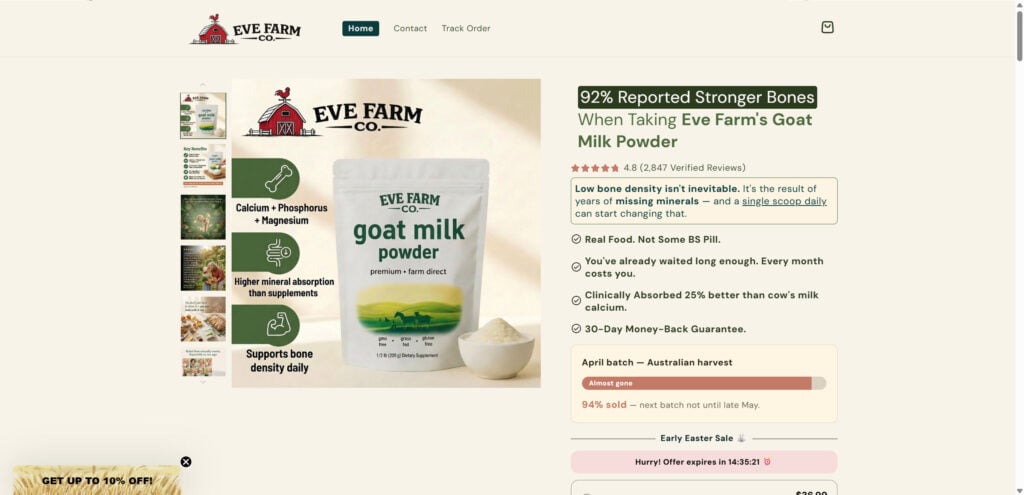
- “92% reported stronger bones”
- “Higher mineral absorption than supplements”
- “Supports bone density daily”
- “Clinically absorbed 25% better than cow’s milk calcium”
- “Calcium your body can actually use”
These are powerful health claims because they suggest measurable physical improvement.
What it likely is
Based on our investigation and product positioning, this appears to be a generic goat milk powder product sold with custom branding.
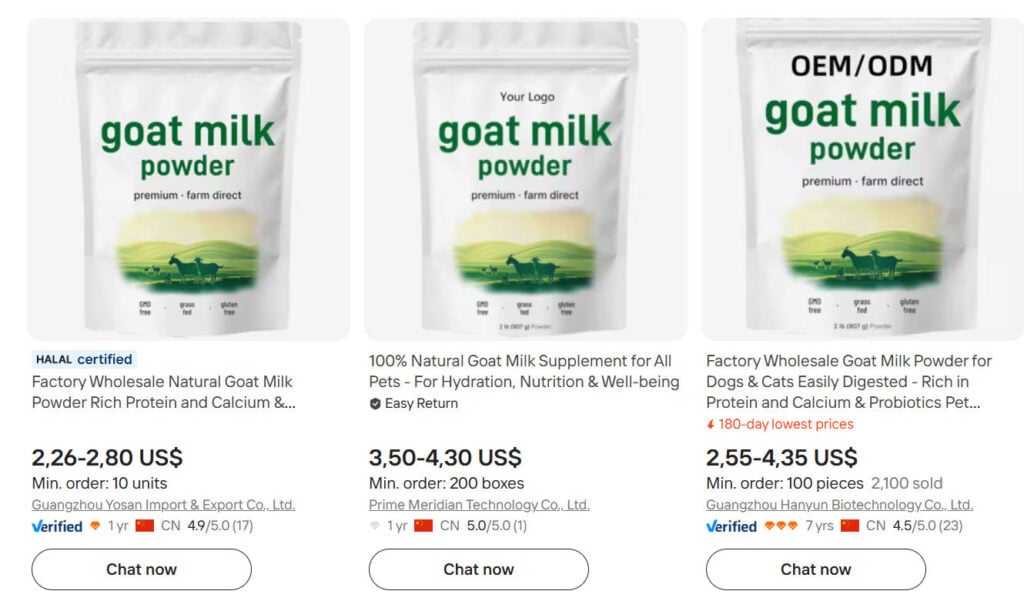
Your supplier screenshots show very similar packaging styles and white-label / OEM goat milk powder products offered at roughly:
- $2.26 to $4.35 per unit in bulk
That strongly suggests this is not a unique formulation or proprietary innovation.
It looks like a standard powder with a custom label and a much stronger marketing story layered on top.
Major Red Flags
1. The “92% reported stronger bones” claim is highly questionable
One of the boldest claims on the page is:
- “92% Reported Stronger Bones When Taking EveLabs’s Goat Milk Powder”
That is exactly the kind of statement that should be backed by:
- a real study
- sample size details
- methodology
- dates
- who conducted it
Instead, the claim is presented like a proven fact without visible evidence.
That is a major red flag.
Claims about stronger bones are not minor lifestyle statements. They imply real physical improvement and should not be used casually.
2. The site uses clinical-style language without showing real clinical proof
The page says:
- “Clinically absorbed 25% better than cow’s milk calcium”
That sounds precise and scientific.
But precision without proof is a common marketing tactic.
A serious health product making that kind of claim should clearly show:
- what study supports it
- whether it refers to this exact product
- whether the comparison was done in humans
- whether the study was independent
Without that, the claim functions more as persuasion than evidence.
3. It appears to be a private-label commodity product
Your screenshots are the biggest clue here.
The wholesale listings show:
- goat milk powder in nearly identical pouch formats
- OEM / ODM customization
- low bulk pricing
- farm-style packaging themes
That matters because it suggests EveLabs is not selling a unique nutrition product.
It is more likely reselling a common powder sourced from a manufacturer and rebranding it as a premium wellness solution.
What that usually means
- no real exclusivity
- no unique formula
- no strong reason for the premium price
- branding is doing most of the work
4. The marketing tries to turn a basic food powder into a medical-style solution
Goat milk powder is a real product.
But the site does not market it like a normal food powder.
Instead, it frames it as a near-corrective solution for:
- low bone density
- missing minerals
- daily bone support
- superior calcium absorption
This is where the concern grows.
A common nutrition product is being positioned as if it meaningfully outperforms standard alternatives, without showing convincing proof.
That is classic health-halo marketing.
5. Artificial urgency is used to pressure quick purchases
The page includes several urgency tactics:
- “April batch — Australian harvest”
- “94% sold”
- “next batch not until late May”
- countdown timer for the offer
These devices are common in high-conversion stores because they push visitors to buy before thinking too carefully.
Why that matters
Urgency tactics are often used when:
- the product is not truly scarce
- the seller wants to reduce comparison shopping
- the marketing message is stronger than the product itself
Real scarcity can exist.
But countdowns, batch bars, and “almost gone” notices are also standard e-commerce pressure tools.
6. The page uses “natural” positioning to build trust fast
The product is framed as:
- real food
- not a pill
- simple
- clean
- natural
That language is effective because many buyers are tired of synthetic supplements.
But “natural” does not automatically mean:
- better absorbed
- more effective
- clinically superior
- worth a large markup
This is one of the most common tricks in wellness marketing:
take something simple, natural, and familiar, then imply that simplicity itself is evidence of superiority.
It is not.
7. The reviews and reported outcomes are difficult to verify
The page shows:
- 4.8 rating
- 2,847 verified reviews
It also pairs these review claims with strong health outcomes.
That should make buyers cautious.
When a store combines:
- high review totals
- strong health claims
- vague “reported” outcomes
without showing independent verification, it becomes difficult to know what is real and what is just part of the sales presentation.
What You Are Probably Buying
If the product arrives, you are most likely getting:
- a standard goat milk powder
- a nutritionally ordinary dairy-based powder
- a product that may contain calcium and minerals naturally
- a product that is not likely to deliver dramatic bone-health results on its own
That is a very different reality from the one implied on the page.
You are probably not buying a breakthrough bone-support formula.
You are buying a basic powder sold as a premium health solution.
Why This Business Model Works
This kind of operation works because it targets a very specific customer psychology.
It appeals to people who:
- do not trust pills
- want “natural” health solutions
- are worried about aging and bone density
- want a simple daily fix
- are more persuaded by wellness language than by technical evidence
The model is effective because it combines:
- a simple product
- emotional health concerns
- scientific-sounding claims
- premium branding
- low wholesale cost
- high retail markup
That combination can be very profitable even when the product itself is unremarkable.
Is EveLabs Goat Milk Powder a Scam?
Not a pure fake-product scam
There is no strong indication from the screenshots alone that the product does not exist at all.
A buyer may well receive a pouch of goat milk powder.
But it does raise serious red flags
The stronger concern is that it appears to be:
- a generic private-label product
- sold with exaggerated health framing
- backed by weak or missing proof
- priced like a premium specialty solution
- pushed through urgency and trust-building tactics
So the most accurate conclusion is this:
The product may be real, but the marketing around it looks overstated and misleading.
Should You Buy It?
Caution is justified.
Reasons to avoid it
- the health claims appear stronger than the proof shown
- the product looks like a generic OEM / private-label powder
- the pricing likely far exceeds the underlying product value
- the urgency tactics feel artificial
- there is no clear evidence this product is meaningfully special
If someone still buys it
They should buy it as:
- plain goat milk powder
They should not buy it expecting:
- clinically meaningful bone improvement
- superior calcium absorption proven for this exact product
- a premium formula that justifies a big markup
What To Do If You Already Ordered
1. Save the product page claims
Take screenshots of:
- the “92% reported stronger bones” claim
- the “clinically absorbed 25% better” statement
- the review count
- the guarantee
- the countdown and scarcity claims
2. Review the return policy immediately
Before the product arrives, check:
- return window
- who pays return shipping
- whether opened products can be returned
- whether any restocking fees apply
3. Keep expectations realistic
Treat it like ordinary goat milk powder, not a clinically proven bone therapy.
4. Contact your payment provider if necessary
If:
- the item never arrives
- the product differs significantly from what was advertised
- the seller becomes unresponsive
then a charge dispute may be appropriate.
The Bottom Line
EveLabs Goat Milk Powder does not look like a revolutionary bone health product.
It looks like a standard goat milk powder repackaged with premium branding and stronger-than-proven health claims.
The biggest red flags are:
- unverifiable statistics
- clinical-style claims without visible evidence
- private-label supplier similarities
- artificial urgency
- premium pricing for what appears to be a generic product
A product can be real and still be sold in a misleading way. That is what this appears to be.








