


An email claims French investigators have opened a case against you. A document, official-sounding department, and short deadline make it difficult to dismiss.
The accusations are frightening enough that replying may feel urgent. Before explaining yourself to the sender, take a moment to examine what the message demands.
Overview
A supposed investigation becomes a demand for a private reply
The fake French police summons email scam impersonates police, gendarmerie, courts, or international agencies. It uses severe accusations to pull recipients into a private exchange.
Messages can threaten prosecution, an arrest warrant, public exposure, or contact with your family. A brief response deadline adds pressure to answer before seeking help.
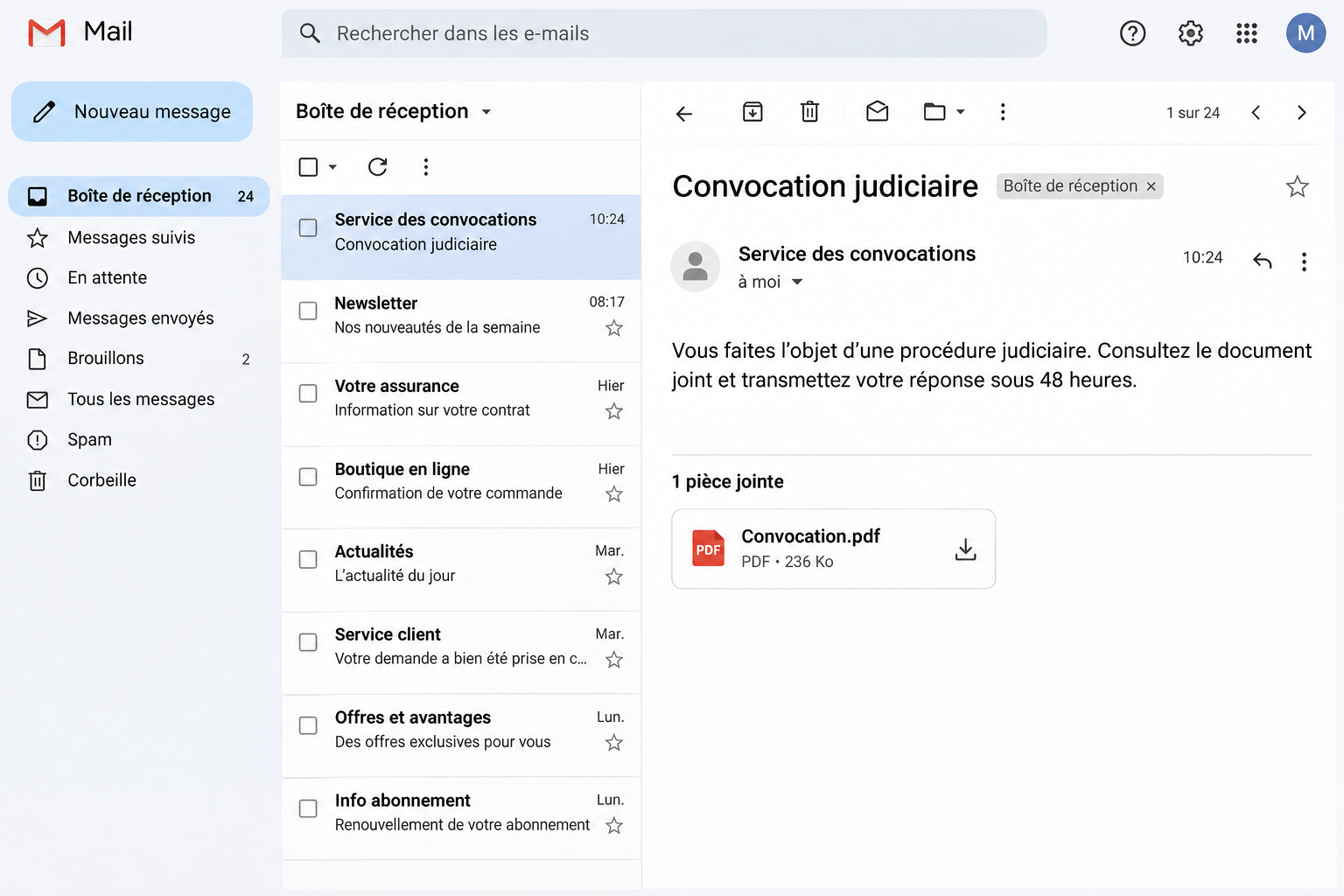
The sender may present the material as a formal notice or attached PDF. A document’s appearance does not establish that an investigation or case exists.
French authorities confirm the identity-document and extortion pattern
Cybermalveillance.gouv.fr’s warning describes continuing campaigns impersonating Police Nationale, Gendarmerie Nationale, judicial services, Europol, and Interpol.
The documented scheme can seek copies of identity documents first, followed by money supposedly needed to stop proceedings. The criminal allegation supplies the leverage.
This is impersonation of legitimate institutions. The warning does not mean every real police communication, court document, or unrelated legal matter can be ignored.
Stop the exchange while checking through an independent channel
You do not need to submit a defense to an unverified email sender. Separate the threatening message from any genuine issue you independently know about.
- Only received the email: preserve it and avoid replying, paying, or opening its unexpected attachment.
- Already replied: stop further exchanges and retain the conversation for an appropriate report.
- Sent identity documents: seek identity-misuse guidance and explain exactly which documents were disclosed.
- Sent money or banking information: contact the financial institution promptly and report the extortion attempt.
The Accusation Is Designed to Make You Explain Yourself
A person who has done nothing wrong can still feel compelled to answer a serious accusation. The message exploits the desire to clear up an apparent mistake.
Its legal language makes silence seem dangerous. Instead of asking whether the sender is genuine, you may start thinking about what explanation would satisfy them.
That gives the impersonator control over the conversation. They can decide your first reply is inadequate and demand more information to supposedly resolve the matter.
Threats of telling relatives or publicizing the case add embarrassment. Someone may avoid asking another person for help because they do not want to repeat the allegation.
The scam depends on that isolation, not on proving the accusation. You can seek help with a frightening message without accepting any claim inside it.
The opening email image is an illustrative reconstruction. It is not an authentic summons, a recovered police document, or evidence that the named recipient committed an offense.
Do not write a detailed personal explanation merely to see what happens. A reply gives an unverified person more material for another demand.
How the Fake French Police Summons Email Scam Works
Step 1: The sender borrows the identity of a public authority
The message names a police service, judicial department, or international agency. A title, signature, or copied logo helps an ordinary email resemble official correspondence.
Names of real departments can appear beside invented administrative labels. You should not need specialist knowledge of French organizational charts to protect yourself from the demand.
The immediate question is who contacted you and how their claim can be checked independently. The sender’s own document cannot authenticate the sender.
Step 2: The message claims investigators collected incriminating evidence
The documented campaign accuses recipients of sexual offenses involving minors and claims evidence was collected through online investigation. Some versions include a supposed IP address.
Those details can make the accusation feel technical and personal. They are still assertions in an unverified message, not access to a genuine case file.
Do not provide browsing history, private photographs, account passwords, or identity papers to rebut the claim. The person making the accusation has not established any authority.
A displayed address or identifier also does not explain how the message reached you. It should not be treated as proof of surveillance or device compromise.
Step 3: A deadline and exposure threat push the recipient toward a reply
The notice demands quick contact and threatens escalation if you remain silent. Legal-sounding consequences are mixed with pressure about reputation, family, or public exposure.
The recipient is encouraged to resolve the matter in private. That makes an ordinary email reply feel like a necessary legal step.
Do not let the message’s deadline dictate your verification route. Check through genuine public contact information rather than the address or telephone details it supplies.
If you already have a real legal matter, contact the authority or qualified adviser handling that matter. Keep that verification separate from the threatening message.
Step 4: The reply becomes an opportunity to obtain identity documents
Authorities describe versions that request copies of identification as an early step. Supplying those documents does not establish innocence or authenticate the supposed investigator.
It creates an additional exposure because the recipient has given sensitive records to someone whose identity is unknown. More information can also make subsequent threats sound personalized.
Do not send a second document because the first was supposedly unreadable. Stop the exchange and explain the disclosure through verified reporting or identity-protection channels.
Step 5: Money is presented as the way to stop proceedings
In the documented extortion pattern, the sender eventually requests money in exchange for supposedly abandoning the case. The earlier accusation makes that offer feel like relief.
Payment does not buy a dependable resolution from an impersonator. A promise to close a file or delete information cannot make the person trustworthy.
Do not negotiate an unofficial settlement with the email sender. If payment already occurred, preserve the instructions and contact the financial institution about the actual transfer.
Why an Official-Looking Sender or PDF Is Insufficient
An email can display a respected institution’s name without coming from its staff. Examine the complete address and reply destination, while recognizing that appearance alone is inconclusive.
A recipient may also see a university or other unrelated domain. That observation does not prove which account was compromised, whether spoofing occurred, or who operated the scam.
There is no need to accuse the unrelated organization to recognize the dangerous demand. Focus on the impersonation, request for documents, and proposed payment route.
A PDF can preserve impressive formatting while adding no authentication. Stamps, scanned signatures, and department headings are easy to copy into an ordinary document.
Do not open an unexpected file just to inspect its visual polish. The threatening email already gives you enough reason to pause and verify.
Receiving a PDF does not by itself establish that malware is on your device. Installing software, entering credentials, or granting access would create separate issues.
If you used a work device and followed a suspicious file’s instructions, inform the security team. Preserve relevant details before deleting evidence or changing managed settings.
How to Verify a Supposed Investigation Safely
Start from the institution’s genuine website or a contact route you independently know. Do not call a number simply because it appears beneath an official-looking signature.
Describe the message as a suspected impersonation. You can ask whether the claimed notice is genuine without submitting personal documents to the person who emailed it.
For messages claiming Europol authority, the agency publishes its own warning about fake correspondence and requests for money or personal information.
The agency’s name does not turn the sender into your local investigator. Use independently reached police channels for a genuine concern rather than continuing the private exchange.
A real case reference, if one exists, should be checked through genuine institutional procedures. Do not assume a string labeled case number has been authenticated.
Keep the original email available while seeking help. Its headers, attachments, and reply instructions may be useful evidence even when the visible message looks generic.
If a relative received the threat, offer to help them locate the proper contact. Avoid asking them to prove that the accusation is false.
That keeps attention on the actual problem: someone is trying to use fear and apparent authority to obtain information or money.
What to Do if You Have Fallen Victim to This Scam
-
Stop replying and refuse further demands. Do not send an explanation, identity document, password, or payment to the sender while deciding what to do.
Preserve the message before blocking or removing it from your inbox. Do not warn the impersonator that you are collecting evidence or planning a report.
-
Keep a complete record of the contact. Save the original email, full sender and reply addresses, attachment names, payment instructions, and any subsequent conversation.
Record what you actually supplied and when. A clear timeline helps distinguish identity exposure, a financial transfer, and a file that was merely received.
Do not publish unredacted documents or addresses while seeking advice. Share sensitive evidence only through verified institutional or professional channels.
-
Contact your financial institution promptly if you paid. Explain that a false police or judicial message induced the transaction, and provide its details.
Ask about the appropriate fraud report, transfer recall, card replacement, or dispute process. The available response depends on how money or account access was exposed.
Keep the institution’s reference and instructions for follow-up. Neither a caller nor a recovery service can guarantee that an existing payment will be returned.
-
Record the payment precisely before following up. Preserve its original currency, recipient, transaction reference, and payment service so the report describes the actual transfer.
-
Report the impersonation through a genuine public channel. French authorities recommend PHAROS for reporting this type of scam attempt.
If you sent money or documents, ask genuine local police about filing a complaint and preserving the evidence they need. Outside France, use your jurisdiction’s reporting process.
Do not confuse submitting an online report with obtaining immediate emergency assistance. Contact the appropriate local emergency service if there is a separate immediate physical threat.
-
Address identity-document exposure separately from payment recovery. Tell the relevant issuer or identity-protection authority what was sent and ask what protective steps apply.
Requirements differ by document and location, so do not assume every disclosed document must automatically be replaced. Follow the genuine authority’s instructions for your circumstances.
Keep the incident reference in case someone later misuses the information. Be alert to follow-up contact that repeats your personal details to appear credible.
-
Secure any account whose credentials were entered. Use its genuine security and recovery controls, checking unfamiliar access, recovery details, and reused passwords where relevant.
If the interaction also involved software installation or remote control, seek device-specific help. An extortion email alone does not justify treating every device as infected.
-
Get support without returning to the impersonator. A trusted person can help organize records, locate genuine contacts, and stay with you while making reports.
Reject anyone offering secret case dismissal or guaranteed money recovery for a fee. A second demand can exploit the same fear as the original message.
Helping a Relative Without Reinforcing the Threat
Ask what arrived and what they did afterward, keeping your tone calm. They may be reluctant to repeat an accusation that feels humiliating or alarming.
Explain that checking the sender is different from defending against the accusation. They do not have to persuade a stranger to stop making claims.
Help preserve the evidence and establish the next genuine contact. A manageable action is more useful than repeatedly telling someone they should have recognized the scam.
If they already paid, focus on immediate reporting and the financial institution’s process. Shame can delay the very contact that needs to happen promptly.
Frequently Asked Questions
Does this email mean French police opened a case against me?
The threatening message does not establish that a case exists. Authorities identify this impersonation pattern as a scam seeking identity documents and money.
Should I reply to explain that the accusation is wrong?
Do not submit a defense to the unverified sender. Preserve the email and use independently reached police or official support channels if verification is needed.
What if the PDF includes a stamp or official signature?
Those visual details can be copied and do not authenticate the sender. Verify through the genuine institution rather than relying on the attachment’s appearance.
Does an unrelated university address prove the university was hacked?
A visible address alone cannot establish the sending method or account compromise. Keep the allegation focused on the fraudulent message and its demands.
What should I do after sending a passport copy?
Stop further contact, preserve the disclosure details, and ask the relevant issuing or identity-protection authority about appropriate safeguards. Report the impersonation through verified channels.
Will paying the sender stop the supposed investigation?
An impersonator cannot provide a trustworthy case resolution. Do not pay, and contact the financial institution promptly if money has already been sent.
The Bottom Line
Do not send documents or money to someone using a supposed French police summons to threaten you by email. Preserve the message and verify independently.
If you already responded, address the specific exposure through genuine police, financial, and identity-protection channels. You do not need to keep explaining yourself to the sender.

Join the discussion
0 commentsShare your experience or ask a question about this article.
Community experiences
Did this happen to you?
Your experience could help someone recognize the same scam. Submit a private report for our team to review.
I experienced this tooReports are reviewed before publication. Sharing publicly is always your choice.
Discussion
Start the conversation
Have a question or something useful to share? Add the first comment.