

If you have been scrolling Facebook, Instagram, or “health news” style pages lately, you may have seen it.
A bold headline promises that taking 1 teaspoon of a “Harvard-backed oat trick” can melt fat fast, crush hunger, and help you drop pounds daily with almost no effort.
It sounds simple. Cheap. Almost comforting.
And that is exactly why it works so well as a scam marketing narrative.
Because once you click, you are not getting a real, evidence-based health guide. You are being pulled into a carefully engineered funnel that uses fake authority, fake urgency, and misleading claims to push you toward buying a supplement.
This article breaks down what the “Harvard-backed oat trick” scam really is, how the operation works step by step, what red flags to look for, and what to do if you already bought in.
Scam Overview
The “Harvard-backed oat trick” pitch is not a single product. It is a reusable marketing template.
Scammers build a viral claim, wrap it in credibility, and connect it to a supplement checkout page. When one brand name gets too exposed or the ad accounts get shut down, they swap the name and keep the same story.
That is why you will see different products tied to the exact same claims. The labels change. The story stays.
At the center of the narrative is a familiar promise:
- A simple home method
- “Backed” by Harvard or top researchers
- Better than popular medications
- Dramatic results in days
- A secret “trick” doctors do not want you to know
If this sounds like a movie trailer, that is not an accident. These pages are designed to entertain you long enough to lower your guard.
The core claim is built to bypass your skepticism
The wording is carefully chosen.
“Harvard-backed” signals prestige and authority. It implies clinical research without having to show it.
“Oat trick” signals safety and simplicity. Oats feel normal, like breakfast, not like a risky drug.
“1 tsp” signals precision. It feels like science. It also feels doable.
And “burn up to 2.2 pounds daily” is the emotional hook. It is the promise that overrides logic, especially for people who have tried everything and are tired of slow results.
But a claim like “burn up to 2.2 pounds daily” should immediately raise questions.
Sustainable fat loss does not work like a magic lever. Even when people lose weight quickly, early changes are often water weight, glycogen changes, and diet shifts, not pure fat loss.
The scam avoids this reality. It sells certainty.
The scam ecosystem is built around fake “health media” presentation
A major red flag is how these pages present themselves.
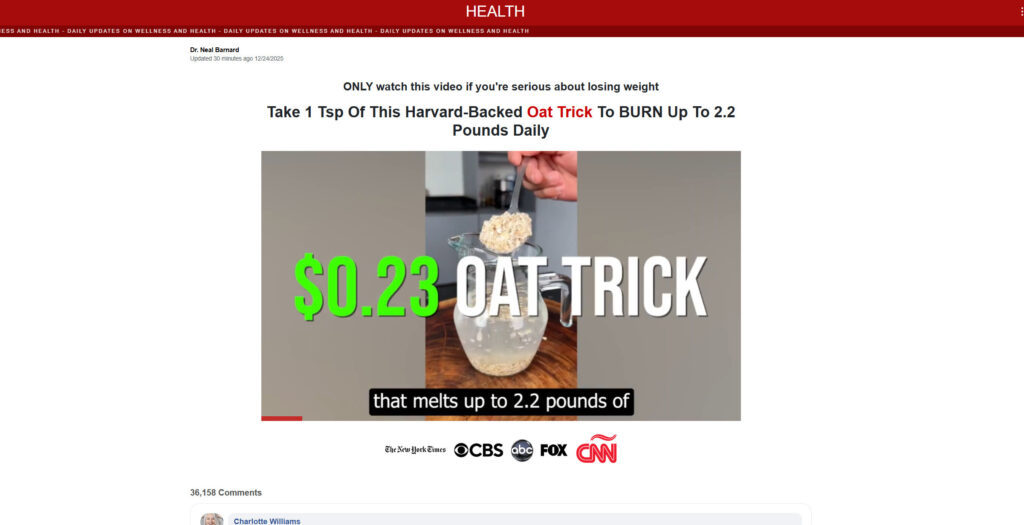
Instead of looking like a normal product website, many “oat trick” campaigns use pages that look like:
- A health blog
- A breaking news story
- A medical update page
- A celebrity wellness reveal
- A “doctor exposé” format
They often include:
- Big outlet logos like CNN, CBS, ABC, FOX, or The New York Times
- A “breaking” style banner
- A headline written like urgent news
- A byline using a doctor name or a medical personality name
- A date that looks official, sometimes even set in the future
- A video frame that appears to be a broadcast clip
This layout is not there to inform you. It is there to stop you from thinking, “Why is a supplement being sold like a late-night infomercial?”
The goal is to make the page feel like a trusted third party is reporting facts, even though the page is simply a sales machine.
Fake authority is the fuel that makes the funnel run
These campaigns often borrow credibility in several ways:
- Using doctor names that sound real, even when they are not
- Claiming “Harvard-backed” or “Harvard doctor” without verifiable proof
- Referring to “top endocrinologists” or “leading researchers”
- Mentioning universities or medical groups as “scientific references”
- Using “FDA registered” language to suggest approval
- Showing badges like GMP, non-GMO, natural, and guaranteed
Some of these terms are real in other contexts, but they are frequently used in a misleading way.
For example, supplements are not “FDA approved” the way prescription drugs are. A website may show “FDA” graphics to create a powerful association, even when there is no meaningful endorsement.
This is especially dangerous when the offer targets people who feel desperate. The more scared or frustrated someone feels about their weight, the more likely they are to lean on borrowed authority.
The “recipe” is usually bait, not the product
One of the most consistent patterns is the bait-and-switch structure.
The ad and headline imply you are about to learn a cheap home remedy. Something like:
- a $0.23 oat trick
- a bedtime method
- an ice and gelatin trick
- an apple cider vinegar hack
- a secret root used by villagers
- a simple teaspoon method
But when you watch the video or scroll the page, the “trick” is never fully delivered for free.
Instead, the message becomes:
“You need to take this special formula that contains the active components.”
And that “formula” is the supplement they are selling.
In other words, the trick is not the trick. The trick is getting you emotionally invested in the story, so you feel compelled to finish it by buying.
The comments and reviews are often manufactured
Many of these pages show:
- Huge comment counts like tens of thousands
- Facebook-style comment boxes
- User photos and first names
- Emotional testimonials with dramatic transformations
- “I tried everything and this finally worked” scripts
But the comments are typically hosted on the sales page itself, not on real Facebook threads.
That matters because it means:
- The seller controls what is shown
- The seller can fabricate the comments
- The seller can remove negative experiences
- The seller can run the same “reviews” across multiple products
Another giveaway is the unrealistic nature of the praise.
Real reviews are messy. They mention shipping issues, taste, side effects, customer service, and mixed results.
Fake reviews read like ad copy.
The pricing structure is designed to push bulk purchases
The checkout is not built for “one bottle to try.”
It is engineered to make you feel foolish if you do not buy the largest package.
You will often see:
- 1 bottle priced high
- 3 bottles priced “better”
- 6 bottles presented as the “best value”
- “Buy 2 get 1 free” style deals
- “Best value” labels on the largest package
- “You save $600” style math
- A discount code like “20OFF” pushed at the bottom
This is not generous pricing. It is a psychological push.
The scammers know that if someone buys six bottles, it is harder to walk away. It also increases the money they take before the customer realizes what happened.
It is not the first time we have seen this aggressive advertising style
The “Harvard-backed oat trick” funnel is part of a much bigger pattern.
We have seen the same aggressive tactics used across countless scammy supplement campaigns, including “miracle” weight-loss drops, blood sugar hacks, memory tonics, vision “root” cures, and skin solutions.
The formula repeats because it works:
- A shocking claim that creates hope
- A borrowed authority figure or institution
- A fake news layout to build trust
- A long video to wear you down
- Fake social proof to remove doubt
- A checkout rush with urgency and discounts
When you recognize this pattern, you start seeing it everywhere.
And that is important, because scammers are not selling one product. They are selling a system.
Why this scam can be especially harmful
Even when the financial loss is “only” a few hundred dollars, the harm can run deeper.
These campaigns often:
- Encourage unrealistic expectations
- Promote medical-sounding claims without medical oversight
- Pressure people to act fast instead of doing research
- Collect personal data like phone numbers and addresses
- Lead to subscription-like billing confusion in some cases
- Make refunds difficult, slow, or impossible
Most importantly, they waste time and attention that could be spent on real health solutions.
If someone is struggling with weight, blood sugar, or appetite, the safest step is working with a qualified healthcare professional, not trusting a viral “secret trick” sold through shady ad funnels.
How The Scam Works
What makes the “Harvard-backed oat trick” operation so effective is that it is not random.
It is structured.
Below is the typical step-by-step path, with the most common persuasion tactics explained in plain language.
Step 1: The ad grabs you with a simple, emotional promise
The first contact is usually a paid ad.
You might see it on:
- “recommended” content widgets
- clickbait-style headlines on news-like pages
The ad usually includes:
- A quick hook like “ONLY watch if you’re serious about losing weight”
- A cheap-sounding ingredient like oats or gelatin
- A shocking result number like “drop 24 lbs” or “burn 2.2 pounds daily”
- A credibility claim like “Harvard-backed”
- A short video clip, often edited for urgency
This step matters because it selects for emotion.
If you are curious, frustrated, or hopeful, you click.
Step 2: You land on a page that looks like health news, not a product pitch
Instead of taking you directly to a normal store page, the ad sends you to a “bridge” page.
This page often looks like:
- A health site with a big header like “HEALTH”
- A “daily updates” style banner
- A byline claiming it is written by a doctor
- A page that mimics journalism formatting
Why do this?
Because if you think you are reading “news,” you trust it more than an ad.
This is the first major credibility hack.
Step 3: The video starts slow on purpose, using story to lower your defenses
The video is rarely short.
These presentations are designed to keep you watching, often using:
- A “warning” tone
- A dramatic backstory
- A villain like Big Pharma or “the industry”
- A hero figure like a doctor who “discovered the truth”
- A promise that the secret will be revealed soon
This is not education. It is a persuasion script.
The longer you watch, the more your brain starts thinking, “I have already invested time, I should finish.”
That is called commitment momentum, and scammers rely on it heavily.
Step 4: The page stacks credibility symbols to create borrowed trust
As you scroll, you may see:
- Logos of major news networks
- University names
- Medical association seals
- “scientific references” blocks
Sometimes you will even see a grid of university logos presented as if they are part of the research story.
But these symbols typically do not link to real studies.
They are not citations. They are decorations.
This step matters because it replaces proof with imagery.
For many people, seeing a recognizable logo creates a feeling of safety, even when nothing is verified.
Step 5: The “oat trick” becomes a cliffhanger, not a free tip
Here is the bait-and-switch moment.
The page heavily teases the oat trick, but instead of giving a clear recipe and telling you to try it, it pivots:
- “This only works if you activate the real mechanism”
- “You need the concentrated compounds”
- “The formula is hard to find”
- “You can only get it on this page”
- “This is the only way to do it right”
And then you see the product.
Often it is a bottle-based supplement, sometimes gummies, sometimes capsules, sometimes powders, sometimes a new brand name.
In other words, the “oat trick” is the marketing wrapper. The real goal is selling a supplement at a high markup.
Step 6: Social proof appears to erase your hesitation
Right when you might start doubting, the page hits you with:
- Thousands of “comments”
- Testimonials with emotional language
- Before and after photos
- “Real people are watching now”
- Popups like “Patricia from Chicago just purchased”
These elements are designed to create a simple thought:
“If all these people are buying, it must be real.”
This is one of the most powerful persuasion levers in marketing.
But in scam funnels, it is often manufactured.
If you cannot verify the reviews on independent platforms, you should treat them as unproven.
Step 7: The offer page pressures you to buy more than you planned
When you reach pricing, the structure is almost always the same:
- The 1-bottle option is expensive enough to feel like a bad deal
- The multi-bottle option looks like the “smart” choice
- The biggest package is highlighted as “best value”
You may also see:
- “Buy 2 get 1 free”
- “Biggest discount”
- “Free shipping”
- “60-day guarantee”
This is where many people make the purchase, not because they fully believe, but because the offer feels like it reduces risk.
The truth is that guarantees can be meaningless if the company is hard to reach, slow to respond, or constantly changing domains.
Step 8: Urgency tactics kick in to prevent research
Now you will see the pressure tools:
- Countdown timers
- “Stock almost gone” banners
- “Last day” warnings
- Limited-time discount codes
- A date at the top saying today is the final day
This is the moment they try to stop you from opening a new tab and researching the product name.
Because research is the enemy of scam funnels.
Scammers want action, not thought.
Step 9: Checkout collects personal data and locks you into the funnel
At checkout, you are asked for:
- Full name
- Phone number
- Shipping address
- Card payment
Many scam campaigns route payments through third-party processors.
That does not automatically mean fraud, but it can make support and refunds harder, especially if the “brand” is simply a shell.
This is also where victims sometimes report:
- Confusing billing descriptors
- Unexpected shipping charges
- Difficulty reaching customer service
- Refund resistance
Step 10: The campaign disappears and returns under a new name
If enough complaints build up, or ad platforms shut down their accounts, scammers pivot.
They may:
- Move to a new domain
- Rebrand the supplement
- Upload a near-identical video with minor edits
- Swap the doctor name in the byline
- Keep the same script and visuals
That is why it is so important to focus on the narrative and funnel structure, not only the product name.
If you only search the exact brand, you may miss the broader operation.
What To Do If You Have Fallen Victim to This Scam
If you already clicked, bought, or entered your information, take a breath.
You are not alone, and you are not powerless. The key is acting calmly and quickly.
1) Document everything while you still can
Before pages change or disappear:
- Screenshot the ad if possible
- Screenshot the order confirmation
- Save the email receipt
- Note the website domains you visited
- Record any phone numbers or support emails shown
- Take screenshots of the product offer and guarantee language
This documentation helps with disputes, chargebacks, and reports.
2) Check your card statement and note the billing descriptor
Look for:
- The exact merchant name
- The date and amount
- Any extra charges you did not expect
Sometimes the merchant name on your statement will not match the product name.
Write down what you see.
3) Contact your bank or card issuer if anything looks suspicious
If you see unauthorized charges, do not wait.
Call the number on the back of your card and explain:
- You believe you purchased through a deceptive ad funnel
- You are concerned about unauthorized or future charges
- You want to dispute the charge if necessary
Ask what they recommend next.
In many cases, you may be advised to:
- Start a dispute
- Request a stop payment
- Replace your card number
4) Attempt a refund, but do it strategically
If the company claims a money-back guarantee:
- Email them with your order number
- Keep the message short and direct
- Ask for confirmation that your refund request is received
- Set a personal deadline, for example 48 to 72 hours for a response
If they ignore you, delay endlessly, or demand unreasonable steps, escalate to your payment provider.
Do not get stuck in an endless email loop.
5) Monitor for follow-up scams
Once scammers have your email or phone number, you may see:
- More “health breakthrough” ads
- Fake support calls
- Messages offering a “special refund link”
- Upsells for other products
Be cautious with any unexpected contact.
Do not click “refund” links sent by random emails or texts.
6) Consider freezing your credit if you shared extensive personal details
If you are worried about identity risk, consider steps like:
- Credit monitoring
- A credit freeze with major bureaus
- Extra alerts on your bank account
This is especially important if you entered phone number, address, and full name on a sketchy page.
7) Report the ad and the page
Reporting may not feel satisfying, but it can help reduce reach.
You can report:
- The ad platform where you saw it
- The website domain to hosting or abuse channels
- Consumer complaint platforms in your region
When reporting, include screenshots and the domain name.
8) Talk to a qualified healthcare professional for real guidance
If the ad targeted your weight, appetite, blood sugar, or health concerns, the safest next step is real medical advice.
A reputable professional can help you create a plan that fits your body, medications, and goals.
Scam funnels sell shortcuts. Real health is personal and evidence-based.
The Bottom Line
The “1 tsp Harvard-backed oat trick” is not a trustworthy health discovery. It is a recurring scam-style marketing narrative used to sell supplements through misleading pages, fake authority signals, and aggressive urgency tactics.
The biggest danger is not just the money you might lose. It is the false hope, the wasted time, and the personal data handed to unknown operators who can rebrand and relaunch under new names.
If you see these ads again, remember the pattern:
A miracle trick. A prestigious name. A fake news layout. A long video. A rushed checkout.
Real health solutions do not need a countdown timer.
FAQ
What is the “1 tsp Harvard-backed oat trick” scam?
The “1 tsp Harvard-backed oat trick” scam is a misleading online marketing funnel that claims a simple oat-based method can trigger rapid weight loss. The ads typically promise dramatic results like burning fat fast, crushing hunger, or losing pounds daily. In most cases, the “oat trick” is never fully shared for free. Instead, it is used as bait to push you toward buying a supplement sold through a high-pressure sales page.
Is the “Harvard-backed oat trick” real?
There is no reliable public evidence that a “Harvard-backed oat trick” exists as advertised in these viral campaigns. Legitimate Harvard research is published through peer-reviewed journals and credible medical outlets, not through anonymous “health” landing pages with countdown timers and “last chance” claims. The wording is designed to borrow Harvard’s authority without proving a real connection.
Why do these ads say “Harvard-backed” or “doctor approved”?
Scam supplement campaigns use authority cues to lower your skepticism. Terms like “Harvard-backed,” “clinically proven,” and “doctor recommended” are often used without verifiable references. The pages may show medical-looking badges or mention researchers, but they rarely provide real citations, study links, trial registration numbers, or clear details that can be independently confirmed.
What product are they actually selling?
The product name varies. Sometimes it is a capsule, gummy, powder, or drops. The brand can change frequently because the funnel is the real business model. When complaints grow or ad accounts are shut down, scammers rebrand the same narrative under a new supplement name while keeping the same promises and sales structure.
Why do the product names keep changing?
Because changing names helps the marketers dodge negative reviews, avoid platform enforcement, and outrun consumer warnings. A new name also resets search results, making it harder for buyers to find scam reports before purchasing. If you focus only on one product name, you can miss the broader scam pattern.
What are the biggest red flags that the oat trick supplement is a scam?
Common red flags include:
- A “health news” page that mimics a media outlet but uses a random domain name
- Logos from CNN, CBS, FOX, or major universities with no real verification
- A long video that teases a secret method but never clearly gives it away
- Claims of extreme weight loss speed, like losing pounds daily with no effort
- Countdown timers, “stock almost gone” warnings, or “today only” messaging
- Popups like “Linda from Texas just bought 6 bottles”
- Huge review counts that cannot be verified anywhere else
- Badges implying FDA approval for a supplement
Does the FDA approve weight loss supplements like this?
No. The FDA does not “approve” dietary supplements the way it approves prescription drugs. Some marketers use confusing language like “FDA registered facility” or show “FDA” graphics to imply legitimacy. That does not mean the supplement is FDA-approved for weight loss, appetite control, or fat burning.
Why do these pages claim you can lose up to 2.2 pounds per day?
Because extreme claims sell. “Up to” language is often used to make a promise without committing to it. But the implied result is still unrealistic for most people, and it is designed to trigger urgency and hope. Safe, sustainable fat loss is typically much slower and depends on many factors, not a teaspoon trick.
Are the before-and-after photos and testimonials real?
In many cases, no. Scam funnels frequently use:
- Stock images
- Stolen transformation photos
- AI-generated faces
- Scripted “Facebook-style” comments that are hosted on the sales page itself
If the testimonials cannot be verified on independent platforms, treat them as marketing content, not proof.
What does the scam funnel usually look like from start to finish?
A typical funnel works like this:
- A paid ad promises a “simple trick” and dramatic results.
- You click and land on a fake health article or “doctor report” page.
- A long video builds a story and delays the “secret.”
- The page uses logos, badges, and fake “scientific references” to build trust.
- The “oat trick” becomes a cliffhanger and the supplement is presented as the solution.
- Fake comments, popups, and review counts appear to create social proof.
- A pricing table pushes multi-bottle purchases with “best value” labels.
- Timers and scarcity warnings pressure you to buy immediately.
- Checkout collects personal details and payment information.
What happens after you buy?
Outcomes vary. Some buyers report receiving a product that does not match the claims. Others report shipping delays, difficulty getting refunds, or confusing billing descriptors. Even when a package arrives, the marketing claims are usually far beyond what any supplement can reliably deliver.
Can these supplements cause side effects?
They can. Supplements may contain stimulants, herbal extracts, or ingredients that interact with medications or health conditions. Because these scam-style pages often lack transparent labeling and proper medical warnings, the risk can be higher. If you took the product and feel unwell, stop using it and contact a qualified healthcare professional.
What if I entered my credit card information on one of these pages?
Take action quickly:
- Check your statement for the exact merchant name and any extra charges
- Save receipts and screenshots of the offer and guarantee terms
- Contact your card issuer if you suspect deceptive billing or unauthorized charges
- Ask about disputing the charge or replacing your card number if needed
What if I never received the product?
If the promised delivery window has passed:
- Email support with your order number and request tracking or a refund in writing
- Set a short deadline for response, like 48 to 72 hours
- If they stall or ignore you, contact your payment provider to dispute the charge
What is the best way to request a refund?
Keep it simple and documented:
- Use email so you have a paper trail
- Include order number, purchase date, and the amount charged
- State clearly that you are requesting a refund
- Ask for written confirmation that the refund is being processed
If they refuse or delay repeatedly, escalate to your bank or card issuer.
How do I spot the fake “health news” websites used in these scams?
Look for these signs:
- The domain is not the real media outlet’s domain (for example, not cnn.com)
- The page design imitates a news site but links do not work normally
- The “author” cannot be verified
- The article reads like an infomercial, not journalism
- No legitimate citations are provided, only claims and logos
Are these scams connected to other viral “trick” health pitches?
Often, yes. The same marketing networks frequently reuse the exact structure for different niches:
- Weight loss “ice and gelatin trick”
- “Bedtime method” gut reset gummies
- Memory “golden honey tonic” cures
- Vision “red root hack” cures
The names change, the funnel stays the same.
Why do scammers use countdown timers and “limited stock” warnings?
Because urgency prevents research. If you feel like time is running out, you are less likely to open a new tab, check reviews, or verify the claims. Scarcity and timers are classic pressure tactics in scam marketing funnels.
How can I protect a family member who might fall for these ads?
A practical approach:
- Explain the pattern: fake news layout, big claims, urgency, multi-bottle push
- Encourage them to pause and search the exact headline or key phrases
- Remind them real medical breakthroughs are reported by credible sources and doctors, not anonymous landing pages
- Offer to review any ad or site with them before they buy
What should I do if I feel embarrassed about falling for it?
Do not beat yourself up. These campaigns are engineered to manipulate normal human emotions like hope, fear, and frustration. Focus on protecting your finances and information now. Acting quickly is what matters, not blaming yourself for being targeted.
What is the safest alternative if I want real weight loss support?
If you want safe, realistic progress:
- Talk with a qualified healthcare professional about your goals and health history
- Focus on proven basics: nutrition habits, sleep, movement, and sustainable calorie balance
- Be cautious with any supplement that promises rapid fat loss with no effort
If something sounds like a miracle, it usually is marketing, not medicine.

Join the discussion
0 commentsShare your experience or ask a question about this article.
Discussion
Start the conversation
Have a question or something useful to share? Add the first comment.