

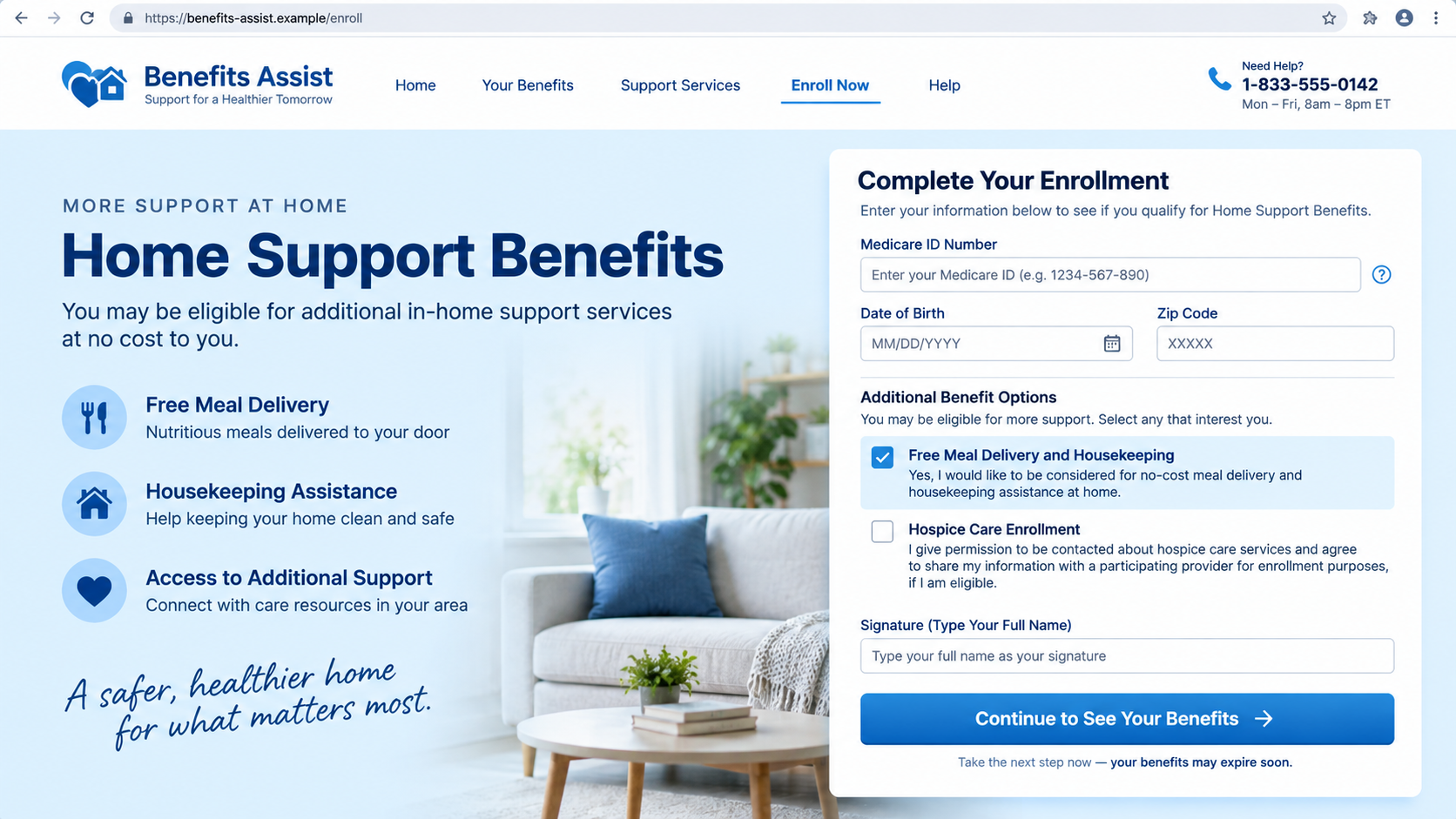
A fake hospice enrollment may begin with a caller offering free meal delivery, housekeeping, medical supplies, or extra care at home. The offer sounds useful, and the only thing needed to get started is a Medicare number and a signature.
Nothing in the conversation sounds like a decision about end-of-life care. That is why the paperwork that appears later can be so shocking.
Overview
The free benefit can hide a hospice enrollment
The fake hospice enrollment scam targets people who have Medicare but do not need hospice care. A recruiter, caller, social media ad, website, or door-to-door salesperson offers an unrelated benefit, then collects enough information to enroll the person with a hospice provider.
The pitch may mention house cleaning, meal delivery, transportation, medical supplies, a wellness visit, or help with benefits. Hospice is either not mentioned or described as a harmless program that adds services without changing anything else.
That description is false. Medicare hospice is a specific medical benefit for a person whose hospice doctor and regular doctor certify that the person is terminally ill, generally with a life expectancy of six months or less if the illness follows its normal course.
The enrollment creates billable Medicare activity
Once a provider records the enrollment, Medicare can be billed for hospice services. The criminal value comes from claims submitted under a real beneficiary’s identity, even when the patient is not terminally ill, did not knowingly choose hospice, or never received the services shown.
The FBI warned in June 2026 that schemes have included enrolling people without their knowledge, falsifying diagnoses, paying recruiters for patient sign-ups, billing for services that were never provided, and pressuring people who did not need hospice care.
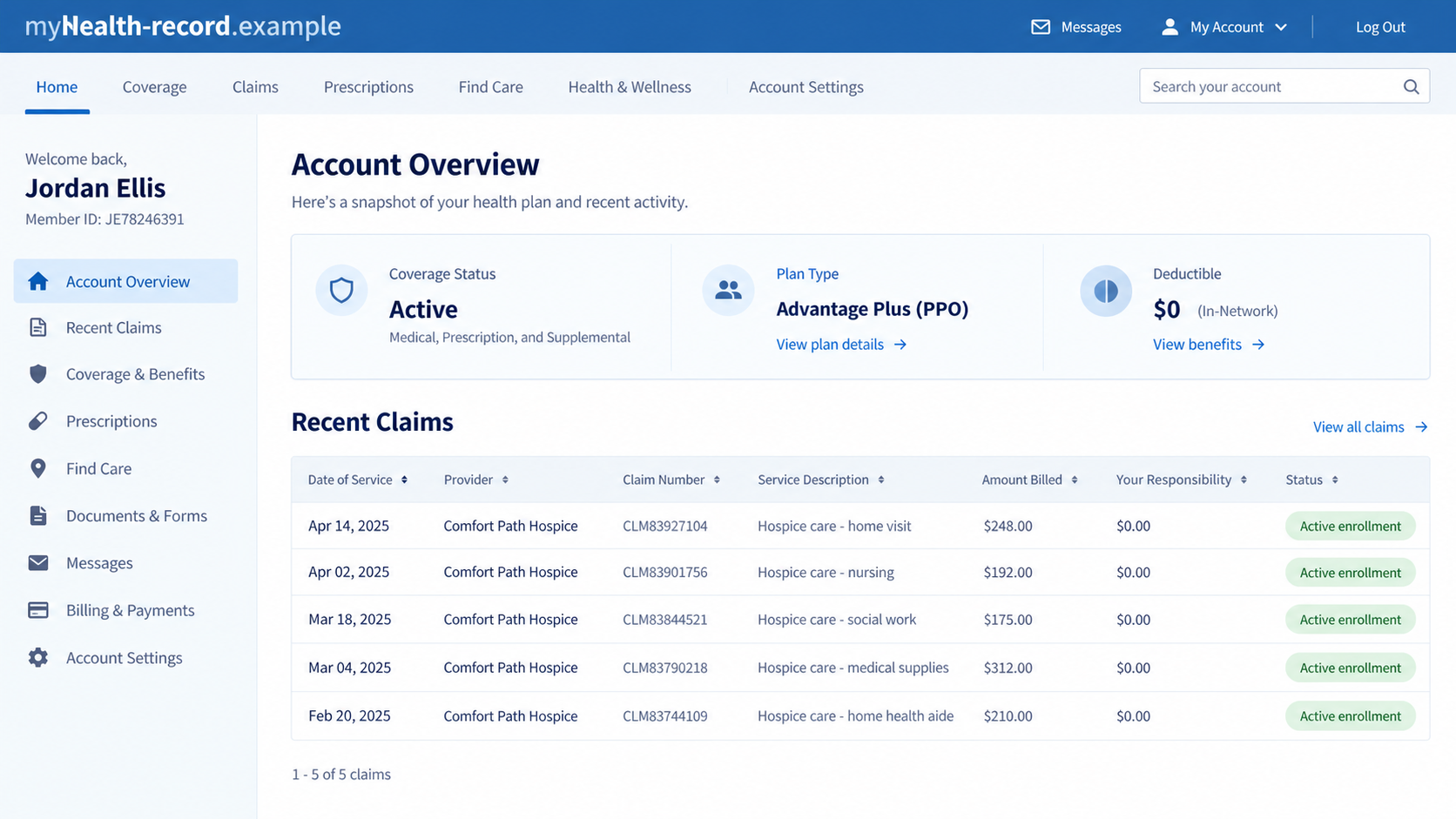
A victim may first discover the problem in a Medicare Summary Notice, an online Medicare account, or a conversation with a doctor who finds that the person’s coverage is being handled under hospice rules.
A real provider name does not make the enrollment proper
Some fraudulent enrollments can involve an actual provider record, National Provider Identifier, office, or salesperson. The important question is not whether a business name exists. It is whether the patient knowingly elected hospice after a valid medical certification and received the care that was billed.
Warning signs include:
- a stranger offers free home services in exchange for a Medicare number;
- a recruiter says hospice is only a benefits program and does not require a terminal diagnosis;
- gift cards, cash, groceries, or other incentives are offered for signing forms;
- the person is asked to sign blank, incomplete, or tablet-based documents that cannot be reviewed;
- a provider appears on a Medicare notice even though no hospice care was requested;
- claims describe visits, supplies, or services the beneficiary never received;
- a doctor or insurer says the patient is enrolled in hospice unexpectedly;
- a salesperson discourages the family from calling Medicare or the patient’s regular doctor.
Why an Unauthorized Hospice Election Matters
Hospice is not simply another discount card or home-help program. It changes how Medicare pays for care connected with a terminal illness. A proper election is a serious, informed medical decision made by the patient or an authorized representative.
Under the Medicare hospice benefit, the patient accepts comfort-focused care instead of treatment intended to cure the terminal illness. Care unrelated to that illness can still be covered, but billing and coordination may become more complicated when an unauthorized provider has inserted itself into the record.
A false enrollment can therefore cause more than an incorrect claim. It can confuse pharmacies, physicians, hospitals, insurers, family members, and legitimate hospice teams. A patient may encounter delays while records are corrected or be told that a service must be handled by a hospice they never chose.
The fraud also follows the beneficiary. Medicare records can show dates, providers, diagnoses, and services that do not describe the person’s actual health. Correcting those records promptly matters for future care and for any investigation.
Medicare advises beneficiaries to compare services on each Medicare Summary Notice with the care they actually received. The notice is not a bill. It is a record of what providers submitted, what Medicare paid, and what the beneficiary may owe.
Questions to ask when an unfamiliar hospice appears include:
- Who certified the terminal illness, and when?
- Who signed the hospice election statement?
- Which provider submitted the claim?
- What services and dates are listed?
- Did the patient receive, request, or understand those services?
- Was any gift, free service, or payment tied to the signature?
How the Fake Hospice Enrollment Scam Works
Step 1: Recruiters look for Medicare beneficiaries
The operation may buy lead lists, place social media ads, call older adults, visit senior communities, or approach people at home. The target is valuable because an active Medicare identity can support repeated claims.
Public information, breached records, earlier health inquiries, and marketing databases can help the caller sound informed. Knowing a name, age, doctor, or health condition does not prove a connection to Medicare.
Step 2: An ordinary home benefit opens the conversation
The recruiter avoids leading with hospice. Instead, the offer concerns food, cleaning, transportation, nursing visits, equipment, pain supplies, or a wellness program.
The service may be described as completely free because Medicare will pay. That simple explanation keeps attention on the benefit while hiding the medical election that makes the billing possible.
Step 3: Personal and insurance details are collected
The victim is asked for a Medicare number, Social Security number, date of birth, address, doctor’s name, medication list, and a copy of an insurance card. A caller may claim the information is needed only to check eligibility.
Those details are enough to identify a beneficiary and build paperwork. A legitimate provider should explain who it is, what care is proposed, why it is medically appropriate, and how the information will be used before collecting sensitive data.
Step 4: A signature is separated from its true meaning
The person may sign on a phone or tablet without seeing the complete document. A recruiter may cover the title, rush the explanation, send only the signature page, or say the form merely authorizes free services.
Other schemes can use forged signatures or submit an election without the patient’s knowledge. Either route creates paperwork that appears more deliberate than the conversation really was.
Step 5: Medical records are manipulated
Hospice eligibility requires medical certification. The FBI says recent schemes have included falsified diagnosis paperwork and enrollment of people who had no terminal illness or chronic condition justifying the service.
The patient may never meet the physician whose name appears, or a real condition may be exaggerated. Families should not assume that a diagnosis code proves the patient was examined properly.
Step 6: Medicare is billed for care that is unnecessary or absent
The provider can submit claims for routine hospice care, visits, supplies, or other services. Some may be delivered in a limited form to make the arrangement look active. Others may never happen.
Because Medicare pays the provider, the beneficiary may not see a card charge. The lack of an immediate personal bill can let the fraud continue until someone reads the claims history carefully.
Step 7: Questions are delayed or redirected
If the patient asks about an unfamiliar notice, the recruiter may say it is routine, a coding issue, or the price of receiving the free benefit. A family may be told that canceling will cause all home services to stop.
That pressure protects the billing relationship. The correct response is to verify directly with Medicare and the patient’s known doctor, not with the person who arranged the enrollment.
What the FBI Has Confirmed
The FBI’s June 2026 public warning describes an emerging fraud scheme aimed at Medicare recipients who do not need hospice. The warning is not based on a disagreement with one company. It identifies a criminal pattern involving unauthorized enrollment and false billing.
Reported conduct includes signing up people who have no terminal illness, enrolling beneficiaries without their knowledge, billing for services not provided, paying bonuses to recruiters, falsifying diagnoses, and pressuring patients to accept care they do not need.
The agency also identified free home services as a lure. House cleaning and meal delivery may be made conditional on using a particular hospice, turning a practical offer into a route toward a medical election.
Medicare’s own hospice benefits guide warns people to avoid offers for services that are not provided by the hospice team and directs suspected fraud reports to 1-800-MEDICARE.
These official warnings establish the scam. They do not mean every hospice, home-care service, recruiter, or unexpected call is fraudulent. Hospice providers deliver essential care every day. The red flag is enrollment or billing that the patient did not knowingly request, medically qualify for, and receive.
Company, Address, and Fulfillment Checks
Verify the provider outside the sales conversation
Ask for the legal provider name, physical address, telephone number, and National Provider Identifier. Then check the provider through Medicare’s official care comparison tools and call a number found independently.
A polished brochure, caller ID, badge, or website can be copied. Independent records show whether a provider exists, but they still do not prove that a specific recruiter is authorized or that the proposed enrollment is appropriate.
Confirm the doctor and diagnosis directly
Call the patient’s regular physician through the practice’s known number. Ask whether the doctor certified hospice eligibility, which diagnosis was used, and whether an election was discussed.
Do not use a callback number supplied by the recruiter. A fraudulent operation can route every number in its paperwork to the same call center.
Match the address and claim dates to real care
Compare the provider address, service dates, and claim descriptions with appointments, visitor logs, medicine deliveries, and family notes. A claim for care on a day when nobody visited deserves an explanation from Medicare.
Keep copies of envelopes, notices, forms, business cards, text messages, and advertisements. Small differences in company names or addresses can connect several claims to the same operation.
Do not treat a free item as fulfilled hospice care
A delivered meal, cleaning visit, gift card, or box of supplies does not validate a hospice election. The promised item can be inexpensive compared with the value of repeated Medicare claims.
Fulfillment must be measured against the medical services billed, the patient’s informed choice, and the care plan. A giveaway cannot substitute for any of them.
What to Do if You Have Fallen Victim to This Scam
- Call Medicare immediately. Use 1-800-MEDICARE (1-800-633-4227) or the contact route inside your genuine Medicare account. Say that you may have been enrolled in hospice without informed consent.
- Ask which hospice is on the record. Request the provider name, claim dates, billed services, and instructions for disputing information that is inaccurate.
- Contact your regular doctor. Ask whether the doctor signed or received any hospice certification and whether your current treatment has been affected.
- Do not sign a second form supplied by the recruiter. A supposed cancellation can collect another signature or admit facts that are not true. Follow Medicare’s official process.
- Preserve every document. Save Medicare notices, claim screenshots, advertisements, caller numbers, emails, texts, names, addresses, business cards, consent forms, and delivery records.
- Review earlier claims. An unauthorized enrollment may be part of a longer billing pattern. Check notices and online history for unfamiliar providers, supplies, home visits, and dates.
- Protect the Medicare number. Tell Medicare that the identifier was disclosed to a suspected fraud operation and follow its instructions for preventing further misuse.
- Secure other exposed identity data. If a Social Security number, identity document, or bank information was shared, visit IdentityTheft.gov, monitor accounts, and consider a credit freeze.
- Check devices used for online forms. Run a Malwarebytes scan if a recruiter asked you to download a file or install software. AdGuard can help block known phishing pages and malicious ads, but Medicare must still correct any unauthorized enrollment.
- Contact the Senior Medicare Patrol. The local SMP program can help beneficiaries understand notices, organize evidence, and report suspected Medicare fraud.
- Report the scheme to the FBI. File at IC3.gov with the provider, recruiter, phone number, address, email, website, dates, and a description of what was promised.
- Warn family caregivers. Explain that messages from the recruiter or provider may be part of the same scheme. Agree that nobody will approve new care or disclose codes without independent verification.
- Reject paid recovery offers. A stranger cannot erase Medicare claims or restore benefits for an upfront fee. Work with Medicare, known doctors, law enforcement, and qualified legal counsel where needed.
Frequently Asked Questions
Can someone enroll me in hospice without my knowledge?
Fraudulent operations can submit false or misleading paperwork, which is why the FBI issued its warning. A lawful hospice election requires informed consent and medical certification. Contact Medicare if the record does not match your decision.
Does hospice mean all of my Medicare coverage disappears?
No. Hospice changes how care related to the terminal illness is managed and paid. Care unrelated to that condition may still be covered. An unauthorized election can nevertheless disrupt coordination and should be corrected quickly.
Is a free meal or cleaning offer always a scam?
No, legitimate community programs exist. The danger appears when the benefit is tied to giving a stranger a Medicare number, signing hospice paperwork, accepting a diagnosis, or using a provider you did not choose.
Why would scammers enroll someone who never pays them?
The target of the billing is Medicare. A beneficiary’s real identity can support claims paid by the program, so the criminal may profit without charging the person’s card directly.
How can I see whether hospice claims were submitted?
Review your Medicare Summary Notices and the claims in your official Medicare account. Compare every provider, date, and service with care you actually received.
Should I call the number on the hospice paperwork?
Preserve it as evidence, but verify through Medicare and independently located provider details first. The number on questionable paperwork may return you to the same operation.
The Bottom Line
The fake hospice enrollment scam turns a useful-sounding home benefit into a hidden medical election and a stream of Medicare claims. The person targeted may be healthy, may never receive hospice care, and may not learn about the enrollment until it interferes with real treatment.
Do not trade a Medicare number or signature for free services. Verify the provider and diagnosis through Medicare and a known doctor. If an unfamiliar hospice or claim appears, act immediately, preserve the record, and report it through official channels.

Join the discussion
0 commentsShare your experience or ask a question about this article.
Discussion
Start the conversation
Have a question or something useful to share? Add the first comment.