

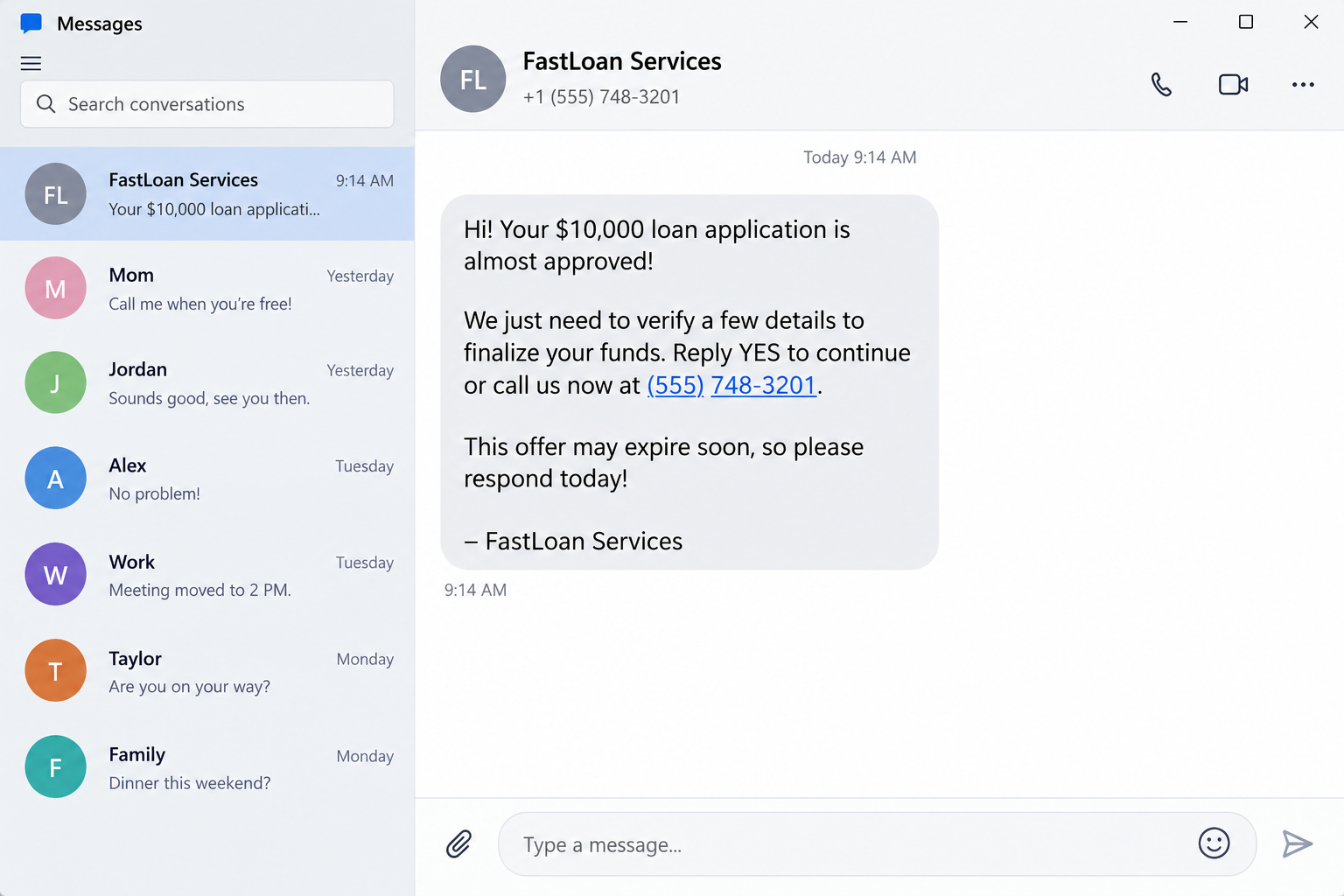
A fake loan text scam starts with an application you never submitted. The message says thousands in funding are almost approved and only one reply, call, or final verification step stands between you and the money.
The offer can be tempting, confusing, or worrying. Before you reply “NO” or call to correct the mistake, look at what the sender is trying to make you reveal.
Overview
The nonexistent application is the opening
The message claims that a personal loan application is incomplete, preapproved, ready for release, or waiting for identity confirmation. It may mention a large amount and say the offer expires today.
The recipient does not remember applying because no application exists. The story is designed to trigger curiosity and start a conversation.
The United States Federal Trade Commission warned about texts that falsely follow up on loan applications, including messages claiming that a recipient is preapproved or has reached the final step.
Every response gives the sender something useful
Replying confirms that the telephone number is active and that the message reached a person. Calling the supplied number connects the recipient to someone trained to turn confusion into an identity-verification conversation.
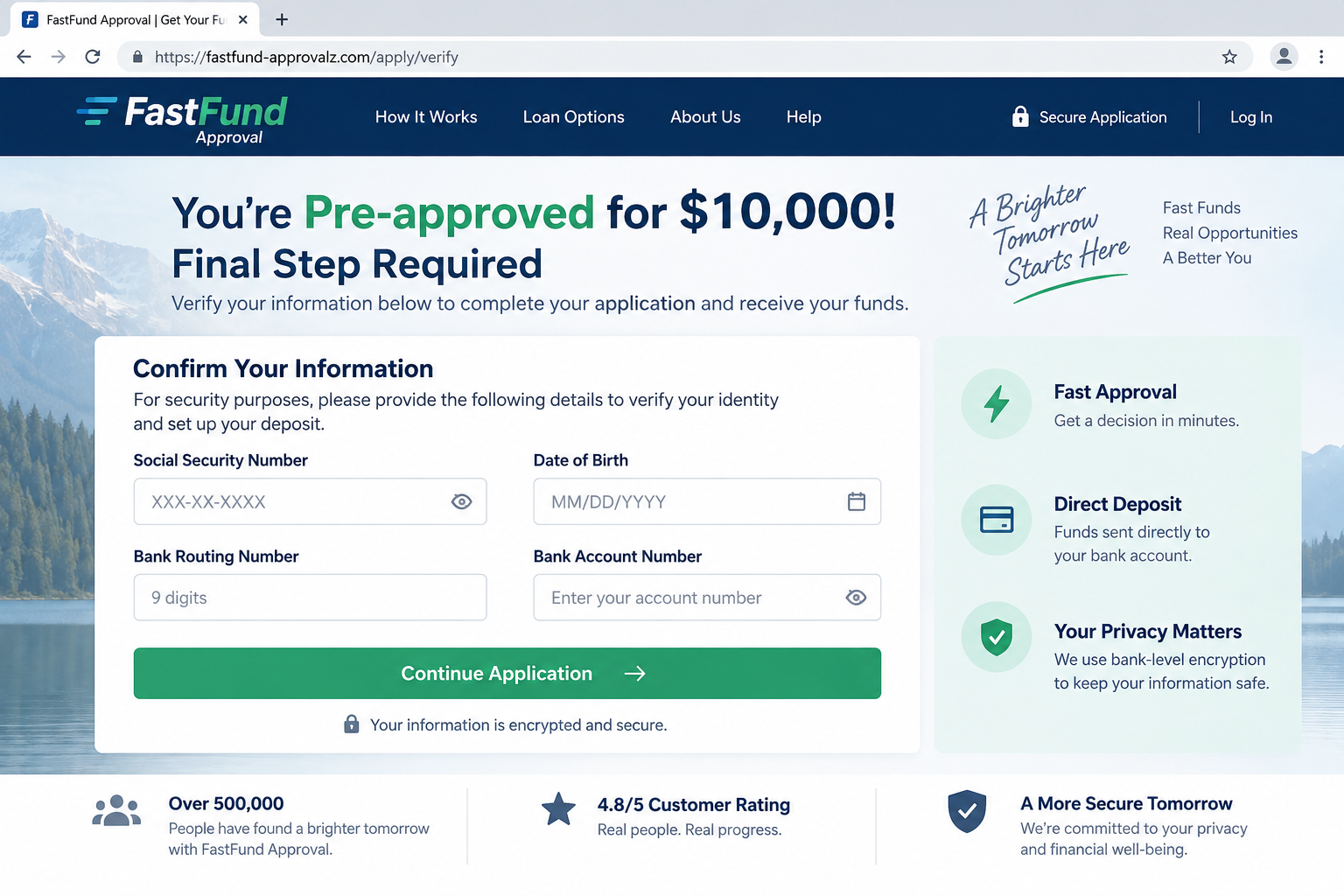
The scammer may request a Social Security number, date of birth, address, bank details, online-banking credentials, or an upfront payment. A phishing link can collect the same information through a polished form.
Even a request to cancel the application can become the excuse for demanding personal data. The false application is never canceled because it was never real.
A legitimate loan begins with your own action
A real lender can advertise, but it does not need secret information to remove an application you did not create. Do not use the message’s link, telephone number, or opt-out instruction.
If the text names a real lender with which you have an account, contact that company through its official website, app, statement, or card. Ask whether any application exists.
Warning signs include:
- A text about a loan application you never started.
- A claim that a large amount is already approved without a proper credit process.
- A request to reply YES, NO, STOP, or CONFIRM before receiving details.
- A callback number that is different from the lender’s published number.
- A form asking for a Social Security number and bank details through an unsolicited link.
- An origination, insurance, processing, or release fee demanded before funds arrive.
- Payment instructions involving gift cards, crypto, wire transfers, or payment apps.
Why People Respond to a Loan They Never Requested
The sender creates a contradiction that feels as if it needs an answer. If you did not apply, you may worry that someone stole your identity. If money is tight, you may wonder whether the offer is genuine.
Both reactions lead toward the same callback number. The criminal does not care whether the recipient is interested in the loan or trying to cancel it.
The amount is usually high enough to attract attention but not so extraordinary that it reads like a lottery win. Words such as preapproved, pending, final step, and funds ready suggest that most of the work is already complete.
A short deadline prevents the recipient from researching the company. The text may say the application will close, the rate will change, or the funds will be reassigned.
The message may include the recipient’s name, city, partial address, or a supposed application number. Data brokers, breached databases, and earlier forms can provide those details.
Scammers also exploit the way legitimate lenders market credit. Many people receive real promotional messages, so a fraudulent one does not always look unusual at first glance.
A local-looking number adds familiarity, but caller ID and text sender information can be spoofed or rapidly replaced. The area code does not reveal where the operator is located.
Some messages offer an easy opt-out. That can feel safer than engaging with a sales pitch, yet replying still confirms an active number and opens the door to a scripted response.
How the Fake Loan Text Scam Works
Step 1: A mass text invents an application
Thousands of recipients receive a message claiming that a loan is preapproved or almost complete. The campaign does not need to know who is borrowing.
A broad send will reach people who recently compared loans, need money, or fear that an identity thief applied in their name.
Step 2: The recipient is told to reply or call
The text may say “Reply YES to continue” or “Reply NO to cancel.” Other versions provide a telephone number for the underwriting, approval, or fraud department.
Either action confirms engagement. An automated system or human operator then delivers the next part of the script.
Step 3: The operator explains away the surprise
If the victim is interested, the operator says a marketing partner submitted an eligibility request. If the victim is alarmed, the operator says identity verification is required to close the file.
Both stories lead to the same questions about identity, employment, income, address, and banking.
Step 4: A form collects sensitive information
The victim is directed to a website that displays a loan amount, approval badge, interest rate, and progress bar. The form requests a Social Security number, date of birth, bank routing number, account number, and online-banking information.
The domain may resemble the invented lender name and carry HTTPS. Those details do not connect it to a licensed financial institution.
Step 5: The scam changes from approval to payment
The operator may claim that funds cannot be released until the borrower pays for insurance, credit repair, processing, a deposit, or a verification transaction.
Legitimate lenders disclose costs and generally deduct authorized fees from loan proceeds. A demand to send money first through an irreversible method is a major danger sign.
Step 6: Stolen data is used for other fraud
The criminal can attempt bank access, open accounts, apply for credit, redirect payments, or sell the identity package. If credentials were shared, unauthorized activity may begin immediately.
A one-time code may approve a login or new device rather than verify a loan application.
Step 7: New demands keep the victim engaged
After an initial fee, the supposed lender discovers a tax, transfer charge, negative balance, or credit problem. Each payment is described as the last obstacle.
No funds arrive because the approval screen and loan balance were fictional from the start.
Preapproval Does Not Mean Money Is Waiting
In ordinary lending, preapproval is not the same as final approval or disbursement. A lender may still verify identity, income, debts, credit, and eligibility.
A legitimate offer contains clear company information, disclosures, terms, costs, and a way to review the agreement without pressure. It does not arrive as an unexplained finished application that requires an immediate secret code.
Be cautious when the sender guarantees approval regardless of credit. A promise that no information is needed can quickly turn into a request for the most sensitive information you have.
Look at the rate and repayment terms, not only the amount. Fraudulent pages often emphasize the cash while hiding the cost or using numbers that do not add up.
Do not install an application so a lender can deposit money. Remote-access tools, device-management profiles, and unknown mobile apps can expose messages, passwords, and bank sessions.
A verification deposit is not proof of a legitimate loan. Criminals may send money from another victim, use a fraudulent check, or display a balance that is not withdrawable.
If a small amount arrives unexpectedly, contact your bank. Do not send it onward or return it to a different account based on instructions from the text sender.
What Can Happen After You Share the Details
A Social Security number, date of birth, and address can support new-account fraud. The criminal may apply for credit, mobile service, utilities, or government benefits.
Bank routing and account numbers can be used in unauthorized debits or to make later impersonation calls more convincing. Online-banking credentials create a more direct risk.
Email access lets the operator intercept security alerts, reset other accounts, and study financial conversations. Malicious forwarding rules can hide replies from the inbox.
A photo of an identity document may be reused in marketplace fraud, account verification, or money-mule recruitment. The resulting activity can make the real owner appear connected to transactions they did not authorize.
Card information may be tested with a small charge before larger purchases. The criminal can also try to add the card to a digital wallet.
If you paid an upfront fee, another caller may soon offer to recover it. That person may know the exact amount and invented lender name because the same group retained your file.
Identity fraud does not always appear immediately. Continue monitoring accounts and credit records after the initial incident is resolved.
How to Check the Lender Without Using the Text
Search for the company independently, but do not rely on the first sponsored result. Compare the legal name, domain, telephone number, physical address, and licensing information across authoritative sources.
In the United States, check the relevant state financial regulator and the Nationwide Multistate Licensing System consumer database when appropriate. Registration alone does not guarantee a good offer, but missing or mismatched records are important warnings.
Call the number on an official statement or verified regulator listing. Ask whether the application reference exists and whether the message’s callback number belongs to the company.
Search the full telephone number and domain with terms such as scam, fraud, complaint, and impersonation. Look for reports describing the same script rather than treating one anonymous review as decisive proof.
Check the domain’s spelling and age. A recently created site with copied lender details deserves caution, especially when it claims years of operation.
Read the privacy policy and lending disclosures. Generic text, another company’s name, missing jurisdiction, and inconsistent contact details suggest a copied template.
Never upload identity documents simply to find out who contacted you. The company must establish its identity before you provide yours.
If you never applied, the safest action is to report and delete the text. You do not have to correct the sender’s records.
Company, Address, and Fulfillment Checks
Confirm the legal lender identity
A marketing name can be invented in minutes. Look for a legal entity, licensing record, regulator details, and disclosures that match the domain and the product being offered.
Do not accept a license number shown only on the suspicious website. Verify it in the regulator’s own database.
Check the physical address independently
Search the address and compare it with official filings. Fraudulent pages may copy a real lender’s office, use a mailbox, list an unrelated building, or provide no address at all.
An impressive location does not prove the text sender works there. Contact the business through separately verified details.
Compare every contact channel
The callback number, sender domain, support email, and website should belong to the same verified organization. A mix of free mailboxes, messaging apps, and constantly changing numbers is not normal loan servicing.
End the call if the operator refuses to let you verify the company and call back.
Verify how funds and fees are handled
Ask for the complete loan agreement and disbursement process before paying anything. Confirm the lender, amount, rate, repayment schedule, and all costs.
Gift cards, crypto, wire transfers to individuals, and payment-app transfers are not normal ways to release loan proceeds. A dashboard balance is not proof that money is available.
What to Do if You Have Fallen Victim to This Scam
- Stop communicating and save the evidence. Keep the complete text thread, sender number, callback number, website address, forms, emails, receipts, and transaction records.
- Contact your bank and card issuer. Report exposed account or card details, dispute unauthorized activity, and ask whether accounts or credentials should be replaced.
- Change compromised passwords. Secure email and banking first, then any account that reused the same password. Turn on multifactor authentication.
- End unknown sessions. Review devices, recovery methods, forwarding rules, digital wallets, payees, and bank tokens. Remove anything you do not recognize.
- Protect your identity. Visit IdentityTheft.gov for a recovery plan in the United States, review credit reports, and consider a credit freeze with all three bureaus.
- Report the campaign. Use the phone’s report-junk control or forward the text to 7726, then report it to the FTC at ReportFraud.ftc.gov.
- Tell the impersonated lender. Use contact details from its official site so it can investigate the number, domain, and copied branding.
- Scan affected devices. Run a full Malwarebytes scan if you downloaded a file, installed an app or profile, or allowed remote access.
- Block known malicious pages. AdGuard can reduce exposure to many phishing domains and deceptive advertisements, but it cannot protect information already submitted.
- Watch for recovery scams. Do not pay anyone who guarantees a refund, identity cleanup, or loan release for another upfront fee.
Report the incident even if you did not lose money. The number, domain, and script can help connect a broader campaign.
If money was sent, ask the payment provider whether it can recall or freeze the transfer. Speed matters, but no recovery is guaranteed.
Frequently Asked Questions
Should I reply NO to cancel the loan application?
No. The application is probably invented, and replying confirms that your number is active. Report and delete the message instead.
Can a lender preapprove me without an application?
You may receive legitimate marketing offers, but a text claiming that a full application is almost complete should be verified through an independently located company channel.
What if the sender knows my name and address?
Those details may come from data brokers, breaches, or public records. They make the script personal but do not authenticate the lender.
Is an upfront loan fee always a scam?
Loan costs vary, but sending money by gift card, crypto, wire, or payment app to release promised funds is a classic warning. Review written terms and verify the lender first.
I clicked the link but entered nothing. What should I do?
Close it, clear any unexpected downloads, update the browser, and scan the device if something installed. Watch for follow-up messages because the visit may confirm interest.
Could the unexpected loan mean someone stole my identity?
The text alone does not prove an application exists. Check credit reports and contact any named lender through official details if you see evidence of a real unauthorized application.
The Bottom Line
A fake loan text scam invents an application so that interest, fear, or a wish to cancel pushes you into revealing valuable personal and banking information.
Do not reply, call the supplied number, or use the link. Report the message, verify any real concern independently, and protect exposed accounts without returning to the sender.








