

Fake tax deduction calculators often arrive with a tempting promise: a larger refund hidden inside a recent rule change and discoverable in minutes.
At first, the questions feel ordinary and the numbers look encouraging. What happens next is why these tools deserve a closer look.
Overview
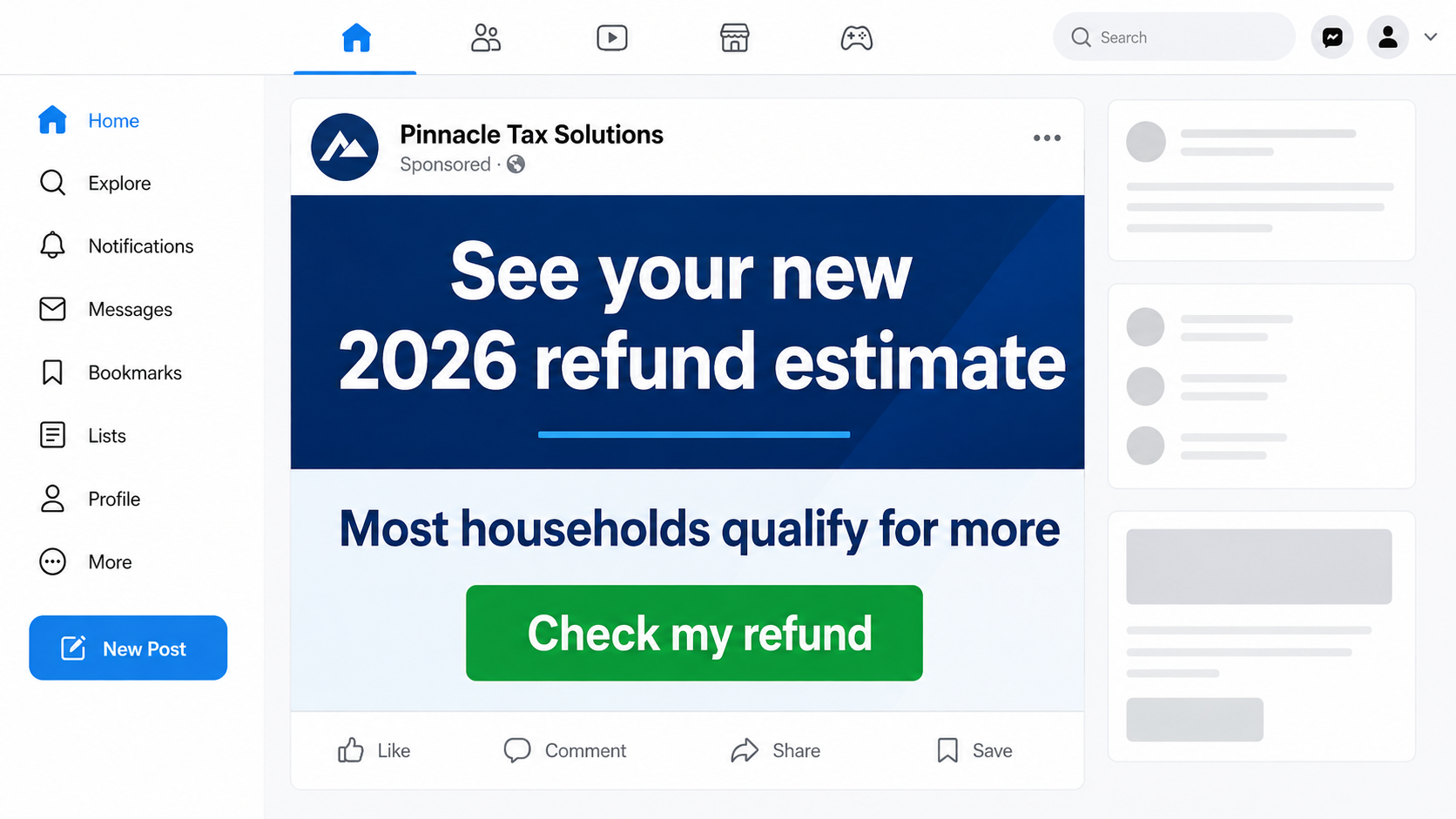
The hook is a refund tied to a recent law
Tax rules do change, and most people do not have time to study every provision.
Scammers exploit that gap by advertising a simple checker that supposedly knows whether the visitor qualifies for new or expanded benefits.
The message may mention working families, a missed credit, a larger standard deduction, a rebate, or an automatic adjustment.
It frames caution as the only thing standing between the user and money already waiting.
A tax calculator is supposed to help you estimate.
It cannot guarantee a refund before it has your complete, accurate tax information, and it does not need your bank login to explain a deduction.
Fake versions use the promise of newly expanded credits or deductions to collect identity data.
Some are promoted through social posts, search ads, unsolicited messages, or sites designed to resemble official guidance.
The first few questions make the result feel earned. The sensitive questions reveal what the site was built to obtain.
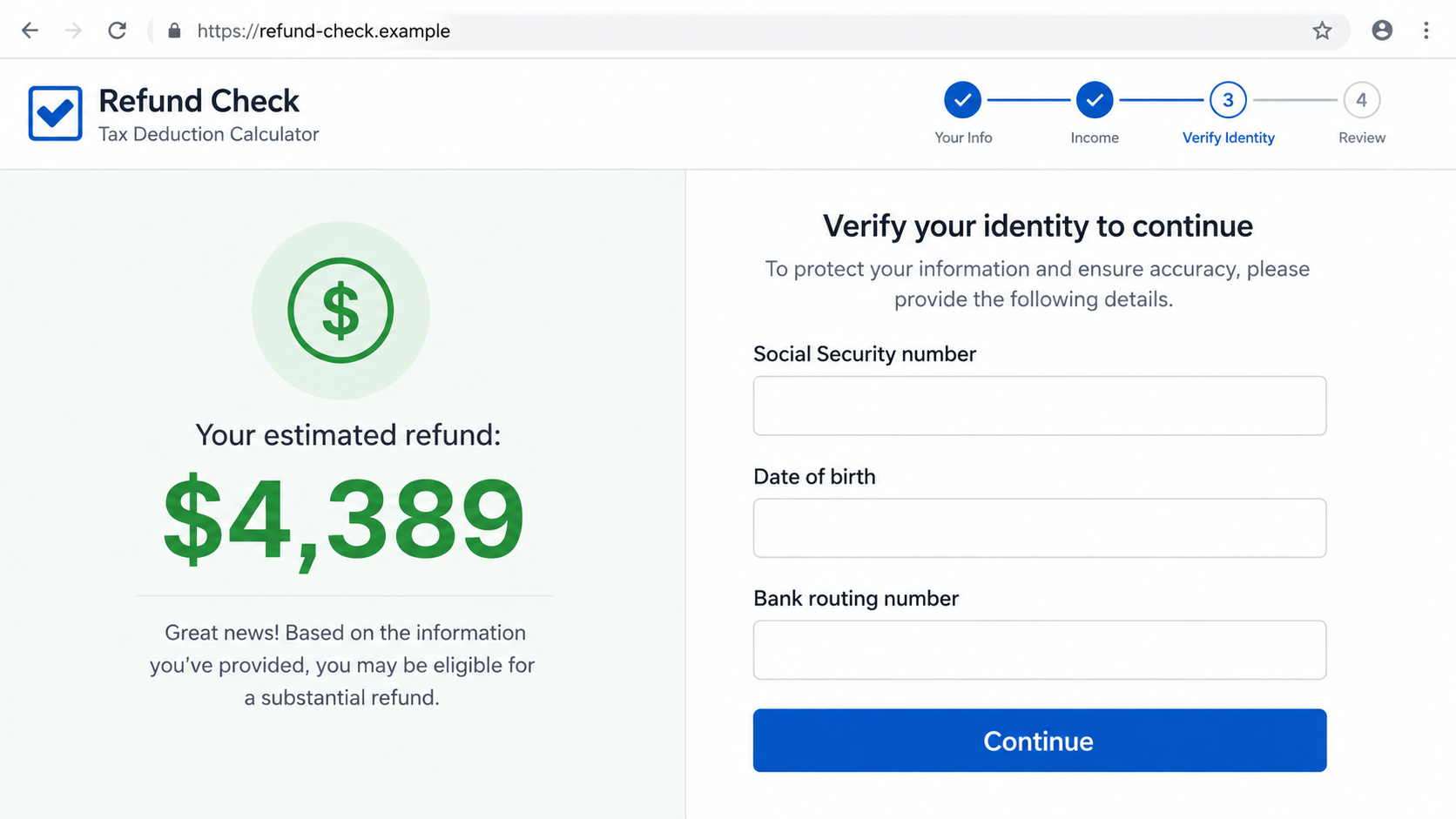
The calculator moves from estimation to identity collection
Legitimate tools may need income, filing status, and household details to produce an estimate.
A suspicious tool goes further, especially before explaining who operates it or how the information will be used.
Dangerous requests can include:
- a full Social Security number;
- date of birth and home address;
- a copy of a driver’s license or tax return;
- bank routing and account numbers;
- IRS Online Account credentials or verification codes;
- a fee to unlock, submit, or accelerate the promised refund.
The IRS has warned specifically about this pattern
In March 2026, the IRS warned about fake tax deduction calculators exploiting public interest in recent tax-law changes.
The agency said tools guaranteeing an unusually large payday may be phishing attempts for dates of birth, Social Security numbers, or bank information.
The warning is about a scam mechanism, not every private tax calculator. Reputable tax-software companies offer legitimate estimators.
The difference is whether the operator can be verified, the estimate is qualified honestly, and the information requested is proportionate.
Why a Big Refund Number Feels So Convincing
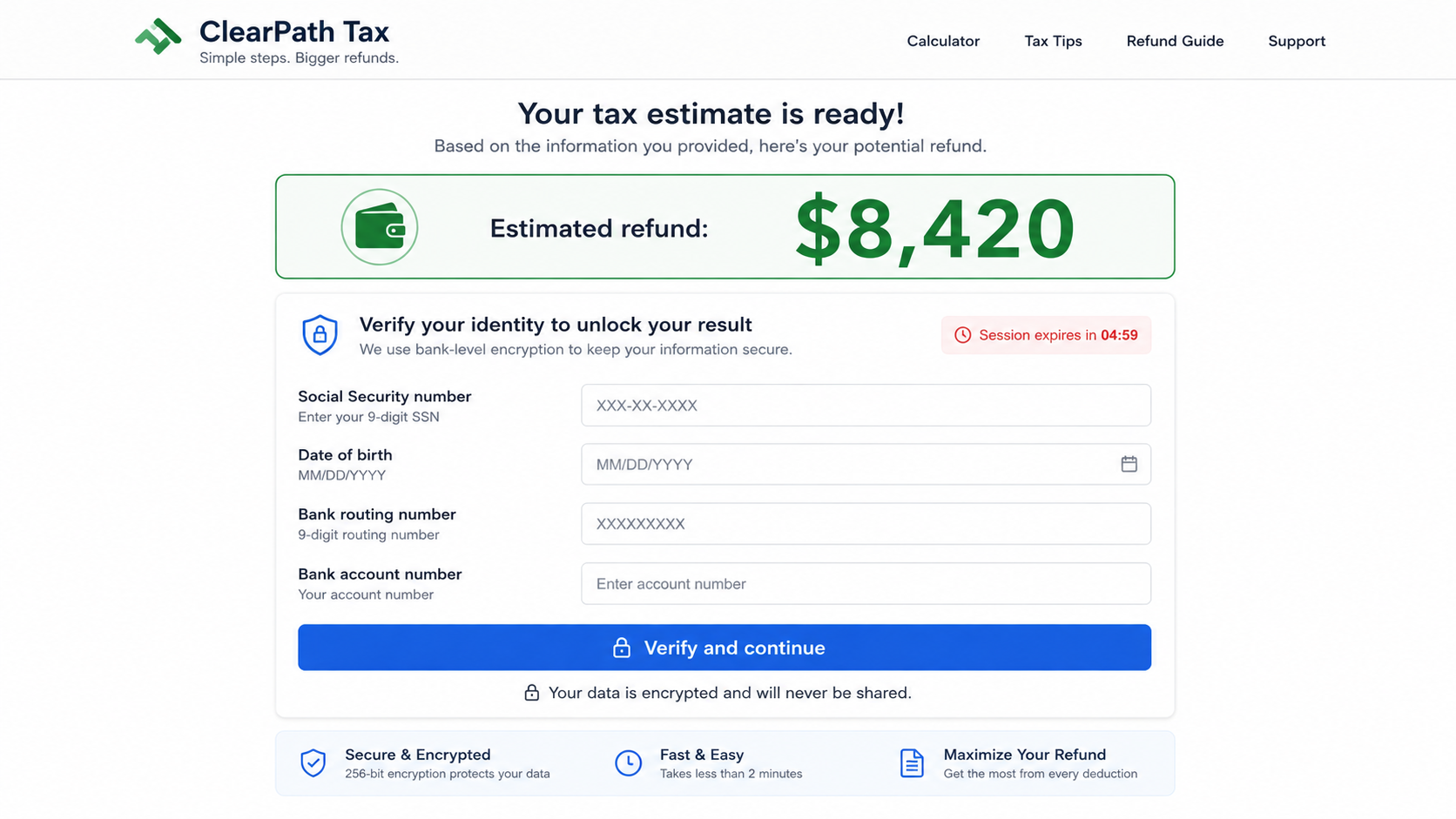
The page does not have to understand your tax situation. It only has to display a number large enough to keep you moving.
Early questions create the appearance of calculation. Select a filing status, enter an income range, choose the number of children, and watch a progress bar advance.
A result shown after those steps feels personalized even if the page gives similar figures to everyone.
The number also changes the user’s emotional position. Before the result, the visitor is evaluating a website.
After the result, the visitor feels they may lose $3,000 or $5,000 by stopping.
Scammers then call the next screen verification. That word sounds protective, but the form may be collecting exactly what an identity thief needs.
A real estimate is conditional. It depends on accurate income, filing status, deductions, credits, withholding, prior payments, and other facts.
A website that promises a guaranteed payday after a handful of broad questions is selling certainty that tax arithmetic cannot support.
How Fake Tax Deduction Calculators Run the Scam
Step 1: An ad turns a tax change into free money
The campaign begins with a sponsored post, search result, short video, email, or text. It says ordinary households are missing a new benefit or that a recent law increased refunds.
The language is broad enough to fit millions of people.
Phrases such as check eligibility, see your amount, and claim before the deadline encourage a click without making a detailed promise that can be tested first.
Step 2: A government-like page borrows authority
The landing page may use flags, official colors, document icons, or words such as federal, relief, taxpayer, and benefits. A padlock in the browser only means the connection is encrypted.
It does not make the operator the IRS.
Some addresses place IRS-like words inside a longer domain. The important part is the registered hostname, not a government term appearing somewhere before or after it.
Step 3: Low-risk questions build momentum
The visitor answers questions that resemble a genuine estimator. These may include age range, state, dependents, filing status, and a rough income bracket.
Each answer is easy, and the page may say the visitor is likely eligible. By the time sensitive fields appear, the user has invested attention and expects a reward.
Step 4: The page manufactures an attractive result
A large refund estimate appears with congratulatory language. There may be a countdown, a limited application window, or a claim that funds are reserved.
No website can reserve an IRS refund simply because someone completed an online quiz. The number may be an arbitrary lure rather than a tax calculation.
Step 5: Verification collects the valuable data
The next screen asks for a Social Security number, date of birth, phone number, address, bank details, or copies of documents.
It may claim those fields are required to match IRS records.
Another version asks the user to sign into an IRS or tax-software account through a linked page. A copied login form can capture credentials and one-time codes.
Step 6: A fee or sales call may follow
After the data is submitted, the site may request a processing fee, sell the lead to aggressive tax-relief marketers, or trigger calls from people offering to file a claim.
A dishonest preparer may propose credits the taxpayer does not qualify for.
The preparer gets paid, but the taxpayer remains responsible for the return and may face repayment, interest, penalties, or an audit.
Step 7: The same identity supports additional fraud
Taxpayer data can be used to attempt a fraudulent return, open accounts, answer security questions, or craft more convincing messages.
Bank details create a separate route to unauthorized debits and payment scams.
The original site can disappear while the data continues circulating. A new calculator, advertiser, or domain can reuse the same script during the next news cycle.
The page’s identity trail matters as much as its refund claim. A calculator handling sensitive data should make its operator easy to verify.
Company, Address, and Fulfillment Checks
The calculator name is not the operator
Look for a legal company name, privacy policy, terms, and a clear explanation of whether the service is an estimator, lead generator, or tax preparer.
A label such as Federal Refund Checker proves nothing by itself.
Search the legal name separately. Do not assume that an advertiser’s display name matches the entity receiving your information.
The address bar matters more than government styling
Official federal tax information is on IRS.gov. A hostname such as irs-refund-help.example is not an IRS site just because it begins with familiar letters.
Open IRS.gov independently. Do not use a link from the ad to decide whether the ad is official.
Support should answer what happens to your data
A legitimate provider should explain why each field is needed, how it is protected, whether it is sold, and how it can be deleted.
A form that demands a Social Security number before showing an operator or privacy contact deserves no trust.
Do not test support by sending more personal information. Ask general questions first and verify the answer through records outside the site.
A real calculation should be reproducible
A trustworthy estimator identifies assumptions and does not present a guaranteed refund.
Compare the result with the official IRS Tax Withholding Estimator or established tax software reached through its known site.
If the page cannot explain which credit, deduction, income figure, or withholding amount created the result, the number is marketing bait rather than useful tax guidance.
Warning Signs That the Calculator Is a Phishing Form
- The ad guarantees a large refund before it knows your full tax facts.
- The page implies a deadline that does not appear on IRS.gov.
- The domain is a misspelling, imitation, or unrelated commercial address.
- A basic estimate requires a complete Social Security number.
- The site asks for online-account credentials or a one-time code.
- Bank details are required before any return has been prepared.
- The legal operator and privacy policy are missing or inconsistent.
- A fee is required to release a refund supposedly already approved.
- A preparer promises credits without reviewing supporting records.
One clue may have an innocent explanation. Several together should end the session.
The safest question is simple: could you obtain the same tax answer by opening IRS.gov or trusted tax software on your own?
If yes, there is no reason to hand sensitive data to an unknown ad.
Fake Calculator, Lead Form, or Bad Tax Advice?
These problems can overlap, but they are not identical.
A phishing calculator is designed to steal information or credentials.
A lead-generation page collects contact details and sells or routes them to marketers, sometimes with consent buried in fine print.
A dishonest tax promoter may persuade people to file claims they cannot legally support.
The user can be harmed in all three cases, but the response differs. Credential theft requires account containment. Identity-data exposure requires monitoring and tax protections.
A questionable return requires prompt advice from a qualified tax professional.
Do not call every unfamiliar calculator criminal without evidence.
Instead, describe what the page actually does: guarantees a result, hides its operator, requests disproportionate data, sends visitors elsewhere, or charges for a benefit it cannot deliver.
The IRS CP53E phishing trap shows a related lesson. Scammers can borrow language from a real tax process.
Familiar terminology still needs to be verified through an independently opened IRS account or official number.
What to Do if You Have Fallen Victim to This Scam
- Stop using the calculator. Close the page and do not pay a verification, filing, or release fee.
- Write down what you entered. Separate contact information, Social Security number, bank details, tax documents, passwords, and one-time codes. Your response should match the exposure.
- Secure any account credentials. Change passwords through the real provider, sign out other sessions, enable MFA, and remove unfamiliar recovery methods.
- Contact the bank if financial data was shared. Ask its fraud team about account monitoring, replacement numbers, blocks, and unauthorized transfers. Use the number on your statement or card.
- Protect your tax identity. Consider obtaining an IRS Identity Protection PIN through IRS.gov so another person cannot easily file a federal return using your Social Security number.
- Check credit reports. Review all three major bureaus and consider a free credit freeze if identity information was exposed.
- Speak to a qualified tax professional. If someone filed or prepared a questionable return, do not try to hide it. Ask how to correct the record before the problem grows.
- Preserve evidence. Save the ad, domain, completed screens, emails, text messages, receipt, payment record, and the name used by any caller.
- Scan the device when appropriate. If you downloaded a file or browser extension, Malwarebytes can check for malware and unwanted software. A scan cannot undo submitted identity data.
- Reduce repeat exposure. AdGuard can block many malicious ads and known scam pages, but it is still important to verify tax sites independently.
- Report the page. Forward tax-related scam emails or site information to phishing@irs.gov and report fraud to the FTC or TIGTA as appropriate.
- Reject recovery offers. A stranger who promises to erase stolen data or guarantee your refund for another upfront payment is not solving the first problem.
Frequently Asked Questions
Are all online tax calculators scams?
No. The IRS and established tax-software providers offer legitimate tools. Verify the operator and domain, and expect an estimate based on stated assumptions rather than a guaranteed payout.
Does a tax estimator need my Social Security number?
A general deduction or refund estimate usually can be produced without a full Social Security number.
A filing service may need it later, but only after you deliberately choose a verified preparer and understand the privacy terms.
Can a website know my exact refund before I file?
Not from a few broad questions. The real amount depends on complete and accurate tax data, withholding, payments, credits, deductions, and IRS processing.
What if the ad says the calculator is government approved?
Do not rely on the claim. Open IRS.gov yourself and look for the program or tool. Government colors, flags, and words are easy to copy.
I entered my information but did not pay. Am I safe?
Payment is only one risk. Social Security, birth, bank, and login data can support identity theft. Take protective steps based on every field you submitted.
Can I recover a fee paid to a fake tax site?
Contact the card issuer, bank, or payment service immediately and ask about a dispute or recall. Recovery is not guaranteed, but speed improves the available options.
The Bottom Line
Fake tax deduction calculators turn confusion about new rules into a promise of easy money. Ordinary questions build credibility before the form reaches more sensitive information.
Use IRS.gov or a tax provider you reached independently. Expect qualified estimates and clear assumptions, never a guaranteed refund unlocked through identity or banking details.
If you submitted sensitive data, treat it as identity theft even if no money moved. Secure accounts, protect your tax identity, monitor credit, and report the site.

Join the discussion
0 commentsShare your experience or ask a question about this article.
Discussion
Start the conversation
Have a question or something useful to share? Add the first comment.