

The vacant land sale scam can begin like an unusually clean listing lead. An owner is ready to sell, flexible on price, and eager to move quickly.
The property is real, the paperwork appears orderly, and genuine professionals may become involved. One hidden detail can change the entire transaction.
Overview
Criminals impersonate owners of property that is easy to avoid visiting
Vacant land is attractive because there is no resident to notice a sign, question a photographer, or challenge a person claiming to sell.
The true owner may live in another state and check the parcel only occasionally.
The criminal does not need to invent the property. County and state records can provide enough genuine detail to make the opening email sound informed.
This scam uses public property records to build a convincing identity.
A criminal can know the owner’s name, mailing address, parcel number, tax status, and legal description before contacting an agent.
The agent, photographer, title company, notary, and buyer can all be legitimate. They may be pulled into a transaction built around one false fact: the seller’s identity.
If nobody verifies the owner through a channel the impostor does not control, genuine professionals can carry the fraudulent sale almost to the finish line.
Real professionals make the false transaction look normal
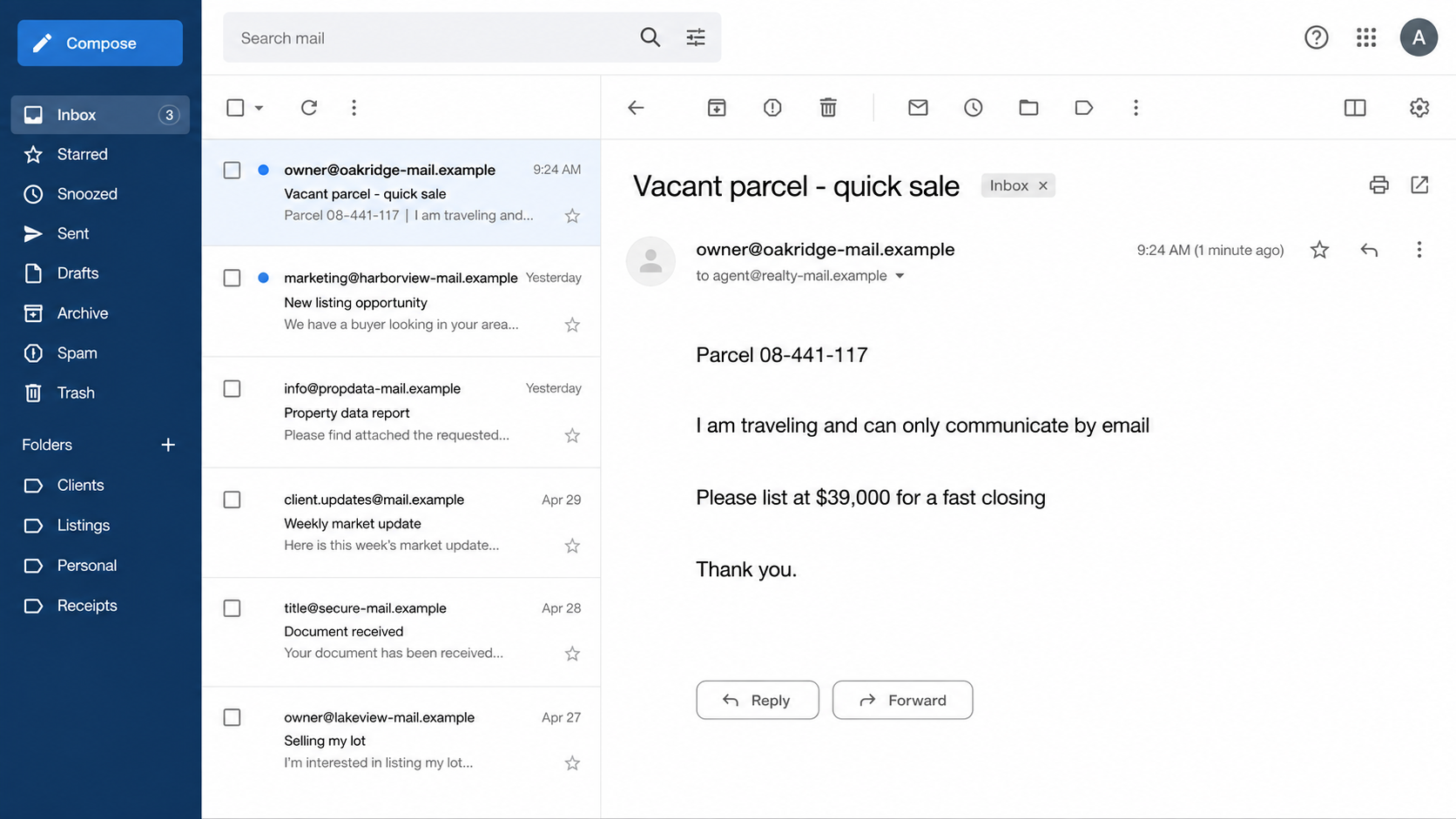
The impostor contacts a real estate agent and asks for a remote sale. If the listing proceeds, ordinary market systems may place it before genuine buyers.
The scheme can involve:
- a newly created email address using the owner’s name;
- a VoIP number that is easy to replace;
- a forged driver’s license or passport;
- a fake or altered deed;
- pressure to price below market and close quickly;
- remote notarization or excuses to avoid live contact;
- wire instructions sending proceeds to another person or state.
The FBI has identified the pattern as identity theft
The FBI’s June 2026 public warning describes criminals impersonating owners of vacant parcels and attempting to sell the property without consent.
The alert covers fake identity documents, new email and VoIP accounts, realtors and title companies, and proceeds directed to a co-conspirator attorney.
This is not a frustrated seller or a disputed commission. The defining act is impersonating the recorded owner to transfer property the criminal does not own.
Why Vacant Parcels Are Attractive Targets
An occupied home has natural witnesses. The owner, tenant, neighbors, utilities, and physical keys all create opportunities for a false seller to be exposed.
A vacant lot has fewer daily signals. It may have no mailbox, no utility account, no building, and no reason for the owner to visit regularly.
Property records also contain useful facts. The impostor can quote the parcel number and legal owner, then use a map and listing history to answer basic questions.
Tax-mailing addresses may show that the owner lives far away. That helps the criminal choose a plausible excuse for remote communication.
The property may also have a clean-looking online history. Since the parcel itself exists, map results, tax entries, and past sale dates reinforce the story instead of exposing it.
That is why checking the land is not enough. The critical check connects the person giving instructions today with the owner already established in reliable records.
Unmortgaged property can be especially attractive because there is no lender involved in the existing title to create another verification point.
An investor-owned or inherited parcel may also have a less active owner.
None of these characteristics proves a listing is fraudulent. They explain why identity verification must be stronger when several appear together.
How the Vacant Land Sale Scam Works
Step 1: Public records identify a promising parcel
The criminal searches for vacant land, often with no mortgage and an owner whose mailing address is elsewhere. Public records provide the name and property description.
Additional personal data may come from data brokers, breached accounts, phishing, social media, or criminal marketplaces.
Step 2: The owner receives a new digital identity
The impostor creates an email address containing the owner’s name and a temporary or VoIP telephone number.
A fake driver’s license or passport may use real biographical details with a different photograph.
The contact methods are controlled by the criminal. Calling the number from the email only confirms that the same impostor can answer two channels.
Step 3: A legitimate agent is asked to list the land
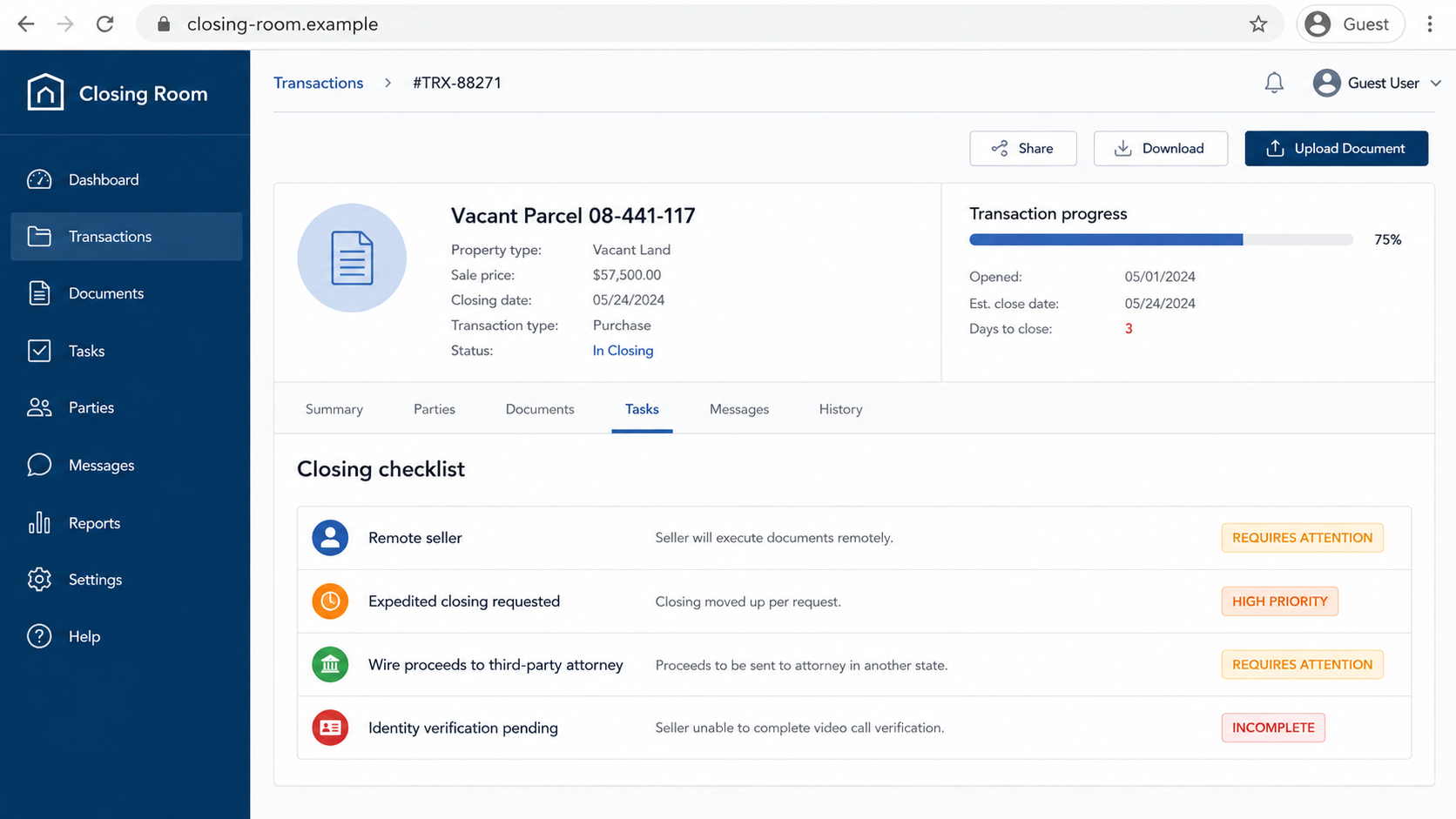
The supposed owner says they want a simple, fast sale. They may accept a low price, discourage negotiation, and explain that travel or illness prevents a meeting.
An attractive price helps recruit a buyer quickly. It also makes everyone worry that a delay will cause the seller to choose someone else.
Step 4: Normal transaction documents carry false identity data
The agent prepares a listing agreement. A buyer submits an offer. A title or closing company opens a file.
Most participants are performing normal work based on the documents they received.
The criminal may provide a forged ID, altered deed, false signature, or notarized document. A professional-looking file is evidence to examine, not proof of ownership.
Step 5: Remote communication avoids the hardest questions
The impostor refuses an in-person meeting or live video verification.
Email is preferred because it gives time to research answers and avoids comparison with the face on an identity document.
Requests for unusual details may be answered vaguely. Surveys, tax history, access rights, nearby owners, and the story of how the land was acquired can reveal gaps.
Step 6: The closing is rushed and the payout is redirected
The seller presses for an expedited close and supplies wire instructions. The recipient may be an alleged attorney, relative, business, or account in a location unrelated to the property.
The FBI alert notes the use of a co-conspirator attorney in another state. Any third-party payout deserves independent legal and identity review.
Step 7: The true owner discovers the transfer later
The owner may learn about the transaction from a recording alert, tax notice, sign on the property, buyer inquiry, or routine records check.
By then, funds may have moved through several accounts. The buyer also faces a serious title problem despite paying real money through what appeared to be a professional closing.
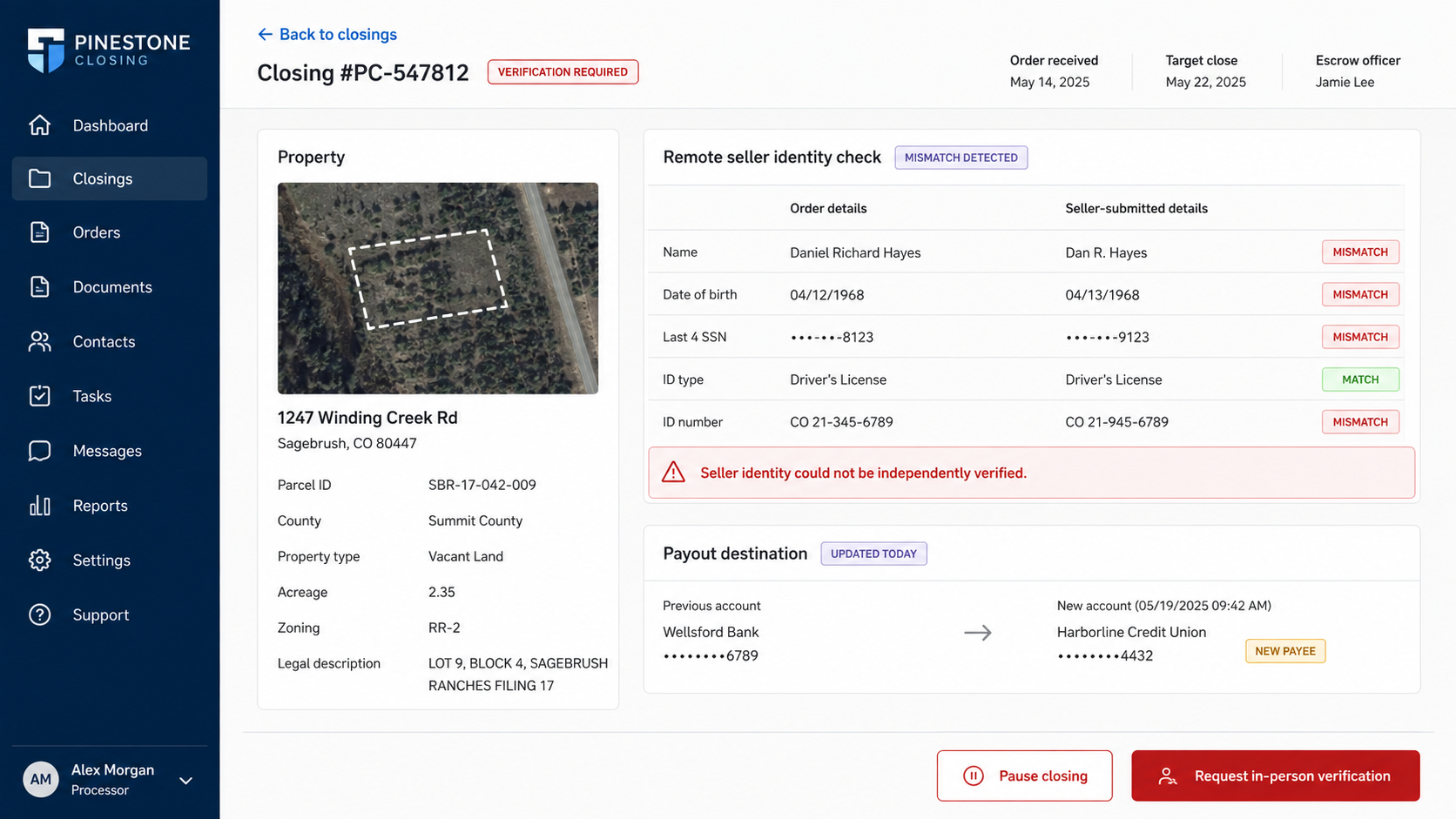
A closing portal may show contradictions the email story hides. Identity mismatches and last-minute payout changes should pause the transaction immediately.
Title professionals should record every failed identity check and keep the original wire instructions. A complete timeline can prevent repeated attempts against the same parcel.
Company, Address, and Fulfillment Checks
The seller’s name is only the starting point
Match government ID, ownership records, signatures, tax information, and prior transaction records. Use knowledge-based questions drawn from reliable records, not details visible on the listing.
Whenever possible, require a live video meeting and compare the person, document, and answers. Follow applicable law and company policy for identity verification.
The address of record is an independent channel
Send a letter to the tax or deed address already held in official records. Do not replace that address with one supplied by the new email.
The FBI recommends certified mail to the address of record when purchasing. This creates a chance for the real owner to learn that someone is attempting a sale.
Support comes from known institutions, not the seller
Verify details with the county recorder, register of deeds, assessor, title insurer, and established closing contacts using official numbers.
An impostor may provide the name of a real attorney or notary. Contact that professional through independently located information and ask whether they are involved.
The money trail must match the ownership story
Sale proceeds ordinarily have a documented reason for reaching the seller or authorized party.
A last-minute third-party wire, out-of-state recipient, or account name mismatch needs to be resolved before closing.
Keep the verification trail with the file. If instructions change, repeat the check through the original trusted contact rather than accepting an email update.
Warning Signs for Agents, Buyers, and Title Companies
- The seller contacts an agent unexpectedly about vacant land.
- The owner lives far from the parcel and refuses a live meeting.
- Communication is limited to email, text, or a replaceable VoIP number.
- The asking price is below market with no clear business reason.
- The seller is unusually indifferent to terms and due diligence.
- Answers about the property’s history are vague or inconsistent.
- Identity documents contain formatting, photo, or data irregularities.
- A deed or notarization comes from an unusual jurisdiction.
- The seller pressures everyone to close before extra checks can finish.
- Proceeds are directed to an unrelated name, attorney, state, or country.
A remote seller is not automatically a criminal. The correct response is stronger verification, not an accusation.
If the person is genuine, the extra steps protect their property and the buyer’s funds. If the person disappears when verification begins, the transaction should not move forward.
How Owners Can Protect a Parcel They Rarely Visit
Search the county recorder, register of deeds, clerk, or appraisal district for a property-alert service.
Some offices send an email or text when a document using your name is recorded.
Check the parcel periodically on real-estate sites and local listing services. An unauthorized for-sale listing may appear before a deed is recorded.
Keep your mailing address current with the tax authority. Returned or ignored notices can give a fraudulent transaction more time.
Save the deed, title policy, survey, tax records, and acquisition documents in a secure place. Review title-insurance coverage and ask the insurer whether it includes post-policy forgery protection.
Ask a trusted local contact to tell you if a sign, survey crew, photographer, or prospective buyer appears at the property unexpectedly.
These steps do not place a magical lock on the land. They make the first unusual event more likely to reach the real owner before money or title changes hands.
What to Do if You Have Fallen Victim to This Scam
- Stop the transaction immediately. Tell the agent, buyer, title company, escrow holder, closing attorney, and bank that the seller’s identity is disputed.
- Contact the recorder or deed office. Ask whether anything has been submitted or recorded and what local procedure applies to a suspected forged transfer.
- Call the financial institutions. If funds were wired, request an urgent hold, recall, or fraud investigation. Use verified numbers and provide transaction references.
- Notify title insurers. The real owner and buyer should contact their insurers and follow policy notice requirements promptly.
- Get qualified legal advice. Property ownership and recording remedies vary by jurisdiction. An attorney can explain how to challenge a forged instrument and preserve rights.
- Preserve every record. Save emails with headers, texts, call logs, IDs, contracts, deeds, notarizations, listing history, wire instructions, IP logs, and closing files.
- Report the identity theft. File with local law enforcement, the FBI Internet Crime Complaint Center, and the FTC identity-theft service when personal data was misused.
- Secure compromised accounts. If the real owner’s email or records were breached, change passwords, revoke sessions, enable MFA, and inspect forwarding rules.
- Check credit and other properties. A forged identity may be used in more than one transaction. Review credit reports and property records tied to the victim.
- Scan devices if files were opened. Malwarebytes can check for malicious attachments or remote-access software connected to the emails. It cannot correct a deed or recover a wire.
- Block known malicious destinations. AdGuard can reduce access to many phishing and scam pages, but closing verification must still happen through official records and known contacts.
- Reject recovery guarantees. Criminals monitor public complaints and may pose as investigators, lawyers, or asset-recovery firms demanding upfront fees.
Frequently Asked Questions
Can someone really list land without the owner’s knowledge?
Yes. A criminal can approach an agent using public property facts and forged identity documents. Listing is not the same as proving lawful ownership.
Why does the scam focus on vacant land?
There may be no occupant to notice activity, and an out-of-area owner may not check the parcel often. That creates time for a remote impersonation.
Is every remote seller suspicious?
No. Remote transactions are common. Risk rises when remote-only contact appears with a low price, urgency, identity inconsistencies, and unusual payout instructions.
Does a notarized deed prove the seller is genuine?
No. Documents and notarizations can be forged, altered, or obtained through false identity. Verify the notary and owner independently.
What is the best way to reach the real owner?
Use an address or contact already present in reliable records, not information supplied by the new seller. Certified mail to the address of record adds an independent check.
Can title insurance help after a fraudulent sale?
Coverage depends on the policy and facts. Notify the insurer immediately and obtain legal advice rather than assuming the loss is automatically covered or excluded.
The Bottom Line
The vacant land sale scam hides one false seller inside a transaction where the property, records, agent, title company, and buyer may all be genuine.
Verify identity through a channel the new contact did not provide. Write to the address of record and pause any closing that redirects proceeds.
Owners should use recording alerts and periodically search their parcel. Early discovery can stop an unauthorized listing before forged documents reach the closing table.

Join the discussion
0 commentsShare your experience or ask a question about this article.
Discussion
Start the conversation
Have a question or something useful to share? Add the first comment.