

If you have been seeing Fuente “Silk Peptide Intensive Lifting Threads” all over your feed, you are not alone.
The ads are built to hit a very specific feeling: you look at a recent photo, something feels “off,” and you want your face to look like you again, fast. Then the page tells you the “golden threads dissolve,” you feel an instant lift, and it is “not Botox, not fillers,” with thousands of five-star reviews and a ticking “next batch ships” bar.
So the real question becomes simple: is this a smart purchase, or another trendy dropshipping beauty offer dressed up like a breakthrough?
This guide walks through what Fuente is, what it claims to do, what to watch out for, and how to vet it before spending money.
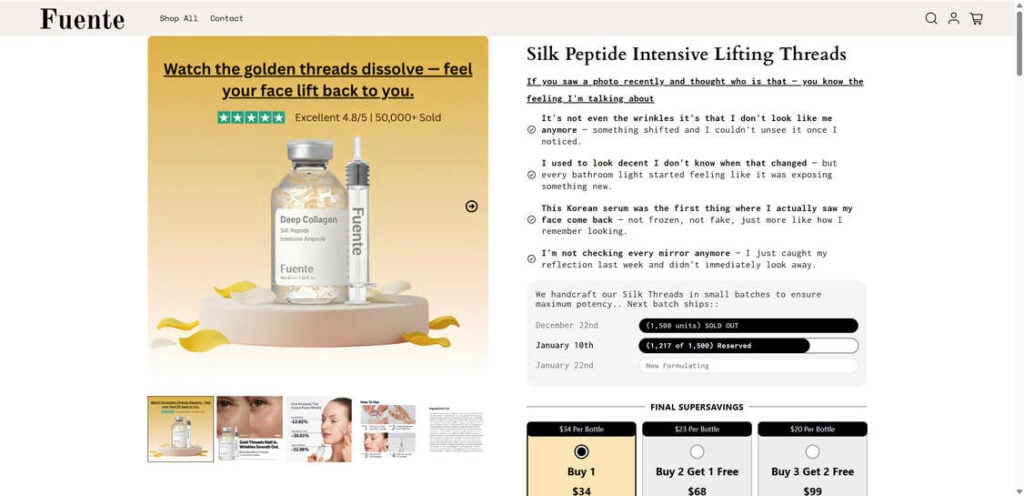
What Fuente Silk Peptide Threads Are Being Sold As
Fuente markets this product like a hybrid between a serum and an in-office thread lift.
The page language usually claims things like:
- “Lifting threads” that melt into the skin
- A visible tightening feel right away
- “Clinically proven” peptide complexes that smooth and firm
- A “Korean” innovation that is now finally available online
- Results that rival Botox, fillers, lasers, or expensive treatments
Most versions show a vial (often labeled “Deep Collagen” or similar), plus a syringe-style applicator. Some listings also call it an “ampoule.”
What are “threads” in skincare marketing?
In many viral skincare products, “threads” are not medical lifting threads.
They are typically one of these:
- Stringy polymer fibers that appear when you stretch the product between fingers
- Film-formers that temporarily tighten the surface as they dry
- Cosmetic microfibers meant to give a “lifted” look under makeup
That does not automatically make a product useless. Some film-formers can create a short-lived tightening effect.
But it is very different from a real thread lift performed by a clinician, and it should not be marketed as the same category of result.
How It Is Supposed to Work (According to the Sales Page)
Most Fuente-style pages describe a “3-step” mechanism:
- Threads melt into the skin
- The skin matrix tightens and smooths
- You see lifted, more youthful skin
They often list ingredients that sound medically persuasive, such as:
- Peptides (sometimes “30 peptide complex”)
- Niacinamide
- Adenosine
- Collagen
- “Silk peptide threads”
Here is the important detail: even if some of those ingredients are legitimate skincare ingredients, the sales promise usually jumps far beyond what topical cosmetics can reliably do.
Peptides can support hydration and skin barrier signals. Niacinamide can help tone and texture. Adenosine is used in some anti-wrinkle products.
None of that equals “a face lift back to you” in the way the page implies.
The Reality Check: What Results Are Realistic?
If this is a cosmetic topical product, realistic expectations look like this:
What you might notice
- Temporary skin tightening from film-formers
- Smoother look in certain lighting
- Short-term plumping from humectants
- Makeup sitting a bit better
What is unlikely (and where marketing often crosses the line)
- Structural lifting like Botox or filler
- Meaningful tightening of sagging skin in weeks
- “Thread lift” outcomes without a medical procedure
- Dramatic changes in facial shape from a topical serum
If the page implies medical-level results from a bottle, that is your first big warning sign.
Why This Looks Like a Common Dropshipping Operation
Based on how these offers are typically packaged and sold online, Fuente has several patterns that show up in private-label dropship campaigns:
1) The same product style appears under multiple names
When an “innovation” is real and proprietary, you usually see consistent branding, clear manufacturer info, and a traceable company history.
With viral skincare offers, you often see nearly identical pages, layouts, claims, and images used across different brand names. The product name changes, but the funnel stays the same.
2) Alibaba-style private label pricing is common in this category
Many “ampoule + syringe” collagen/peptide style products and “thread” serums are widely sold wholesale for low unit costs, then resold at a high markup with premium storytelling.
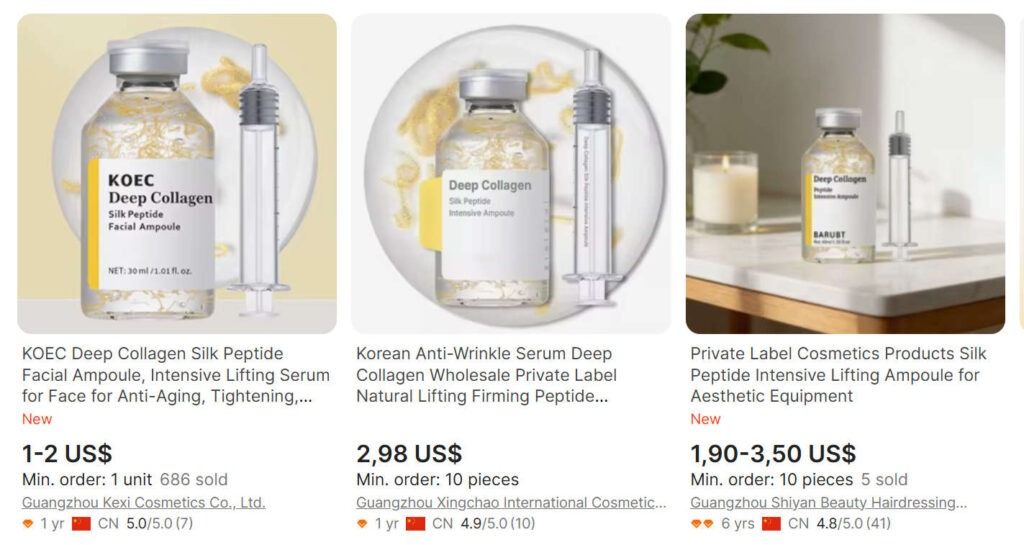
A high markup alone does not prove fraud, but it increases the odds you are paying for marketing, not formulation quality.
3) The site relies heavily on emotion-based copy
The copy is written like a personal confession, not a normal product description.
That is a conversion tactic. It is designed to bypass careful thinking and trigger “I need this right now.”
4) Urgency widgets and “batch” timers
“Reserved units,” “sold out,” “next batch ships,” countdown clocks, and “final supersavings” are classic pressure tactics.
If the urgency is always on, it is not urgency. It is a script.
Red Flags to Watch Out For
Use this checklist before buying Fuente or any similar “lifting threads” serum.
Marketing red flags
- Claims that mimic or compare to Botox/fillers/laser without solid proof
- “Instant lift” promises that sound guaranteed
- “Clinically proven” without linking to real studies
- “Dermatologist approved” with no verifiable names or credentials
- Vague language like “medical grade,” “patented,” “FDA approved”
Proof red flags
- Reviews that look generic, repetitive, or too perfect
- Before-and-after photos that look like stock images, reused creator pics, or inconsistent lighting and angles
- Claims of “50,000+ sold” without any brand footprint outside ads
Transparency red flags
- No full ingredient list (INCI) visible before checkout
- No company address, or an address that does not match the brand story
- Return policy that is vague, short, or packed with exclusions
- Support email only, no phone, no real customer service footprint
Product and safety red flags
- “Needle” or syringe-like applicators used to imply medical effect
- Claims of affecting collagen structure dramatically in days
- No safety guidance for sensitive skin, pregnancy, breastfeeding, or active skin conditions
If you see multiple red flags together, treat it as high-risk.
What to Check Before You Buy
If you still want to consider it, do a quick legitimacy audit first.
1) Ingredient list, in full
Look for a proper INCI list, not just “peptides, niacinamide, adenosine.”
A real brand can show concentrations or at least full ingredient naming.
No INCI list usually means you cannot properly evaluate irritation risk or quality.
2) Company identity
Look for:
- Legal business name
- Physical address
- Policies that reference a real entity
- A consistent support footprint (not just a generic inbox)
If the brand identity is paper-thin, expect customer service to be thin too.
3) Return and refund terms
Read the policy like you are already unhappy.
Check for:
- Return window length
- Who pays return shipping
- Whether opened products are excluded
- Restocking fees
- Requirements like “must be unused and in original packaging” (often impossible once you test it)
4) Shipping reality
Many dropship offers ship from overseas even when they imply “local” fulfillment.
Look for:
- Estimated delivery windows
- Tracking reliability
- Customs and duties responsibility
- What happens if it never arrives
5) Independent mentions that are not ads
Search for discussions that are not sponsored. If all you find is the brand’s own pages and affiliates, be cautious.
Does “FDA Approved” Mean Anything Here?
If you see “FDA approved” on a cosmetic serum page, slow down.
In the US, the FDA does not “approve” cosmetics the way it approves drugs. Skincare products can be marketed legally without FDA approval, and “FDA approved” language is often used loosely or misleadingly in this space.
If Fuente is framed like a drug-level anti-aging treatment while being sold as a cosmetic, that mismatch matters.
Is It Safe?
No one can guarantee safety from a sales page.
The most common issues with products like this are:
- Irritation or contact dermatitis
- Breakouts from heavy occlusives or fragrance
- Stinging around eyes
- Reactions if used on compromised skin barrier
Who should be extra cautious
- Sensitive skin or rosacea
- Eczema or dermatitis history
- Pregnancy or breastfeeding (ask a clinician first)
- Use of tretinoin, acids, or recent peels
- Recent microneedling, laser, or procedures
If you try any “tightening” serum, patch test first and avoid the eye area unless it is explicitly formulated for it.
So, Should You Buy Fuente Silk Peptide Threads?
If your goal is a real lift or a true replacement for injectables, the smart answer is no.
Topical cosmetics can improve hydration, texture, and the appearance of fine lines. They do not replicate a thread lift, filler, or Botox outcome in a reliable, meaningful way.
If you still want to try it as a cosmetic “tightening effect” product, only do it if:
- The company is transparent and reachable
- The ingredient list is fully available
- The return policy is fair and realistic
- You are comfortable with the possibility of minimal results
In most cases, people end up paying premium pricing for a generic private-label formula and a very persuasive landing page.
Better Alternatives That Usually Make More Sense
If you want visible improvement without gambling on a viral funnel, consider:
For texture and brightness
- Niacinamide products from established brands
- Vitamin C (if your skin tolerates it)
For fine lines and long-term change
- Retinoids (OTC retinol or prescription tretinoin with medical guidance)
For immediate smoothing
- Known film-forming primers or tightening serums from reputable brands, with realistic claims
For real lifting
- In-office options: neuromodulators (Botox-type), fillers, RF microneedling, ultrasound tightening, or clinician-guided skincare plans
You will usually get more predictable value from brands with clear formulation standards and support.
What To Do If You Already Ordered
- Save everything: order confirmation, receipts, product page screenshots, emails, tracking pages.
- Track the delivery window: note promised delivery dates.
- Email support early if shipping is slow: ask for a clear timeline and tracking.
- If you suspect you were misled, consider disputing the charge through your payment method if the product never arrives or the company refuses refunds.
- Monitor your statements for unexpected charges if you entered payment info on a sketchy site.
- If you had a skin reaction, stop use, document photos, and contact a clinician if symptoms are significant.
FAQ: Fuente Silk Peptide Threads
What are Fuente Silk Peptide Threads?
They are marketed as a lifting serum or ampoule that contains “threads” and peptides to tighten and smooth the skin. In practice, products in this category are usually topical cosmetics designed to create temporary tightening or smoothing.
Do the “threads” actually lift your face?
A topical product cannot reproduce the structural lift of a medical thread lift. The “thread” concept is commonly cosmetic, referring to fibers or film-formers that can create a short-term tightening feel.
Is Fuente the same as Botox or fillers?
No. Botox and fillers are medical treatments with measurable mechanisms and outcomes. A topical serum may improve appearance temporarily, but it is not a substitute for injectables.
How fast should you see results if it works?
If there is a film-forming tightening effect, you might notice it within minutes to an hour after application. Longer-term changes from skincare ingredients typically take weeks to months and are modest.
Are the reviews and before-and-after photos trustworthy?
Be cautious. Many dropshipping funnels reuse testimonials, influencer clips, or stock-like before-and-after images. Look for independent reviews outside the brand’s site and ads.
Is it “clinically proven”?
If the page does not link to independent clinical studies on the exact product, treat “clinically proven” as marketing language. Ingredient-level research is not the same as product-level proof.
Is it safe for sensitive skin?
It depends on the full ingredient list. Without a complete INCI list and clear safety guidance, you cannot properly judge irritation risk. Patch testing is the minimum.
Why is it sold on multiple sites or under different names?
This often happens with private-label cosmetics. A manufacturer sells a generic formula, then multiple sellers rebrand it with different names, packaging, and marketing stories.
What is the biggest risk when buying products like this?
The biggest risks are paying a premium for a generic formula, dealing with weak customer service and refunds, and being disappointed by results that do not match the marketing promises.
What should a legitimate brand provide before you buy?
A full ingredient list, clear company identity and address, realistic claims, a fair refund policy, and support that feels like a real business, not just an ad funnel.

Join the discussion
0 commentsShare your experience or ask a question about this article.
Discussion
Start the conversation
Have a question or something useful to share? Add the first comment.