

Nail fungus is frustrating, embarrassing, slow to treat, and often expensive to fix. This is exactly why products like the FungaBeam Nail Fungus Light attract so much attention. The device claims to eliminate stubborn nail fungus using low level laser therapy in just seven minutes a day, with no drugs and no chemicals, plus visible results within two weeks. The marketing sounds impressive, but does FungaBeam actually deliver what it promises? And more importantly, is the company behind it trustworthy?
This in depth investigation looks closely at the product, the claims, the photos, the website, the marketing tactics, and the way the sellers operate. The goal is simple. To help consumers understand what FungaBeam really is, where it comes from, and whether it is a safe and reliable purchase.
Overview
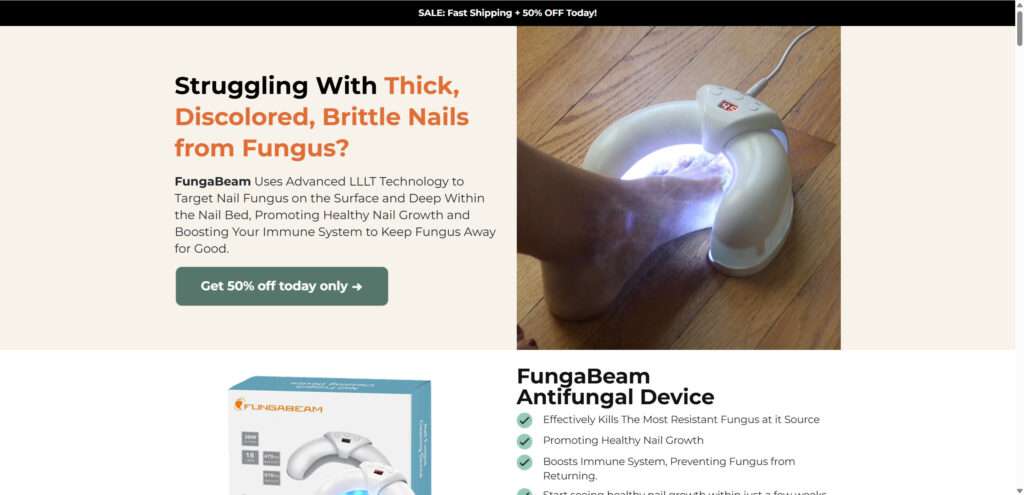
FungaBeam Nail Fungus Light is marketed as a breakthrough home device for treating toenail and fingernail fungus. The website claims that the product uses low level laser therapy, or LLLT, to reach deep into the nail bed and destroy fungus at its source. It promises powerful results with minimal effort, no medications, no creams, and no pills. For many people who are tired of slow acting topical treatments or expensive podiatry visits, the idea of a fast acting, drug free, at home cure sounds almost too good to be true.
Unfortunately, once you look beyond the claims, there are several serious issues that raise questions about whether the product is genuine. These red flags are significant because they show a major disconnect between the promises and the reality.
No Verified Media Features
The FungaBeam website boldly claims that the product has been “As Seen On” major outlets such as NBC, CBS, USA Today, and Fox News. These logos are displayed at the top of the page, implying credibility, legitimacy, and mainstream recognition. However, there is no proof. No articles. No video clips. No press releases. Nothing that verifies the product has ever been mentioned by any legitimate media source.
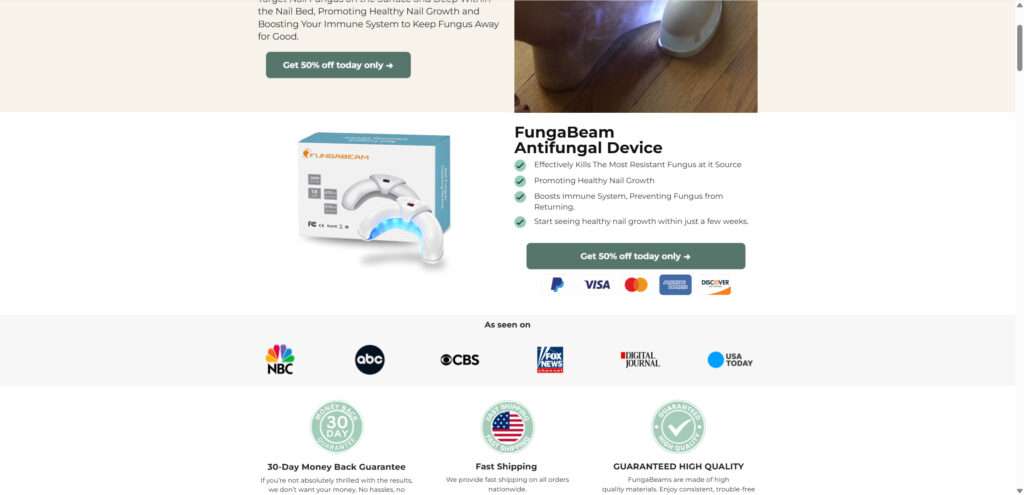
Authentic companies that receive real media coverage always show links, screenshots, or official mentions. The complete lack of evidence reveals that these claims are designed to build false authority and convince buyers to trust a brand they otherwise would not.
Copied and Reused Product Photos
Another major issue is that most of FungaBeam’s product photos are not unique to the brand. The same images appear across multiple Chinese wholesale platforms such as AliExpress, Alibaba, and Taobao. Many sellers list this exact device for $3 to $6, depending on order quantity. These listings clearly show that the product is not a medical device, not proprietary, and not developed by experts.
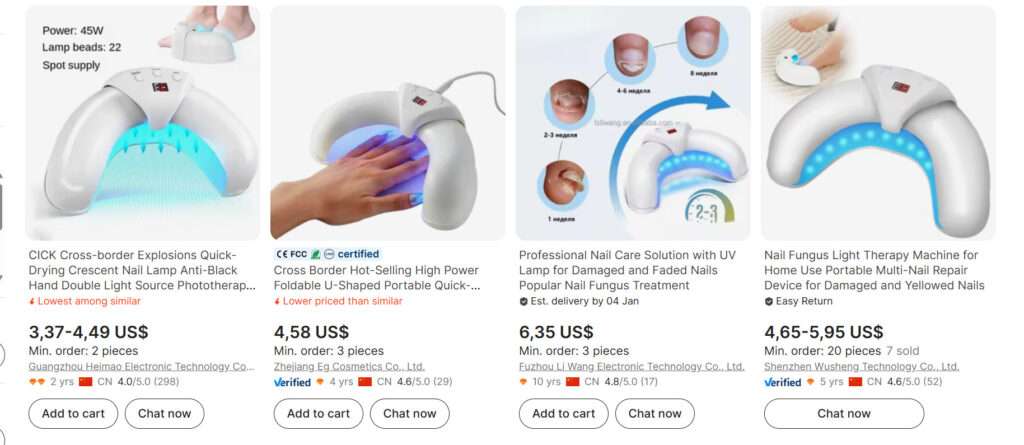
Instead, it is a generic LED or UV nail lamp sold for manicure and nail drying purposes. Dropshippers often buy these $3 lamps and rebrand them as premium medical devices priced at $50 to $120. The practice itself is not illegal, but the problem surfaces when sellers claim medical benefits that are not supported by research. The lamp is not designed to treat fungal infections, and most of the claims about LLLT appear to be exaggerated or unsupported.
FDA Approval Claims Without Proof
The FungaBeam website uses statements like “FDA Cleared” and “Medical Grade Laser Technology.” These claims are extremely serious because FDA clearance requires published documentation and a database entry. There is no clearance number, no registration certificate, and no evidence that the product has ever been evaluated by the FDA.
Additionally, low level laser therapy devices that genuinely qualify for medical use are regulated. They must disclose wavelength, power output, beam type, safety information, and contraindications. The FungaBeam page does not provide any of this information. It only gives general statements designed to sound scientific without offering real medical detail. This is a strong indicator that the claims are marketing driven rather than science driven.
Fake Doctor Recommendations
One of the most problematic elements on the site is its use of so called doctor endorsements. The images used to represent the recommending doctors are stock photos found across various unrelated websites. These images are not real podiatrists or dermatologists. Real medical endorsements require video interviews, clinic documentation, or at minimum a verifiable name and credential. FungaBeam provides none of this.
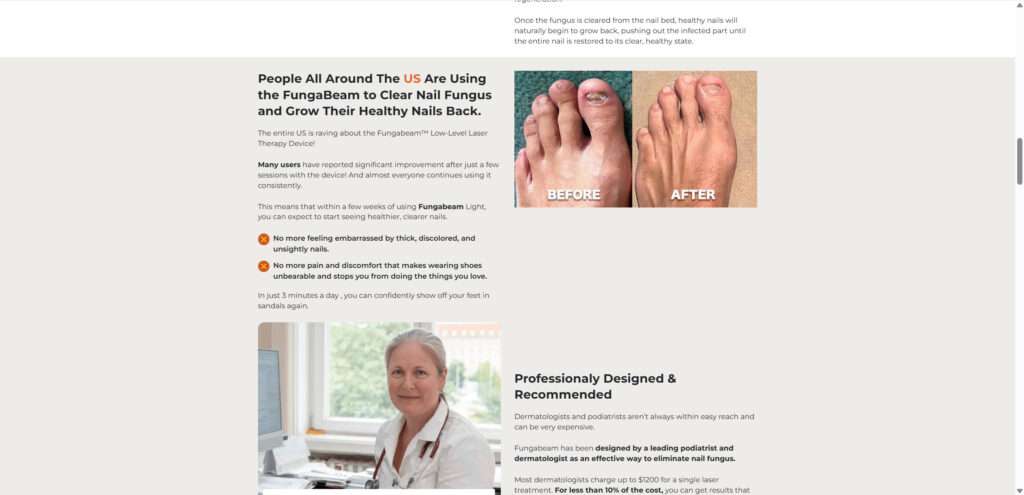
Using stock images of doctors is a classic marketing trick that attempts to exploit consumer trust in medical authority. This is especially concerning when the product is intended to treat a medical condition.
Manipulative Sales Tactics
The website uses several aggressive tactics to push buyers into making quick decisions. These include countdown timers that restart on every page refresh, claims of limited stock when the item is actually manufactured in bulk, and “50% Off Today Only” banners that never expire. These techniques are common in short term dropshipping campaigns where the goal is to collect as many orders as possible before customer complaints catch up.
Additionally, multibuy discounts such as “Buy 3 and Save 60%” are used to increase transaction value. Many dropshipping sellers do this intentionally because once the customer experiences disappointment or tries to return the product, the shipping fees make refunds nearly impossible.
Suspicious Website Reviews
The FungaBeam homepage displays a high rating with thousands of positive reviews. These reviews appear overly polished, repetitive, and uniformly positive. When checked against third party review platforms such as Reddit, Trustpilot, or ResellerRatings, there are no consistent mentions of the brand. This indicates that the reviews shown on the site are either fabricated or curated in a way that removes any negative feedback.
Authentic products always have mixed reviews, discussions, or questions across public platforms. The complete lack of external feedback suggests a very new or very temporary operation.
A Generic Lamp Sold As a Medical Breakthrough
The most important issue is that the device is identical to a cheap U shaped UV or LED nail lamp commonly used for drying gels and acrylics. These lamps are mass produced and have no clinical studies showing they can treat nail fungus. Real LLLT devices intended for fungal infections typically use specific wavelengths, controlled beam patterns, and medically certified lasers.
The FungaBeam lamp does not seem to meet these criteria. There is no published wavelength. No information on power density. No scientific explanation of how the light could penetrate the nail bed deeply enough to destroy fungus. Scientific research shows that nail fungus is stubborn and often requires prescription medication or medical grade lasers with focused energy. A $3 to $6 cosmetic lamp is unlikely to replicate these clinical effects.
In short, the overview reveals a long list of unresolved problems that make FungaBeam highly questionable. What remains is understanding how the entire operation works behind the scenes.
How The Dropshipping Operation Works
FungaBeam is not sold by a medical manufacturer, a dermatology company, or a research backed startup. Instead, it appears to be part of a common pattern used by dropshipping marketers who specialize in health related impulse products. These operations rely on heavy advertising, emotional triggers, medical sounding claims, and deep discounts. The business model is designed to maximize sales volume and minimize refunds.
Below is a step by step breakdown of how this type of operation works from start to finish.
Step 1. Finding a Cheap Generic Product on Chinese Marketplaces
The first stage of this operation involves identifying a low cost product on platforms such as AliExpress, Alibaba, or 1688. Sellers search for items that can be marketed as problem solvers for common health issues. These niches tend to convert well because buyers are already desperate for solutions.
The U shaped nail lamp fits this perfectly. It is:
• Extremely cheap to buy
• Lightweight and easy to ship
• Visually appealing with bright LED lights
• Easy to photograph
• Suitable for exaggerated scientific claims
Once the dropshipper finds this lamp for $3 to $6, they calculate a markup that turns it into a high profit item.
Step 2. Rebranding The Lamp as a Medical Device
After securing a supplier, the dropshipper gives the product a new name. In this case, the name FungaBeam is used because it suggests clinical lasers and targeted fungal treatment. The item is then repackaged digitally using:
• A new logo
• Professional looking graphics
• An upgraded brand identity
• Fake doctor endorsements
• Medical sounding terminology
This rebranding is done entirely online. The actual factory does not produce a medical device, nor does it package it as one.
Step 3. Creating a High Pressure Landing Page
The next step is building a website. Dropshipping tools make this extremely easy. The site is designed to look trustworthy, using large fonts, clean layouts, friendly colors, and badges that mimic FDA certifications or medical associations.
Common elements include:
• “As Seen On” sections using major news logos
• Scarcity timers
• Fake discount claims
• Comparison charts showing FungaBeam outperforming real treatments
• Emotionally charged before and after photos
• Stock images of happy users
• Long forms of text written to reassure buyers
These pages are structured to push customers directly into the checkout page without reading too deeply or analyzing the claims.
Step 4. Launching Widespread Social Media Advertising
With the website live, the dropshipper begins running ads aggressively. These ads appear on platforms such as:
• Facebook
• Instagram
• TikTok
• YouTube
• Snapchat
The ads often show:
• Footage of the lamp glowing under feet
• People with severe fungal infections
• Unrealistic transformation photos
• Testimonials with stock footage
Marketers typically spend large amounts of money upfront because they rely on volume to maximize short term profit.
Step 5. Profiting From High Markups
The profit margin in these operations is enormous. If the lamp is purchased from China for $3 to $6, the dropshipper can price it at $49 to $119. Additional bundles like “Buy 3 and Save 60%” bring the effective cost even lower and increase profits dramatically.
For example:
• Product cost: $5
• Customer price: $49.99
• Shipping fee charged to customer: often $6 to $12
• Real shipping cost: typically $2 to $4
This means the seller may profit $40 or more per unit. Even after accounting for ads, the margins remain attractive, especially when thousands of units are sold across multiple regions.
Step 6. Avoiding Refunds and Returns
Most of these operations are structured to make refunds extremely difficult. There are several tactics used:
• Return address in China
• No customer service phone number
• Delayed responses via email
• Denied returns due to “wear and tear”
• Requirement that customers pay return shipping
Because shipping to China is expensive, customers often give up. A single return can cost anywhere from $20 to $65 depending on location. This creates a situation where returning a $49.99 product costs more than keeping it. Sellers design their policies exactly this way because it protects their revenue.
Step 7. Closing The Shop and Rebranding Under a New Name
Once too many customer complaints accumulate or payment processors flag the store for excessive chargebacks, the dropshipper shuts it down and opens a new one under a different brand. This pattern repeats across countless health gadgets and miracle cure devices.
FungaBeam appears to fit this template perfectly. Several related products exist, all using the same lamp but under different names. The goal is not long term brand building. The focus is rapid sales with minimal accountability.
What To Do If You Have Bought This
If you already purchased the FungaBeam device and now realize the product may not meet expectations, there are several steps you can take to protect yourself financially and prevent further issues.
1. Check Whether Your Order Has Shipped
Dropshipping orders often take 10 to 35 days to ship. If your order has not yet been processed or shipped, you should immediately contact the seller and request cancellation. Include:
• Your order number
• The email used at checkout
• A clear statement that you want to cancel
If they refuse or do not respond, the next steps become essential.
2. Document Everything
Keep all records of:
• Order confirmation emails
• Screenshots of the website’s claims
• Payment transaction details
• Delivery delays
• Any misleading statements
Documentation is crucial if you need to file a dispute later.
3. Test The Product Safely (If It Arrived)
If the device arrives, use extreme caution. Do not expose your eyes to LED or UV light. Since there is no guarantee the product is certified or tested, avoid prolonged or direct exposure.
Most buyers find that the lamp is simply a manicure dryer. If it does not match the advertised claims, you have grounds for a refund or chargeback.
4. Request a Refund Directly From the Seller
Send a clear request stating that the product is not as described. Provide:
• Photos of the delivered item
• Screenshots of the advertised claims
• An explanation of the discrepancies
Request a full refund. If they require you to return the product to China, understand that this is their primary method of avoiding refunds.
5. File a Dispute With Your Payment Provider
If the seller refuses to cooperate, file a dispute with:
• PayPal
• Your credit card company
• Your bank
Use the phrase “Item Not As Described.” Provide all documentation. Banks usually side with the buyer in these cases.
6. Monitor Your Account for Unexpected Charges
Some dropshipping sites have aggressive upsells or recurring charges. Immediately check for any:
• Subscriptions
• Monthly renewals
• Duplicate transactions
If you find anything unusual, contact your bank.
7. Report The Website If Necessary
Reporting helps prevent others from being misled. You can report it to:
• Federal Trade Commission (FTC)
• Better Business Bureau (BBB)
• Payment processor (PayPal, Stripe, etc.)
These agencies collect data on misleading practices.
8. Consider Reputable Medical Alternatives
If you still want to treat nail fungus, speak with a real doctor. Effective options include:
• Prescription topical formulas
• Oral antifungal medications
• Clinically tested laser treatments
• Debridement by a podiatrist
These methods have actual research behind them.
9. Warn Others
Sharing your experience can help other people avoid similar problems. Consider posting honest reviews on forums or consumer protection sites.
The Bottom Line
FungaBeam Nail Fungus Light promises fast, drug free, at home treatment for stubborn nail infections. However, the marketing claims are not supported by evidence. The photos are taken from wholesale listings. The endorsements are not real. The media features are unverified. The technology does not match its advertised capabilities. The device itself appears to be a basic $3 to $6 manicure lamp that has been aggressively rebranded and sold for $49 to $119 through a dropshipping operation that makes refunds difficult.
While the device may look impressive in ads, it lacks the clinical power required to treat real nail fungus. Consumers should approach this product with extreme caution and consider evidence based alternatives.
FAQ
Is FungaBeam Nail Fungus Light a real medical device?
No. The device is identical to inexpensive U shaped LED and UV nail lamps sold on AliExpress and Alibaba for $3 to $6. There is no proof that it meets medical standards, no documentation of FDA clearance, and no clinical data showing that it can treat nail fungus.
Does low level laser therapy cure nail fungus?
There are legitimate medical grade lasers used by podiatrists to treat nail fungus, but these devices are expensive, highly regulated, and use controlled wavelengths and power levels. The FungaBeam device does not provide information about its wavelength, laser class, or medical certification. A $3 cosmetic lamp cannot replicate the results of regulated clinical equipment.
Why does the website show “As Seen On NBC, CBS, USA Today”?
These media claims have no evidence. The FungaBeam website does not provide links, articles, or screenshots verifying these features. Using major news logos without proof is a common tactic in temporary dropshipping campaigns to create false trust.
Are the before and after photos real?
There is no proof that the before and after images belong to real customers. Many appear edited, generic, or pulled from unrelated nail fungus case studies online. Because the product does not use clinically validated technology, dramatic results are unlikely.
Why are the doctor images on the site suspicious?
The doctors shown are stock photos found on other websites for unrelated purposes. The site does not provide verifiable names, credentials, or clinical statements from real medical professionals.
Is FungaBeam dropshipping?
Yes. The product is shipped from China and is listed on wholesale marketplaces at very low prices. The FungaBeam brand does not manufacture anything. The operation rebrands a generic lamp and sells it at a high markup.
Why is the price so high compared to wholesale listings?
Dropshipping brands often price cheap products at a premium using marketing tactics such as medical claims, dramatic testimonials, and limited time discounts. This creates the illusion of value even though the product itself costs only a few dollars.
Does the device actually kill fungus in the nail bed?
No scientific evidence supports this claim. Nail fungus resides beneath the nail plate, where light cannot penetrate deeply enough to destroy fungal cells. Dermatologists typically use oral antifungal medications, prescription creams, or professionally administered laser therapy.
Why does the site always show a discount timer and limited stock warnings?
These are artificial urgency tactics. The countdown resets on page refresh, and the stock numbers are not real. This strategy pushes customers to buy quickly without researching the product’s legitimacy.
Is it safe to use the device on nails or skin?
Use caution. Since the device has no verified medical certification, no safety testing, and no regulatory approval, there is no guarantee that the light output is safe. Avoid direct exposure to eyes and do not rely on it for medical treatment.
Why does the device look identical to manicure lamps?
Because it is. The lamp’s shape, LED layout, timer display, and casing design match dozens of generic manicure dryers sold worldwide. The product was not developed for fungus treatment.
Why is there no customer support phone number?
Most dropshipping websites avoid providing phone support to reduce accountability. Slow email responses also delay refund windows and discourage complaints.

Join the discussion
0 commentsShare your experience or ask a question about this article.
Community experiences
Did this happen to you?
Your experience could help someone recognize the same scam. Submit a private report for our team to review.
I experienced this tooReports are reviewed before publication. Sharing publicly is always your choice.
Discussion
Start the conversation
Have a question or something useful to share? Add the first comment.