

Glow Drop Tan is not sold as a simple one-time beauty purchase. Its own terms say the tanning drops are offered exclusively through a recurring monthly subscription—a crucial fact that can be easy to miss behind the free gifts, bundle discounts and glossy transformation ads.
The product may arrive, but buyers risk receiving inexpensive generic drops that do not match the advertised results, cannot be returned after testing, and trigger another monthly charge. That combination makes GlowDrop a subscription trap we recommend avoiding.
Glow Drop Tan Scam Overview
GlowDrop.co sells ingestible tanning drops, gummies and other wellness products through a polished Shopify store. The site promises a gradual bronze glow from within and uses bundles such as “Buy 1, Get 1 Free” to make the first order look valuable.
The decisive detail is buried in the legal terms: GlowDrop says its tanning drops are available exclusively under a recurring subscription framework. Placing an order authorizes monthly charges until cancellation. The free promotional bottles apply only to the first order; later renewals revert to the base quantity while the recurring price continues.
The advertised 30-day money-back guarantee is also far less useful than it sounds. The refund policy requires products to be unopened, unused and in the original packaging. Sale items and bundles are listed as non-refundable, and the 30-day clock starts on the purchase date—not the delivery date. A customer cannot meaningfully test an ingestible tanning product for several weeks and still return it under those conditions.
GlowDrop identifies only the trade name “GlowDrop,” a phone number, email address and a Delaware address. It does not clearly name the legal company that takes responsibility for the subscription. The listed address—611 South Dupont Highway, Suite 102, Dover, Delaware—is used by many unrelated businesses and is associated with ZenBusiness registered-office services. It is not evidence that GlowDrop has staff, a warehouse or a product manufacturer at that location.
Public feedback is sharply divided. Trustpilot currently shows a 3.5/5 score with roughly 40% 1-star reviews and 55% 5-star reviews. Some buyers praise support or say they like the drops. Many others report no change in skin tone, long shipping delays, parcels apparently coming from China, refund difficulty, adverse reactions and unexpected billing. Several positive reviews praise customer service before the reviewer has meaningfully tested the product, so the star average needs context.
Why GlowDrop is a high-risk purchase
- The subscription is mandatory. The terms say tanning drops are sold exclusively through recurring monthly billing.
- The “free” bottles do not repeat. Renewal orders contain only the base quantity, while the standard recurring charge continues.
- The guarantee cannot be used after a fair test. Opened or used products, sale items and bundles are excluded.
- The legal seller is not clearly identified. A trade name and registered-office address are not a substitute for a named company.
- The supply chain is opaque. The shipping policy mentions Asian fulfillment, while reviewers frequently describe packages traveling from China.
- The review profile is highly polarized. A large 1-star share reports no results, delays, billing disputes and refund problems.
- Similar generic drops cost only a few dollars wholesale. The retail price appears driven largely by advertising and branding.
What Glow Drop Tan Claims to Do
GlowDrop claims that its drinkable formula supports the body’s natural tanning process and can create a deeper, more even glow without relying on prolonged sun exposure. Marketing highlights ingredients such as beta-carotene, L-tyrosine and lutein, then connects them to visible skin-color changes.
The language uses real biological terms but skips a vital step. The seller does not present a credible, independently published trial proving that the finished GlowDrop formula safely produces the transformations shown in its ads. Research about a nutrient is not proof that this particular dose, mixture and delivery method works as advertised.
Beta-carotene can influence skin color at high intake, but carotenoid coloration is not the same biological process as a UV-induced tan. L-tyrosine participates in melanin pathways, yet taking it orally does not guarantee a predictable cosmetic outcome. “Supports tanning” is much weaker than the dramatic before-and-after message consumers see.
The Mandatory Subscription Explained
Every tanning-drop order starts recurring billing
GlowDrop’s terms state that the tanning drops are offered exclusively as a subscription. By making the initial purchase, the buyer authorizes the company to charge the stored payment method each month at the then-current standard rate. This is not merely an optional autoship discount described alongside a one-time purchase.
The promotional quantity applies only once
Offers such as Buy 1, Get 1 Free, Buy 2, Get 2 Free and Buy 3, Get 3 Free apply only to the first subscription order. On renewal, the customer receives only the base quantity selected—one, two or three units—without the free duplicates, even though the recurring standard price continues.
Cancellation before the first renewal requires an email
The customer portal can be used after the first renewal, according to the terms. Anyone trying to stop the subscription before that first renewal is instructed to email support. Cancellation must be completed at least 24 hours before the next billing time, and the company says processed or shipped renewal orders will not be refunded.
This structure creates a classic subscription trap
A shopper may focus on the apparent bundle bargain and not realize that the transaction creates a monthly commitment. By the time the product arrives and the customer decides it has not worked, the next billing date may be close—or may already have passed.
The 30-Day Guarantee Is Not Truly Risk-Free
GlowDrop advertises a 30-day money-back guarantee, but the refund page requires the item to be unused, unopened, undamaged and in its original packaging. It also excludes sale items, gift cards and bundles. Shipping fees are non-refundable, and the buyer normally pays return postage.
Those rules contradict the practical purpose of a satisfaction guarantee. To learn whether the drops change skin tone, the customer must open and consume them. Doing that removes refund eligibility. If the initial purchase was a discounted bundle—the main type of offer promoted by the store—it may also be excluded as a sale item or bundle.
The deadline begins on the purchase date. Trustpilot complaints describe delivery times of several weeks in some cases. A delayed package can leave little or no testing period before the 30 days expire. The guarantee lowers anxiety at checkout but offers limited protection to a dissatisfied user.
The Company and Address Problems
The site gives a trade name, not the responsible legal entity
The contact page calls GlowDrop a “registered brand” and lists the trade name GlowDrop. It does not identify an LLC, corporation, registration number or named owner. The terms repeatedly refer only to “GlowDrop,” leaving buyers without a clear legal company name for complaints or verification.
The Dover address is a shared registered-office location
The published address is 611 South Dupont Highway, Suite 102, Dover, DE 19901. Public records and business pages connect the same suite to many unrelated companies. It is also used in filings that name ZenBusiness as the registered agent.
Using a registered office is legal and common. The problem is presenting that address as a “physical business address” without explaining that it is a shared formation-service location. It does not tell customers where GlowDrop management, customer service, inventory or manufacturing actually operates.
The fulfillment story remains vague
The shipping policy says orders may be sent from centers in the United States, United Kingdom, European Union and Asia. It does not identify those warehouses or the manufacturer. Numerous customer reviews say tracking originated in China or that delivery took three to six weeks. Those reports are individual experiences, but they fit a dropshipping or cross-border fulfillment model.
What the Trustpilot Reviews Reveal
Trustpilot presents a split picture rather than universal failure. Some customers report prompt refunds, helpful support and a visible color change. Others say the product had no effect after one or two months, tasted metallic, caused stomach problems or headaches, arrived very late, or was difficult to return.
The distribution matters: about 40% of reviewers give one star, while approximately 55% give five stars. Trustpilot also notes that GlowDrop invites customers to review and has not replied to negative reviews. Invited reviews are not automatically false, but they can overrepresent early service impressions.
Several highly positive posts focus on fast email replies, order updates or excitement to start using the product rather than proven tanning results. At least one reviewer alleges that free product was offered for a positive review, and another says support requested a staff-name mention. Those are allegations from individual reviewers, not independently proven facts, but they are relevant when evaluating the unusually polarized score.
The recurring complaint patterns
- No visible change after five to eight weeks of consistent use.
- Metallic or unpleasant taste, nausea, headaches, blisters or other reactions.
- Orders taking weeks to arrive and tracking that appears to originate in China.
- Slow responses or repeated reassurance without a concrete shipping update.
- Refund requests delayed until the 30-day window has nearly expired.
- Returns refused because the bottle was opened or the order was a bundle.
- Charges or orders customers say they did not clearly authorize.
How the GlowDrop Funnel Works
Step 1: A transformation ad sells the dream
Social ads show pale skin becoming noticeably bronzed and suggest that the user can avoid sunbeds or hours in the sun. The visual result creates desire before the viewer considers safety, evidence or billing.
Step 2: A promotional game creates engagement
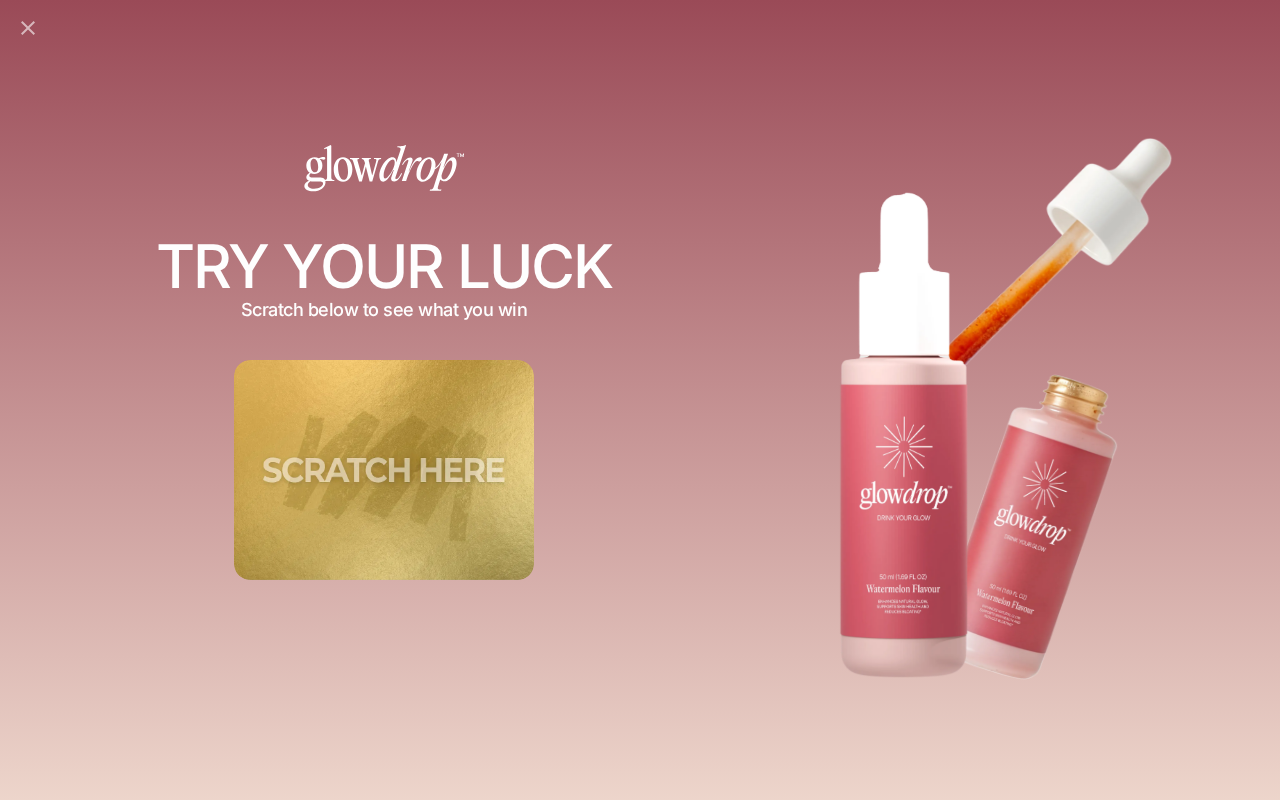
The GlowDrop landing page uses a scratch-card-style prize screen. The shopper is encouraged to “try your luck” and reveal a deal, making the discount feel personal and temporary even though this is part of the sales funnel.
Step 3: Free bottles make the first order look exceptional
Buy-one-get-one and larger bundle promotions anchor the purchase around quantity. The customer thinks about the number of free bottles rather than the monthly agreement attached to the order.
Step 4: The checkout starts the subscription
According to the company’s own terms, the purchase authorizes recurring monthly charges. The offer is not simply a discounted one-time trial.
Step 5: The product ships through an opaque supply chain
A bottle may arrive, often after cross-border transit. Receiving it does not prove the scientific claims or justify the markup over similar generic products sold cheaply through wholesale marketplaces.
Step 6: The customer must use it to discover it does not work
Tanning results are promised over time. The buyer opens the product and uses it for weeks, which makes it ineligible for return under the refund policy.
Step 7: The renewal creates the real financial loss
The next monthly charge can arrive while the customer is still waiting for results or trying to cancel. Renewal orders do not repeat the introductory free units, and processed orders are treated as non-refundable.
Is Glow Drop Tan a Scam or Legit?
GlowDrop is a real store that appears to ship products, but its mandatory subscription and unusable-after-testing guarantee make the offer deceptive and high risk. This is not simply a question of whether a parcel arrives.
The likely outcome is an overpriced, generic-looking supplement that may do little or nothing, followed by recurring charges and a return policy that excludes the very customers who opened the product to test it. The unclear legal entity, shared registered-office address and polarized complaint profile add further concern.
Our verdict: avoid GlowDrop. The website’s own terms provide enough reason. A beauty supplement should not require an automatic monthly commitment, and a genuine trial guarantee should not disappear the moment the product is opened.
What to Do If You Already Ordered GlowDrop
Cancel the subscription immediately in writing
Email support@glowdrop.co before the first renewal and state clearly that you cancel the subscription, all future shipments and all future charges. Include the order number and email address used at checkout. Ask for written confirmation.
Use the customer portal after the first renewal
If a renewal has already occurred, cancel through the account portal as well as by email. Take screenshots showing the cancellation date, status and next billing information. Complete it more than 24 hours before the next scheduled charge.
Save the terms and offer
Keep screenshots of the bundle, scratch-card discount, checkout, subscription wording, 30-day guarantee and refund policy. Also save the order confirmation, tracking page and all messages with support.
Do not keep using a product that causes symptoms
Stop taking the drops if you experience nausea, headaches, blistering, an allergic reaction or another concerning effect. Seek medical advice when appropriate and preserve the bottle, label, ingredient list and lot number.
Request the refund before the deadline
Even if the bottle is opened, request a refund and explain why the advertised guarantee was not usable. Ask the company to identify the return address and legal entity processing the refund. Do not send a parcel until support confirms the procedure in writing.
Block unauthorized recurring charges
If the company charges the card after documented cancellation, contact the bank or payment service promptly. Provide the terms, cancellation evidence and statement. Ask about disputing the renewal and blocking future merchant-initiated payments.
Report misleading subscription advertising
Customers can report unclear recurring billing, misleading guarantees or unsafe supplement claims to their consumer-protection authority, advertising regulator or payment provider. Use specific facts and attach screenshots.
Frequently Asked Questions
Is every GlowDrop order a subscription?
The current terms say GlowDrop Tanning Drops are offered exclusively through a recurring subscription and that purchases authorize monthly charges until cancellation.
Can I return GlowDrop after trying it?
The refund policy says returned items must be unused and unopened. That means customers who test the drops normally lose eligibility, despite the 30-day guarantee headline.
Is GlowDrop located in Delaware?
The site lists a Dover address used by many unrelated companies and associated with registered-office services. It does not prove that GlowDrop’s staff, warehouse or manufacturer operates there.
Does GlowDrop ship from China?
The company says it uses fulfillment locations in the US, UK, EU and Asia. Multiple reviewers report China-origin tracking or long cross-border shipping, but the exact source can vary by order.
Are the Trustpilot reviews fake?
We cannot label the reviews fake. The profile is highly polarized, and many positive reviews focus on service before product results. Allegations of incentives should be treated as reviewer reports, not established facts.
Do the tanning drops work?
GlowDrop has not shown convincing independent evidence that the finished formula reliably produces the dramatic tan in its advertising. Numerous buyers report no visible change after weeks of use.
The Bottom Line
GlowDrop uses a polished beauty brand, scientific-sounding ingredients, a scratch-card promotion and “free” bottles to sell a mandatory monthly subscription. The guarantee protects unopened merchandise—not a customer who genuinely tested the product.
Avoid this offer. If you already ordered, cancel in writing now, monitor your card and preserve every page of the offer before it changes.








