

An unexpected invitation to audition for a well-known production can feel like the break an aspiring actor has been waiting for. The Hamnet casting scam uses that excitement to make an unsolicited opportunity seem urgent, exclusive, and too important to question.
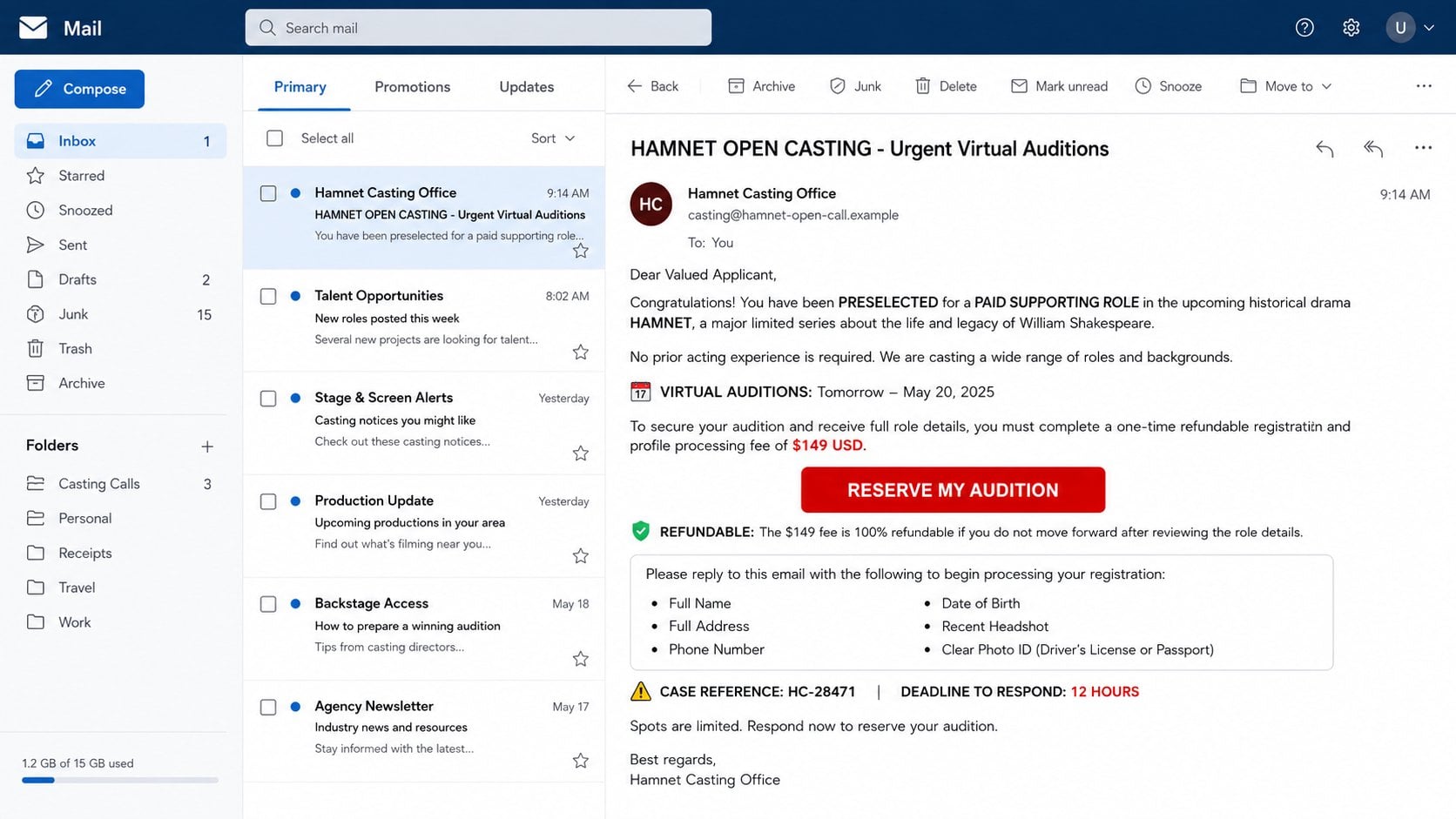
The message may promise a paid role with no experience, a virtual audition tomorrow, and a refundable reservation fee. Before sending money or identification, the applicant needs to establish whether any real casting office is behind the offer.
Overview
What the Hamnet casting scam promises
The message claims that casting is open for a film, series, promotional appearance, or supporting role connected to Hamnet. It may say the recipient was preselected from a talent database even when they never applied or created a profile with the sender.
Scammers often promise unusually high daily pay, flexible experience requirements, travel coverage, and a guaranteed audition slot. The generous terms are paired with a deadline that leaves little time to contact a genuine production representative.
- A paid role without a formal application
- A virtual audition scheduled within hours
- No experience, union status, or agent required
- A refundable registration or profile fee
- A request for a headshot, identity document, and bank details
What the fake casting office wants
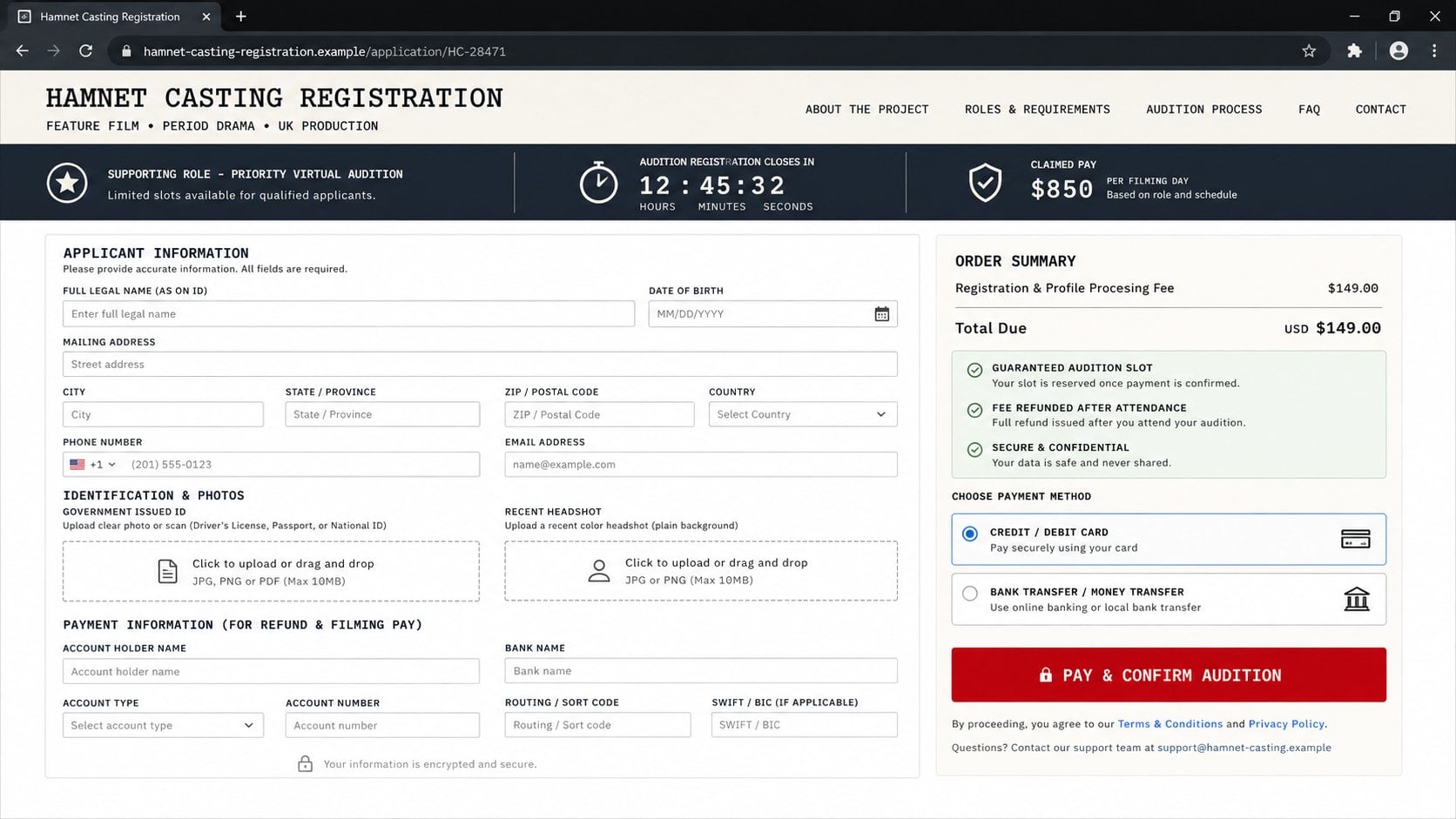
The operation can pursue both money and identity data. An applicant may be charged $49, $149, or more for registration, a background check, headshots, training, a wardrobe deposit, a script, or access to an online audition.
The application can collect a legal name, address, date of birth, phone number, government ID, tax information, bank account, and images. Those records are valuable for identity fraud even if the applicant refuses the final payment.
Why a real production title is persuasive
Fraudsters do not need a relationship with the production. They can copy public casting language, names, release information, and entertainment news to build a convincing invitation around a title people recognize.
The scam has no connection to the legitimate Hamnet production, its filmmakers, distributors, casting professionals, or performers. A real name inside the message only proves that the sender can search the internet.
How the Hamnet Casting Scam Works
Step 1: A talent scout makes unexpected contact
The first message can arrive by email, text, social media, or a casting-platform direct message. The sender may say they found the recipient’s profile, received a referral, or are conducting a last-minute search for a specific look.
Generic wording allows the same message to reach thousands of people. A supposed scout may flatter the recipient’s appearance or background without mentioning any actual work, training, representation, or audition they completed.
Step 2: The offer skips normal casting steps
The recipient is told they are preselected, shortlisted, or effectively hired before speaking with a verified casting director. There may be no full role breakdown, production company, union status, shooting location, schedule, or contract.
The lack of detail is presented as confidentiality. In reality, secrecy prevents applicants from comparing the message with legitimate notices and asking industry contacts whether the opportunity exists.
Step 3: Urgency forces a rushed decision
A virtual audition is scheduled for the next morning, and the applicant has only 12 hours to reserve a place. The sender claims that dozens of other people are waiting and the slot cannot be held.
This pressure is artificial. Professional casting can move quickly, but a genuine representative should still be willing to identify themselves, explain the process, and allow reasonable independent verification.
Step 4: A portal requests identity and payment information
The link opens a polished application page with the production title, a case number, claimed pay, and upload fields. The domain is unrelated to a verified casting company, studio, distributor, or established casting platform.
The page asks for a headshot and resume, then expands into sensitive data such as a passport, driver’s license, bank details, or tax number. A prominent payment box describes $149 as refundable after attendance.
Step 5: The audition becomes a sales or payment trap
After paying, the applicant may be directed to a short video call that contains no meaningful audition. The caller instead sells expensive classes, photographs, portfolio hosting, membership, or another mandatory service.
Another version sends a fake check for travel, wardrobe, or equipment. The victim is instructed to deposit it and pay a preferred vendor. The check later bounces, while the real money sent to the supposed vendor is gone.
Step 6: New fees appear and the role disappears
The scammers invent costs for insurance, work permits, script access, union processing, travel documents, or courier delivery. Each payment is described as the final obstacle before the contract or filming schedule is released.
When the applicant refuses, communication stops or becomes threatening. Personal information may be reused in fake job applications, account takeovers, loan attempts, or a later recovery scam promising to refund the casting fees.
Common Versions of the Fake Hamnet Audition
The guaranteed supporting role
This version says a specific look or accent is urgently needed and no acting experience is required. The recipient is promised $850 per filming day before completing an audition.
Pay varies across real productions, but guaranteed employment from an unsolicited message should be treated with caution. Casting decisions involve verified representatives, availability, contracts, and role requirements.
The refundable profile fee
The sender describes the charge as a deposit rather than a fee. They promise it will be returned after the video call, which makes payment feel risk-free.
Refund language does not protect the applicant when the recipient is an anonymous payment account. A dishonest operator can disappear, invent a policy violation, or demand another fee to release the refund.
The mandatory photographer or acting class
The applicant is told their photos are unsuitable and only an approved photographer can produce the required package. Others are pressured into a costly class or workshop before they can read for the role.
Training and photography can be legitimate services, but they should not be disguised as mandatory payments for a guaranteed job. The FTC’s modeling scam guidance warns that real agencies do not charge applicants for test shoots or to secure a place.
The fake check for wardrobe or travel
A supposed production accountant emails a check and tells the recipient to buy equipment or pay a travel coordinator. The bank may show provisional funds before discovering that the check is fraudulent.
The applicant remains responsible for money withdrawn or sent onward. A cleared-looking balance is not confirmation that the underlying check is valid.
Company, Address, and Fulfillment Checks
Verify the casting director and production company
Search the sender’s full name, company, and professional history independently. Confirm the role through an official production, studio, casting office, agent, union, or established casting platform, not through links supplied in the invitation.
Impersonators may use the name of a real casting director. Contact that professional through a separately verified website or representative and ask about the exact notice.
Inspect the email, domain, and office address
A personal mailbox or newly created domain is a warning when the sender claims to represent a major production. Compare the from address, reply-to address, application domain, and payment recipient.
Look up the office address and phone independently. A real building does not prove the sender works there, and caller ID can be spoofed.
Confirm the audition and employment process
Ask for the role breakdown, audition sides, schedule, shooting location, contract type, rate, usage, union status, and the person responsible for hiring. Details should remain consistent across the notice, call, and documents.
A legitimate process does not guarantee a part simply because someone pays a registration charge. The FTC’s warning about virtual casting call scams states that paying to get a job is a scam sign.
Trace fees, checks, travel, and promised services
Identify the legal payee for every charge and determine why an applicant, rather than the employer, must pay it. Refuse gift cards, cryptocurrency, money transfers, payment apps, and deposits to an individual’s account.
Do not spend a production check or forward part of it until the issuing bank independently confirms it is genuine. Verify travel reservations directly with the airline, hotel, or agent using contact details you found yourself.
Warning Signs of a Fake Casting Call
- You never applied, but the message says you were preselected.
- The role is guaranteed before a real audition.
- No experience is required for unusually high pay.
- The sender hides basic details behind a confidentiality excuse.
- An audition slot requires an upfront or refundable fee.
- You must use a specific photographer, teacher, or vendor.
- The application requests identity or bank data too early.
- The email domain does not match a verifiable casting business.
- A check must be deposited and part of it sent elsewhere.
- The sender discourages contact with an agent, union, or production office.
Poor grammar can reveal a scam, but fluent writing does not establish legitimacy. Focus on whether the sender, production, role, and payment process can be confirmed outside the message.
How to Check a Casting Offer Before Responding
- Save the message without clicking its link or opening attachments.
- Search the exact casting notice and sender name with complaint and scam terms.
- Find the production’s verified representative through a separate source.
- Ask your agent, union, or an experienced industry contact to review the offer.
- Compare the domain registration and company history with claimed experience.
- Request the complete role breakdown and contract details in writing.
- Reject any requirement to pay for access to employment.
- Keep sensitive identity and banking information private until a real engagement is verified.
Talking to someone else is especially valuable because excitement makes inconsistencies easier to overlook. A legitimate opportunity will not collapse because an applicant takes time to verify it.
What to Do if You Have Fallen Victim to This Scam
- Stop paying and end contact. Do not send a final registration, refund, insurance, travel, or contract fee. Block the sender after preserving the evidence.
- Contact the payment provider. Explain that the transaction arose from a fraudulent casting offer. Ask whether a transfer can be recalled, a card replaced, or a charge disputed, and note the claim deadline.
- Report a fake check immediately. Tell the bank that the check may be fraudulent, even if funds appear available. Do not send money to the supposed vendor or spend the provisional credit.
- Protect exposed identity documents. Contact the issuing agency if a passport or driver’s license was uploaded. Follow local identity-theft procedures, monitor credit, and consider a fraud alert or freeze where available.
- Secure email and casting accounts. Change reused passwords, end unknown sessions, remove unfamiliar recovery details, and enable two-factor authentication. Check whether the scammer changed profile information.
- Scan files and devices. If you opened an audition attachment, installed video software, or granted remote access, run a full Malwarebytes scan. Remove unknown tools and change passwords after the device is clean.
- Add protective filtering. AdGuard can reduce contact with known phishing and tracking domains. It cannot validate a casting director or recover a fee, so independent checks remain necessary.
- Preserve a complete record. Save messages, headers, URLs, screenshots, application forms, uploaded-file names, payment receipts, checks, phone numbers, and video-call details. Write a timeline of what happened.
- Notify the impersonated parties and platforms. Report the account to the email, social media, casting, job, or payment platform. Alert verified representatives of the production so they can warn other applicants.
- File an official fraud report. Use the relevant national consumer-protection, identity-theft, cybercrime, or law-enforcement service. The FTC also accepts job-scam reports through ReportFraud.ftc.gov.
Be cautious if someone contacts you afterward and promises to recover the payment or secure the role. Recovery scammers use information from the first fraud to sound informed, then demand another advance fee.
Frequently Asked Questions
Is every Hamnet casting notice a scam?
No. A real production can have legitimate casting activity. The scam is the unverified offer that impersonates a production, guarantees work, collects sensitive data, or demands money from the applicant.
Do actors ever pay for casting calls?
Applicants should not have to pay to obtain a promised role or guaranteed audition. Optional training and photography are separate services and should not be presented as a condition for employment.
Can a virtual audition be legitimate?
Yes. Self-tapes and video auditions are common. Verify the casting professional, production, role, domain, and instructions independently before uploading material or joining a call.
What if the registration fee is described as refundable?
The label does not make the payment safe. A scammer can refuse the refund or disappear. Confirm the opportunity first and reject charges used to reserve access to a job.
Is a check from the production proof that the offer is real?
No. Fake checks can appear in an account before being reversed. Never send part of a check to a vendor or buy equipment for someone who sent unsolicited funds.
What if I sent only a headshot and resume?
The immediate identity risk is lower than sending a passport or bank account, but the information can support impersonation and targeted fraud. Stop contact, report the account, and watch for follow-up messages.
The Bottom Line
The Hamnet casting scam turns a recognizable production title into a shortcut around normal verification. Flattery, high pay, a rushed virtual audition, and a refundable fee are used to obtain money and personal information before the applicant asks who is really hiring.
Verify the casting director and production through a separate channel, never pay to secure a role, and do not forward money from a supposed employer’s check. If you already responded, contact the payment provider, protect exposed identity data, secure your accounts, preserve the messages, and report the impersonation.

Join the discussion
0 commentsShare your experience or ask a question about this article.
Discussion
Start the conversation
Have a question or something useful to share? Add the first comment.