


Online treatment starts with questions people would not normally answer on a shopping website. Understanding who receives those answers matters before submitting an intake form.
Hims and Hers faces an FTC lawsuit involving health information, subscription charges and cancellation. Its current policies also contain details customers should understand before paying.

Overview
What the FTC alleges about the platform
The FTC alleges that Hims and Hers shared sensitive health information with advertising companies despite privacy assurances, and misled customers about billing and cancellation.
Five additional states joined the lawsuit through an amended complaint filed November 10, 2026. The case remains pending; these are allegations, not a completed trial judgment.
What customers can check independently
The current site displays advertising-consent choices. Its privacy policy distinguishes protected medical information from other information, while its terms describe automatic subscriptions and separate membership charges.
These documents let customers identify practical risks without assuming every prescription, clinician or transaction is fraudulent. The important questions concern disclosure, consent and control.
The decision before submitting personal or payment information
Do not proceed until you understand which information may support advertising, what action authorizes payment, and every subscription that will remain active.
- Read privacy choices before answering sensitive questions.
- Check the full payment schedule rather than promotional pricing.
- Separate medication subscriptions from any ongoing membership.
- Keep proof of cancellation and any refund request.
The Lawsuit Is About More Than Ordinary Advertising Cookies
The FTC’s November announcement identifies two connected concerns: sensitive information shared with advertising platforms, and prescription subscriptions customers allegedly did not knowingly authorize.
The agency names Meta, Snap and other third parties. Its billing allegation concerns charges following medical intake, rather than an ordinary customer knowingly selecting a clearly disclosed refill.
The amended complaint also challenges cancellation friction and the clarity of refill dates. It alleges that some customers had little opportunity to review recommended treatment before being charged.
Those allegations make the point of commitment important. A form presented as a consultation can create a very different expectation from an order authorizing a recurring purchase.
Before submitting, identify which button does what. Is it requesting clinical review, starting a paid membership, authorizing a medication order, or combining several actions?
If the page does not make that distinction clear to you, stop before entering payment details. Asking for clarification is more useful than trying to reverse an unwanted order.
The lawsuit does not supply a public tool telling each visitor exactly which information was shared about them. That requires a specific account inquiry or privacy request.
Save the actual screen and confirmation associated with your experience. Your evidence should identify your transaction, not merely repeat another customer’s description of a different treatment.
What the Current Privacy Choices Actually Say
The Hims homepage displays a privacy panel describing tracking used to personalize advertising and improve services. It explicitly says the information may include sensitive health information.
The panel provides separate consent and non-consent buttons. Their presence is observable, but this review did not test network traffic after either choice.
The practical point is to make a deliberate choice before exploring treatment categories. Do not treat a health-oriented website as automatically excluded from advertising-related data collection.
The September 17, 2026 privacy policy also contains a prominent notice that sensitive personal data may be sold, using the meaning assigned by certain state privacy laws.
That wording does not necessarily describe a cash sale of complete medical records. The policy discusses advertising disclosures and separates information it classifies as protected.
Its distinction matters because browsing a page about a condition can itself reveal something sensitive. You need not upload a complete clinical record for privacy to matter.
Read the policy alongside the choices actually offered on your device. A general reassurance about privacy cannot tell you which preference you previously selected.
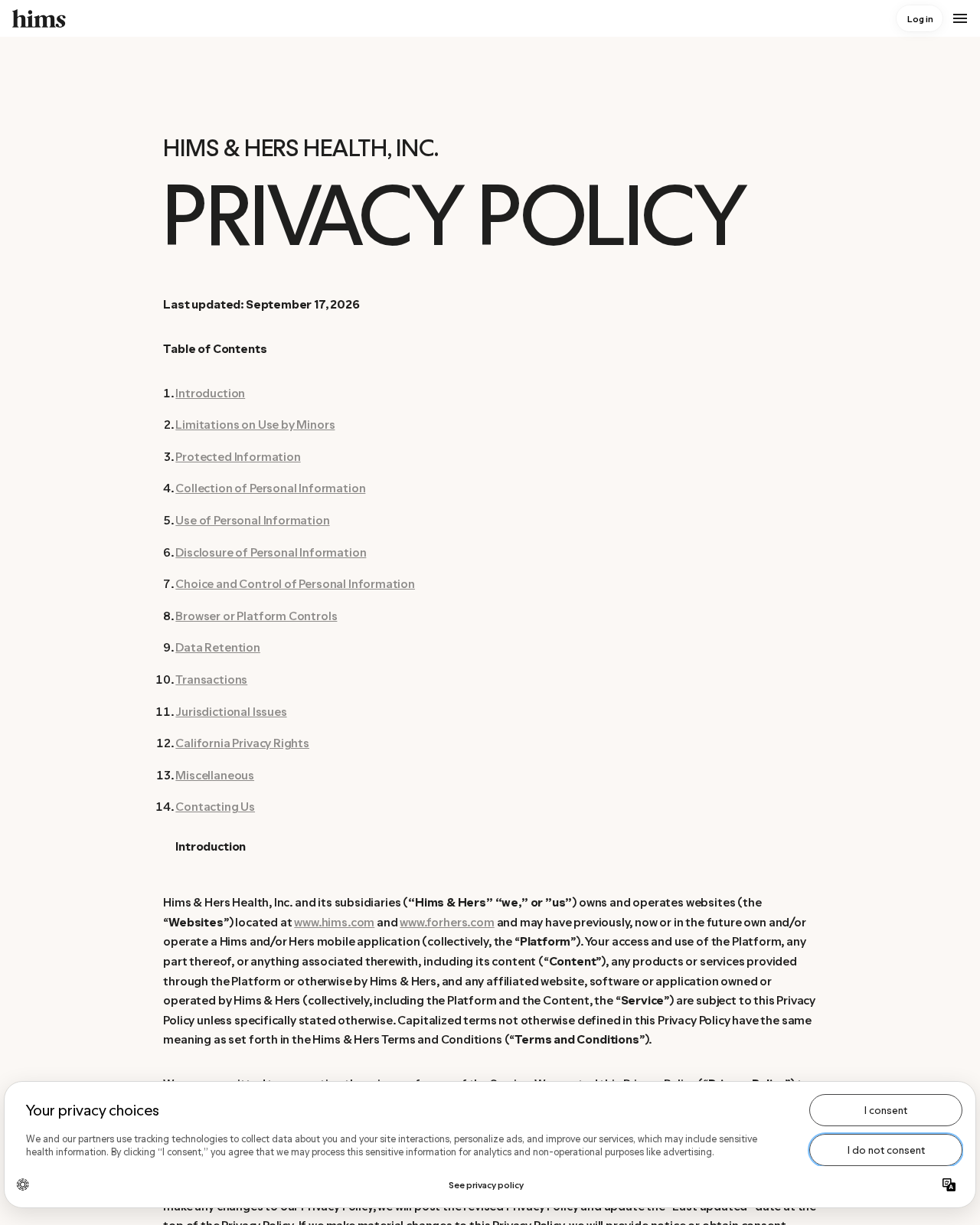
The privacy document identifies the platform operator and provides separate sections for protected information, disclosures, user controls and retention. Those distinctions should not be collapsed into one promise.
Account details, advertising information and clinical records may travel through different relationships. Ask about the specific information that concerns you instead of requesting an undefined privacy guarantee.
For example, asking which advertising partners received identifiable browsing information is more precise than asking whether the company respects privacy in general.
What Hims and Hers Says About Its Safeguards
In its July 29, 2026 privacy statement, Hims and Hers says it separates information patients share with healthcare providers from marketing activity.
The company also describes technical safeguards, including abstraction and hashing, intended to reduce identifiable information. It presents its privacy controls as meaningful choices for users.
That is the company’s account of its practices, not an independent technical audit. The litigation will address the disputed conduct and relevant legal standards.
For customers, two questions remain distinct: what the company promises now, and what happened to information already supplied under an earlier experience or setting.
Changing a browser preference may affect future collection without answering a historical disclosure question. Keep that difference clear when communicating with the privacy team.
A useful response should identify the scope of your request, explain applicable controls and address any limits. A marketing statement alone does not resolve an account-specific concern.
Who Handles the Website, Treatment, Medication and Billing?
The Platform Is Not Every Medical Provider
The posted terms distinguish Hims and Hers as the platform business from affiliated medical groups, providers, pharmacies and laboratories involved in supplying services.
That distinction affects where a complaint belongs. A billing inquiry, treatment question and request for clinical records may need different recipients.
Use the organization identified in your own documents. Do not assume that a physician controls advertising settings or that a billing representative can change clinical treatment.
Membership and Medication Can Be Separate Charges
The terms describe separate weight-loss and testosterone membership arrangements alongside medication plans. Canceling a medication plan alone can leave an associated membership renewing.
This is a concrete reason to inspect every active subscription. Stopping the shipment you recognize does not necessarily close the separate service relationship.
Check your own plan names, renewal dates and charges. A headline monthly price does not establish the total cost of every service connected to the account.
Processing Dates Matter More Than Delivery Dates
The terms allow certain renewal charges or shipments to occur early. General support instructions ask customers to act at least 48 hours before the next order date.
Do not wait for a package to arrive before checking whether another order has processed. Review the account’s schedule and save the date displayed there.
If the dates in an email and account screen differ, request written clarification promptly. Keep both records instead of assuming the later date controls.
Returns and Treatment Changes Are Different Processes
The refund help page warns that a refund cannot be guaranteed once the pharmacy processes an order. Requesting cancellation therefore does not automatically reverse an existing charge.
Ask separately about the upcoming subscription, any order already processing and any refund requested. Obtain a response addressing each item rather than a vague account update.
Discuss medication changes with the prescribing professional. Do not abruptly interrupt prescribed treatment because of an advertising or billing investigation.
How to Cancel a Standard Subscription
The company’s current subscription guide provides a specific website route. Log in, open Subscriptions, find the relevant plan and choose Manage.
Under the help options, open Additional Options and Manage subscription, then choose Discontinue plan and Cancel Subscription. Finish the prompts rather than stopping at the first menu.
On the app, the guide starts from the profile icon and Subscriptions. The remaining management and cancellation choices follow the same general sequence.
Check every subscription you intend to end. Save the resulting status and confirmation, then review the next scheduled payment rather than assuming a menu click completed cancellation.
The guide separately notes that an order already processing or shipped is not canceled by ending the subscription. Contact support about that order without delay.
Some treatment types use a different auto-renewal control. If the listed route is absent, use the support instructions for your actual plan rather than canceling an unrelated item.
Care+ and Medication Renewals Need Separate Checks
The current membership help page calls this service Care+, covering peptides, testosterone and weight loss. The terms also use treatment-specific membership labels.
Its Care+ instructions use Manage subscription and a control for turning off auto-renewal on medication or membership. Select which renewal you actually intend to stop.
The guide says ending the membership also cancels associated medication subscriptions. Ending medication alone leaves the membership active and billing on its schedule.
That asymmetry is easy to overlook when the unwanted charge appears connected to a prescription. Review the membership itself, not only the pharmacy shipment.
Keep the distinction in your written request: specify the membership name, medication plan and future renewals you want ended. Ask support to confirm each separately.
For initial weight-loss and testosterone medication plans, the terms promise a refund when cancellation occurs within 48 hours of submitting payment information, before shipment.
The first month’s membership fee remains nonrefundable. For prepaid medication already shipped, membership charges can continue until that medication supply period ends.
If you need continuing care elsewhere, arrange that with a suitable clinician or pharmacy. Closing a commercial subscription and maintaining treatment continuity are separate decisions.
Privacy Requests Should Be Separate From Cancellation
The privacy policy directs requests to privacy.hims.com/policies for access, correction, deletion and advertising choices. It also describes browser-specific controls and the Global Privacy Control signal.
Deleting an account or requesting less advertising does not necessarily cancel a paid subscription. Likewise, canceling an order does not itself answer a request about previously shared information.
Send separate, clearly labeled requests when you need both. Keep your subscription confirmation apart from the privacy case reference so neither request disappears into the other.
Ask what information can be deleted and what must be retained. Clinical, legal or transaction records may involve different obligations from optional advertising information.
Provide only the identification needed through the company’s designated secure route. Do not send medical records or identity documents to someone who contacts you unexpectedly.
If you believe a reply fails to address your request, preserve it and consider the applicable privacy complaint route. Availability depends on location and the information involved.
What to Do If You Used Hims or Hers
- Save your own intake and billing records.
Keep the offer, submitted-form confirmation, plan details, receipts and relevant account messages. Record what you understood would happen when you submitted the form.
Redact medical details and payment numbers before sharing evidence publicly. A useful billing complaint does not require broadcasting your health history.
- List every active plan and renewal date.
Compare your account with bank statements and confirmation emails. Identify membership and medication charges separately, including any plan that remains active after shipment cancellation.
Record the displayed processing date before requesting changes. That helps explain whether a later charge occurred before or after your cancellation request.
- Complete the correct cancellation route for each plan.
Use the appropriate subscription or membership controls and finish all confirmation prompts. Save the final status and ask support about any item still shown as renewing.
Request a separate decision on an existing order or refund. Do not mistake a stopped renewal for reversal of a payment already processed.
- Send privacy requests through a separate secure channel.
Specify whether you seek access, deletion, advertising opt-out or information about previous disclosures. Keep a copy and any reference number provided.
Check whether the response addresses your actual question. A statement that settings changed does not necessarily describe what happened to previously shared information.
- Escalate disputed charges with accurate supporting evidence.
If support does not resolve a charge you dispute, ask your payment provider about the available process. Explain the dates, authorization issue and cancellation evidence honestly.
Do not describe an authorized purchase as an unauthorized transaction merely because you disliked it. Distinguish disputed consent, non-delivery and unresolved cancellation.
- Preserve treatment continuity while resolving the commercial issue.
Contact the prescribing professional about any necessary changes or transfer. Keep relevant clinical records accessible while deciding whether to continue using the platform.
A privacy request, billing dispute or account closure is not medical advice. Follow appropriate clinical guidance rather than altering treatment on the basis of a headline.
Frequently Asked Questions
Does the FTC case prove Hims and Hers is entirely fraudulent?
No completed judgment establishing that conclusion is shown by the pending case. The agency alleges specific privacy, consent, billing and cancellation violations.
Take those allegations seriously without treating every clinician, medicine or customer experience as identical. Check the particular information and plan involved in your situation.
Does a privacy-consent button prove no sensitive information was previously shared?
A current control does not establish what happened during an earlier visit. Its presence also does not independently demonstrate how the website implements each preference.
Use the control deliberately and request account-specific information if needed. This investigation did not submit health details or test advertising traffic after choosing consent.
Will canceling medication automatically stop my membership payments?
The membership guide says canceling medication alone can leave the membership active. Review both plan entries and their renewal settings before assuming all billing has ended.
Request confirmation naming the subscription you want canceled. Keep the response with your payment records and check the following billing cycle.
Can I cancel after the pharmacy has processed an order?
You can request help, but stopping future renewals does not automatically cancel an order already processing. The refund help page does not guarantee a refund at that stage.
Contact support promptly and distinguish the existing order from future shipments. Save your request and the explanation of any remedy offered.
Will deleting my account also delete every medical record?
Do not assume that account deletion erases every related record. The platform distinguishes information it handles from records associated with medical providers and pharmacies.
Ask the appropriate organization what your request covers and what it must retain. Preserve records you need for continuing treatment before closing access.
What should I check before starting a new intake?
Understand the privacy choices, payment authorization, full plan price and renewal conditions before submitting. Identify any membership fee separate from the medication cost.
If those terms are unclear, obtain an explanation first or use another suitable care route. Do not pay simply because a consultation screen feels reassuring.
The Bottom Line
Do not submit sensitive health information or authorize payment without understanding the privacy choices and recurring commitments. The pending FTC case makes those questions particularly important.
Existing customers should inspect every plan, complete the correct cancellation process and preserve confirmations. Send privacy and refund requests separately so each issue receives a specific answer.
Keep clinical decisions with qualified healthcare professionals. You can challenge advertising or billing practices and protect personal information without assuming a prescribed treatment should be stopped abruptly.

Join the discussion
0 commentsShare your experience or ask a question about this article.
Community experiences
Did this happen to you?
Your experience could help someone recognize the same scam. Submit a private report for our team to review.
I experienced this tooReports are reviewed before publication. Sharing publicly is always your choice.
Discussion
Start the conversation
Have a question or something useful to share? Add the first comment.