

If you suffer from bunion pain, you’ve probably seen countless ads promising quick, non-surgical relief. One of the most aggressively marketed products today is the Hyggear Bunion Corrector, promoted as a safe, effective, and medically endorsed solution. The company claims it can realign toes, relieve pain, and even correct bunions with regular use. On the surface, it sounds like a dream come true for those struggling with painful foot conditions.
But does it actually work—or is it just another overhyped dropshipping operation designed to take your money?
In this detailed review, we’ll break down everything you need to know. From how the product is marketed to how the operation works behind the scenes, you’ll learn whether Hyggear is worth your money or a trap you should avoid.
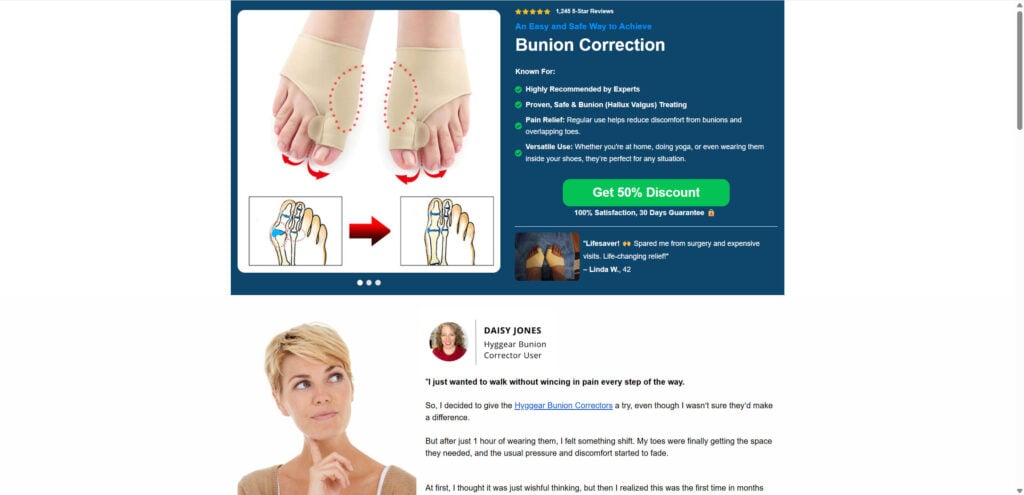
Overview of Hyggear Bunion Corrector
The Hyggear Bunion Corrector is marketed as a medical-grade, expert-recommended device that provides bunion correction without surgery. According to its website, it promises a variety of benefits. Let’s analyze these claims carefully.
Claimed Features and Benefits
- Pain Relief – The corrector allegedly reduces bunion-related discomfort by spacing out the toes and providing cushioning.
- Toe Realignment – Hyggear suggests that consistent use will realign toes and improve foot balance.
- Medical Recommendation – The site claims the product is “highly recommended by experts.”
- Versatility – Advertised as wearable during yoga, at home, or even inside shoes.
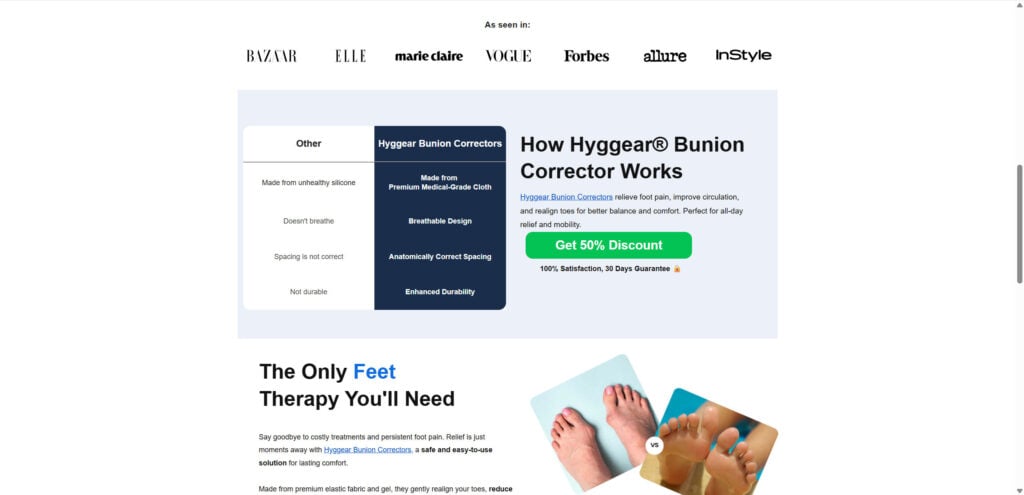
- Durability – Marketed as being made from “premium medical-grade cloth” with breathable material.
- Non-Surgical Alternative – Suggested as a replacement for costly bunion surgery.
Marketing Strategies
Hyggear’s website is filled with aggressive marketing tactics:
- Fake Scarcity – Banners claiming “Only a few left” or “50% Discount Today Only.”
- Fake Urgency – Countdown timers pressuring visitors to buy immediately.
- Exaggerated Reviews – The site lists over 1,200 five-star reviews, but independent platforms like Trustpilot and Reddit tell a very different story.
- Media Logos – The site features logos of Vogue, Forbes, Marie Claire, Elle, and more, giving the impression of endorsements that do not exist.
- Stock Photos for Testimonials – Many so-called “customer reviews” feature generic stock images or AI-generated faces.
Red Flags
- Lack of Scientific Evidence – There are no clinical studies proving that bunion correctors can permanently correct bunions. At best, toe separators provide temporary comfort.
- Inconsistent Reviews – On independent platforms, many customers complain about shipping delays, wrong items, or not receiving their order at all.
- Dropshipping Signs – Identical bunion correctors can be found on AliExpress and Alibaba for $3–$8 per pair, while Hyggear charges $40–$60 or more.
- Medical Claims Without Proof – Saying the device is “proven” or “recommended by experts” without real endorsements is misleading.
Customer Complaints
A look at Trustpilot, Facebook reviews, and Reddit threads reveals recurring issues:
- Wrong Orders: Customers accidentally order multiple pairs and receive partial refunds.
- Non-Delivery: Some buyers report being charged but never receiving the product.
- Poor Customer Service: Emails go unanswered or customers are told to wait indefinitely for shipments.
- Quality Issues: Users say the material feels cheap and wears out quickly.
This paints a very different picture from the polished marketing on the Hyggear website.
How The Operation Works
To understand why Hyggear is suspicious, let’s break down the dropshipping business model it appears to follow.
Step 1: Sourcing from Wholesale Suppliers
Hyggear does not manufacture its own bunion correctors. Instead, it sources generic products from Chinese wholesale platforms like Alibaba and AliExpress. These identical products are widely available for just a few dollars.
Step 2: Rebranding and Packaging
Once sourced, the same cheap toe separators are rebranded with the Hyggear name. A professional-looking website is built to make the product appear unique and medically advanced. The language is designed to suggest clinical backing that doesn’t exist.
Step 3: Inflated Pricing
The biggest giveaway of a dropshipping operation is the pricing difference:
- Wholesale Price: $3–$8 per pair.
- Hyggear Price: $40–$60 per pair (with fake “50% discounts”).
The company often claims the product is “normally $100” and then shows a “limited-time sale” to trick customers into thinking they’re getting a bargain.
Step 4: Aggressive Marketing Tactics
Hyggear employs classic high-pressure sales tactics:
- Urgency: Countdown timers, fake “low stock” alerts, and last-chance deals.
- Authority Illusion: Logos from major media outlets to imply coverage.
- Social Proof: Hundreds of fake or exaggerated 5-star reviews.
- Medical Endorsements: Claims of being recommended by doctors without naming any specific experts.
Step 5: Customer Acquisition
Ads for Hyggear are pushed heavily on Facebook, Instagram, and TikTok, targeting people searching for foot pain solutions. The ads highlight the fear of surgery and frame Hyggear as a miracle alternative.
Step 6: Order Fulfillment
When customers purchase, Hyggear forwards the order to a wholesale supplier, who then ships the product directly from China. This leads to:
- Long shipping times (2–6 weeks or more).
- Wrong or missing orders.
- Low-quality packaging.
Step 7: Limited Customer Service
If customers complain, they are often met with:
- Generic Responses: “Your order is on the way, please wait.”
- Partial Refunds: Customers are sometimes offered half their money back instead of full refunds.
- Return Barriers: Returns may require shipping to obscure addresses in China, making it costly or impossible.
Step 8: Repeat Under Different Names
When a brand like Hyggear gains too many negative reviews, the operation often rebrands under a new name and launches another website selling the exact same product.
This cycle allows the sellers to continue profiting while avoiding accountability.
What To Do If You Have Fallen Victim
If you’ve already purchased from Hyggear and feel scammed, you’re not alone. Here’s what you can do to protect yourself and possibly recover your money.
1. Contact Hyggear Directly
- Send an email requesting a refund.
- Keep records of all correspondence.
- Request tracking information if your order hasn’t arrived.
2. Dispute the Charge with Your Bank or PayPal
- If you paid by credit card or PayPal, file a chargeback dispute.
- Provide evidence such as misleading advertising screenshots, product comparisons, or lack of delivery.
3. Report to Consumer Protection Agencies
- In the U.S., contact the Federal Trade Commission (FTC).
- In the U.K., file a complaint with Action Fraud.
- In the EU, report via your national consumer protection body.
4. Leave Reviews to Warn Others
- Post your experience on Trustpilot, SiteJabber, or Reddit.
- Share details in bunion support groups or online health forums.
5. Avoid Similar Sites in the Future
- Watch for signs of dropshipping:
- Fake urgency (timers, “only a few left”).
- Media logos without links to real articles.
- Vague company addresses.
- Identical products on multiple websites.
6. Seek Real Medical Advice
- If you have bunion pain, consult a licensed podiatrist.
- Consider physical therapy, orthotics, or in severe cases, surgical correction.
- Do not rely on unproven gadgets that only offer temporary comfort.
The Bottom Line
The Hyggear Bunion Corrector is marketed as a miracle solution for bunions, but in reality, it’s little more than a cheap toe separator sold at a massive markup. The exaggerated claims, fake reviews, urgency tactics, and dropshipping model all point to a shady operation rather than a legitimate medical device.
While some users may find temporary comfort from wearing bunion sleeves, there is no scientific evidence that Hyggear or similar products can correct bunions. At best, they provide minor cushioning. At worst, they leave customers frustrated, out of money, and still in pain.
If you’re serious about bunion relief, consult a medical professional instead of falling for flashy online marketing.









Hello:
I just read your review and wish I would have seen it before I bought these things. I only opened one package but found out quickly that it is not for my foot problem. Tried to find a return address or telephone number but there is none to be found. I wrote several times via Email, even sending pictures of my ugly feet, but again no answer. Can you help?
Thank you so much for any help.
Best Regards,
Hi Eleonore, I’m sorry this happened.
If there is no return address, no phone number, and no response to your emails, that is a serious red flag. We do not sell the product and cannot arrange a return, but you can still contact your card issuer or PayPal and dispute the charge as item not suitable/not as described and seller unreachable.
Keep the unopened packages, photos, order confirmation, and copies of your emails as evidence. Also, for your privacy, avoid posting your phone number publicly in comments.
So glad I read your comments as I nearly bought today.
Joy, glad you checked first. A good rule: if the page is pushing urgency, huge discounts, and “miracle” results with vague company info, it’s usually not worth the risk. If you want a safer route, look for products sold by established retailers with clear return policies and real reviews.