

The internet is buzzing about a device called Hyper Charge Pro. Marketed as a miracle charger that boosts phone performance, extends battery life, and saves users from ever needing to buy a new smartphone again, it’s become a viral sensation. But behind the flashy ads and 5-star reviews lies a critical question: Is Hyper Charge Pro actually legit, or is it just another overpriced dropshipping scam? Let’s break it down.
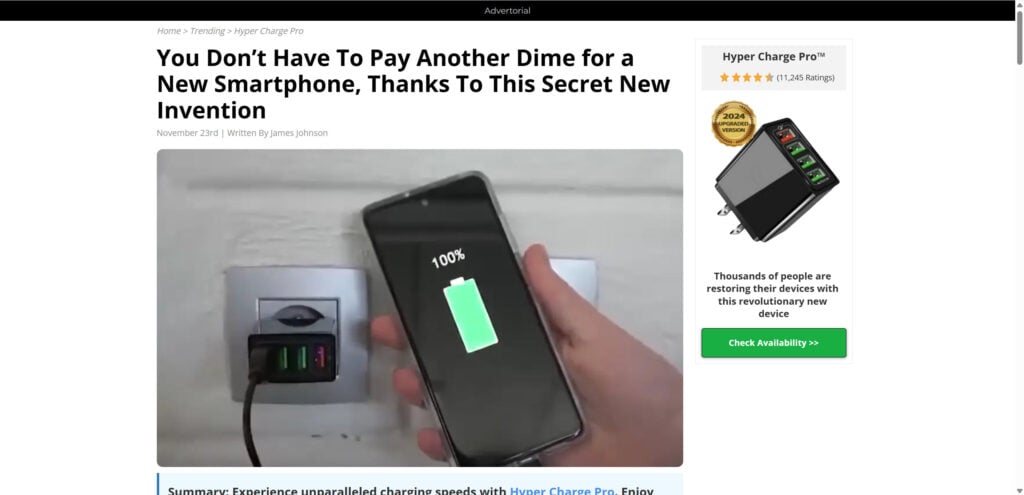
Hyper Charge Pro Overview
Hyper Charge Pro is promoted as a revolutionary smartphone charger, boasting features like:
- Charging phones from 1% to 100% in record time
- Extending battery lifespan
- Boosting phone performance with “Smart Defrag Technology”
- Cutting energy consumption by 38%
- Charging four devices simultaneously
The marketing claims are impressive. According to its promotional pages:
- It uses QC 3.0 technology to charge devices 4x faster.
- It prolongs battery life and optimizes performance.
- It prevents overheating with built-in temperature control.
- It automatically adjusts output for each connected device using AI.
Testimonials on the site are glowing, and review counts show tens of thousands of 5-star ratings. But something seems off—and for good reason.
Here are some major red flags:
- Fake media mentions: Claims to be featured by NBC, Fox, and USA Today are unsubstantiated.
- AI-generated reviews: Many images and reviews appear to be AI-created.
- Dubious technology terms: Buzzwords like “Smart Defrag Technology” don’t exist in the context of phone chargers.
- Over-the-top promises: No charger can “restore phone performance” or make your phone last forever.
- Suspiciously high discount: From $120 to $39, but only if you act now…
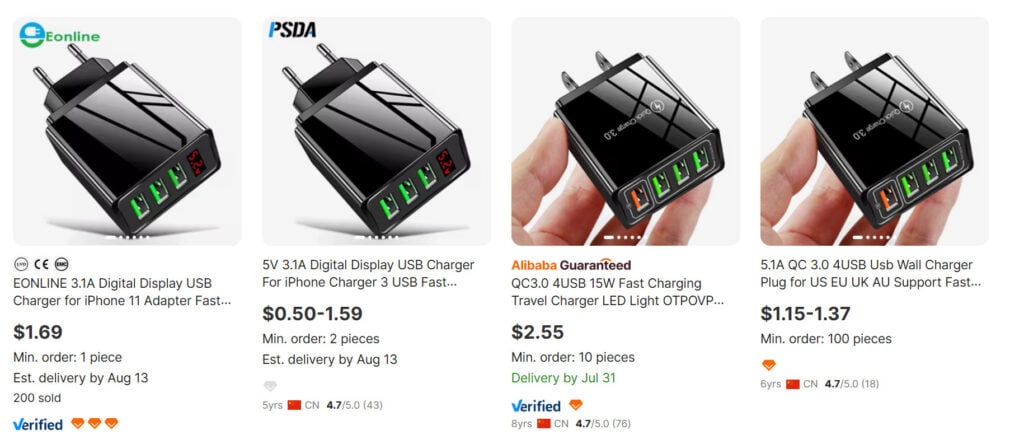
- Identical devices sold on Alibaba for $1.15 to $2.55 each.
These are classic tactics used in deceptive dropshipping operations.
How the Operation Works
Step 1: Product Sourcing
The charger is a generic 4-port USB wall charger, widely available on sites like Alibaba for $1 to $3 depending on quantity. There’s nothing revolutionary about it.
Step 2: Rebranding
The seller gives the product a catchy name, in this case, “Hyper Charge Pro.” They claim it’s a U.S.-developed, patent-pending device created by a teen genius or ex-Apple engineer. This is entirely fabricated.
Step 3: Building a Funnel
A fake news-style advertorial page is created. It mimics a news article, often with a fake author name and bogus publication date. The title will grab attention: “You Don’t Have To Pay Another Dime for a New Smartphone, Thanks To This Secret Invention.”
Step 4: Social Media Ads
They launch aggressive Facebook and Instagram ad campaigns, targeting older consumers, especially those 45+ who are less tech-savvy and more vulnerable to persuasive marketing.
Step 5: Psychological Triggers
The ad and product page are designed to push urgency and emotion:
- *”Only a few units left!”
- “50% OFF today only!”
- “Thousands have already ordered!”*
They use fake reviews, Trustpilot widgets (often forged or misused), and doctored comparison tables to create a sense of trust and value.
Step 6: Checkout Trap
Once the user is convinced, they click “Add to Cart.” The checkout page is designed to upsell (buy 2, get 1 free) and collect full payment. The real cost of the charger is $1 to $2, but the user ends up paying $39 to $69 or more.
Step 7: Dropshipping Fulfillment
The order is shipped directly from a Chinese supplier, taking 2 to 4 weeks. The packaging may be plain, and there is no brand labeling. Sometimes it doesn’t arrive at all.
Step 8: Post-Sale Silence
If users want refunds, they are redirected through generic customer service forms or ghosted. The return address may be fake or located in China, making returns expensive and impractical.
What To Do If You Have Fallen Victim
If you’ve already purchased Hyper Charge Pro and suspect you’ve been scammed, here’s what you should do:
1. Contact Your Bank or Credit Card Company Immediately
- Request a chargeback if the product was misrepresented or never delivered.
- Act quickly. Most institutions allow chargebacks within 60 to 120 days.
2. Report the Website and Ads
- FTC (U.S.): https://reportfraud.ftc.gov/
- Internet Crime Complaint Center (IC3): https://www.ic3.gov
- Report fake Facebook or Instagram ads via their platforms.
3. Leave a Review to Warn Others
- Post reviews on Trustpilot, SiteJabber, Reddit, or ScamAdviser.
- Include your experience and screenshots if possible.
4. Monitor Your Credit/Debit Account
- Watch for unauthorized charges.
- Consider freezing your card or requesting a new one.
5. Don’t Blame Yourself
These scams are designed to trick even smart people. The scammers use psychological tactics and high-pressure marketing to manipulate consumers.
Frequently Asked Questions About the Hyper Charge Pro Scam
Is Hyper Charge Pro a scam?
Yes, Hyper Charge Pro appears to be part of a deceptive dropshipping operation. It is a low-cost USB wall charger sold under a rebranded name at a highly inflated price. The product is marketed using fake claims, AI-generated reviews, and fabricated endorsements from major media outlets. While it technically functions as a basic charger, the promises of boosting performance, extending battery life, and restoring phone speed are completely false.
What is Hyper Charge Pro supposed to do?
According to its marketing, Hyper Charge Pro claims to:
- Charge your phone from 1% to 100% in minutes
- Boost smartphone performance using “Smart Defrag Technology”
- Extend battery lifespan
- Reduce electricity use by 38%
- Charge up to 4 devices at once
- Prevent overheating and battery damage
However, these claims are misleading. No phone charger can improve internal phone performance or defragment software. These are made-up tech terms used to deceive buyers.
Is Hyper Charge Pro a real product?
Hyper Charge Pro is a real physical product, but it is not unique or advanced. Identical chargers are widely available on wholesale sites like Alibaba for as little as $1.50. The version sold as Hyper Charge Pro is a generic 4-port USB charger that has been rebranded, marked up by over 2000%, and sold using false advertising.
Where is Hyper Charge Pro manufactured?
The charger is manufactured in China. Despite being marketed as a product designed by a “teen genius in the U.S.” or “former Apple engineers,” there is no evidence supporting these stories. The product is sourced directly from Chinese suppliers and dropshipped to customers without any branding.
Why is Hyper Charge Pro being called a scam?
Hyper Charge Pro is called a scam for several reasons:
- It uses false advertising and fake media mentions
- It promotes non-existent technology like Smart Defrag
- It inflates the price of a $2 charger to $40 or more
- Customer service and refund processes are often unreliable or ignored
- It creates false urgency with countdown timers and fake discounts
These are common tactics used in viral dropshipping scams designed to extract as much money as possible before the operation disappears or rebrands.
Can a charger really speed up my phone?
No, a charger cannot improve your phone’s internal speed or performance. Your phone’s processing speed and app performance are controlled by its processor, memory, and software—not by how it charges. Claims that a charger can make your phone faster are entirely false.
Does Hyper Charge Pro improve battery health?
There is no credible evidence that Hyper Charge Pro improves battery health. The idea that a wall charger can “extend battery lifespan” or “restore battery performance” is misleading. Most modern smartphones already manage charging efficiently. Using a basic charger—even one with QC 3.0—won’t provide any unique health benefits for your battery.
Are the reviews for Hyper Charge Pro real?
Many of the reviews displayed on the Hyper Charge Pro website appear to be fake or AI-generated. The Trustpilot scores are either misrepresented or taken from unrelated products. Photos of reviewers are often stock images or AI-created avatars. Be cautious of any product with overly positive, unverified reviews and generic names like “James J.” or “Lilly S.”
Is it possible to get a refund for Hyper Charge Pro?
In most cases, customers report difficulties obtaining refunds. If you made a purchase and were misled, you should:
- Contact your credit card provider or bank and request a chargeback
- File a complaint with the Federal Trade Commission (FTC) or your country’s consumer protection agency
- Report the seller’s website and ad on platforms like Facebook or Instagram
Always act quickly, as many scammers shut down their storefronts after a short time.
How can I check if a product like Hyper Charge Pro is a scam?
To protect yourself from future scams, follow these tips:
- Search the product name + “scam” or “review” before buying
- Look up the product on Alibaba to see if it’s a cheap, unbranded import
- Check for fake urgency tactics like countdown timers and “limited stock” messages
- Avoid websites with fake media logos or claims of being featured on major news outlets without links
- Read real user reviews on forums like Reddit or Trustpilot (not the product’s own site)
The Bottom Line
Hyper Charge Pro is not what it claims to be.
It is not a revolutionary invention. It won’t restore your phone’s performance or prevent you from needing a new phone. It is a low-cost, mass-produced charger sold with exaggerated promises, fake endorsements, and inflated pricing.
While the device might technically charge your phone, you could get the exact same item for under $3 on sites like Alibaba. You’re not paying for quality or innovation. You’re paying for a marketing story.
Always do your research before purchasing from viral ads. Look for real reviews, verify tech claims, and compare with marketplace listings. And most importantly, if it sounds too good to be true, it probably is.
Stay smart. Stay skeptical. Stay safe online.









the question is DOE’S IT WORK
Short answer: no, not in the way it is advertised.
The longer answer is that the claim being made is not one the device or the ingredients could deliver, and the evidence offered for it consists of testimonials, stock photographs and studies that either do not exist or examine something else entirely. Where there is a modest real effect behind a product like this, the advertising invariably inflates it into something transformative, and it is the inflated version people pay for.
The reason we cover these is usually not the product’s performance anyway – it is the billing. Most of the complaints in these comments are about being charged three or four times for one order, or enrolled in a subscription nobody remembers agreeing to. So even in the case where something works a little, buying it this way is the problem. If you want to try something in this category, buy a named brand from a shop with a returns policy you can actually use.
I do believe that manufacturers give their devices an induced Lifetime, built into the Original OS.
There is something real underneath that suspicion, but it is worth separating from the myth, because the difference matters when someone is deciding whether to buy a “repair” product or a new phone.
What genuinely happens: software support ends after a set number of years, so security updates stop; new operating system versions are heavier than old hardware was designed for, so an ageing device feels slower after an update; batteries degrade chemically and some manufacturers throttle performance as they weaken – Apple was fined in France and settled a US class action over doing that without telling anyone; and repairs are made deliberately awkward through glued assemblies, paired parts and unavailable spares. All of that is real, documented, and legitimately criticised, which is why right-to-repair legislation now exists in several places.
What does not happen is a timer in the OS that kills the device on a date. If it existed it would have been found long ago – people decompile these systems constantly – and no regulator investigation has ever produced one.
The practical upshot: before replacing a slow phone, have the battery tested and replaced, which is often the entire problem for a modest cost, and check whether it still receives security updates. And treat any product or app claiming to restore performance or extend a device’s life as worthless – that is the category these ads exploit.
Yet, if you believe that the phone companies are actually installing software, which will cause your phone to run slower, or not charge properly, then you have to also believe they would post this type of responses.
So wo can you believe? Its an Catch 22.
Hi David, that’s a fair question.
The confusion is exactly what these products rely on. The key difference is that legitimate claims are backed by clear, verifiable technical explanations and independent testing, while many of these viral products rely mostly on marketing claims and vague explanations.
That is why it is important to look beyond the advertising and check independent sources before trusting the claims.
Excellent! This covered all expected questions.
Thank you, Edd. I appreciate the feedback and I’m glad the article answered the questions you had.
BS! Phone companies pay good money to dispute these products to keep them off the market and out of consumers hands ! They are gonna say anything to make sure their product only last s a short time and us consumers will be forced to buy new product that is gonna do the same thing in a predetermined time because they design them to fail after a predetermined time to force customers to purchase new ! All manufacturers of any product does this this ! Design products to fail after a fairly controlled period of time! Corrupt as hell !! Big money pushing the little guy down even if he’s right and his product works as reported , especially if it works as reported ! Control and greed ! No wonder our country has gone to hell !!
Hi Gene, thanks for sharing your view.
A lot of buyers feel strongly about products like this in both directions. The main concern raised in the article is not just whether a device seems helpful to one person, but whether the advertising claims and technical explanations are honest and supported. That is where a lot of these products run into criticism.
Your comment still gives readers another perspective.
What really needs to be investigated is- do major manufacturers of mobile devices like Apple or Samsung build into their software updates codes that are meant to adversely affect the operation of the batteries. A truthful answer would support or dash these scam social media advertisers claims.
It has been investigated, and the answer is more interesting than either camp usually admits – so it is worth setting out properly.
What was found: Apple did throttle CPU performance on iPhones with degraded batteries, without telling anyone, and was fined €25 million in France, settled a US class action for up to $500 million, and paid £/A$ settlements elsewhere. Their stated purpose was preventing unexpected shutdowns as an ageing battery’s voltage sagged – which is a genuine engineering problem – but the concealment was the offence, and there is now a Battery Health setting where you can see the capacity and switch throttling off. Samsung and others have been fined in Italy for similar performance issues after updates.
What has never been found, despite the code being examined constantly by security researchers who would gain enormously from proving it: anything that deliberately damages a battery or kills a device on a schedule. Batteries degrade chemically at a rate determined by charge cycles, heat and being held at 100% – not by software – and each generation of the operating system is heavier than the last, so an old device slows down for reasons that require no conspiracy.
So the honest summary is concealment and neglect rather than sabotage. Two practical consequences. First, if your phone feels slow, have the battery capacity checked before replacing the device – iPhones show it under Settings, Battery, Battery Health, and a replacement battery often restores it entirely for a modest cost. Second, treat any app or product claiming to “repair” or “restore” a battery as worthless; that is precisely the category these ads exploit, and some of them are outright malware.