


HypeRocket advertises daily crypto earnings without asking you to learn how to trade. Its pitch puts the name of a real exchange right beside the return.
If a friend sent you the offer, you might already have seen a calculator or a picture of someone’s balance. It helps to know what each one represents.

Overview
The daily return is a sales claim, not a track record
The HypeRocket promotion asks for USDT or USDC and advertises up to 0.5% a day from automated trading. Its promotional site shows a $50 minimum deposit.
Another HypeRocket page advertises up to 1% daily by including potential appreciation of HYPE. A token rising in price is not the same as receiving cash.
That distinction can disappear when the numbers sit next to each other. It matters when you want to use today’s earnings rather than wait to sell a token later.
The HypeRocket risk disclosure warns that participants can lose their capital. Neither daily earnings nor protection from loss is established by the calculator beside the pitch.
The 250% figure is a cap, not an amount due
HypeRocket’s strategy page describes a 250% cap for its standard contract. The page counts trading returns and referral commissions toward that cap.
When the same counter includes both, two people who put in the same amount can be shown very different progress without having earned different trading returns.
The site shows a $10,000 example with a $25,000 target. The figure describes how the seller presents the cap, not a promise backed by a verified account.
- Trade profits are what the strategy earns after relevant costs and any losses.
- Referral commissions are what a compensation plan credits based on other people’s activity.
- A withdrawal is money that reaches a destination you control and can actually use.
Hyperliquid is not the company making this offer
Hyperliquid operates a blockchain and trading infrastructure described in its own documentation. HYPE is a real token, and HYPE perpetual contracts are real markets.
HypeRocket’s claim that it trades there on customers’ behalf is a separate claim. Seeing Hyperliquid’s name does not establish that the venue endorses the offer or guarantees balances.
The public sales materials do not tie the sample payouts to an independently verified customer account and trading history. That gap is what matters before sending your own funds.
How the HypeRocket Offer Asks You to Commit More
Step 1: A small starting amount makes the pitch easy to try
The sales page calls for stablecoins and says you don’t need trading experience. It presents the $50 starting point as a way to let the strategy do the work.
That figure is what the offer asks you to risk initially. The type of coin you send does not turn it into an insured bank deposit.
Stablecoins are designed to track a reference value. They cannot make a perpetual trading strategy stable or force an operator to honor a request to withdraw.
Find out who controls the destination before treating a transfer as funding your own account. A wallet you can open is not necessarily where your deposited crypto remains.
Step 2: The dashboard examples turn assumptions into exact amounts
The strategy page shows a sample daily earnings history for a $10,000 account. The figures are easy to read, but the screen is part of the promotion.
At 0.5% of $10,000, the illustrated daily return comes to $50. That calculation doesn’t show that trades earned the amount after losses.
A useful record would link starting funds, trades, trading costs and withdrawals to the same account over time. Credits on a sales page cannot do that.
Hyperliquid’s documentation on liquidations explains what can happen when a position falls below its margin requirement. A real trading venue makes those losses possible, not impossible.
Step 3: Keeping earnings in the contract shortens the projection
The strategy guide estimates about eight months to the cap if earnings are fully reinvested at the maximum daily rate. That estimate assumes the rate holds as the amount grows.
Reinvesting keeps funds exposed to the same program instead of turning them into money you can spend. If the rate falls or losses occur, the calculator’s timeline no longer applies.
The promotions also describe performance packages with higher caps. Paying for or qualifying through a larger commitment changes the offer’s limits, not the trading strategy’s ability to earn.
Before treating any projection as income, ask what happens on losing days and how a drawdown changes your balance. An example using the maximum rate doesn’t answer either question.
Step 4: Referrals give the person sharing the offer a financial stake
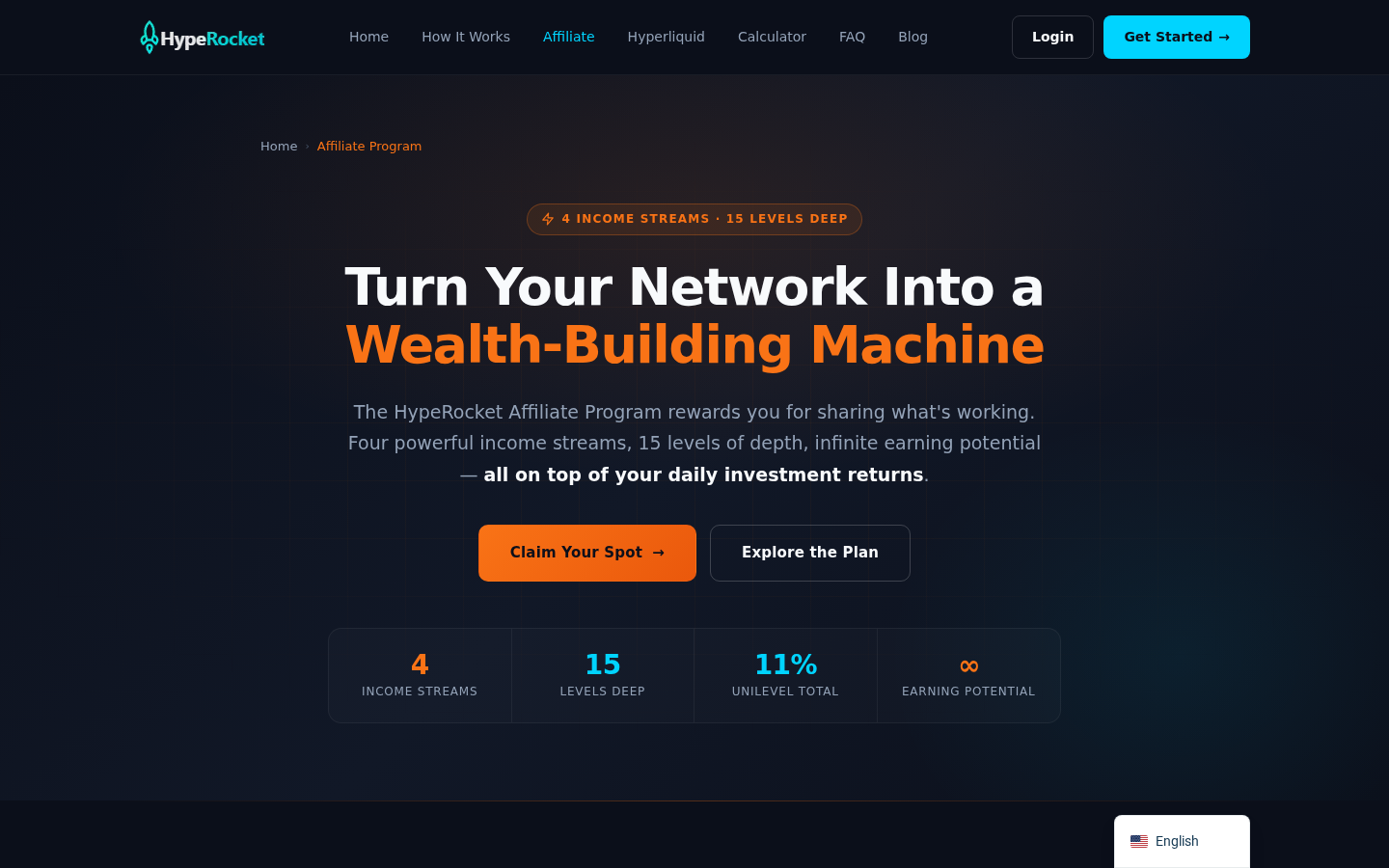
The affiliate page promotes four ways to earn. One pays a commission on money deposited through the referral network, starting with a stated 4% on direct referrals.
A matching payment, by contrast, is described as a share tied to credited earnings of people in that network. The reason for the credit matters when you examine someone’s balance.
If a promoter reached the cap faster, ask how much came from trading and how much from the network. You may be comparing two different incomes.
The affiliate page calls out compensation up to 15 levels for its deposit-based commission track. The payment is not limited to a single introduction between a promoter and a customer.
Step 5: Compare the promise of withdrawals with what can be verified
The strategy page promotes access to accrued earnings any time and discusses returning the initial deposit when the contract reaches its standard cap. Those are not the same promise.
Someone who withdrew an earnings credit has not necessarily shown they could recover the original deposit early. Ask about each right independently before treating the money as liquid.
The separate risk page says withdrawals can slow during stressed markets or infrastructure problems. Its warning matters more than a slogan promising no delay in an example.
If a promoter offers to demonstrate the process using your money, decline. A fresh transfer gives you no reliable answer about losses, fees or the right to recover principal.
Who Takes the Deposit and Who Handles a Dispute?
Ask which company your own terms name
One HypeRocket risk disclosure refers to Bitopex Trading LTD. The German-language affiliate agreement uses Bitopex Ltd and lists a Costa Rica address for that affiliate relationship.
Do not assume an affiliate agreement governs a customer deposit, or that similarly written company names identify the same legal entity. Ask for the specific contract applicable to your account.
A helpful answer names the party, its registration identifier and the service for which it is responsible. The party paying promoters does not necessarily control every customer asset.
An address does not establish permission to manage your money
A location in an affiliate agreement tells you what the document says about its contracting party. It does not identify a trading license or where a customer’s funds would sit.
Ask for authorization by legal name, service and country, then check whether that matches the register. One registration or corporate identifier should not do the work of three independent checks.
Keep the regulator’s record and the contract together if you find both. Differences in spelling, country or scope are reasons to pause before assuming the record covers the offer.
A referral contact is not a recovery department
Someone who walked you through an offer may only be an affiliate. In a dispute, you need the company that can explain a missing credit or act on your withdrawal.
Ask for its formal complaints route and what response records it provides. A reply in a private chat is not a substitute for an account statement or identifiable transaction.
If you cannot establish who has authority to move or return the funds, do not rely on a chat member who claims they can fix it for another payment.
Custody and access are separate from the trading story
HypeRocket describes use of smart contracts and wallet connections. Those words alone do not tell you who holds the deposited funds or whether you can recover them without cooperation.
Ask which rights your own wallet retains after a transfer, what the contract does with funds, and which party can suspend or decline an instruction.
Proof that a deposit reached an address is not proof it was traded under the advertised strategy. It also cannot show whether the advertised balance is available to withdraw.
What a Withdrawal Can and Cannot Prove
If someone shows you a transfer into their wallet, pay attention to the asset, date and amount. A transfer of one token is not receipt of a stated stablecoin balance.
A transfer may establish that a specific payment happened. It does not establish where the payer obtained the money or whether other customers can make similar withdrawals.
Consider what the promoter is measuring. A small payout against earnings credited today leaves a different question from whether the initial deposit is still being held under the contract.
The same check applies to the token price. Someone can show an increase in the market price of HYPE without showing they sold any at that price.
If access were genuinely under your control, the terms would explain how to exit without depending on a promoter. That includes who can pause transfers and what disputes change.
The separate disclosure warns that a failed service provider or troubled market can affect access. A cap in the pricing example cannot settle either risk.

What to Do If You Connected a Wallet or Sent Crypto
-
Stop before confirming another wallet request. Do not sign a transaction you do not understand, even if the person calls it a balance check or a withdrawal test.
If you only viewed the pitch, close it without depositing. If you connected a wallet, disconnect the site through your wallet’s own connected-app controls rather than the promoter’s link.
-
Check whether you granted spending permission. Disconnecting a site does not cancel existing blockchain permissions. Use a tool your wallet documents for the network where you actually signed.
For supported MetaMask networks, open MetaMask Portfolio, connect your wallet there, and choose Spending Caps from Overview. Find the token and spender you don’t recognize.
Choose the revoke option for that approval and review the network fee in MetaMask. Confirm only the revocation, then check that the approval is gone once the transaction settles.
If your network is not listed, an empty page does not prove the wallet is clear. Ask the wallet provider for its approved method for that network.
-
Separate the transfer from the balance on screen. Find the transfer identifier from your wallet or exchange. Save the network, destination, amount, date and account receipt before you lose access.
Ask the identified provider for the status of your own funds and its written withdrawal conditions. If it says a withdrawal was sent, request the actual transfer identifier.
-
Contact the payment provider you actually used. Tell the exchange or bank what you authorized. Provide the transaction references and evidence of any misleading request.
An exchange may be able to record a report or examine activity within its service. It cannot simply undo a confirmed blockchain transfer to an external address.
-
Preserve evidence before reporting the incident. Keep messages, the exact offer link, any referral relationship and requests for unexpected fees. Report suspected online fraud in the US to IC3.
Skip anyone who contacts you with guaranteed recovery. Do not give them wallet secrets or pay a separate advance fee to release a balance you have not received.
Frequently Asked Questions
Is HypeRocket the same company as Hyperliquid?
HypeRocket advertises using Hyperliquid, but that is not an endorsement by the trading venue. The venue’s documentation does not certify the results advertised by HypeRocket.
Does 0.5% daily mean I can expect that every day?
No, the site uses up-to language and its risk disclosure warns of losses. The maximum in a promotion is not an independently measured average.
Is the 250% figure a guaranteed payout?
No, the strategy page describes it as a cap that includes referral commissions and trading returns. A cap does not tell you what you will actually earn or withdraw.
Can I withdraw my full deposit whenever I want?
The strategy page discusses accrued earnings separately from the initial deposit. Ask for written principal withdrawal terms; don’t rely on an example about withdrawing earnings.
How does a HypeRocket referral change what I am seeing?
The affiliate plan describes commissions linked to deposits and other activity in a referral network. A promoter’s reported balance can therefore include payments other than trading gains.
Should I deposit more to get a withdrawal released?
No, do not send an unexpected fee or transfer to release an existing balance. Ask the independently identified provider for written conditions and preserve the request.
The Bottom Line
Do not deposit into HypeRocket based on its daily return examples. The promotional figures do not establish trading results, and the affiliate credits do not show the strategy works.
If you already transferred funds, stop adding money and record the destination and transaction. Ask for written withdrawal terms and report suspected fraud without paying someone else to recover it.

Join the discussion
0 commentsShare your experience or ask a question about this article.
Community experiences
Did this happen to you?
Your experience could help someone recognize the same scam. Submit a private report for our team to review.
I experienced this tooReports are reviewed before publication. Sharing publicly is always your choice.
Discussion
Start the conversation
Have a question or something useful to share? Add the first comment.