


The QBNC card pitch makes it look easy to turn crypto into money you can spend on an ordinary day.
The question is what happens between the balance you can see and the money you can actually use at a shop or ATM.
Overview
QBNC offers the interface, not the card itself
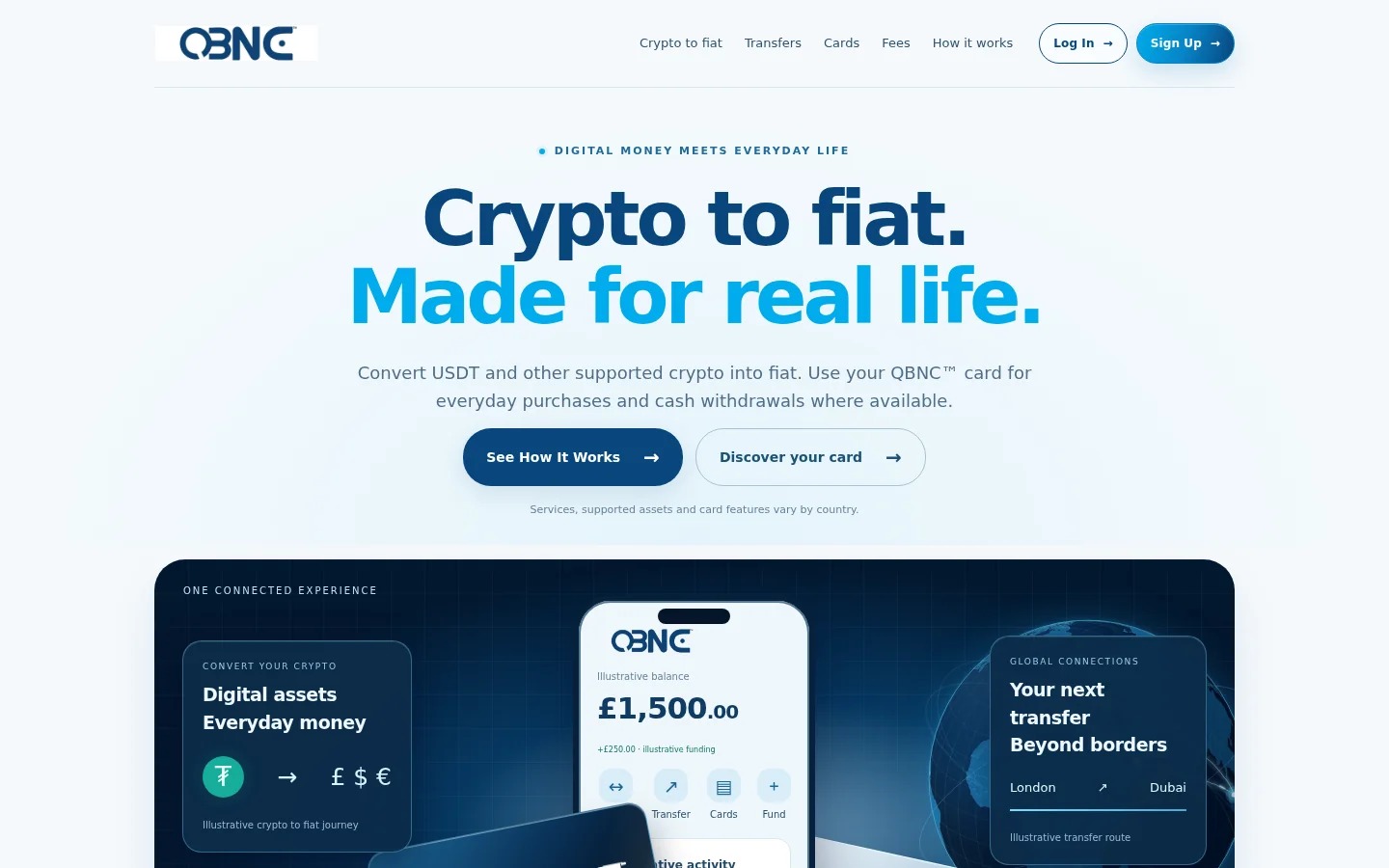
The QBNC homepage promotes converting supported crypto into regular currency, spending from a card and withdrawing cash where available. Those are different services, even when they appear on one screen.
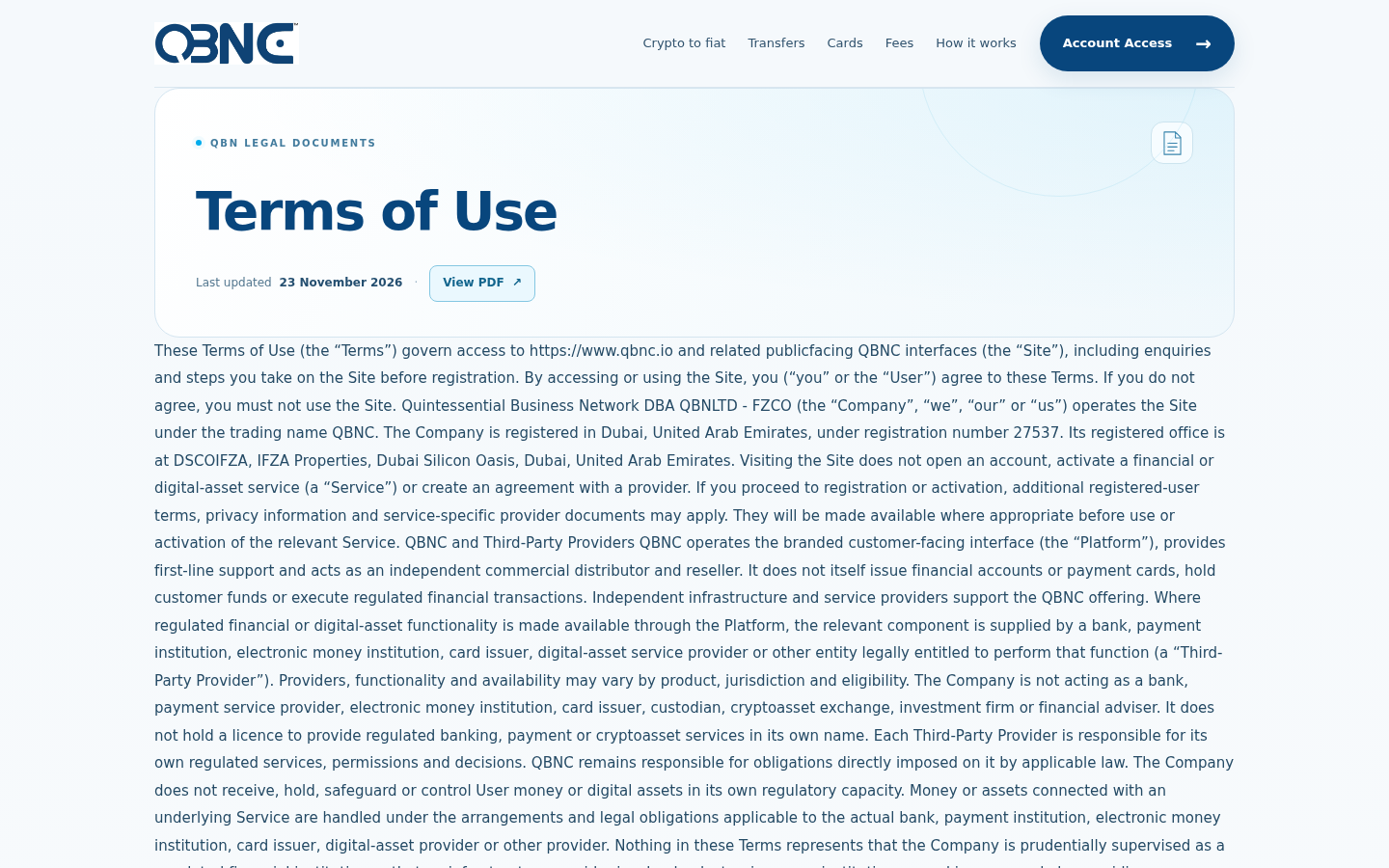
The public terms say QBNC provides the branded interface and first-line support. It describes itself as a distributor and reseller, not the company that issues cards or holds customer funds.
That arrangement can be legitimate when the companies are named and their terms are clear. The QBNC public pages don’t identify a card issuer for a specific country.
That leaves you unable to verify who would owe you the balance or handle a disputed card purchase before you go further into the application.
The fee schedule is not published yet
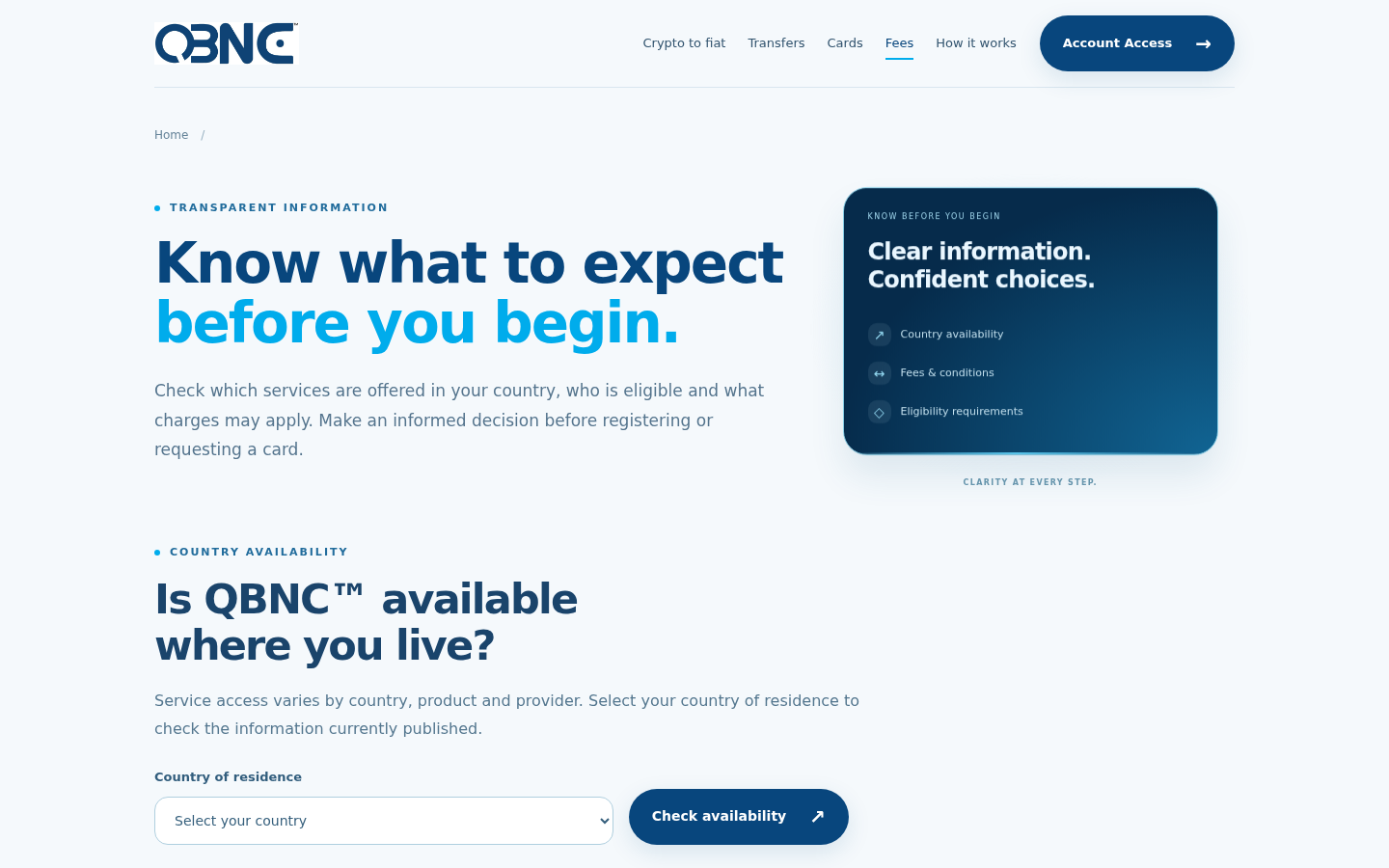
The Fees page lists categories from card issuance and monthly charges to withdrawals, replacement and delivery. It expressly says a confirmed fee schedule has not been published.
You cannot use that page to price a conversion, a cash withdrawal or a full year of keeping a card. The blank schedule does not mean those actions are free.
Consider the whole trip your money takes. Funding in crypto, holding fiat and spending abroad can involve more than one currency conversion.
- Conversion costs determine how much regular currency remains after the provider converts your crypto.
- Funding charges can affect the amount that reaches a separate card balance, if your program has one.
- Foreign exchange, provider withdrawal charges and local ATM fees can change how much cash you finally receive.
A QBN warning matters, but check which offer it names
Spain’s securities regulator, the CNMV, warned in February 2025 that QBN was not authorized to provide the specified investment services in Spain, including covered foreign currency transactions.
The warning names the old QBN domain, myqbn.com. It does not name the QBNC card site or rule on an unnamed card issuer’s authorization.
QBNC’s terms connect its brand to Quintessential Business Network. Treat the warning as a reason to verify the parties, not a ruling on every branded service.
The question worth asking is not whether you recognize the brand. It is whether the company named in your cardholder agreement can provide that service where you live.
How the QBNC Card Offer Is Supposed to Work
Step 1: Check which services your country can use
The Fees page starts with a country selector. Its presence does not mean a card is available in every country listed, or that every resident will pass eligibility checks.
A positive result for a conversion service would not establish availability of the card. For a travel card, confirm residence eligibility separately from where you could spend after approval.
The card page shows sample designs but makes formats and features program dependent. Do not assume the pictured plastic card will be shipped to you.
Look for the country, card format and legal issuer together. If any of these are missing, you don’t yet know what you would be applying for.
Step 2: Find out who is requesting your identity documents
The terms say the relevant third-party provider runs identity verification and that applicants submit the underlying documents through that provider’s designated system.
QBNC says it may receive limited verification status information. Its ability to tell you an application is pending does not make it the organization that checks and retains your documents.
Look at who requests the upload. A promoter’s link or a message from someone claiming to be support does not establish who operates that form.
Ask for the provider’s privacy notice, the official upload route and a way to confirm both independently. Do not send a passport photo through a group or personal chat.
Step 3: Separate the transfer from the quoted conversion
The site describes funding with a supported asset, then converting it to an available regular-currency balance. A crypto transfer and the resulting conversion are not the same transaction.
A transfer record can confirm that your crypto moved. It cannot confirm how much fiat the provider credited, whether it is available to withdraw or who is liable for it.
Ask how long the quote lasts, which costs it includes and when the resulting funds become available. A sample screen cannot answer those questions.
The homepage’s £1,500 balance is labeled illustrative. It shows the layout, not a real customer balance or a demonstration of funds being released.
Step 4: Check how the card gets funded and what cash access means
The card page says some programs use separate funding, while others may share a balance. If your card is separate, cleared fiat may still need to be moved onto it.
Even once funds are available for card purchases, that does not establish that you can take them out at an ATM. The format, network and country all matter.
Ask what happens to the balance if the card application is declined, closed or never delivered. The answer should tell you who processes a return and what charges may apply.
If the only way to find out is to deposit first, stop there. A payment is not a sensible substitute for a fee schedule or an agreement you can keep.
Who Is Responsible for the Card, Your Balance and Support?
The legal name is not the name printed on the card
The public terms name Quintessential Business Network, doing business as QBNLTD – FZCO, as the operator. They give Dubai registration number 27537 and use QBNC as the trading name.
That is the operator’s own disclosure. A corporate registration number identifies a company; it does not tell you which institution will issue a card or safeguard the money.
A useful answer names the legal entity on the cardholder agreement and identifies its regulator. The name and permission should match what you can check in the relevant regulator’s register.
The Dubai address does not tell you where the money goes
QBNC’s public terms list an office in Dubai Silicon Oasis. The same terms say the underlying provider handles funds or assets under the arrangements applicable to that particular service.
You could therefore see a business address in one country, a card issuer in another and a different business dealing with crypto conversion. Ask which company receives what you send.
Pay attention to the exact name on a transfer instruction or receipt. A mismatch is not automatically fraud, but it needs a written explanation before you send money.
General support and a card emergency are different jobs
The terms provide a general email address. The Contact page says service contacts will be published at launch and directs urgent card problems to the issuer.
If your card disappears, you need the issuer’s verified urgent contact. If a conversion fails, you need the provider that took the crypto, along with a record of the transfer.
Don’t wait until a transaction is stuck to find out how complaints work. Get the escalation route, response times and any outside dispute body in the actual product paperwork.
Check the agreement for the service you are using
QBNC’s public terms govern use of the site. They say the product agreement or provider’s tariff can apply separately and prevail for that service if there is a conflict.
Keep a copy you can open without signing in. If access is restricted later, you will still have the fee table, withdrawal rules and name of the company to contact.
The public statement that terms will be available before activation is useful. It does not show what terms you will personally receive, so don’t accept assurances in place of documents.
When a provider shares its tariff, start with a transaction you would actually make. Ask for the amount that would reach your card after conversion and any funding charge.
Then compare spending that balance with taking it out at an ATM. Ask which rate applies when the cash machine offers to convert the transaction for you.
A monthly charge matters even in months when you never use the card. Ask when it begins, whether inactivity has a cost and how to close the account.
Closing a card and returning a separate fiat balance may be two different requests. Ask who handles each one, so you aren’t bounced from the card issuer to general support.
The agreement should also identify what happens to a remaining balance if the provider stops serving your country. A working card today doesn’t answer that question.
Look for a complaint route in a language you can use. The platform’s support address may not reach the company holding your money.
Find out whether the provider says the balance is safeguarded, insured or neither. These are different protections, and neither should be assumed from a registration number.
Why QBN Global Is a Separate Decision
QBN Global advertises leveraged forex trading, while QBNC promotes spendable balances and cards. A card program does not give you the same rights as a brokerage customer.
The QBN Global landing page displays a regulatory headline behind a notice saying the site is not intended for residents of the United States, United Arab Emirates, Australia and Singapore.
The notice also asks visitors to acknowledge that QBN Global is not licensed or authorized to provide services in their jurisdiction. Do not confirm statements that are untrue for you.
QBNC’s company registration does not verify the broker’s permissions, and the broker’s homepage does not verify the card issuer. Check the specific entity and jurisdiction for each service.
For the older QBN investment offer, see the CNMV warning for Spain. It is not a worldwide finding or a determination about a current card transaction.
What to Do If You Applied for a Card or Sent Money
-
Pause before taking the next step. Stop new transfers and gather any product agreement, deposit instructions and fee disclosure already provided. Check whether they name an issuer or service provider.
If your only contact is the person who referred you, do not use an upload link or a wallet address they send to resolve the issue.
-
Find the records for each transaction. Keep the crypto transfer identifier and the currency, amount, date and destination. Match it with the conversion or card funding receipt, if any.
For a card charge, save the statement line and merchant description. Ask the institution that issued your payment card about a dispute if you do not recognize it.
-
Ask what has happened to the balance. Have the provider explain in writing whether the funds are received, converted, held for a check, credited or returned.
Get a case reference and the expected next update. If your provider does not respond, keep the paperwork and ask your local regulator where to direct a complaint.
-
Protect the records you already uploaded. Ask for the legal name and privacy contact of the company that took your documents, especially if you never received a card agreement.
If the upload went to an unknown recipient, watch for misuse of your identity. Contact the relevant document issuer or local identity theft service for advice on protective measures.
-
Do not send a separate release payment. If someone asks for an unexpected top-up to free a balance, verify the request through a contact you found independently.
Ask the original exchange or payment provider what it can do. A confirmed crypto transfer usually cannot be reversed, but the exchange may be able to record the report.
Frequently Asked Questions
Is QBNC the bank holding my funds?
Its public terms say it is not a bank or custodian and does not itself hold customer funds in that capacity. Check the provider paperwork for the exact holder.
Does the QBNC website name my card issuer?
The public card page says to check the issuer but does not identify one for a particular country and product. Ask who is named in the cardholder agreement.
Does an empty fee table mean the QBNC card is free?
No, the site explicitly says the fee schedule has not been published. Do not infer zero monthly fees, free conversion or free cash withdrawals from missing prices.
Can I use a virtual QBNC card at any ATM?
A virtual card alone does not promise ATM access. The card page says withdrawals depend on the available program, format, location, network and balance.
Is QBNC the same thing as QBN Global?
They present different services, card and payment access on one side and forex trading on the other. Do not accept the terms for one as proof about the other.
Does Spain’s CNMV warning rule that the QBNC card is a scam?
No, the warning names the older QBN investment site and addresses authorization in Spain. It does not establish fraud or provide a ruling on the current card offer.
The Bottom Line
Do not fund QBNC or upload identity documents until you can verify the issuer, the company holding your balance and the full tariff for your country.
If you already sent money, stop adding to the balance and get a written account status from the provider. Keep your payment records in case you need to dispute it.

Join the discussion
0 commentsShare your experience or ask a question about this article.
Community experiences
Did this happen to you?
Your experience could help someone recognize the same scam. Submit a private report for our team to review.
I experienced this tooReports are reviewed before publication. Sharing publicly is always your choice.
Discussion
Start the conversation
Have a question or something useful to share? Add the first comment.